





A single HVAC failure in a data center can push inlet temperatures past safe limits in minutes, not hours. That's why the complete guide to data center hvac maintenance exists: server rooms don't forgive skipped filter changes or neglected coils the way an office building might. When cooling capacity drops even slightly, you're looking at throttled equipment, failed drives, or a full outage that lands on your desk at 3 a.m.
This guide gives you the maintenance schedules, inspection checklists, and best practices that actual facility teams use to keep CRAC units, chillers, and condensers running at spec. You'll find preventive maintenance intervals broken down by component, plus guidance on coil cleaning frequency that accounts for real-world dust and biofilm buildup, not generic manufacturer defaults.
We'll also cover where cleaning chemistry matters as much as scheduling. Harsh acid-based coil cleaners can pit aluminum fins and shorten equipment life, which is exactly the problem non-toxic, non-corrosive formulations solve. Whether you manage a single server room or a multi-site colocation footprint, you'll walk away with a practical data center HVAC maintenance checklist and a repeatable HVAC preventive maintenance program you can hand straight to your maintenance crew.
Throughout this guide, "data center HVAC maintenance" refers to the full set of recurring tasks, inspections, and cleaning routines that keep CRAC units, chillers, condensers, and their controls performing at spec, not a single one-time service call.
Why HVAC maintenance matters for data center uptime
Downtime rarely announces itself with a warning. One CRAC unit trips offline, ambient temperature in the aisle climbs past safe levels within ten to fifteen minutes, and servers start throttling before anyone even reaches the alarm panel. Unplanned outages tied to cooling failures rank among the most common causes of data center incidents, right alongside power loss. Downtime prevention starts with treating HVAC maintenance as critical infrastructure work, not a line item you defer until next quarter's budget review.
Most cooling failures trace back to a handful of predictable causes, and almost all of them show up in inspection logs before they cause an outage:
- Clogged air filters restricting airflow across coils
- Refrigerant leaks slowly reducing cooling capacity
- Dirty condenser coils forcing compressors to overwork
- Stuck or miscalibrated economizer dampers
- Sensor drift feeding bad data to the building management system
How heat builds up faster than you think
Temperature rise in a server room isn't linear, and that catches a lot of facility teams off guard. A rack pulling several kilowatts generates heat that a single failed condenser fan can't dissipate fast enough, and within minutes you're past the manufacturer's recommended inlet range. Thermal runaway compounds itself: hotter components draw more current, which generates more heat, which pushes remaining fans harder until something else fails. This is exactly why the complete guide to data center hvac maintenance approach treats every degree above spec as a countdown clock instead of a minor inconvenience you can address next week.
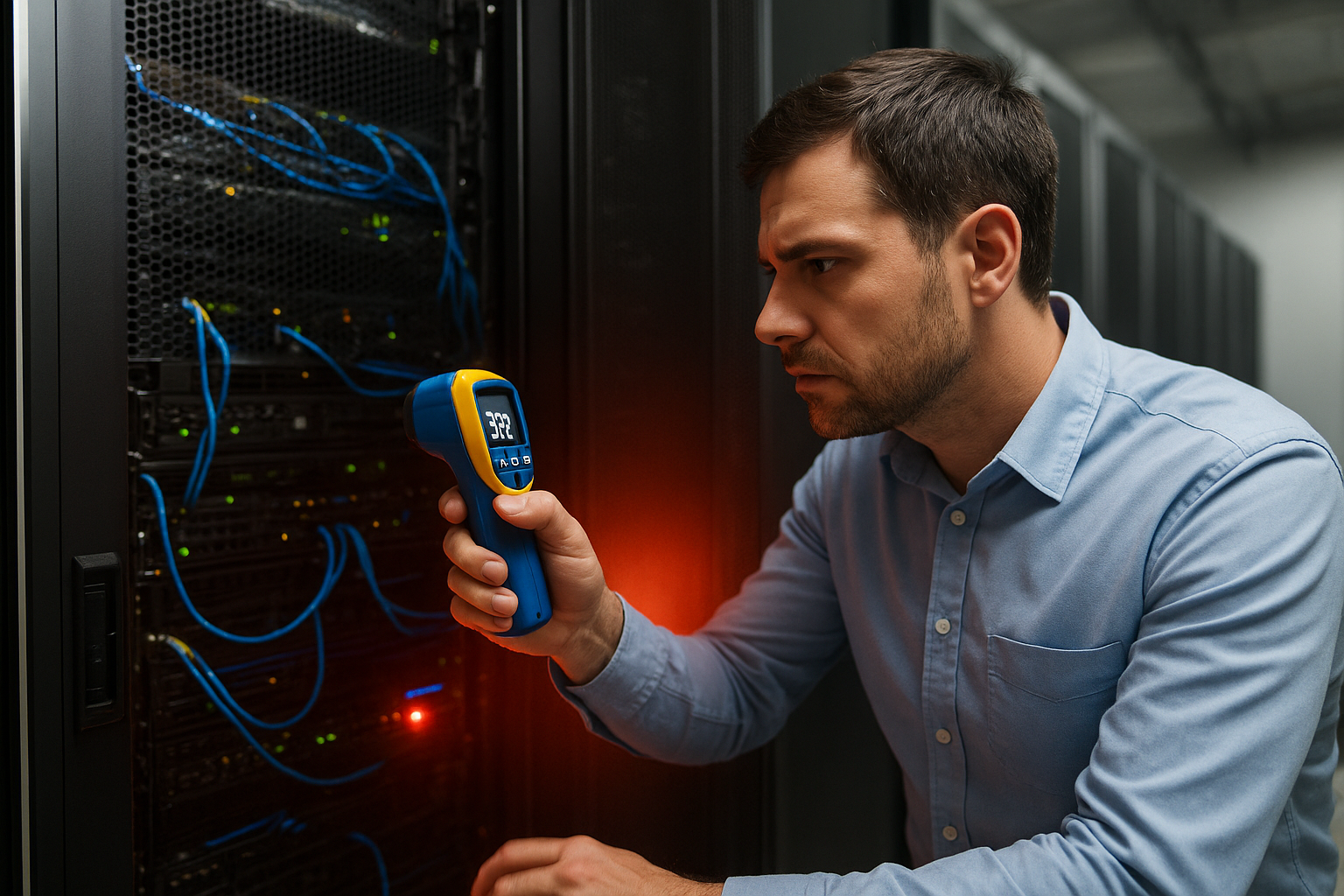
A data center's cooling system isn't separate from its compute infrastructure, it is infrastructure.
What's actually at stake beyond the outage
Equipment lifespan takes a hit even when you never experience a full shutdown. Servers running hot cycle their fans harder, drives fail more frequently, and power supplies degrade faster under sustained thermal stress. Equipment lifespan shortens years before you'd expect based on manufacturer warranty terms, and claims often get denied when logs show repeated temperature excursions. Factor in the energy costs of a cooling system fighting dirty coils and clogged filters, and you're effectively paying twice: once in wasted electricity, and again in early equipment replacement.
Why uptime commitments raise the stakes further
Colocation providers and enterprise IT teams operate under contracts that penalize downtime in real dollars, sometimes tens of thousands per hour depending on the terms involved. Service level agreements turn a coil cleaning schedule into a financial decision, not just a maintenance one. Facility managers who skip preventive maintenance intervals to save a few hours of labor often end up explaining a five- or six-figure credit to their finance team instead, which is a far more expensive conversation than the maintenance call would have been.
How to build a data center HVAC maintenance program
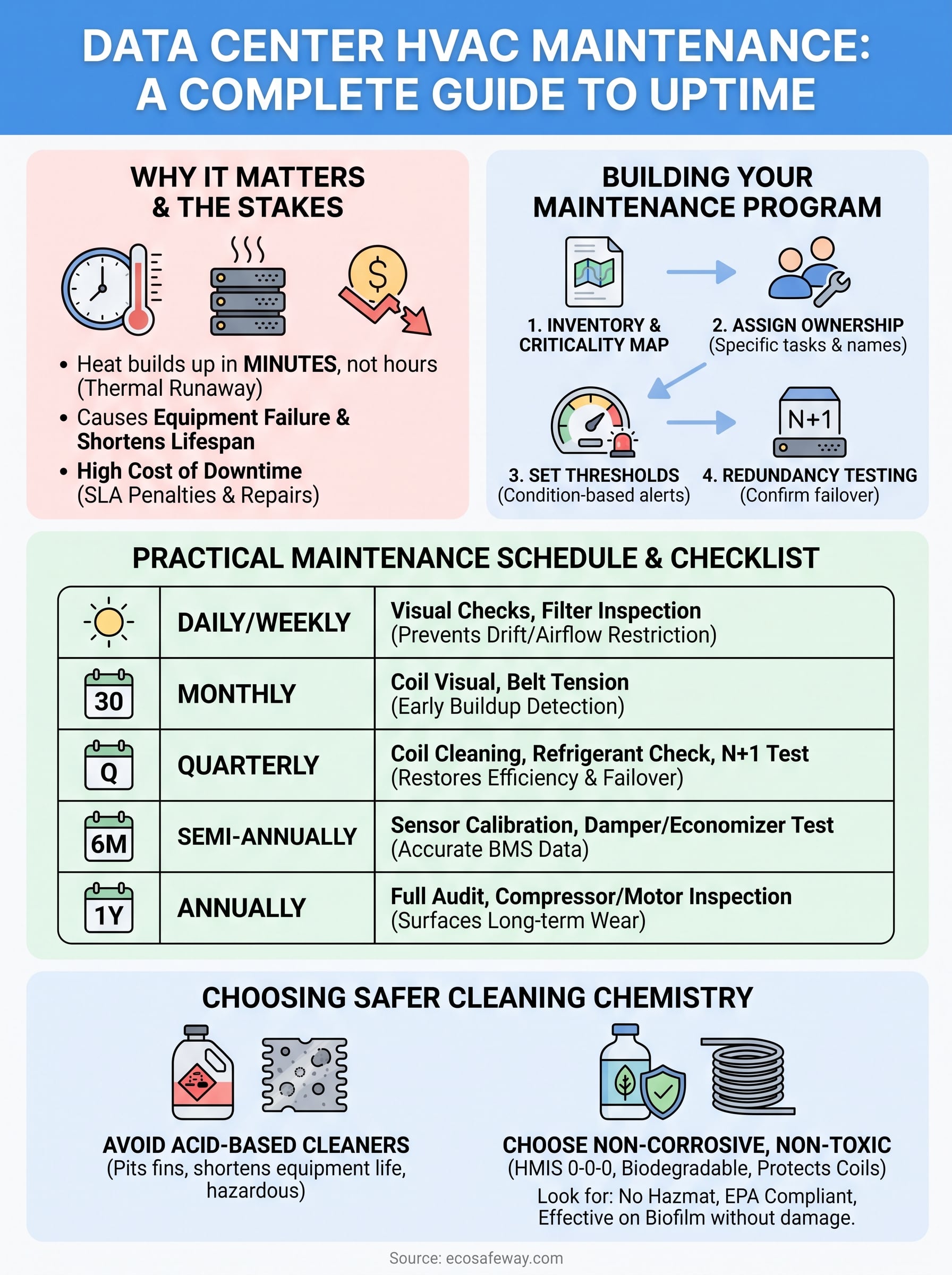
Building a real data center cooling maintenance program means moving past the manufacturer's generic PM checklist and designing something that reflects your actual facility, your equipment mix, and your risk tolerance. Data center HVAC maintenance works best as a layered system: daily checks catch the obvious stuff, monthly inspections catch drift before it becomes failure, and quarterly deep dives catch the slow degradation that daily walkthroughs miss entirely. Skip any one layer and you're relying on luck to fill the gap.
Start with an equipment inventory and criticality map
You can't maintain what you haven't documented as part of a serious HVAC maintenance checklist. Walk every mechanical room and rooftop unit, and log make, model, install date, and refrigerant type for every CRAC, CRAH, chiller, and condenser on site. Then rank each unit by criticality: a CRAC unit serving a single low-density storage room doesn't carry the same weight as the primary cooling for your highest-density compute row.
The units that fail fastest under neglect are usually the ones nobody ranked as critical.
This criticality map drives everything downstream, from preventive maintenance intervals to spare parts inventory to which units get redundant sensors.
Assign ownership and build accountability
Maintenance programs fail most often because nobody owns the outcome, not because the checklist was wrong. Assign a named person, not a department, to each maintenance task category:
- Filter changes and visual inspections: facility technician, weekly
- Coil cleaning and refrigerant checks: HVAC contractor or in-house specialist, quarterly
- BMS sensor calibration: controls technician, semi-annually
- Full system audit: facility manager plus outside contractor, annually
Document every completed task in a CMMS or even a shared spreadsheet if you're running a smaller footprint. Auditors, insurance carriers, and your own future self will thank you when something goes wrong and you need to prove the maintenance history.
Set thresholds, not just schedules
Calendar-based maintenance catches predictable wear, but a predictive maintenance strategy built on condition-based maintenance catches the problems that don't follow a calendar. Pair your scheduled tasks with sensor thresholds that trigger unscheduled inspections: rising delta-T across a coil, dropping suction pressure, or climbing vibration readings on a compressor. When a threshold trips, someone gets an alert and responds within a defined window, typically 24 hours for non-critical drift and immediate response for anything touching your highest-criticality units.
Train technicians on the maintenance program, not just the equipment
A well-designed HVAC preventive maintenance program still fails if the people executing it were never trained on why each step matters. New technicians often learn to change a filter or check a gauge without understanding how a missed step cascades into a cooling failure. Build a short onboarding checklist that walks new hires through your criticality map, your coil cleaning frequency rationale, and your escalation path when a threshold trips. Refresh that training annually alongside your full system audit, since HVAC maintenance standards, refrigerant regulations, and cleaning chemistry recommendations shift over time.
Build in redundancy testing
A maintenance program that never tests failover isn't complete. Schedule quarterly N+1 tests where you deliberately take one cooling unit offline during low-load periods and confirm the remaining units hold temperature within spec. This exposes weak spots in your redundancy before a real failure does, and it's far cheaper to discover a undersized backup unit during a planned test than during an actual outage. [The ASHRAE guidelines for data center thermal management remain the industry reference point for acceptable temperature and humidity ranges if you need a benchmark to test against.](https://trindomglobal.com/server-room-cooling-requirements/)
A practical maintenance schedule and checklist
Theory only gets you so far. What actually prevents a 3 a.m. call is a data center HVAC maintenance schedule a technician can run through without guessing what matters today versus what can wait until next quarter. Preventive maintenance intervals work best when they're tied to specific tasks and specific owners, not vague reminders to "check the HVAC system" that end up skipped when the shift gets busy.
Daily and weekly tasks
Quick visual checks catch the majority of issues before they escalate. A technician walking the mechanical room should look for unusual noise, water pooling near units, and any alarm lights on the BMS panel. Filter inspection matters more than most teams realize: a filter that's 40% clogged already restricts airflow enough to raise coil temperatures and force compressors to run longer cycles.
Most catastrophic HVAC failures start as small anomalies that showed up on a checklist nobody read that day.
The full maintenance schedule
Here's a breakdown that reflects what well-run facilities actually follow, adjusted for real dust loads and duty cycles rather than manufacturer minimums:
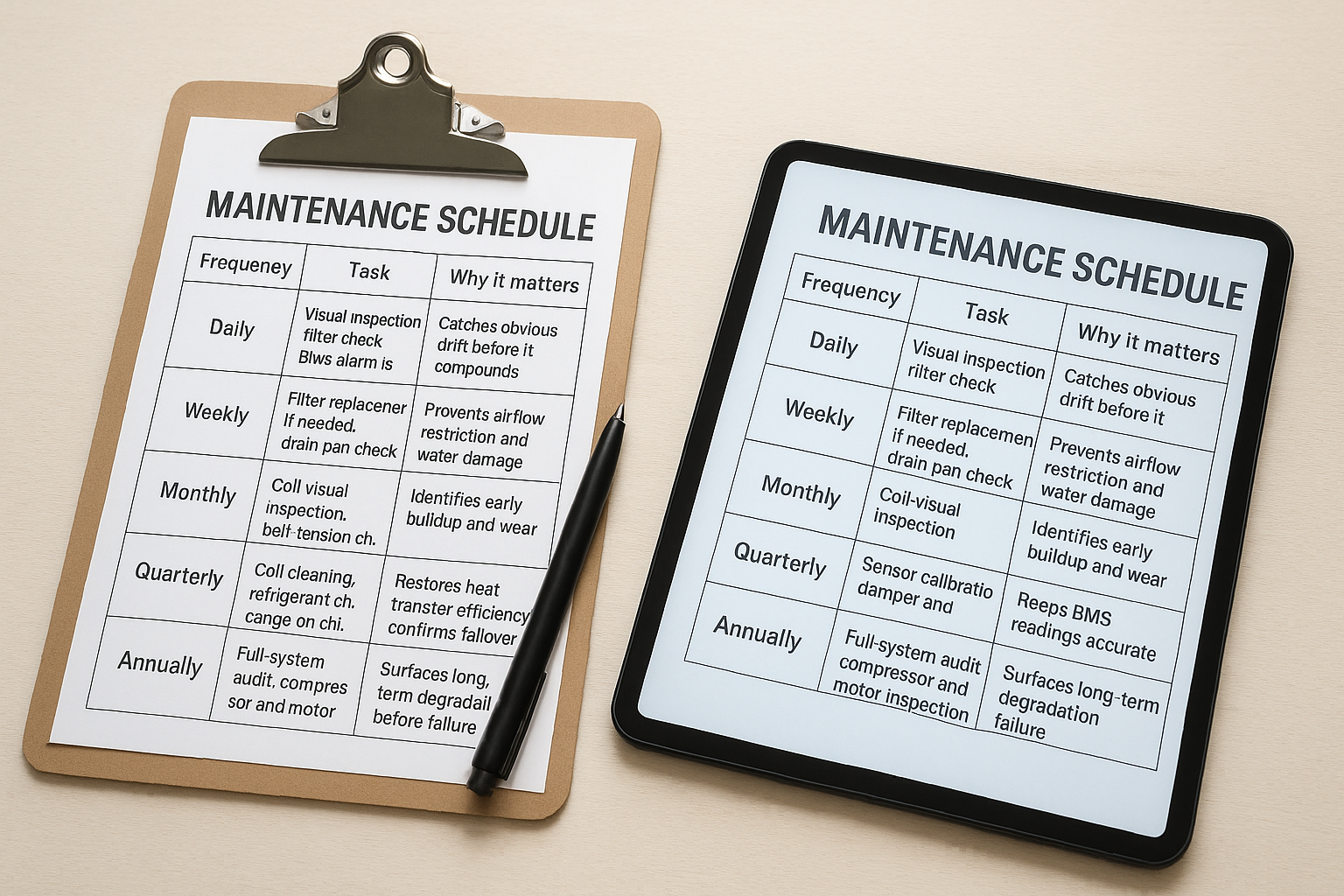
| Frequency | Task | Why it matters |
|---|---|---|
| Daily | Visual inspection, filter check, BMS alarm review | Catches obvious drift before it compounds |
| Weekly | Filter replacement if needed, drain pan check | Prevents airflow restriction and water damage |
| Monthly | Coil visual inspection, belt tension check | Identifies early buildup and wear |
| Quarterly | Coil cleaning, refrigerant charge check, N+1 redundancy test | Restores heat transfer efficiency, confirms failover |
| Semi-annually | Sensor calibration, damper and economizer testing | Keeps BMS readings accurate |
| Annually | Full system audit, compressor and motor inspection | Surfaces long-term degradation before failure |
Coil condition deserves special attention on this schedule. Coil cleaning frequency shouldn't run on a fixed calendar alone; a facility near a construction site or with poor filtration needs quarterly cleaning at minimum, while a clean, well-filtered environment might stretch to twice a year without losing efficiency.
Documentation that actually holds up
Every completed task needs a timestamp, a technician name, and a note on what was found, not just a checkbox. Insurance disputes, equipment warranty claims, and SLA credit negotiations all hinge on whether you can produce a maintenance history that shows consistent, documented care rather than sporadic attention.
A workable checklist template looks like this for each unit:
Unit ID: CRAC-04
Date:
Technician:
Filter condition (%):
Coil condition (clean/light/heavy buildup):
Refrigerant pressure:
Delta-T across coil:
Anomalies noted:
Action taken:
Follow-up required (Y/N):
Running this same format across every unit lets you spot patterns across the whole facility instead of treating each CRAC or chiller as an isolated case. Once you notice one unit consistently showing heavier coil buildup than its neighbors, you've found either a filtration gap or an airflow problem worth investigating before it turns into a failure. Tracking this way also makes it obvious when coil cleaning frequency needs adjusting for that specific unit rather than the whole fleet.
Choosing safer cleaning products for HVAC equipment
Every coil cleaning task on your maintenance schedule involves a choice most facility teams don't think hard enough about: what's actually in the cleaner touching your aluminum fins and copper tubing. Acid-based coil cleaners work fast, but they etch aluminum over repeated applications, leaving microscopic pits where corrosion and biofilm take hold faster the next time around. You end up cleaning more often to fight a problem the cleaner itself created, which quietly erodes the same equipment lifespan your whole maintenance program is supposed to protect.
Choosing the wrong cleaning chemistry can undo years of careful preventive maintenance in a single service visit.
What to look for in a coil cleaner
A non-corrosive coil cleaner should lift dirt, dust, and biofilm without leaving fin surfaces more vulnerable than before you started. When you're evaluating products for a data center environment, run down this list before a technician opens a new drum:
- HMIS 0-0-0 rating, meaning no health, flammability, or physical hazard
- No hazmat shipping or storage requirements, which simplifies procurement and on-site handling
- EPA compliant and phosphate-free formulation
- Biodegradable and non-toxic, so runoff near drain lines doesn't create a disposal headache
- Effective on grease, dust, and biofilm without acids or caustic solvents
Products built around these standards, like the coil and condenser cleaners in Eco Safeway's lineup, remove buildup through enzyme and surfactant action instead of chemical burn, which protects fin geometry and airflow characteristics over the long run.
Reading past marketing language
Almost every cleaner on the shelf claims to be "green" or "eco-friendly" somewhere on the label, and that's exactly why the claim means almost nothing on its own. Non-hazardous cleaning chemicals carry a verifiable HMIS 0-0-0 rating and safety data sheet you can actually check, not just a marketing phrase on the front of the bottle. Ask your supplier for the SDS before you approve a product for facility-wide use, and compare the hazard ratings line by line rather than trusting the packaging.
Matching cleaner to your maintenance schedule
Safer chemistry also changes how your team works day to day. Technicians can clean coils without full respirators or hazmat protocols, which shortens service windows and removes a barrier that sometimes causes teams to skip a scheduled cleaning altogether. Non-corrosive formulations hold up fine at the quarterly intervals outlined in your coil cleaning frequency schedule, and because they don't degrade metal over repeated use, you're not trading short-term cleaning speed for long-term fin damage. That tradeoff, more than almost anything else on this list, is where a lot of facility budgets quietly leak money over a five-year equipment cycle.
Frequently asked questions about data center HVAC maintenance
**How often should data center HVAC maintenance be performed?**Most facilities run daily visual checks, weekly filter inspections, monthly coil reviews, and quarterly deep maintenance that includes coil cleaning and redundancy testing, with a full system audit annually. The exact data center maintenance checklist should flex based on dust load, duty cycle, and unit criticality rather than following manufacturer defaults blindly.
**What belongs on a data center maintenance checklist?**At minimum: filter condition, coil cleanliness, refrigerant pressure, delta-T across coils, damper and economizer function, sensor calibration status, and any anomalies noted by the technician. Pairing this checklist with the documentation template earlier in this guide turns routine HVAC maintenance visits into a searchable history you can use for warranty claims, audits, and SLA disputes.
**Is data center HVAC maintenance different from standard commercial HVAC maintenance?**Yes. Standard commercial systems tolerate wider temperature swings and longer response windows. Data center cooling maintenance is built around tighter tolerances, N+1 redundancy testing, and condition-based thresholds because even a short cooling lapse can trigger thermal runaway across dense equipment racks.
Keeping your cooling systems reliable year-round
Data center HVAC maintenance isn't a project you finish once and forget. It's a data center cooling maintenance routine you run every week, every quarter, every year, refined as you learn how your specific units behave under your specific load. The facilities that never see a cooling-related outage aren't lucky. They've built preventive maintenance intervals into daily operations, documented everything, and chosen cleaning chemistry that protects coils instead of slowly damaging them.
Start with the schedule in this guide, adapt it to your equipment mix, and hold your team accountable to the checklist rather than good intentions. The coil cleaning frequency you settle on matters less than the consistency with which you follow it.
When you're ready to retire acid-based cleaners for good, take a look at Eco Safeway's data center HVAC cleaner and coil descaler, built specifically for CRAC and CRAH coils that need to last.


