





If you're weighing a move into facility operations, the building engineer role probably keeps popping up in your job search, and you want real numbers before you commit. This job blends mechanical know-how with hands-on problem solving, covering everything from HVAC repairs to plumbing emergencies at 2 a.m.
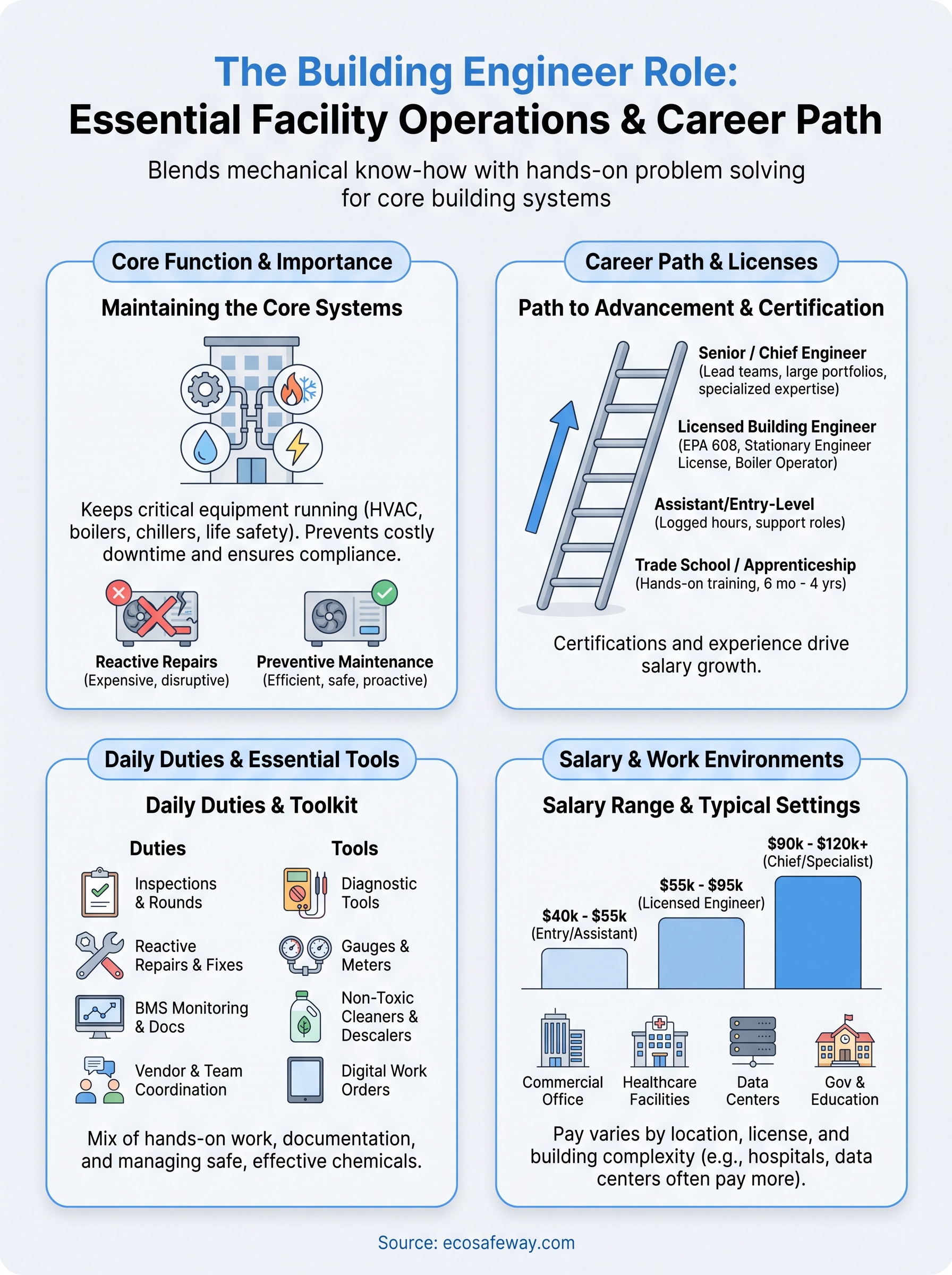
A building engineer keeps a property's core systems running: boilers, chillers, cooling towers, electrical panels, and life safety equipment. Salaries typically range from $50,000 to $85,000 depending on certifications and building size, and most employers expect a mix of trade school training and on-the-job experience rather than a four-year degree.
Below, we break down daily job duties, licensing requirements, and the career path from apprentice to chief engineer. We also touch on the maintenance chemicals engineers rely on daily, since cooling towers and condenser coils need cleaning products that won't corrode equipment or expose crews to hazardous handling rules, a detail Eco Safeway's non-toxic industrial cleaners were built to solve.
Why building engineers matter more than ever
Every commercial building, hospital, and manufacturing plant depends on a small crew of people who keep its mechanical guts running. When a chiller trips at 3 a.m. or a boiler starts short-cycling in January, the building engineer is the person who gets the call. Demand for this role has grown steadily as buildings age, systems get more complex, and owners face real financial consequences when equipment fails. The job isn't glamorous, but it's become one of the more stable, well-paid trades in facility management.
Buildings are older and more complex than ever
Much of the commercial building stock in the United States was constructed decades ago, and the mechanical systems inside them, HVAC, plumbing, electrical, fire suppression, have been retrofitted, patched, and upgraded piecemeal over the years. That creates a tangle of legacy equipment mixed with modern building automation systems, and someone has to understand how all of it interacts. A building engineer today needs to read a pneumatic control diagram from 1985 and troubleshoot a networked BMS dashboard installed last year, sometimes on the same shift.

Downtime is expensive and dangerous
When core systems fail, the costs stack up fast. A cooling tower going offline in a hospital isn't just an inconvenience, it can threaten patient safety and trigger regulatory scrutiny. A data center losing climate control can cost a client thousands of dollars per minute in equipment risk. Property managers know this, which is why they're willing to pay for engineers who can prevent problems instead of just reacting to them.
A skilled building engineer isn't a repair technician, they're the person standing between a minor mechanical issue and a six-figure emergency.
Here's a quick look at what's typically at stake when different systems go down:
| System | Common Failure | Business Impact |
|---|---|---|
| Chillers/HVAC | Loss of cooling in summer | Tenant complaints, health risk in hospitals, lease violations |
| Boilers | No heat in winter | Code violations, tenant habitability claims |
| Fire/Life Safety | Sprinkler or alarm malfunction | Building shutdown, liability exposure |
| Electrical | Panel failure | Equipment damage, safety hazard, possible fire |
| Cooling towers | Scale buildup, biological growth | Reduced efficiency, Legionella risk, costly descaling |
That last row matters more than most facility teams realize. Cooling tower maintenance is one of the more overlooked reasons buildings hire dedicated engineers rather than relying on general handymen. Scale and biofilm buildup don't just hurt efficiency, they create real health liabilities if left unchecked, which is a big part of why facilities lean on engineers trained to manage water treatment and descaling schedules properly.
Energy codes and sustainability mandates raise the stakes
States and cities have been rolling out stricter energy performance standards for commercial buildings, and owners who miss compliance deadlines face fines. The U.S. Department of Energy has pushed efficiency programs for years, and local benchmarking laws in cities like New York and Chicago now require buildings to report energy use annually. Meeting these targets falls squarely on the building engineer's shoulders, since they're the ones adjusting setpoints, scheduling equipment cycles, and choosing maintenance products that don't undercut efficiency gains. An engineer who understands how a corrosive descaler shortens condenser coil life, for example, is protecting both the equipment and the building's energy performance numbers at once.
Demand is outpacing the supply of qualified engineers
The Bureau of Labor Statistics tracks steady demand across maintenance and repair occupations, and building engineering fits squarely into that growth pattern as commercial real estate expands and older buildings require more specialized upkeep. Meanwhile, fewer younger workers are entering the trades compared to previous generations, which means experienced engineers can often negotiate better pay and choose from multiple job offers. Owners and property management firms increasingly compete for the same shrinking pool of licensed, experienced candidates, especially in cities with strict fire and safety code requirements. Facility managers who want to build a reliable team are learning they need to invest early, sometimes recruiting apprentices straight out of trade school and covering certification costs to keep them long-term.
How to become a building engineer
Most people don't wake up one day and decide to become a building engineer. They fall into it through an apprenticeship, a stationary engineer license program, or years spent as an HVAC tech who gets pulled into broader facility work. There's no single accredited degree that guarantees the title, which throws a lot of career changers off. What actually opens doors is a mix of trade training, hands-on hours, and the right licenses for your state and building type.
Start with trade school or an apprenticeship
Community colleges and trade schools offer HVAC, electrical, and refrigeration programs that run anywhere from six months to two years, and these give you the technical foundation employers want to see. Union apprenticeships, run through groups like the International Union of Operating Engineers, combine paid on-the-job training with classroom instruction, often over three to four years. Either path beats walking in cold, since most hiring managers won't consider candidates without some formal mechanical training behind them.
Get licensed for your state and system type
Licensing requirements vary a lot depending on where you work and what kind of equipment you'll touch. A few common ones:
- Stationary engineer license: required in cities like Chicago and New York for anyone operating high-pressure boilers or refrigeration systems above certain thresholds
- Universal EPA 608 certification: needed to handle refrigerants in HVAC systems, required nationwide under federal law
- Boiler operator certification: state-issued, often tiered by boiler horsepower and pressure class
- Fire alarm and life safety certifications: increasingly required in commercial and healthcare buildings
Check your state's licensing board early, since some certifications require thousands of hours of documented experience before you can even sit for the exam.
Build hands-on hours before chasing titles
No license replaces time spent actually turning wrenches. Entry-level roles like maintenance technician, HVAC helper, or assistant engineer give you the logged hours licensing boards want, and they teach you how buildings actually behave, which is different from how a textbook describes them. Most engineers spend two to five years in these support roles before stepping into a standalone building engineer position.
You don't become a building engineer by passing a test, you become one by logging enough hours that the equipment stops surprising you.
Know the maintenance side, not just the mechanics
Here's the part a lot of new engineers underestimate: knowing how to clean and treat equipment matters as much as knowing how to repair it. An engineer who understands cooling tower descaler chemistry and how corrosive acids shorten condenser coil life has an edge over one who only knows repair procedures. Employers increasingly ask candidates about maintenance product knowledge during interviews, especially in hospitals and data centers where hazardous chemical handling creates liability. Learning which cleaning products are non-corrosive and won't trigger hazmat shipping restrictions isn't a footnote skill, it's becoming part of the core job description.
Core duties and responsibilities on the job
The title sounds narrow, but a building engineer's daily reality touches almost every mechanical system under one roof. On any given shift you might swap a boiler igniter, chase a refrigerant leak, reset a fire panel, and log water treatment readings for a cooling tower, all before lunch. Core responsibilities stay consistent across most commercial buildings, though the mix shifts depending on whether you're running a hospital, an office tower, or a manufacturing plant.
A typical day on the job
Days rarely follow a script, but most engineers rotate through the same categories of work:

- Morning rounds checking gauges, temperatures, and pressure readings on boilers, chillers, and pumps
- Responding to tenant or facility complaints about heat, cooling, or plumbing
- Preventive maintenance tasks pulled from a work order system, like filter changes or belt inspections
- Testing life safety equipment, including fire pumps, alarms, and emergency generators
- Water treatment checks on cooling towers, including scale and biological growth monitoring
- Documentation of readings, repairs, and chemical usage for compliance records
No two shifts look identical, but skipping any of these categories for too long is how small problems turn into shutdowns.
Preventive maintenance versus reactive repairs
Experienced engineers spend more time preventing failures than fixing them. Preventive maintenance means following manufacturer schedules for belt replacements, bearing lubrication, and coil cleaning before efficiency drops or parts fail outright. Reactive repairs, the 2 a.m. calls and emergency shutdowns, still happen, but a well-run building minimizes them through consistent inspection routines. Facilities that lean on enzyme drain cleaners and non-corrosive descalers instead of harsh acids tend to see fewer emergency coil replacements, since corrosive chemistry quietly shortens equipment life long before anyone notices a leak.
The engineers who get promoted aren't the fastest at fixing emergencies, they're the ones whose buildings rarely have any.
Documentation and regulatory compliance
Regulators expect paper trails, not memory. Logging boiler inspections, refrigerant handling records, and water treatment chemical usage protects both the building owner and the engineer if an incident ever triggers an audit. Cities with strict fire and boiler codes, like Chicago and New York, require documented proof that licensed staff performed required checks on schedule. Skipping this paperwork, even when the mechanical work is done correctly, can still result in fines or license issues down the line.
Coordinating vendors and contractors
Coordination rounds out the job description more than most job postings admit. Larger repairs, elevator servicing, major electrical work, specialized chemical treatments, often require outside contractors, and the building engineer manages that relationship. Scheduling access, verifying the work meets code, and confirming that any chemicals brought onsite won't damage equipment or trigger hazmat handling rules all fall under the engineer's watch. This is where knowledge of non-toxic industrial cleaners pays off directly, since approving the wrong descaler or degreaser for a contractor to use can undo months of careful maintenance work in a single service visit.
Building engineer salary and pay expectations
Money is usually the first question anyone asks about this trade, and the honest answer is: it depends heavily on where you work, what you're licensed for, and what kind of building you're maintaining. Building engineer salary figures span a wide range nationally, from entry-level assistant roles in the low $40,000s to chief engineer positions in major metro hospitals or high-rise complexes clearing $100,000 or more. Location drives a huge chunk of that spread, since a stationary engineer license in New York City commands a different rate than the same license in a mid-sized Midwest suburb.
What the numbers actually look like
Grouping salary by experience level and building type gives a clearer picture than a single national average, since the role covers everything from apartment complexes to data centers.
| Career Stage | Typical Annual Salary | Common Setting |
|---|---|---|
| Assistant/entry-level engineer | $40,000 - $52,000 | Residential, small commercial |
| Building engineer (licensed) | $55,000 - $78,000 | Office towers, hospitals, manufacturing |
| Senior/lead engineer | $75,000 - $95,000 | Large campuses, healthcare systems |
| Chief engineer | $90,000 - $120,000+ | High-rise, hospital, or multi-site portfolios |
These ranges track closely with what the Bureau of Labor Statistics reports for skilled maintenance and repair trades, where licensing and building complexity push pay well above general handyman rates.
Certifications and licenses move the needle
Certifications aren't just a hiring requirement, they're one of the fastest ways to raise your pay. A stationary engineer license for high-pressure boilers or refrigeration typically adds several thousand dollars to a base salary compared to an uncertified maintenance role, and EPA 608 universal certification is often treated as a baseline expectation rather than a bonus. Engineers who stack certifications, boiler operator, fire alarm systems, refrigeration, tend to negotiate from a stronger position because they qualify for buildings that legally require licensed staff onsite.
The fastest way to raise your salary in this trade isn't switching employers, it's stacking licenses that fewer engineers bother to earn.
Building type changes the pay scale
Hospitals, data centers, and government facilities generally pay more than standard office buildings, mostly because the consequences of a mechanical failure are higher stakes. A cooling tower descaler mistake in a hospital that leads to a Legionella scare carries real legal exposure, so these employers pay a premium for engineers who understand water treatment chemistry and documentation requirements, not just repair work. Government union positions also tend to offer strong benefits packages and pension plans that don't always show up in base salary comparisons but add real value over a career.
Overtime and shift differentials add up
Salary numbers rarely tell the whole story, since many building engineer roles include overtime for emergency calls, holiday coverage, and rotating shift work. Facilities running 24/7 operations, hospitals, manufacturing plants, data centers, often pay shift differentials for nights and weekends, which can add meaningfully to annual earnings beyond the posted base salary. Anyone comparing job offers should ask directly about on-call expectations and overtime policy, since two postings with identical base pay can end up paying very differently once real-world hours get factored in.
Skills, certifications, and tools you'll need
Getting hired as a building engineer takes more than a diploma. Employers screen for a specific mix of technical licenses, hands-on troubleshooting ability, and familiarity with the products you'll use every day on the job. Skipping any one of these categories, even if your resume looks strong otherwise, tends to get applications passed over fast.

Technical skills employers actually test for
Hiring managers rarely ask theoretical questions. They want proof you can read a wiring diagram, diagnose a failing compressor, or interpret a BMS alarm without panicking. Mechanical troubleshooting across HVAC, plumbing, and electrical systems forms the baseline, while familiarity with programmable logic controllers and building automation software has become close to mandatory in office towers and hospitals. Welding, basic pipefitting, and refrigerant recovery round out the skill set most job postings list as required rather than preferred.
Certifications that open doors
Licenses prove you're legally allowed to touch certain equipment, and they're often the deciding factor between two otherwise equal candidates.
| Certification | What It Covers | Who Requires It |
|---|---|---|
| EPA 608 Universal | Refrigerant handling | Federal law, all HVAC work |
| Stationary Engineer License | High-pressure boilers, refrigeration | Chicago, NYC, and similar cities |
| Boiler Operator Certification | Boiler operation by horsepower class | State licensing boards |
| Fire Alarm/Life Safety | Fire suppression and alarm systems | Commercial and healthcare buildings |
| CFC/OSHA 10 or 30 | Workplace safety compliance | Most commercial employers |
The Occupational Safety and Health Administration publishes updated safety training standards that most facility employers reference when building internal certification requirements, so it's worth checking their guidance directly rather than relying on secondhand summaries.
Tools and products that belong in your kit
Good engineers carry more than a wrench set. Their toolkits usually include:
- Multimeter and combustion analyzer for HVAC diagnostics
- Refrigerant gauges and recovery machine
- Vibration meter for early bearing failure detection
- Water treatment test kits for cooling tower chemistry
- Non-corrosive descaling and coil cleaning products
That last item matters more than most trade programs teach. Reaching for an acid-based descaler on a condenser coil solves today's scale problem while quietly shortening the coil's usable life, and it usually means suiting up in hazmat gear the job never should have required in the first place.
The engineers who last longest in this trade treat their cleaning products with the same scrutiny they give their diagnostic tools.
Switching to eco-friendly HVAC cleaners and phosphate-free descalers eliminates that tradeoff entirely, since non-corrosive formulations clean scale without eating away at aluminum fins or copper tubing.
Soft skills nobody puts on the job posting
Communication rarely shows up in a certification checklist, but it decides who gets promoted. You'll explain outages to property managers, coach junior techs through repairs, and negotiate with contractors who want to cut corners on chemical safety. Reliability under pressure, especially during a 2 a.m. emergency call, separates engineers who get trusted with bigger buildings from those who stay stuck fixing the same small fires year after year.
Building engineer vs similar facility roles
Job titles in facility operations overlap so much that candidates often apply for the wrong role without realizing it. A building engineer isn't the same as a facilities manager, a maintenance technician, or an HVAC technician, even though job postings sometimes use these titles interchangeably. Knowing the distinctions matters for salary negotiation and for figuring out which certifications actually apply to the job you want.
Building engineer versus facilities manager
Employers often confuse these two roles, but the split usually comes down to hands-on work versus administration. A facilities manager oversees budgets, vendor contracts, and long-term capital planning, while the building engineer handles the physical equipment those budgets pay for. Facilities managers rarely carry a stationary engineer license or touch a boiler directly; they're the ones approving the invoice after the engineer diagnoses the problem. Larger properties often employ both roles side by side, with the engineer reporting into the facilities manager on staffing and budget decisions.
Building engineer versus maintenance technician
Maintenance technicians and building engineers share a lot of daily tasks, but licensing and scope separate them. A maintenance technician typically handles general repairs, drywall patches, appliance fixes, minor plumbing, without needing a stationary engineer license or boiler certification. Building engineers carry that additional licensing and take responsibility for life safety systems, high-pressure equipment, and compliance documentation that a technician role doesn't require. Many engineers start as maintenance technicians and move up once they log enough hours and pass the required exams.
Building engineer versus HVAC technician
HVAC technicians specialize narrowly, focusing on heating and cooling systems, refrigerant handling, and ductwork. A building engineer's scope stretches wider, covering electrical, plumbing, fire safety, and structural maintenance alongside HVAC. Some HVAC technicians transition into building engineering once they broaden their skill set and pick up additional licenses beyond EPA 608 certification.
Job titles blur in this industry, but licensing scope draws the real line between roles.
Here's a side-by-side comparison to make the distinctions concrete:
| Role | Primary Focus | Typical License | Salary Range |
|---|---|---|---|
| Building Engineer | All mechanical systems, compliance | Stationary engineer, EPA 608 | $55,000 - $95,000+ |
| Facilities Manager | Budgets, vendors, planning | PMP or CFM (optional) | $65,000 - $110,000 |
| Maintenance Technician | General repairs | Trade certificate (varies) | $38,000 - $55,000 |
| HVAC Technician | Heating/cooling systems | EPA 608 | $45,000 - $65,000 |
| Property Manager | Tenant relations, leasing | Real estate license (varies) | $50,000 - $85,000 |
Property managers deserve a separate mention since they're often confused with building engineers in smaller residential settings. A property manager handles leasing, tenant complaints, and rent collection, calling in a building engineer or outside contractor whenever mechanical issues surface. In small apartment buildings, one person sometimes wears both hats, but in commercial and healthcare settings, these roles stay firmly separate because the licensing and liability requirements differ so much. Understanding where your target role sits on this spectrum helps you aim your certifications and job search at the right title instead of chasing a mismatched posting.
Career paths and advancement opportunities
A building engineer career rarely stays flat for long. Most people who stick with the trade move through a fairly predictable ladder: assistant engineer, then licensed engineer, then senior or lead engineer, then chief engineer overseeing an entire property or portfolio. Advancement depends less on tenure and more on licensing progress and willingness to take on buildings other engineers avoid, like hospitals or high-rise mixed-use towers with layered code requirements.
Climbing the ladder from assistant to chief engineer
Chief engineer roles go to people who've stacked licenses and proven they can run a building without daily supervision. That usually means:
- Logging enough hours to qualify for a stationary engineer license, not just holding EPA 608 certification
- Taking ownership of preventive maintenance schedules instead of waiting for a supervisor to assign them
- Managing vendor relationships and approving contractor work without needing sign-off on every decision
- Building a track record of passed inspections and clean compliance audits
Engineers who check these boxes typically move into chief roles within eight to twelve years, though buildings with 24/7 operations sometimes promote faster out of sheer staffing need.
Specializing versus staying generalist
Some engineers choose depth over breadth, focusing heavily on refrigeration, building automation systems, or water treatment chemistry instead of chasing a chief title. Specialists in cooling tower and condenser maintenance often become the go-to person across a multi-building portfolio, since fewer engineers understand descaling chemistry and Legionella risk well enough to manage it without outside consultants. This path can pay comparably to a chief engineer role, especially in healthcare or data center environments where a single mechanical failure carries outsized financial risk.
Specializing in the systems other engineers avoid usually pays better than chasing a bigger title.
Moving into consulting, ownership, or training roles
Experienced engineers don't have to stay employees forever. Consulting work, energy audits, and compliance reviews attract building engineers who've spent decades inside mechanical rooms and know exactly where systems fail before an owner's own staff notices. Others move into facilities management outright, trading hands-on repair work for budget oversight and vendor negotiation, a natural step for engineers who've already been coordinating contractors for years. A smaller group starts training the next generation, either through union apprenticeship programs or as in-house mentors for a management company that's tired of losing junior staff to competitors.
Government and healthcare systems offer another route worth mentioning, since these employers often promote based on union seniority and certification tiers rather than internal politics. That structure appeals to engineers who want predictable raises tied to documented achievements instead of subjective performance reviews. Whichever direction someone chooses, the trades that pay off long-term all share one trait: engineers who understand maintenance chemistry and equipment protection, not just repair skills, get pulled into higher-stakes buildings faster than those who only know how to fix what's already broken.
Where building engineers work
A building engineer title can mean something very different depending on the property behind it. The core skills transfer across settings, but the daily pressure, pay scale, and equipment mix shift a lot depending on whether you're maintaining an apartment complex or a hospital campus. Picking the right environment early in your career shapes both your paycheck and how fast you climb the ladder outlined above.

Commercial office towers and mixed-use buildings
Office towers remain the most common employer for building engineers, and they offer a broad mechanical education since a single high-rise can house chillers, boilers, elevators, and a full building automation system under one roof. Commercial real estate portfolios often rotate engineers between properties, which builds versatility fast but also means less specialization than a single-site healthcare job. Property management companies running multiple towers tend to promote from within, so an assistant engineer who performs well at one site often gets first pick when a chief engineer position opens at a larger building in the portfolio.
Hospitals and healthcare facilities
Healthcare settings pay a premium because the stakes are higher and the code requirements are stricter. A hospital engineer manages redundant power systems, medical gas lines, and infection control protocols alongside the usual HVAC and boiler duties, and a mechanical failure here can affect patient safety directly rather than just tenant comfort. This is also where cooling tower descaler chemistry and Legionella prevention move from a nice-to-know skill to a documented, audited requirement, since the CDC publishes water management program guidance that hospital facilities are expected to follow closely.
Data centers and industrial plants
Data centers run cooling systems around the clock, and a few minutes of lost climate control can damage servers worth millions. Engineers here specialize heavily in condenser and chiller maintenance, and they're often the first to adopt non-corrosive cleaning products since any chemical residue that risks equipment downtime gets flagged immediately by risk-averse facility owners. Manufacturing plants offer a similar intensity, with engineers maintaining production-critical HVAC and steam systems where unplanned downtime translates directly into lost output.
Government, education, and residential settings
Government buildings and school districts hire engineers through union pipelines more often than private employers, and these roles tend to come with strong benefits, predictable schedules, and seniority-based advancement. Residential and multifamily properties, by contrast, usually need a broader generalist who can handle everything from a leaking water heater to a failed elevator inspection without specialized backup on call. Marinas and mixed-use waterfront properties round out a smaller but growing niche, where engineers maintain shore power systems, pump-outs, and dock equipment alongside standard building mechanicals, often relying on ocean-safe cleaners for equipment exposed to saltwater and marine runoff.
The building type you choose early in your career often determines your salary ceiling more than your certifications do.
Whichever setting you land in, the maintenance products on hand matter just as much as the equipment itself, since a corrosive descaler or hazardous degreaser can undo an otherwise well-run preventive maintenance program in a single service visit.
Weighing a career in building engineering
A building engineer career rewards people who like solving mechanical puzzles under real pressure, not just those chasing a paycheck. The path runs through trade school or apprenticeship, stacks of licenses, and years of logged hours before the title and salary catch up to the workload. Pay climbs steadily once you specialize, especially if you master the maintenance chemistry that protects boilers, chillers, and cooling towers from premature failure.
If you're already on this path, or managing engineers who are, the products you hand them matter as much as the licenses on their wall. Corrosive descalers and hazardous degreasers quietly undo good preventive maintenance work and create hazmat handling headaches nobody asked for. Give your team formulations that clean coils and cooling towers without eating away at the equipment. Browse Eco Safeway's industrial HVAC and cooling tower descaler and see what a non-corrosive formula can do for your maintenance schedule.


