




If you manage a building, a plant, or a portfolio of properties, you already know facility maintenance touches everything: HVAC uptime, coil corrosion, drain odors, cooling tower scale, and the safety data sheets your team has to keep on file for every chemical in the closet. It's a broad job with a simple goal: keep the physical assets running safely and efficiently without surprise breakdowns.
This article breaks down exactly what facility maintenance covers, so you can stop guessing whether a task falls under preventive maintenance, corrective work, or compliance-driven upkeep. You'll get a clear definition, the main types of maintenance programs, and how facility teams decide which strategy fits which equipment.
We'll also walk through best practices that reduce downtime and liability, including how the cleaning chemicals you choose affect equipment lifespan, worker safety, and regulatory compliance. That last point matters more than most maintenance guides admit: an HMIS 0-0-0 rated, non-toxic cleaner for a cooling tower or coil isn't just an environmental choice, it's a maintenance decision that cuts corrosion, cuts hazmat handling, and cuts your risk exposure at the same time.
Why facility maintenance matters for your organization
Facility maintenance isn't a back-office task you can defer until something breaks. It's the difference between a building that runs quietly for decades and one that bleeds money through emergency repairs, failed inspections, and equipment that dies years before its rated lifespan. Every dollar you spend on planned upkeep now saves multiples of that later, and every skipped inspection compounds risk you'll eventually have to pay for.
The financial cost of neglect
Neglected equipment doesn't fail gracefully. A cooling tower that's never been descaled loses efficiency gradually, then fails suddenly, usually during peak demand when replacement parts and rush labor cost the most. The U.S. Department of Energy has long noted that reactive repairs run several times more expensive than scheduled maintenance, because emergency labor, expedited shipping, and unplanned downtime all carry a premium reactive budgets never account for.
A facility that only fixes things after they break is always paying the highest possible price for every repair.
Safety and compliance risk
Beyond the balance sheet, poorly maintained facilities put people at risk. Corroded coils, clogged drains, and untreated cooling towers create conditions for Legionella growth, mold, and slip hazards, all of which expose hospitals, property managers, and government facilities to liability and regulatory penalties. Chemical choice plays into this directly: a technician handling a corrosive acid-based descaler needs gloves, ventilation, and hazmat training, while an HMIS 0-0-0 rated cleaner carries none of those requirements, which lowers both injury risk and compliance paperwork.
Equipment lifespan and reliability
Equipment that's cleaned and serviced on schedule simply lasts longer. Condenser coils stay efficient, ice machines stay sanitary, and marine engines resist the scale buildup that shortens raw water cooling system life. Reliability isn't abstract here, it's the reason a well-maintained chiller runs its full 20-year design life instead of failing at year 12.
| Approach | Typical Outcome |
|---|---|
| Reactive maintenance | Higher repair costs, unplanned downtime, shorter equipment life |
| Preventive maintenance | Predictable costs, longer equipment life, fewer emergencies |
| Non-toxic, HMIS 0-0-0 products | Lower injury risk, no hazmat shipping delays, reduced corrosion damage |
Environmental and regulatory pressure
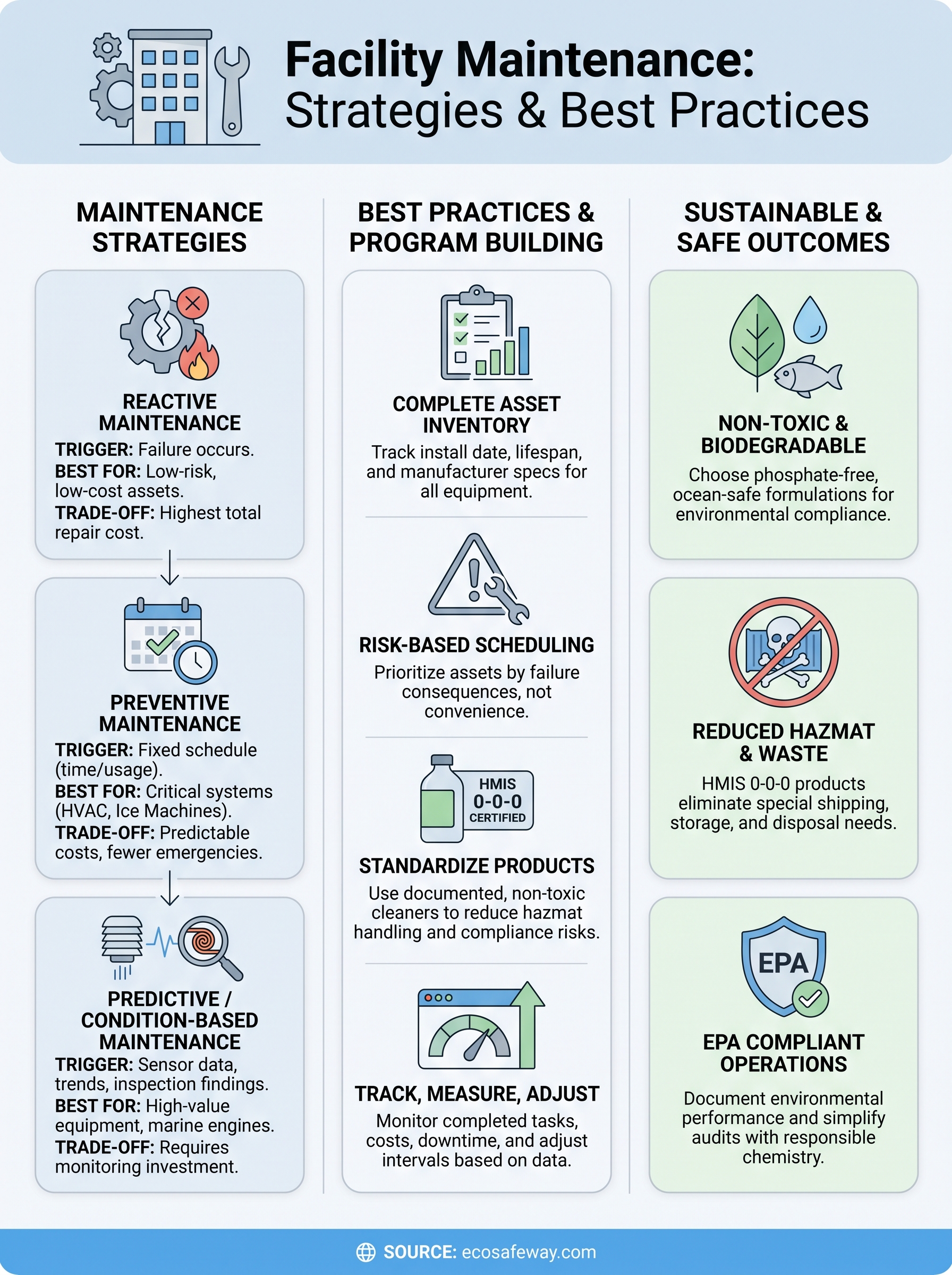
Regulators and tenants alike now expect facilities to operate under EPA compliant standards, not just meet minimum code. Phosphate-free, biodegradable, ocean-safe formulations reduce your exposure to environmental fines and make it easier to document responsible operations during audits. Choosing cleaning chemistry with facility maintenance in mind, rather than treating it as an afterthought, protects your equipment, your people, and your standing with regulators all at once.
How to build an effective facility maintenance program
Building a real facility maintenance program starts with knowing exactly what you own and how it's aging, not with a checklist copied from another building. You need an asset inventory, a maintenance calendar tied to manufacturer specs, and a system for tracking what actually happened versus what was scheduled. Skip any of these three and the program collapses into reactive firefighting within a year.
Start with a complete asset inventory
Walk every mechanical room, rooftop unit, and drain line before you write a single schedule. List each asset, its install date, expected service life, and the manufacturer's recommended service interval. This inventory becomes the backbone of every decision that follows, including which cleaning chemistry belongs in which maintenance kit.
Set schedules by risk, not convenience
Prioritize assets by what happens if they fail. Cooling towers, ice machines, and hospital HVAC systems carry health and liability exposure, so they get tighter inspection cycles than a storage-area exhaust fan. Build your calendar around that risk order, not around whichever vendor calls first.
The best maintenance programs are built around consequence, not convenience.
Standardize your maintenance products
Many facility teams lose control of their program by letting each technician pick whatever cleaner is on the shelf. Standardize on documented, HMIS 0-0-0 certified products for coils, cooling towers, and drains so every team member follows the same safety and performance baseline, with no guesswork about hazmat handling.
Track, measure, and adjust
A program only improves if you measure it. Track these four things monthly:
- Completed vs. scheduled maintenance tasks
- Unplanned repair costs by asset
- Equipment downtime hours
- Chemical and product usage against your standardized list
Review the numbers quarterly and adjust intervals where data shows you're over- or under-servicing an asset. That feedback loop is what separates a maintenance program from a maintenance guess.
Types of facility maintenance strategies
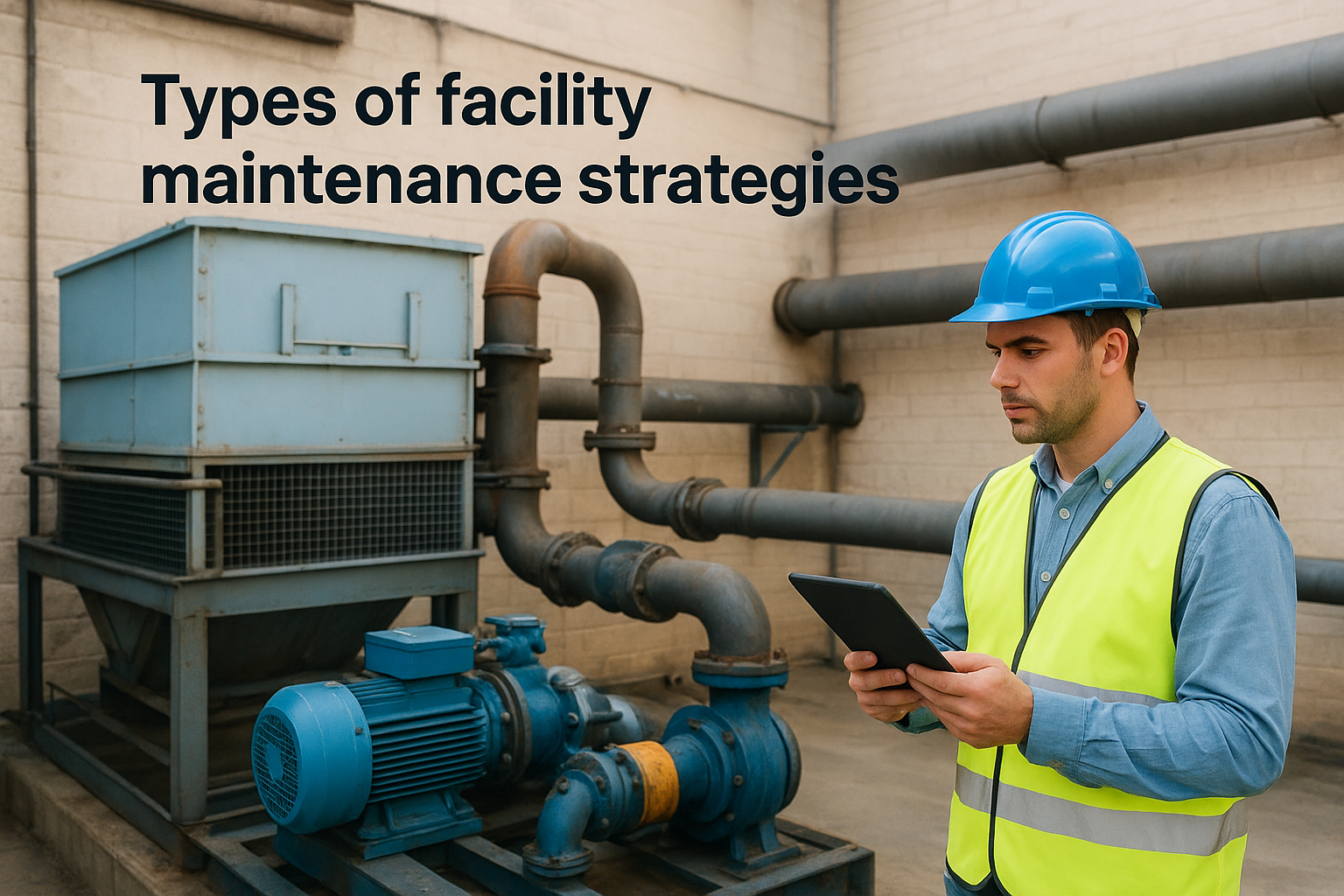
Facility maintenance strategies fall into four broad categories: reactive, preventive, predictive, and condition-based. Picking the right strategy for each asset class matters more than forcing one approach on an entire building. A hospital's cooling tower needs closer monitoring than a rarely used storage fan, so facility maintenance teams that blend approaches by asset priority end up with lower costs and fewer surprises than teams that pick a single strategy and apply it everywhere.
Reactive vs. preventive maintenance
Reactive maintenance fixes equipment after it fails, which keeps upfront spending low but guarantees the highest cost per repair once you factor in emergency labor and downtime. Preventive maintenance schedules service before failure, based on manufacturer intervals or run hours, trading a small recurring cost for far fewer emergencies. Most facilities run a mix, applying preventive schedules to critical systems like cooling towers and ice machines while letting low-risk assets run reactive.
Preventive maintenance costs more upfront and less overall, every single time.
| Strategy | Trigger | Best For | Trade-off |
|---|---|---|---|
| Reactive | Failure occurs | Low-risk, low-cost assets | Highest total repair cost |
| Preventive | Fixed schedule | Cooling towers, HVAC, ice machines | Some unnecessary servicing |
| Predictive | Sensor data or condition trends | High-value critical equipment | Requires monitoring investment |
| Condition-based | Inspection findings | Marine engines, coils | Needs trained inspectors |
Predictive and condition-based maintenance
Predictive maintenance uses sensor data, vibration analysis, or fluid samples to catch failure signs before they turn into downtime. Condition-based maintenance relies on direct inspection, checking coil corrosion, scale buildup, or raw water flow, and scheduling service when the evidence calls for it rather than the calendar. Marine engines benefit heavily from condition-based checks, since raw water systems scale at different rates depending on water chemistry and run hours.
Watch for these triggers when deciding it's time to act:
- Coil corrosion visible during a routine inspection
- Cooling tower scale reducing heat transfer efficiency
- Raw water flow restriction in marine engine cooling systems
- Vibration or temperature readings outside the normal range
Common facility maintenance challenges and how to solve them
Every facility maintenance program runs into the same handful of obstacles, regardless of building type or industry. Recognizing these problems early lets you fix them before they turn into budget overruns or safety incidents.
Budget and staffing shortfalls
Most teams operate with fewer technicians than the schedule requires, which pushes preventive tasks to the bottom of the list whenever an emergency call comes in. Cross-training staff on multiple systems, rather than siloing one person per equipment type, stretches limited labor further. Pair that with a standardized product list so any trained tech can service a cooling tower or coil without hunting for the right chemical.
Hazardous chemical handling
Traditional descalers and degreasers often require gloves, respirators, and hazmat shipping paperwork, which slows down routine jobs and adds liability every time a container moves. Switching to HMIS 0-0-0 rated cleaners removes that friction entirely, since there's no special handling, storage, or shipping classification required.
The fastest way to cut maintenance liability is to remove the hazardous chemicals from the job in the first place.
Inconsistent documentation
When technicians log work differently, or not at all, you lose the data needed to justify budget requests or defend against an audit. A shared digital log, checked weekly, closes that gap fast.
Equipment downtime during peak demand
Failures cluster during peak season, exactly when replacement parts and labor cost the most. Solve it with these steps:
- Schedule inspections before seasonal demand spikes, not during them
- Keep critical spare parts on-site for high-risk assets
- Flag any asset showing early wear during off-peak months
- Confirm cleaning products on hand meet EPA compliant standards before the busy season starts
Best practices for sustainable facility maintenance
Sustainability in facility maintenance isn't a separate initiative you bolt onto your existing program. It's what happens when you choose products and processes that protect equipment, people, and the environment at the same time, instead of trading one for another. Sustainable maintenance practices usually cost less over the life of the asset, not more, because they cut disposal costs, hazmat fees, and corrosion damage in one move.
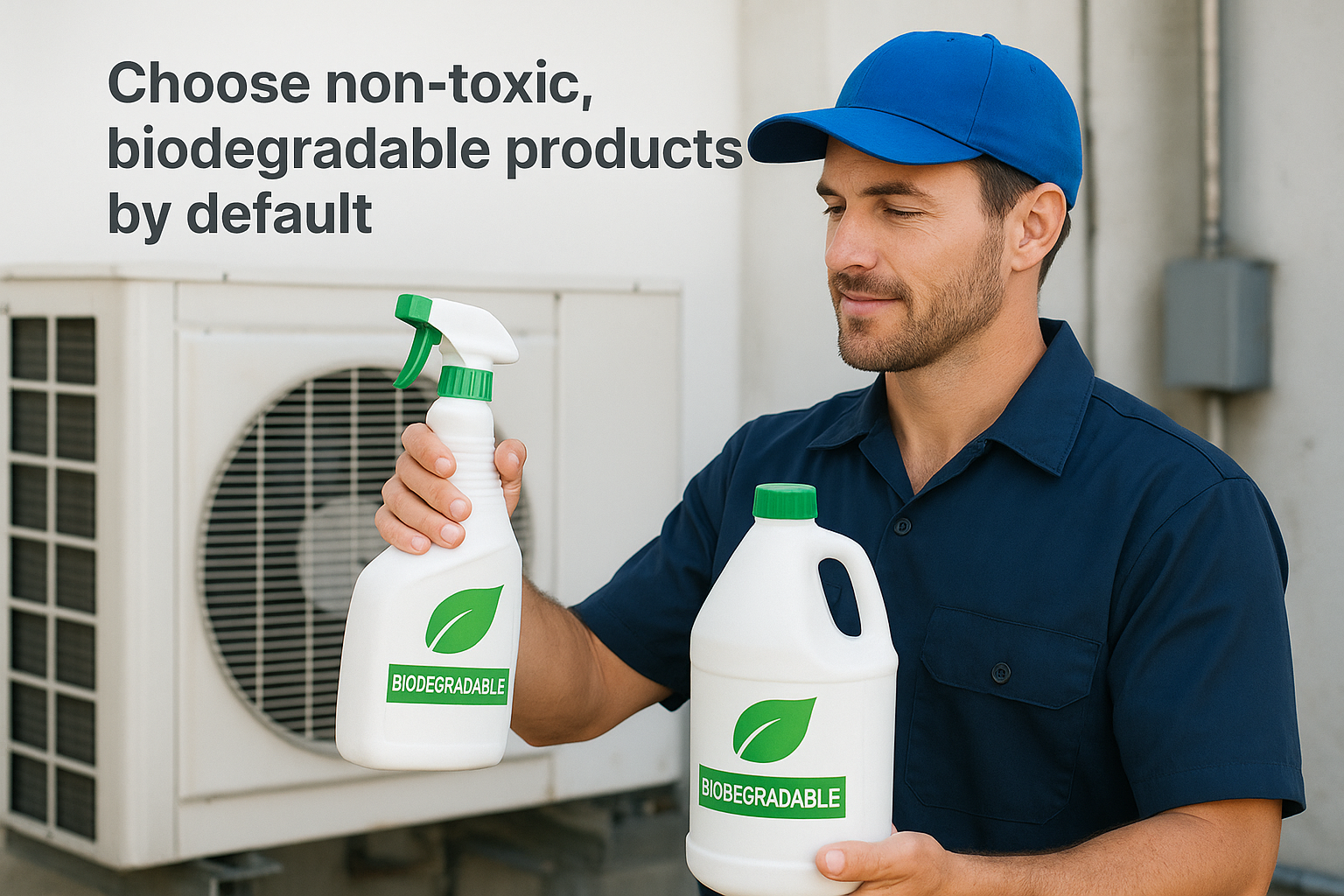
Choose non-toxic, biodegradable products by default
Make biodegradable, phosphate-free formulations your default choice for coil cleaning, descaling, and drain treatment, not the exception you reach for during an audit. Ocean-safe and EPA compliant products eliminate the runoff concerns that come with acid-based cleaners, which matters directly for marina operators and any facility near a storm drain or waterway.
Sustainable maintenance means the product that's safest for your equipment is also the one that's safest for the drain it flows down.
Cut waste through preventive scheduling
Every emergency repair generates waste: replaced parts, discarded fluids, extra packaging from rush-shipped components. Preventive scheduling reduces that waste volume simply by catching problems while they're small. A coil cleaned quarterly needs a fraction of the chemical volume that a heavily scaled coil requires during an emergency descale.
Reduce hazmat shipping and storage footprint
Traditional industrial chemicals often carry hazmat shipping classifications that require special packaging, placarding, and storage limits. Switching to HMIS 0-0-0 certified products removes those requirements entirely, which cuts fuel used in specialized freight and reduces the storage footprint needed for hazardous material cabinets.
Document your environmental performance
Track the following each quarter to prove your sustainability gains hold up under audit:
- Volume of hazardous chemicals eliminated from inventory
- Reduction in hazmat shipments and associated fees
- Water and energy efficiency gains from cleaner-running equipment
- Compliance status against EPA and local discharge standards
Facilities that document these numbers consistently find it easier to justify budget for further upgrades, since the savings are visible rather than assumed.
Keeping your facility running smoothly
Facility maintenance succeeds or fails on the decisions you make before anything breaks: the asset inventory you keep current, the schedules you build around risk, and the products you standardize across every technician's cart. Preventive and condition-based strategies consistently beat reactive firefighting, and choosing HMIS 0-0-0 rated products removes hazmat handling and shipping headaches from the equation entirely, cutting cost and risk at once.
None of this works if your cleaning chemistry undermines the equipment you're trying to protect. Corrosive descalers shorten the same coils and cooling towers your program is meant to extend, which defeats the purpose of scheduling maintenance in the first place. Choose formulations built for the job, not just for the shelf price.
If you're ready to replace acid-based descalers with a formula that protects coils instead of eating them, check out the industrial HVAC and cooling tower descaler built for exactly that job.


