





A neglected cooling tower doesn't just lose efficiency, it drives up energy costs, accelerates equipment failure, and creates real health risks like Legionella growth. The difference between a system that runs reliably for decades and one that becomes a constant money pit usually comes down to one thing: a structured cooling tower maintenance checklist that covers every task from daily inspections to annual overhauls.
The problem is that many facility teams either inherit outdated procedures or rely on memory instead of a documented schedule. Tasks get skipped. Small issues, scale buildup, clogged nozzles, degraded water treatment, compound into expensive repairs. Preventative maintenance isn't complicated, but it does require consistency and the right approach to each component, including the cleaning chemicals you put through the system.
That's where this guide comes in, and where Eco Safeway fits. We manufacture non-toxic, HMIS 0-0-0 rated descalers and coil cleaners specifically designed for cooling tower systems, products that remove scale and buildup without corroding metal surfaces or creating hazardous waste. Below, we've laid out a complete task-by-task maintenance schedule organized by frequency so you can keep your cooling towers operating at peak performance year-round.
What to know before you start
Before you run through any cooling tower maintenance checklist, you need a solid understanding of what you're working with. Jumping straight into tasks without knowing your system type, your water chemistry baseline, or your chemical compatibility can turn routine maintenance into an expensive mistake. Two facilities can look identical from the outside and require completely different maintenance approaches based on tower design, local water conditions, and the equipment they serve.
Know your tower type and configuration
Cooling towers fall into two main categories: open-circuit and closed-circuit systems. In open-circuit towers, water contacts the air directly as it cools; in closed-circuit systems, the process fluid runs through a coil and never mixes with the spray water. Your maintenance tasks, especially your cleaning and descaling protocols, differ significantly between the two.

Beyond the circuit type, you also need to know whether your tower uses a counterflow or crossflow air distribution design, how many cells it has, the fill material (PVC, wood, or ceramic), and the total system volume. Pull the original equipment manufacturer (OEM) documentation before your first inspection. If that documentation no longer exists, your first job is to walk the system and document everything yourself.
| Tower Variable | Why It Matters |
|---|---|
| Open vs. closed circuit | Determines how biological growth and scaling occur |
| Fill material | Affects cleaning method and chemical compatibility |
| System water volume | Drives bleed-off rates and chemical dosing calculations |
| Number of cells | Determines isolation and inspection sequencing |
Understand water treatment basics
Water chemistry is the single biggest factor in whether your tower develops scale, corrosion, or biological problems between service intervals. Before you build any schedule, you need to know your makeup water source and its baseline hardness, pH, conductivity, and total dissolved solids. Municipal water and well water behave differently, and coastal facilities often deal with elevated chloride levels that accelerate metal corrosion.
If you skip the water chemistry baseline, every other step in your maintenance schedule is a guess.
You also need to establish your cycles of concentration target, which tells you how much the water is allowed to concentrate before you bleed off and dilute it. Most facilities run between three and five cycles. Going too high without proper inhibitor coverage leads to rapid scale buildup on heat exchange surfaces, which directly reduces thermal efficiency and increases energy costs.
Gather the right tools and chemicals before you begin
Running a maintenance inspection without the right equipment leads to incomplete checks and missed problems. At minimum, you need a calibrated pH meter, a conductivity meter, test strips or a titration kit for biocide residuals, a turbidity comparator, and a borescope or inspection light for fill and basin access.
On the chemical side, confirm that your descaler, biocide, and corrosion inhibitor are compatible with your fill material and your basin construction. Eco Safeway's non-toxic, HMIS 0-0-0 rated descalers work on metal surfaces without the corrosion risk that acid-based products carry, which matters when you're treating a system you can't take fully offline.
Step 1. Build your baseline inspection
Before you track any recurring tasks, you need a one-time baseline inspection document that captures the current state of your system. Think of this as the foundation your cooling tower maintenance checklist is built on. Without it, you have no reference point for what "normal" looks like, which makes it nearly impossible to catch gradual degradation before it becomes a repair bill.
Document every component before you inspect anything
Walk the entire system and record what you find for each major component. Photograph fill sections, basin walls, nozzle patterns, fan blades, and drift eliminators so you have visual references to compare against in future inspections. Note any existing scale deposits, surface corrosion, cracks, or biological growth. Record the manufacturer, model number, and installation date for the fan motor, gearbox, pump, and fill material.
The first time you document a component, you set the benchmark every future inspection is measured against.
Capture your water chemistry readings on the same day. Test and record pH, conductivity, total dissolved solids, calcium hardness, and total alkalinity as your starting values. These numbers tell you whether your current bleed-off and inhibitor program is working or needs adjustment before you begin any scheduled maintenance.
Build a simple system reference sheet
You don't need complex software to do this well. A single-page reference sheet stored with the tower's maintenance file gives your team everything they need during each visit.
Use this template as your starting point:
| Field | Record Here |
|---|---|
| Tower type (open/closed) | |
| Number of cells | |
| Total system water volume (gallons) | |
| Fill material type | |
| Basin material | |
| Baseline pH | |
| Baseline conductivity (µS/cm) | |
| Cycles of concentration target | |
| Fan motor model and HP | |
| Last descaling date |
Fill out every row before your first scheduled inspection. Any field left blank is a gap in your program.
Step 2. Daily and weekly checklist
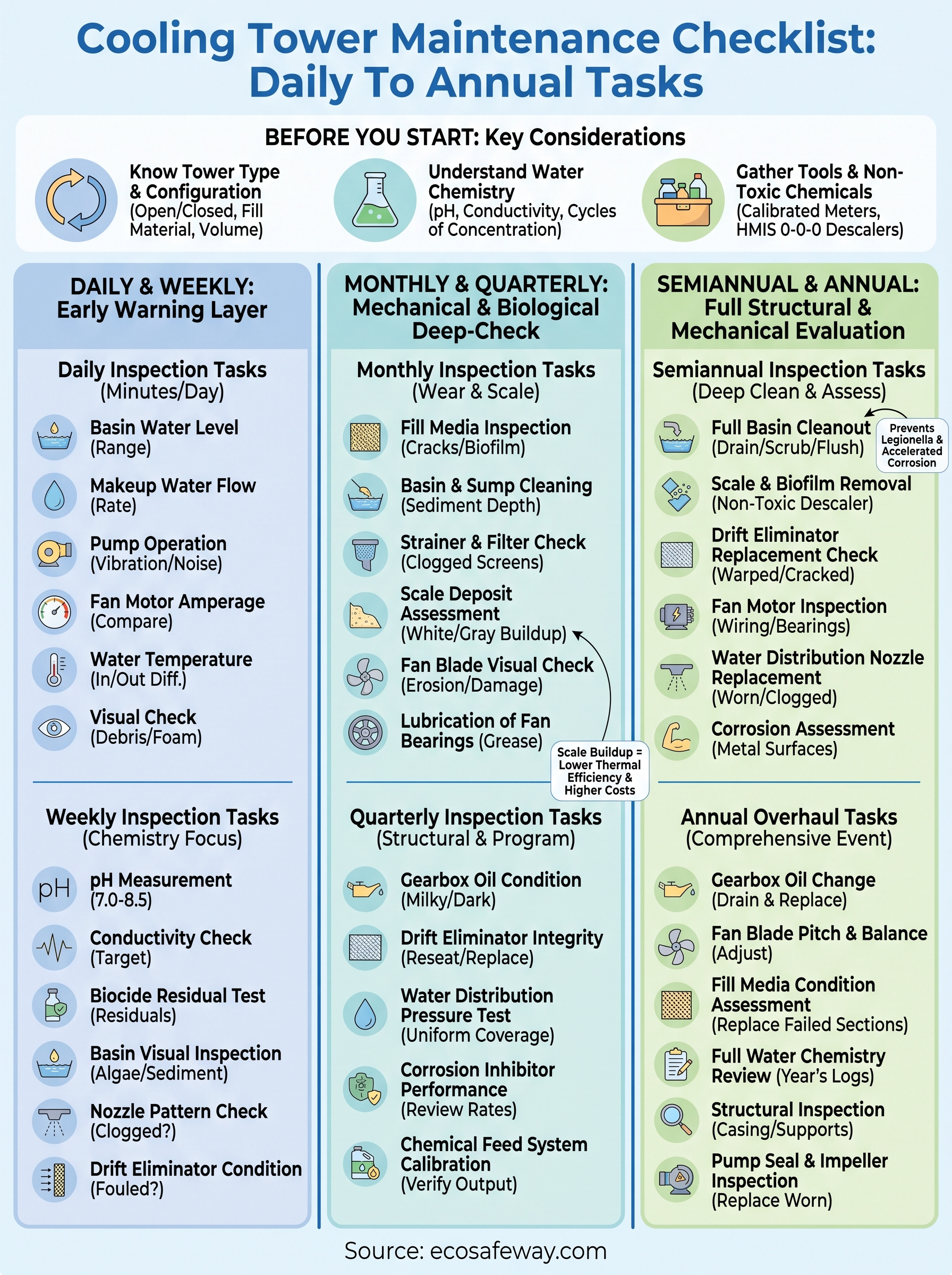
Your daily and weekly tasks form the early-warning layer of your cooling tower maintenance checklist. These checks take minutes, but they catch the problems that compound fastest: abnormal temperatures, chemical drift, biological growth indicators, and mechanical wear. Skipping even a few days creates blind spots that let minor issues escalate before your next scheduled service window.
Consistent daily checks cost minutes; skipping them costs thousands.
Daily inspection tasks
Each day your tower runs, you need a quick visual and instrument check of the core operating parameters. You're looking for anything outside your established baseline, not a full service, just a structured scan that confirms the system is operating within normal range.
Run through these every operating day:
- Basin water level: Should sit within the design operating range; low levels indicate evaporation loss or a float valve problem
- Makeup water flow: Confirm the valve is functioning and water is entering the basin at the correct rate
- Pump operation: Listen for unusual vibration or noise; check that discharge pressure reads within normal range
- Fan motor amperage: Compare to nameplate rating; a spike can signal bearing wear or airflow obstruction
- Water temperature: Log both inlet and outlet temperatures and compare against your baseline differential
- Visual check for debris or foam: Foam indicates either organic contamination or over-treatment with biocide
Weekly inspection tasks
Weekly checks go a layer deeper. Water chemistry is the primary focus at this frequency because treatment residuals, pH, and conductivity shift quickly depending on load, temperature, and evaporation rate.
Complete these every week:
| Task | Target Range / Action |
|---|---|
| pH measurement | 7.0 to 8.5 for most systems |
| Conductivity check | Adjust bleed-off if above your cycles of concentration target |
| Biocide residual test | Confirm oxidizing or non-oxidizing residual per your treatment program |
| Basin visual inspection | Check for algae, sediment, or debris accumulation |
| Nozzle pattern check | Look for clogged or misdirected spray nozzles from basin access points |
| Drift eliminator condition | Confirm no sections are dislodged or heavily fouled |
Document every reading in your maintenance log with the date, time, and the name of the technician who performed the check.
Step 3. Monthly and quarterly checklist
Monthly and quarterly tasks form the mechanical and biological deep-check layer of your cooling tower maintenance checklist. By this point, your daily and weekly checks have been catching water chemistry drift and operational anomalies. Monthly and quarterly intervals let you assess the components that degrade too slowly to catch in a week but fast enough to cause real problems if you ignore them for an entire season.
Monthly inspection tasks
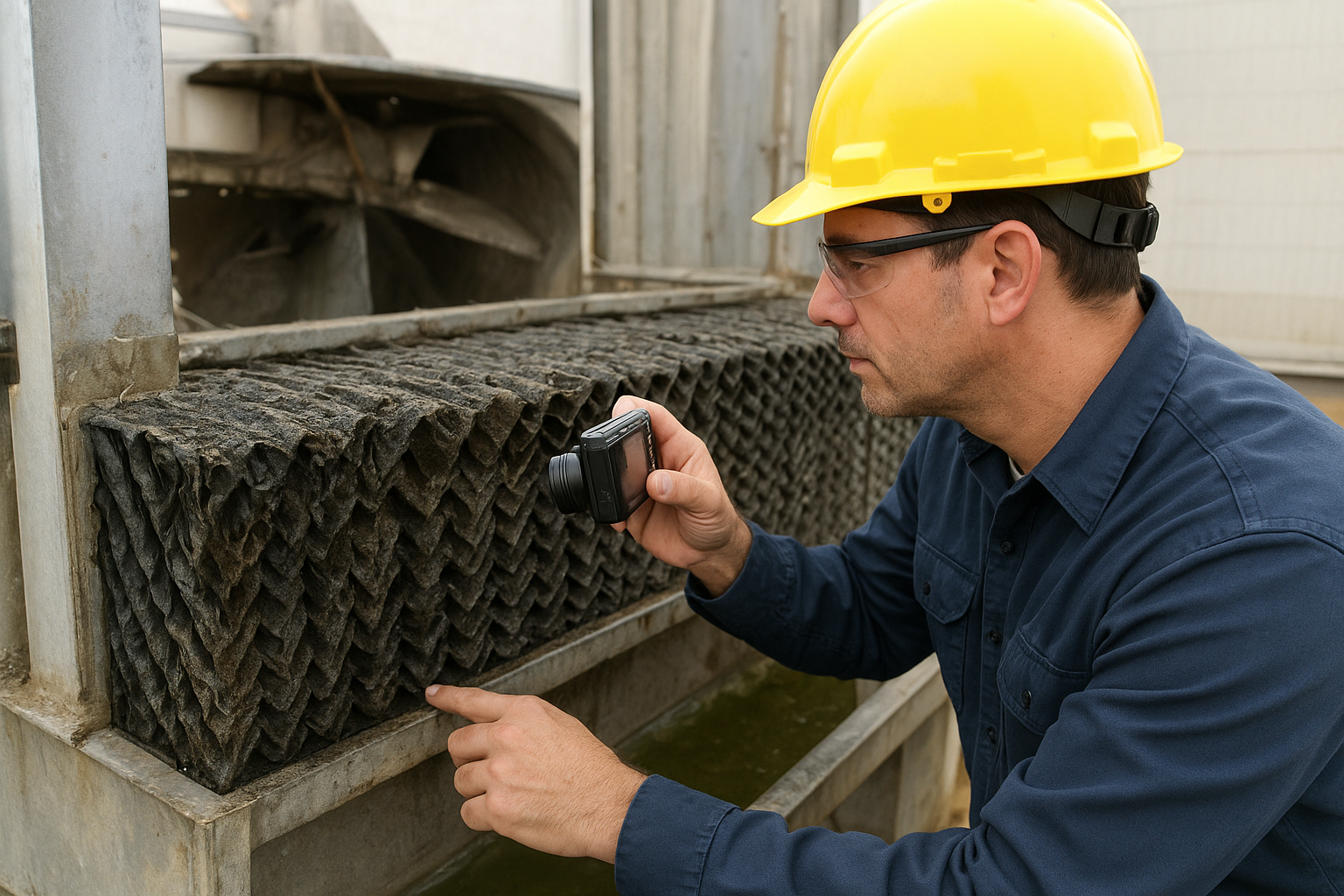
Your monthly check focuses on mechanical wear and scale accumulation on heat transfer surfaces. These are the items that look fine from a distance but show early degradation up close. Run through each task below and log what you find, including photographs when you spot anything abnormal.
| Task | What to Look For |
|---|---|
| Fill media inspection | Cracking, sagging, or heavy biofilm accumulation |
| Basin and sump cleaning | Sediment depth, algae patches, and debris buildup |
| Strainer and filter check | Clogged screens that reduce flow and raise pump load |
| Scale deposit assessment | White or gray mineral buildup on fill, nozzles, or basin walls |
| Fan blade visual check | Erosion, imbalance signs, or physical damage |
| Lubrication of fan bearings | Apply grease per OEM specification |
Scale buildup of even 1/32 of an inch on heat exchange surfaces can reduce thermal efficiency by more than 10 percent.
When you find scale deposits during your monthly check, treat them promptly with a non-corrosive descaler before buildup thickens and requires mechanical removal. Eco Safeway's HMIS 0-0-0 descalers dissolve mineral deposits without attacking metal basin surfaces or degrading PVC fill.
Quarterly inspection tasks
Quarterly checks go deeper into structural integrity and chemical program performance. At this frequency, you're evaluating whether your ongoing water treatment program is actually working and whether any components show wear patterns that point to an upcoming failure.
Complete these every quarter:
- Gearbox oil level and condition: Milky oil signals water intrusion; dark oil signals oxidation
- Drift eliminator integrity: Reseat or replace any dislodged sections
- Water distribution system pressure test: Confirm uniform nozzle coverage across all cells
- Corrosion inhibitor performance review: Compare current metal corrosion rates against your program targets
- Chemical feed system calibration: Verify pump output matches dosing calculations for your current water volume
Step 4. Semiannual and annual checklist
Semiannual and annual tasks represent the deepest level of your cooling tower maintenance checklist. At this frequency, you're not scanning for drift or catching daily anomalies. You're performing a full structural and mechanical evaluation of every major component, replacing wear parts before they fail, and verifying that your water treatment program has kept scale, corrosion, and biological growth under control across the full operating period.
Semiannual inspection tasks
Run these checks every six months, ideally before peak cooling season and again before winter shutdown if your system cycles down. These tasks focus on components that wear gradually and on chemical residue that builds up despite a consistent treatment program.
| Task | Action Required |
|---|---|
| Full basin cleanout | Drain, scrub, and flush the cold water basin completely |
| Scale and biofilm removal | Apply non-toxic descaler to fill, nozzles, and basin walls |
| Drift eliminator replacement check | Replace any warped or cracked sections |
| Fan motor inspection | Check wiring, insulation resistance, and bearing play |
| Water distribution nozzle replacement | Swap out clogged or worn nozzles that daily checks flagged |
| Corrosion assessment on metal surfaces | Document and treat any active corrosion sites |
A full basin cleanout twice per year prevents the sediment accumulation that harbors Legionella and accelerates corrosion at the basin floor.
Annual overhaul tasks
Your annual overhaul is the most comprehensive event in your maintenance cycle. This is when you pull the system down long enough to inspect every component you cannot safely access during operation. Plan for adequate downtime and have replacement parts on hand before you begin.
Work through this checklist once per year:
- Gearbox oil change: Drain and replace completely, not just top off
- Fan blade pitch and balance verification: Adjust per OEM specification
- Fill media condition assessment: Replace sections showing structural failure or heavy biological fouling
- Full water chemistry program review: Compare the year's treatment logs against your target parameters and adjust inhibitor and biocide dosing for the next cycle
- Structural inspection of tower casing and supports: Check for cracks, corrosion, or fastener failure
- Pump seal and impeller inspection: Replace worn seals before they cause unplanned downtime
Keep your tower reliable year-round
A complete cooling tower maintenance checklist is not a one-time document you file and forget. It's a living system that keeps your equipment running efficiently, your water chemistry in check, and your maintenance team working from documented evidence instead of memory. Every task in this guide, from daily basin checks to annual overhauls, compounds over time. Run them consistently and you prevent the scale buildup, biological growth, and mechanical wear that turn manageable maintenance into unplanned downtime.
The chemicals you use matter as much as the schedule you follow. Acid-based descalers and harsh cleaners corrode your metal surfaces, degrade fill media, and create hazardous waste disposal problems. Eco Safeway's non-toxic, HMIS 0-0-0 rated formula removes scale safely without any of those risks. If your current descaling product is working against your equipment rather than for it, start with a better option: Industrial HVAC & Cooling Tower Descaler.


