





If you manage a cooling tower, you already know the water inside it isn't just water. It's a breeding ground for scale, corrosion, and bacteria unless you treat it correctly. Every cooling tower chemical you add serves a specific job, and mixing up their purposes (or skipping one entirely) is how facilities end up with fouled coils, pitted metal, or a Legionella scare during an inspection.
This article breaks down the five chemical categories doing the real work in your system: corrosion inhibitors, scale inhibitors, biocides, pH adjusters, and dispersants. You'll learn what each one actually does to the water and metal surfaces, why leaving one out creates problems for the others, and how to tell if your current treatment program is actually protecting your equipment or just checking a compliance box.
We'll also flag where traditional treatment chemicals introduce hazards you don't need, from corrosive handling requirements to environmental discharge restrictions. If you're comparing options or looking for a non-corrosive cleaner approach to keep your tower running clean without the hazmat headaches, this rundown gives you the baseline to make that call.'
1. Corrosion inhibitors
Corrosion inhibitors sit at the top of this list because metal loss is the most expensive problem a cooling tower can develop. Once your carbon steel piping, copper condenser tubes, or galvanized fill starts pitting, you're not looking at a cleaning fix. You're looking at a capital repair.
What they do
These chemicals form a protective barrier on metal surfaces, usually a molecular film that blocks oxygen and dissolved minerals from reacting with the metal itself. Without that film, the constant cycling of water through your tower slowly eats away at heat exchanger tubes and steel components, which is exactly the kind of damage that shortens equipment life and drives up replacement costs.
A tower without corrosion protection isn't losing water efficiency, it's losing metal.
Common types used
Traditional programs lean on a handful of chemistries, each with tradeoffs:
- Molybdate-based inhibitors, effective but increasingly restricted due to discharge limits
- Phosphonates, common but can contribute to phosphate loading in wastewater
- Azoles, targeted specifically at copper alloy protection
- Zinc-based blends, often paired with phosphonates for carbon steel systems
Signs your system needs one
Watch for reddish-brown water discoloration, visible pitting on accessible piping, or a rising iron count in your water analysis reports. If your maintenance log shows more frequent tube cleaning or unexplained heat transfer loss, corrosion is a likely culprit even before it's visible.
Choosing a safer option
Many facility managers assume corrosion protection requires hazardous handling procedures, but that's not universally true anymore. Look for formulations with an HMIS 0-0-0 rating, meaning no special hazmat shipping, no acid burns during dosing, and no corrosive residue for your team to manage. Non-toxic doesn't mean weaker protection, it means you get the metal-safe barrier without the safety liability.
2. Scale inhibitors
Scale forms when dissolved minerals like calcium and magnesium fall out of solution as water evaporates and cycles up in concentration. That mineral buildup coats your heat exchanger surfaces like a blanket, and even a thin layer of scale deposits can cut heat transfer efficiency by double digits, forcing your system to work harder for the same cooling output.
What they do
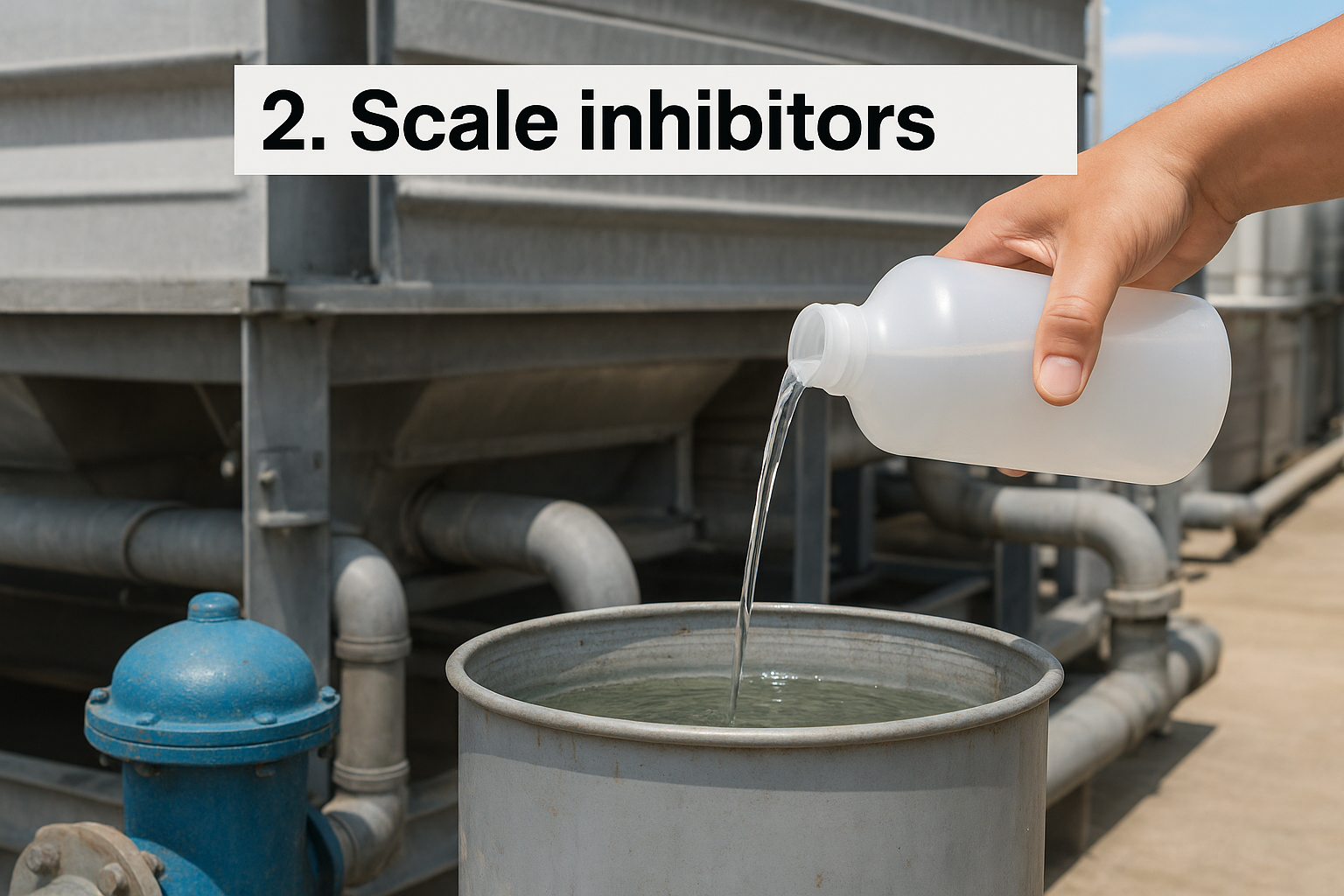
Scale inhibitors keep calcium carbonate and other minerals suspended in the water instead of letting them crystallize on hot surfaces. They work by disrupting the crystal growth process at a molecular level, so particles stay small and get carried out with the blowdown rather than bonding to your tubes.
Scale doesn't just clog pipes, it insulates the exact surfaces your system relies on to transfer heat.
Common types used
- Phosphonates, widely used but tied to phosphate discharge restrictions
- Polyacrylates, effective at higher cycles of concentration
- Sulfonated polymers, often blended for hard water conditions
Signs your system needs one
Rising approach temperatures, reduced water flow, and white mineral crusting on fill media all point to scale buildup already underway.
Choosing a safer option
Look for phosphate-free formulations that skip the wastewater compliance headaches while still controlling hardness deposits without corrosive handling requirements.
3. Biocides and algaecides
Open cooling towers pull in dust, pollen, and airborne bacteria every time they cycle air through the water stream. Left untreated, that water becomes a warm, wet incubator for microbial growth, including the bacteria responsible for Legionnaires' disease outbreaks tied to poorly maintained towers.
What they do
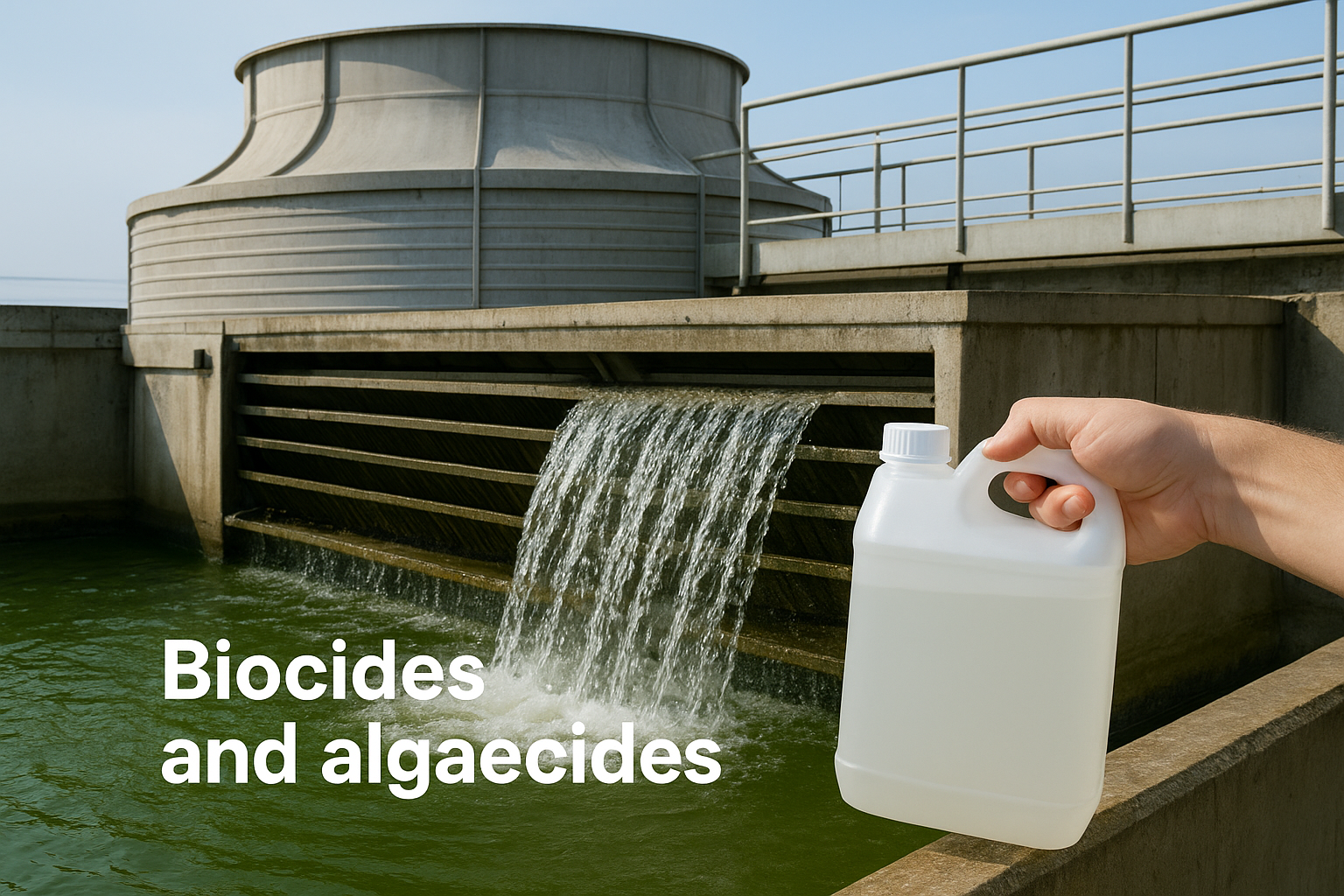
Biocides kill bacteria, algae, and fungi directly, while algaecides target photosynthetic growth specifically. Together they knock down the microbial population before it forms biofilm, a slimy layer that shields bacteria from future treatment and feeds corrosion underneath it.
A tower with clean-looking water can still be a Legionella risk if biocide dosing has lapsed.
Common types used
- Oxidizing biocides like chlorine and bromine, fast-acting but corrosive to metal at high doses
- Non-oxidizing biocides, rotated in to prevent bacterial resistance
- Quaternary ammonium compounds, common algaecides for surface growth
Signs your system needs one
Slimy fill media, cloudy water, foul odors, or a positive Legionella test all signal your biocide program isn't keeping pace with biological load.
Choosing a safer option
Prioritize non-toxic disinfectants that control bacteria without chlorine's handling risks or corrosive byproducts, protecting both your team and your metal surfaces.
4. pH adjusters
Water chemistry drifts constantly in a cooling tower as minerals concentrate and chemicals react, and that drift changes how every other cooling tower chemical in your program performs. Get the pH wrong and your corrosion inhibitors stop forming a stable film while your scale inhibitors lose their grip on dissolved minerals.
What they do
pH adjusters push the water toward a target range, usually slightly alkaline, where corrosion and scale risks stay balanced against each other. Swing too acidic and metal corrodes faster; swing too alkaline and scale forms faster, so this is a balancing act, not a one-time fix.
Common types used
- Sulfuric acid, effective but corrosive and dangerous to handle
- Sodium hydroxide, raises pH but carries serious burn risk
- Buffered alkaline blends, gentler alternatives for stable dosing
Get pH wrong and every other treatment chemical you're paying for stops working as designed.
Signs your system needs one
Erratic pH readings, accelerated corrosion despite inhibitor dosing, or scale forming outside expected cycles all point to unstable pH control.
Choosing a safer option
Select non-corrosive formulations that hold pH steady without acid burns or hazmat storage requirements on-site.
5. Dispersants
Dispersants finish the job the other four categories start. Even with corrosion inhibitors, scale inhibitors, biocides, and pH control running smoothly, suspended solids like dirt, dust, and biological debris still accumulate in the water. Without a dispersant keeping those particles apart, they clump together and settle wherever flow slows down, usually in your fill media or heat exchanger.
What they do
Dispersants keep particulate matter electrically charged so particles repel each other instead of sticking together. That keeps sediment, iron oxide, and organic debris suspended long enough to exit through blowdown instead of settling into a sludge layer on your equipment.
Dispersants don't kill or prevent contamination, they keep it moving out of your system before it settles.
Common types used
- Polyacrylate polymers, common for general sediment control
- Lignosulfonates, effective against iron and manganese deposits
Signs your system needs one
Sludge buildup at the tower basin, reduced flow through strainers, or sediment accumulation in fill media all point to inadequate dispersion.
Choosing a safer option
Favor non-toxic dispersant blends that clear sediment without contributing to phosphate loading or discharge violations downstream.
Building a balanced water treatment program
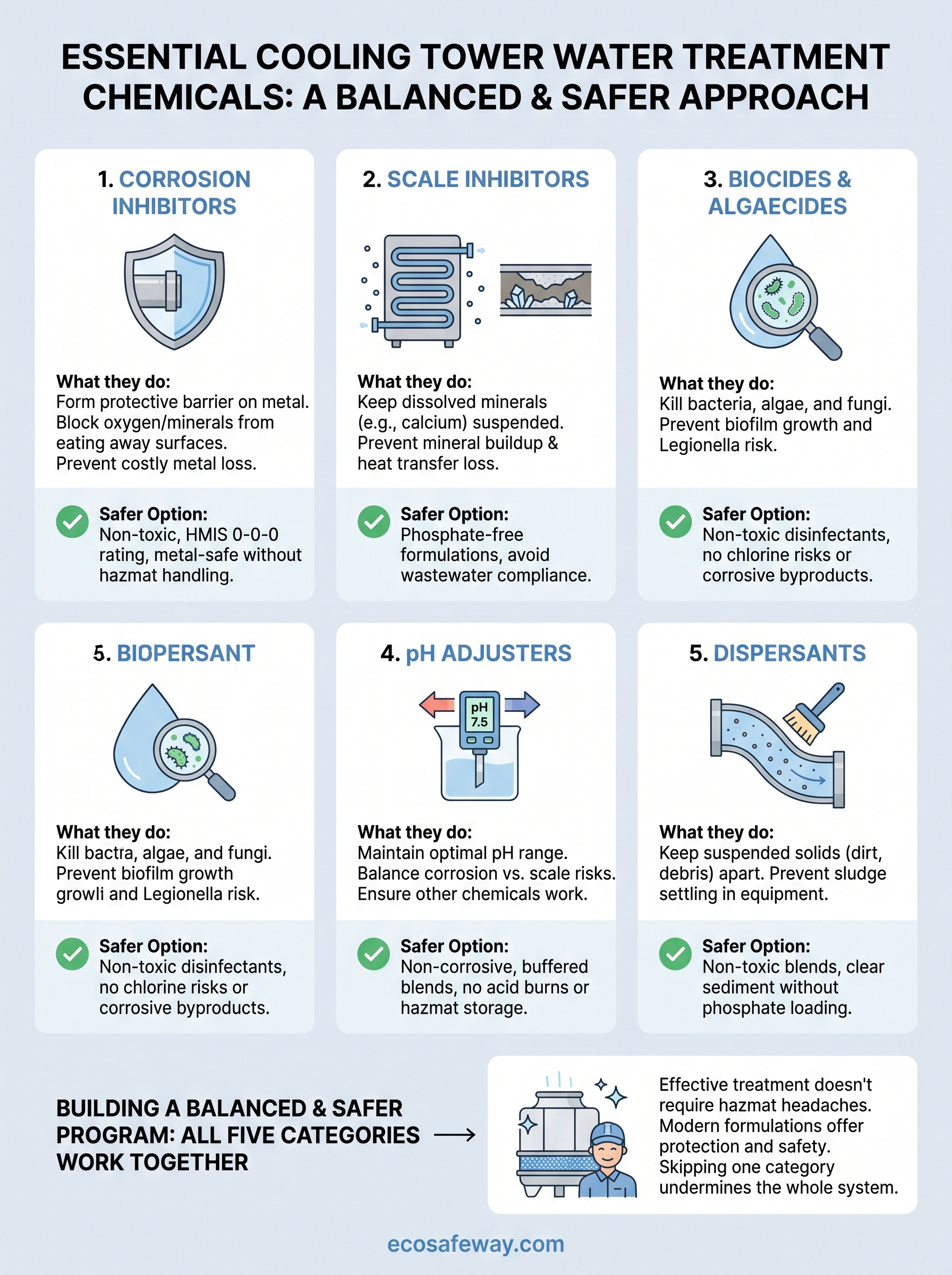
No single cooling tower chemical carries the whole job. Corrosion inhibitors protect metal, scale inhibitors keep minerals suspended, biocides knock down bacteria, pH adjusters keep everything else working as designed, and dispersants sweep out what's left. Skip one category and you don't just lose that function, you undermine the other four.
Running all five doesn't have to mean acid burns, hazmat storage, or discharge violations. The safer formulations mentioned throughout this list prove you can hit every treatment goal without the corrosive handling that traditional programs still lean on. That's the real shift happening in this industry: facilities managers are realizing protection and safety aren't a tradeoff.
If your current program still relies on hazardous chemistries for descaling, take a look at Eco Safeway's industrial HVAC and cooling tower descaler for a non-corrosive way to keep your system clean.


