





Scale buildup on cooling tower condenser tubes and fill media doesn't announce itself until efficiency drops, energy bills climb, or a tech flags heat transfer problems during routine checks. At that point, you're already losing money. A cooling tower descaling chemical dissolves calcium carbonate, magnesium, and mineral deposits that accumulate wherever hard water circulates through heat exchange equipment, and picking the right one determines whether you fix the problem or create a new one with corroded metal and pitted surfaces.
Most facility managers assume descaling means acid, and that's exactly where things go wrong. Strong acids strip scale fast, but they also eat away at copper, aluminum, and galvanized steel components, shortening equipment life and creating hazardous waste disposal headaches. Effective descaling doesn't require that trade-off. Non-corrosive formulations can dissolve the same mineral deposits without damaging tower internals or requiring protective gear.
This article breaks down what a cooling tower descaling chemical actually does, the difference between acid-based and non-toxic descaler options, and how to apply either type correctly for full mineral removal without downtime or equipment risk. You'll leave knowing exactly what to look for on a product label and how to run a proper descaling cycle.
Why scale buildup hurts cooling tower performance
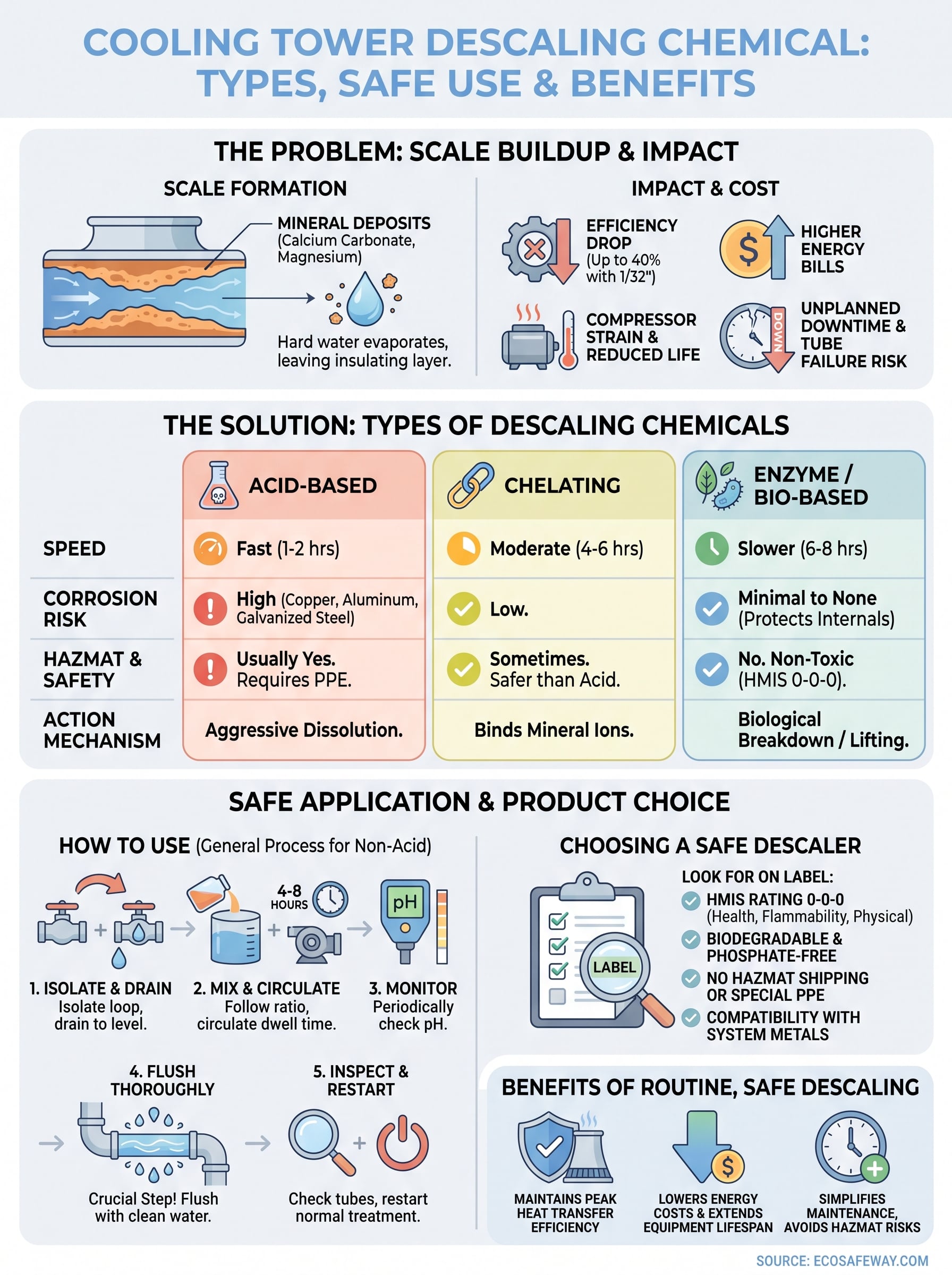
Mineral scale forms an insulating layer on condenser tubes the moment hard water evaporates and leaves calcium and magnesium behind. This layer acts like a blanket wrapped around your heat exchange surfaces, and heat transfer efficiency drops fast once it's there. A scale layer as thin as 1/32 inch can cut heat transfer efficiency by up to 40%, according to industry data cited by the U.S. Department of Energy's guidance on industrial water systems. That's not a rounding error on your utility bill. It's a direct hit to compressor load, chiller runtime, and energy costs that compounds every day the scale stays put.
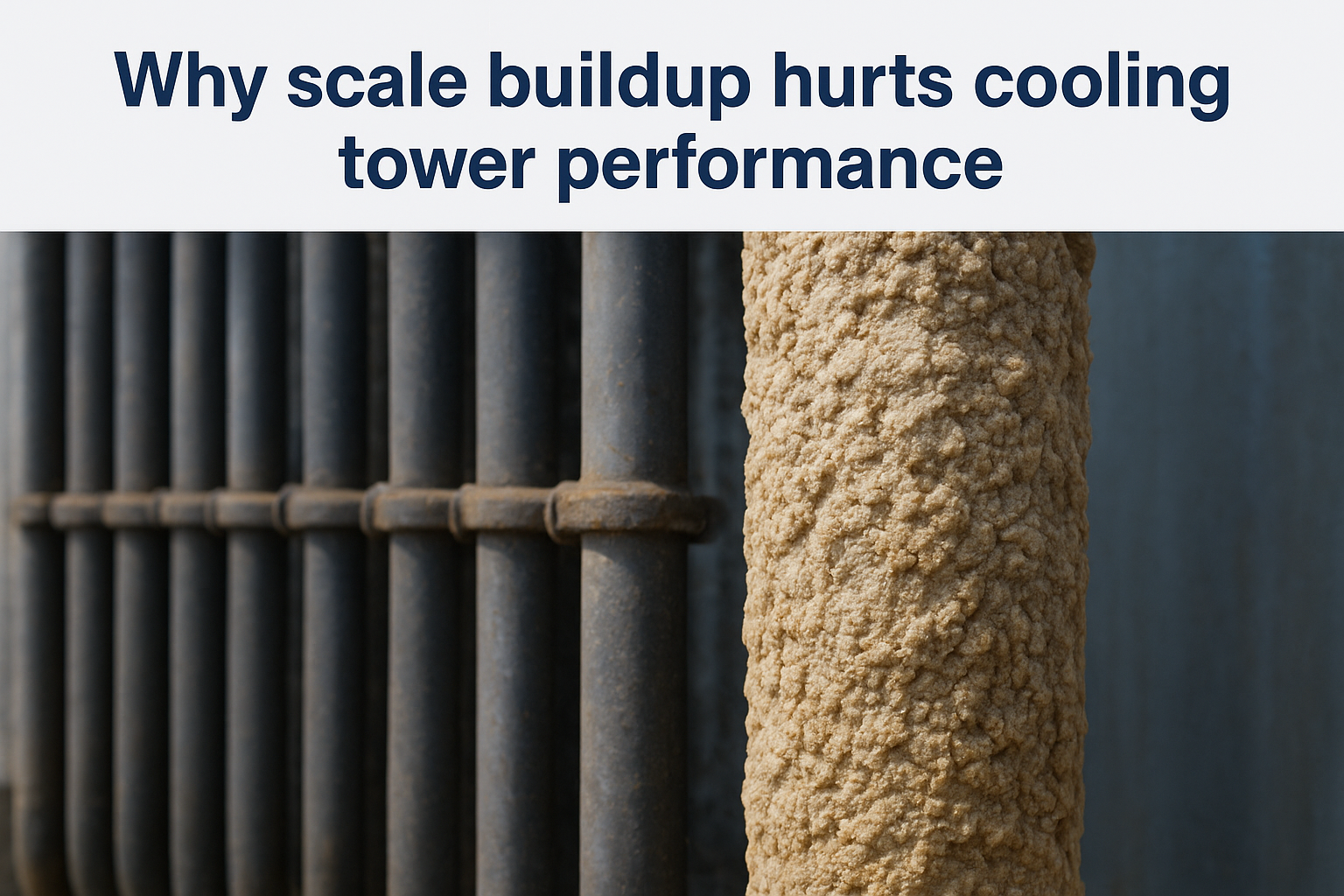
A 1/32-inch scale layer can slash cooling tower heat transfer efficiency by nearly 40%, turning a maintenance issue into a monthly cost problem.
Beyond efficiency, scale creates mechanical problems that snowball. Deposits narrow pipe diameters, forcing pumps to work harder to move the same volume of water. Fill media clogs with mineral crust, disrupting the even water distribution that cooling towers depend on for proper evaporative cooling. Once flow gets uneven, you start seeing hot spots, localized corrosion, and biological growth in the low-flow zones where stagnant water collects. Legionella risk climbs right alongside scale buildup, since scale gives bacteria a rough surface to colonize and hides them from biocide treatments.
Downtime follows close behind. Facilities that ignore early-stage scale often end up scheduling emergency shutdowns for descaling instead of planned maintenance windows, which means lost production hours and rushed vendor calls. Equipment lifespan takes the bigger hit long-term. Condenser tubes designed to last 15-20 years can fail in half that time when scale forces the system to run hotter and harder than it was engineered for.
Here's a quick breakdown of what unmanaged scale actually costs you over time:
| Scale Thickness | Efficiency Loss | Typical Impact |
|---|---|---|
| 1/32 inch | Up to 40% | Higher energy bills, reduced cooling capacity |
| 1/16 inch | Up to 60% | Compressor strain, frequent cycling |
| 1/8 inch+ | 70%+ | Emergency shutdowns, tube failure risk |
Regular monitoring and timely treatment with a proper descaling chemical keeps these numbers from ever showing up on your maintenance report.
How to use a cooling tower descaling chemical safely
Applying a descaling chemical isn't a pour-and-walk-away job. Proper dilution ratios and circulation time matter as much as the product you choose, and skipping steps leads to incomplete scale removal or damage to seals and gaskets that weren't built for the wrong concentration.
Prepping the tower before treatment
Before you introduce any chemical, isolate the cooling tower loop from the rest of the building system and drain it if the product label calls for a closed-loop circulation. Shutting down circulation pumps during isolation prevents chemical from reaching areas outside the treatment zone. Check pH and hardness levels first so you know your baseline and can confirm the descaler worked once you're done.
Running the treatment cycle
Follow this general sequence for most non-acid descaling products:
1. Isolate the loop and drain to treatment level
2. Mix descaler per label ratio (never eyeball concentration)
3. Circulate for the recommended dwell time, typically 4-8 hours
4. Monitor pH periodically during the cycle
5. Flush thoroughly with clean water
6. Inspect tubes and fill media for remaining deposits
7. Restart normal water treatment program
Skipping the flush step is the single most common mistake that leaves residual chemical circulating through your system long after treatment ends.
Non-toxic, HMIS 0-0-0 rated descalers simplify this whole process since you don't need respirators, acid-resistant gloves, or eyewash stations on standby, and disposal doesn't require hazmat handling.
Types of descaling chemicals and how they compare
Descaling chemicals fall into three broad categories: acid-based, chelating, and enzyme or bio-based formulations. Each dissolves calcium carbonate deposits through a different chemical mechanism, and that mechanism determines how much risk you're taking on with your metal surfaces and gaskets.
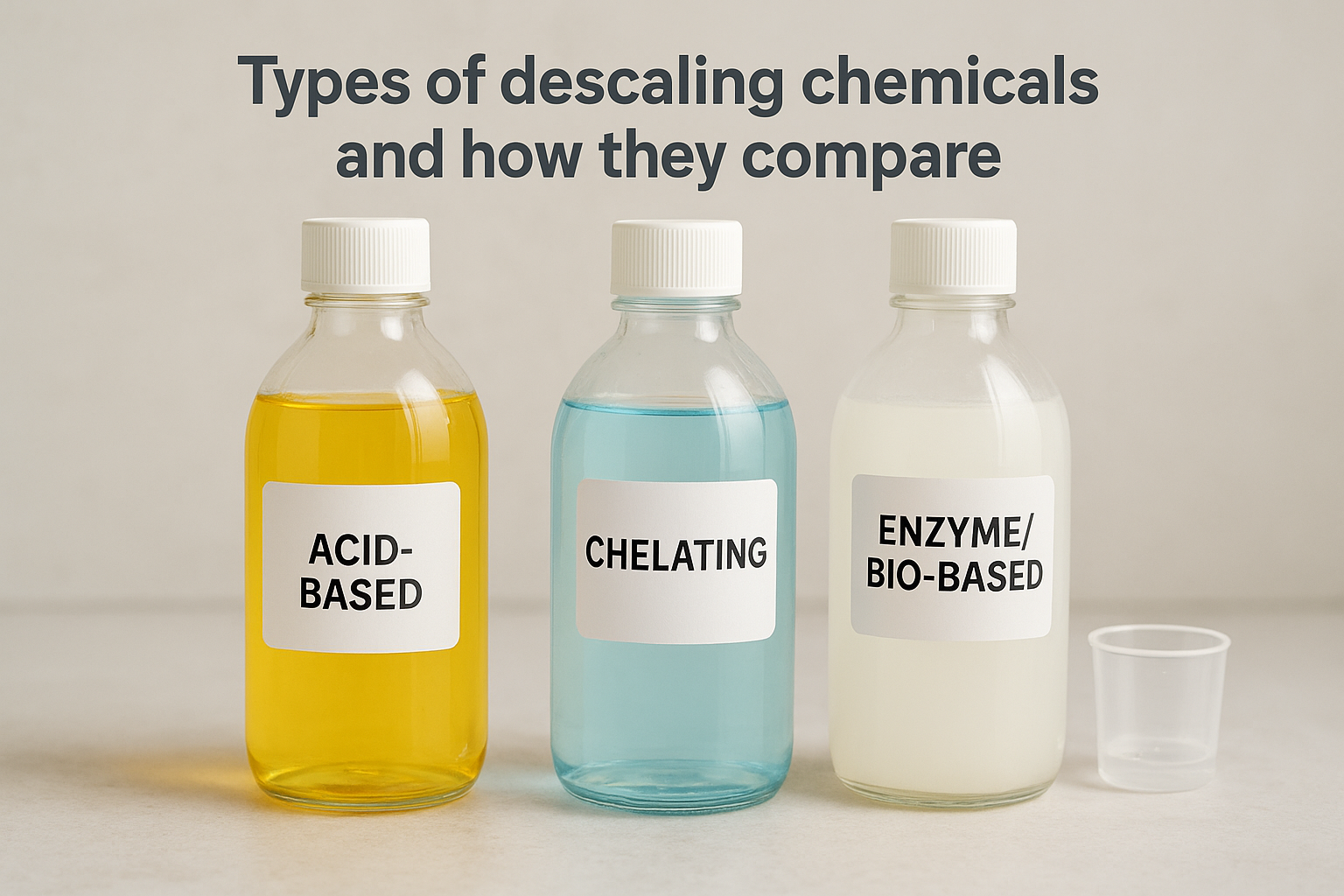
Acid-based descalers
Sulfamic, hydrochloric, and phosphoric acid products remove scale quickly, often within an hour of dwell time. Speed comes at a cost though. Metal corrosion risk rises sharply on copper, aluminum, and galvanized components, and these products typically carry hazmat shipping and disposal requirements.
Chelating and enzyme-based descalers
Chelating agents bind mineral ions and lift them off surfaces without generating the aggressive pH swings acids cause. Enzyme and bio-based formulations work more slowly but leave tower internals untouched, which matters if you're trying to hit a 20-year equipment lifespan instead of 10.
The fastest descaler on the shelf is rarely the safest choice for equipment that has to run another decade.
Here's how the three categories stack up:
| Type | Speed | Corrosion Risk | Hazmat Shipping |
|---|---|---|---|
| Acid-based | Fast (1-2 hrs) | High | Usually yes |
| Chelating | Moderate (4-6 hrs) | Low | Sometimes |
| Enzyme/bio-based | Slower (6-8 hrs) | Minimal to none | No |
Matching the category to your tolerance for downtime versus long-term equipment protection is the real decision here, not just picking whatever clears scale fastest.
Choosing a safe, non-toxic descaler for your system
Selecting the right cooling tower descaling chemical means weighing more than dissolving power. You need a product that clears mineral scale completely while leaving gaskets, seals, and metal surfaces intact, and that starts with reading the safety data sheet before the product spec sheet.
What to check on the label
Look for these markers before you buy:
- HMIS rating of 0-0-0 for health, flammability, and physical hazard
- No listed PPE requirements beyond basic gloves
- Biodegradable and phosphate-free formulation
- No hazmat shipping classification
- Compatibility statement for copper, aluminum, and galvanized steel
Why the safety rating matters
An HMIS 0-0-0 certification confirms a product carries zero health, flammability, or physical hazard rating, which means no special storage, no respirator on site, and no hazardous waste manifest when you're done. Facilities juggling OSHA compliance and environmental permits gain real operational simplicity here, since staff can handle the product without training sign-off or emergency eyewash stations nearby.
A descaler that needs a hazmat placard to ship probably needs one to store and dispose of too.
Non-toxic formulations also protect the people doing the work, not just the equipment. Technicians handling enzyme-based or chelating descalers avoid the skin and respiratory exposure risks tied to acid products, and that reduces liability for the facility manager who signed off on the purchase order in the first place.
Keeping your cooling tower scale-free
Scale doesn't wait for a convenient maintenance window, and neither should you. The real takeaway here is simple: a cooling tower descaling chemical only earns its place in your maintenance program if it removes mineral deposits without trading one problem for another. Acid-based products clear scale fast but chip away at equipment life and add hazmat handling to your workload. Chelating and enzyme formulations take a bit longer but protect condenser tubes, gaskets, and the people running the treatment cycle.
Running a routine descaling schedule instead of waiting for efficiency losses to show up on your energy bill keeps your tower running at design capacity year after year. Pair that schedule with a non-toxic, HMIS 0-0-0 rated product and you skip the PPE requirements, the disposal headaches, and the corrosion risk that comes standard with harsher chemistry.
If you're ready to switch to a descaler that protects your equipment and your team, check out Eco Safeway's Industrial HVAC & Cooling Tower Descaler.


