





If you manage a building, plant, or data center, you've probably walked past a cooling tower without knowing exactly what it does or why it matters to your operation. That's normal. Cooling towers sit outside on rooftops or in mechanical yards, quietly running, until scale buildup or a compliance issue forces you to pay attention. At that point, you need clear answers, not marketing jargon.
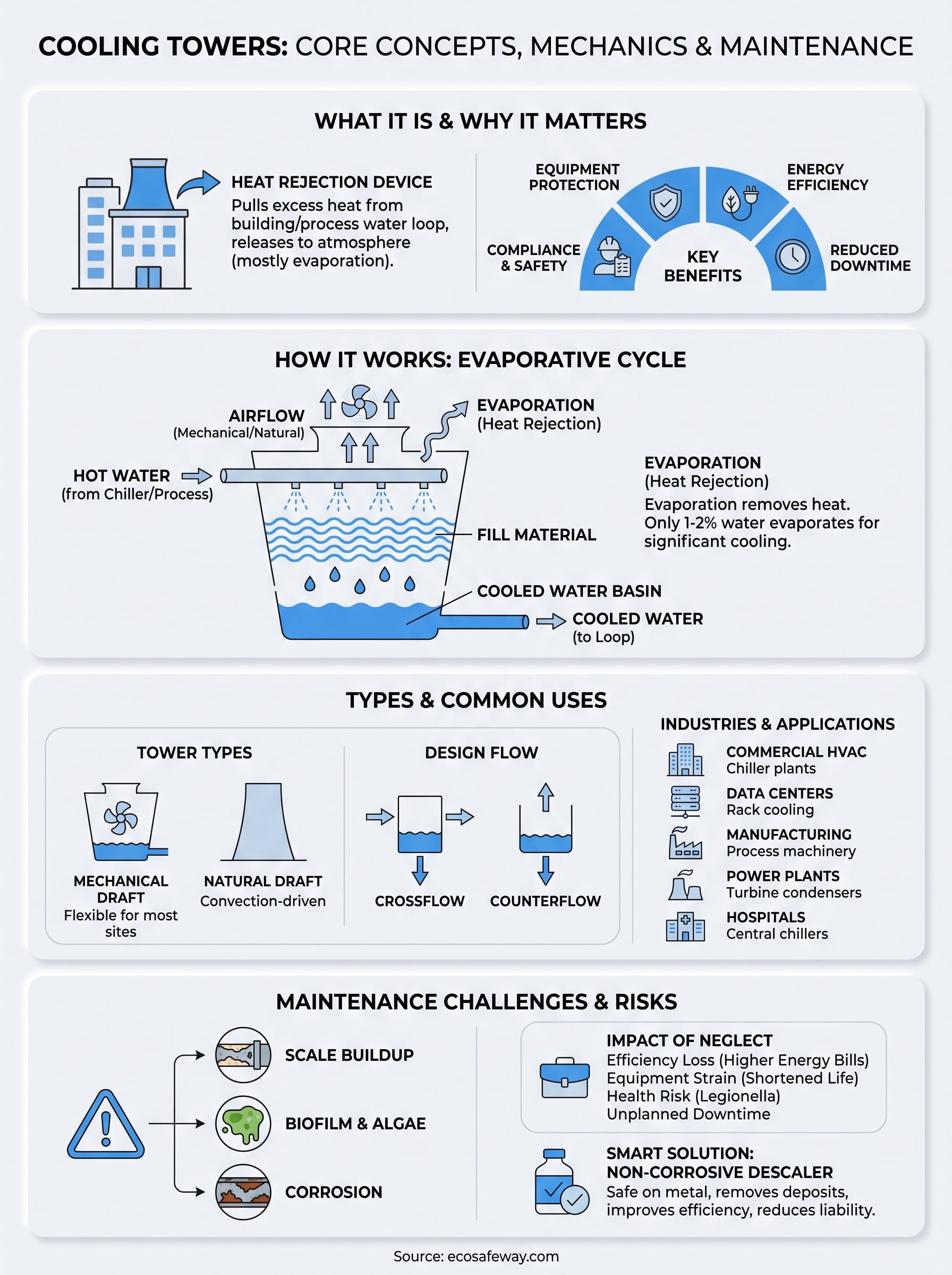
A cooling tower is a heat rejection device that pulls excess heat out of a building's or process's water system and releases it into the atmosphere, mostly through evaporation. It works alongside chillers, condensers, and HVAC equipment to keep large systems from overheating. You'll find them cooling everything from office towers and hospitals to power plants and manufacturing lines, anywhere a cooling system needs to dump heat efficiently and continuously.
This article breaks down exactly what a cooling tower is, walks through the mechanics of how it moves heat, and covers the industries and equipment that depend on them. We'll also touch on the maintenance side, since scale, biofilm, and mineral buildup are the real threats to performance and why choosing the right cooling tower descaler matters for equipment lifespan and safety.
Why cooling towers matter for HVAC and industrial systems
Every large building or industrial process generates heat that has to go somewhere. Without a way to reject that heat, chillers overheat, compressors trip, and production lines shut down. Cooling towers solve this problem by giving heat a path out of the water loop and into the open air, which is why they sit at the center of almost every large-scale HVAC or process cooling design. Skip this step, or run it poorly, and you're looking at higher energy bills, shortened equipment life, and unplanned downtime.
The cost of inadequate heat rejection
Regular buildings and plants rely on heat rejection to keep chillers, condensers, and compressors within safe operating ranges. When scale or biofilm coats the tower's fill and heat exchange surfaces, the whole system loses efficiency fast. A tower running at even 10% reduced efficiency can force a chiller plant to work harder, driving up electricity use and wearing down compressors years ahead of schedule. That's an operational cost most facility managers don't see coming until the utility bill lands.
| Condition | Typical Impact |
|---|---|
| Clean tower, proper water treatment | Full rated efficiency, lower energy use |
| Light scale/biofilm buildup | 5-10% efficiency loss, higher chiller load |
| Heavy scale/mineral deposits | 20%+ efficiency loss, risk of compressor strain |
| Untreated for years | Frequent breakdowns, premature equipment replacement |
A poorly maintained cooling tower doesn't just waste energy, it quietly shortens the life of every piece of equipment connected to it.
Where cooling towers fit in the bigger system
Hospitals, data centers, and manufacturing plants all depend on chiller performance, and chillers depend on cooling towers to shed the heat they absorb. Think of the tower as the exhaust point for the entire cooling loop. If it can't release heat efficiently, the chiller can't cool efficiently, and everything downstream, from server racks to operating rooms, feels the effect. This tight relationship is why facility teams treat tower maintenance as equipment protection, not just cleaning.
Regulatory and safety stakes
Government facilities, hospitals, and commercial buildings also face real regulatory pressure around cooling tower operation. Poorly maintained towers create ideal conditions for Legionella bacteria growth, a documented public health risk tracked closely by agencies like the CDC. Facility managers who ignore water treatment protocols aren't just risking equipment, they're risking liability and compliance violations that can shut down operations entirely.
Here's what's typically at stake when tower maintenance gets deprioritized:
- Energy costs climb as scale reduces heat transfer efficiency
- Equipment lifespan shortens due to increased mechanical strain
- Health compliance risks rise with bacterial growth in stagnant or scaled water
- Downtime increases as breakdowns become more frequent
- Insurance and liability exposure grows with documented neglect
Understanding these stakes is the first step toward taking cooling tower performance seriously, long before you get to choosing a descaler or treatment plan.
How cooling towers work step by step
Understanding the mechanics behind cooling towers makes the maintenance conversation much easier to follow later. At its core, a cooling tower takes hot water from a chiller or process loop, exposes it to air, and lets evaporation carry heat away before sending the cooled water back into the system. The process repeats continuously, which is why the tower's internal surfaces take a beating over time.
The evaporative cooling cycle
Every cooling tower, regardless of size, follows roughly the same sequence:
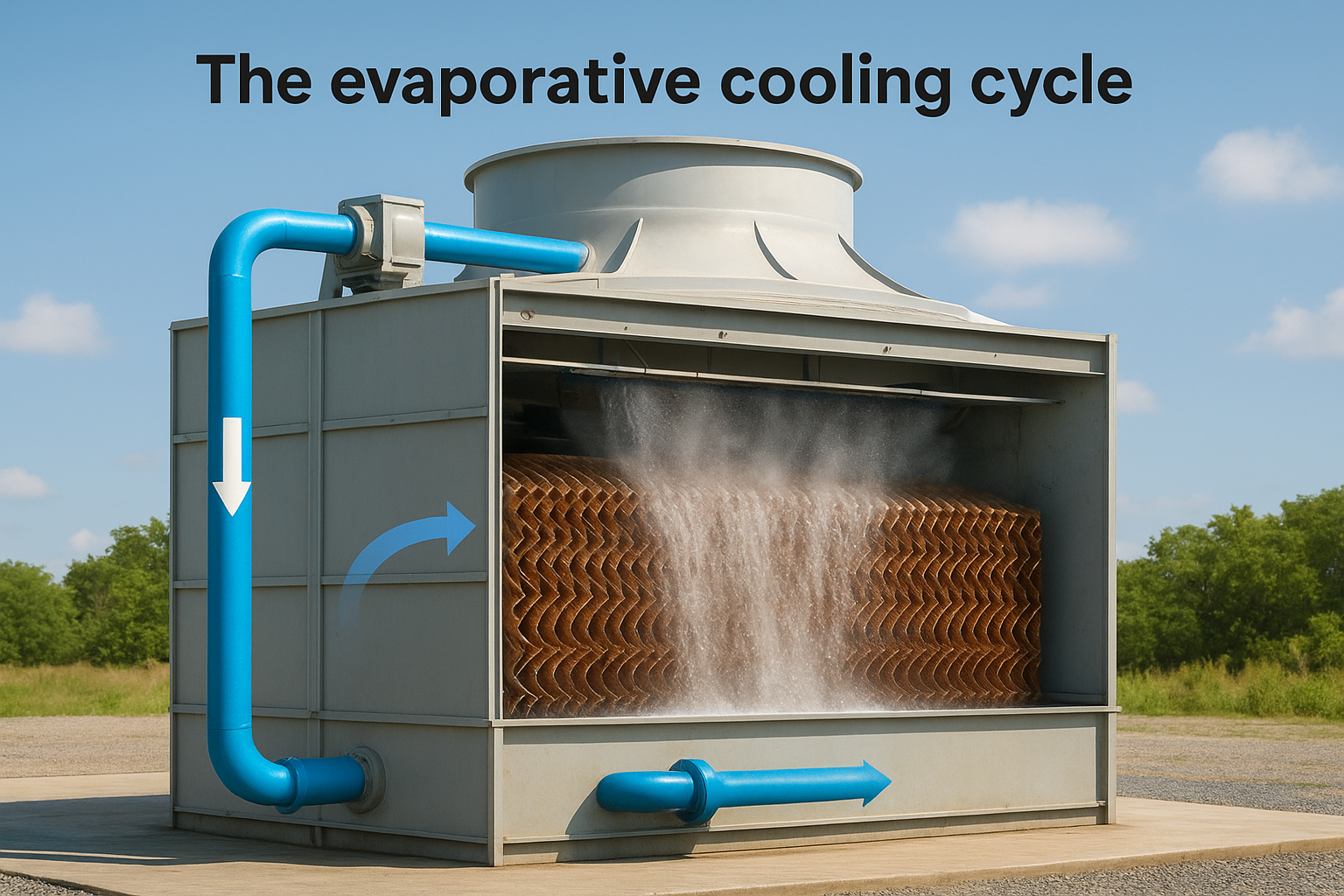
- Hot water enters the tower from the chiller condenser or process equipment, usually through a distribution header at the top.
- Water spreads across fill material, thin plastic or metal sheets designed to maximize surface area and slow the water's fall.
- Air moves through the tower, either pulled by mechanical fans or driven by natural convection, contacting the falling water.
- Evaporation removes heat, since a small fraction of the water evaporates and carries a disproportionate amount of thermal energy with it.
- Cooled water collects in a basin at the bottom and gets pumped back into the building or process loop to absorb more heat.
Why evaporation does the heavy lifting
Fans and fill material matter, but evaporation is what actually rejects the heat. Only about 1-2% of the circulating water needs to evaporate to remove a significant heat load, which is why cooling towers are so efficient compared to dry heat exchangers.
Evaporation, not airflow alone, is the real engine behind every cooling tower's performance.
Gravity and airflow work together to keep water moving through the fill long enough for evaporation to happen at scale. Mineral content left behind after evaporation, however, doesn't disappear. It concentrates in the remaining water and eventually deposits on fill surfaces, fan blades, and basin walls, setting up the scale problems covered later in this article.
Types of cooling towers and how they differ
Not every cooling tower looks or works the same way. Facilities choose a design based on heat load, footprint, water quality, and how much mechanical maintenance they can handle. Two main classifications matter most: how the tower moves air, and how water and air interact inside the tower. Getting this right at the design stage affects everything downstream, including how often you'll need to descale or treat the system.
Mechanical draft vs. natural draft
Mechanical draft towers use fans to force or pull air through the fill, giving operators precise control over airflow and cooling capacity. Natural draft towers rely on the density difference between hot and cool air to create airflow on their own, which works well at massive scale but requires a much taller structure. Most commercial and industrial sites use mechanical draft because it fits smaller footprints and adjusts easily to changing loads.
Crossflow vs. counterflow design
In a crossflow tower, air moves horizontally through the fill while water falls vertically, making inspection and maintenance access easier. In a counterflow tower, air moves upward against the falling water, which improves heat transfer efficiency but makes fill access tighter.
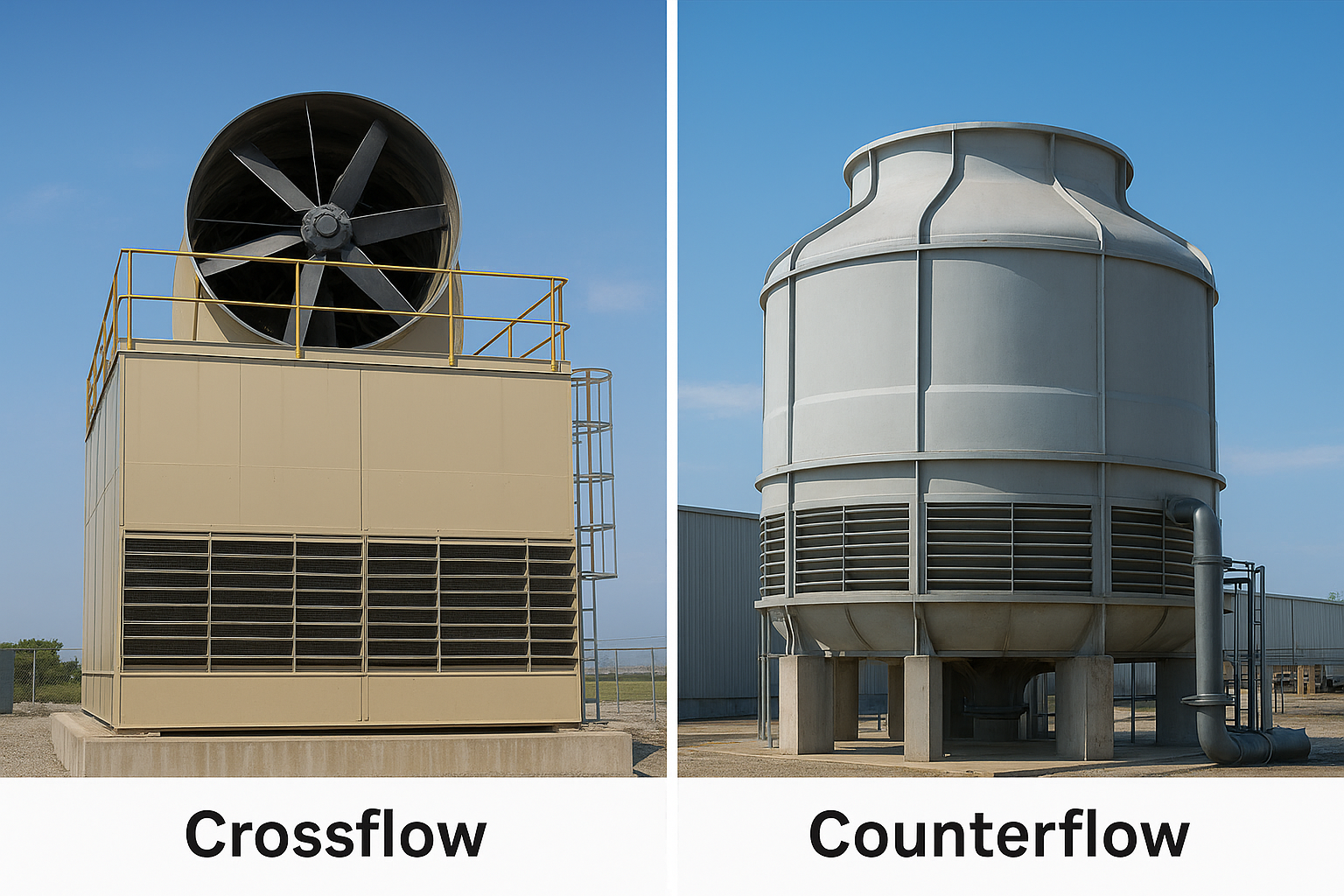
The tower design you choose upfront determines how easily you can inspect, clean, and maintain it for the next twenty years.
| Tower Type | Airflow Method | Best Fit |
|---|---|---|
| Mechanical draft | Fan-driven | Most commercial/industrial sites |
| Natural draft | Convection-driven | Large power plants |
| Crossflow | Horizontal air, vertical water | Easier maintenance access |
| Counterflow | Air against water flow | Higher thermal efficiency |
Open vs. closed circuit systems
Open circuit towers expose water directly to air, which is common but increases exposure to contaminants and scale-forming minerals. Closed circuit towers keep process water sealed in coils, using a separate spray water circuit for cooling, reducing contamination risk but adding equipment cost. Choosing between them often comes down to water quality goals versus budget constraints.
Common uses and industries that rely on cooling towers
Almost every industry that runs large-scale equipment ends up needing a cooling tower somewhere in the process. Commercial office buildings and hospitals use them to support central chiller plants that keep occupants comfortable and sensitive equipment within safe temperature ranges. Data centers depend on them even more heavily, since server racks generate constant heat loads that would overwhelm standard HVAC systems without dedicated heat rejection capacity working around the clock.
Industrial and manufacturing applications
Manufacturing plants use cooling towers to protect machinery that would otherwise overheat during continuous production runs. Power plants rely on massive natural draft towers to cool steam turbine condensers, a use case where even small efficiency losses translate into significant fuel and output penalties. Chemical processing facilities and refineries use towers to manage reaction temperatures, since overheating in these environments isn't just costly, it's a serious safety hazard.
Whatever the industry, the same rule applies: the equipment only performs as well as the cooling tower supporting it.
Where facility teams see the biggest impact
Here's a quick look at how different sectors depend on cooling tower performance:
| Industry/Facility | Primary Equipment Cooled | Why It Matters |
|---|---|---|
| Hospitals | Central chillers, air handlers | Patient safety, infection control |
| Data centers | Server racks, CRAC units | Uptime, equipment protection |
| Manufacturing plants | Process machinery | Production continuity |
| Power plants | Steam turbine condensers | Output efficiency |
| Commercial buildings | HVAC chiller plants | Occupant comfort, energy costs |
Property managers and government facility operators often oversee several of these use cases at once, especially in mixed-use complexes or campus settings. Regardless of the industry, the underlying need stays the same: reject heat consistently, protect the connected equipment, and avoid the scale and biofilm buildup that eventually turns a high-performing tower into a maintenance liability.
Cooling tower maintenance and common problems
Every cooling tower eventually runs into the same set of problems: scale, biofilm, and corrosion working together to choke off heat transfer. Hard water minerals like calcium and magnesium precipitate out as water evaporates, coating fill surfaces and basin walls with a hard, insulating layer. That layer doesn't just look bad, it directly blocks the heat exchange process the entire tower depends on, forcing chillers to work harder for the same cooling output.
Scale, biofilm, and corrosion in real operating conditions
Biofilm forms wherever warm, wet surfaces sit exposed to air, and cooling tower basins are almost perfect breeding grounds. Left untreated, this slime layer traps sediment, feeds bacteria including Legionella, and accelerates metal corrosion underneath it. Facility teams often notice the warning signs before they notice the cause: reduced airflow, rising discharge water temperature, or a musty smell near the basin.
Scale and biofilm rarely announce themselves loudly, they just quietly steal efficiency until the utility bill or a compliance inspection forces the issue.
Common problems worth tracking on a maintenance checklist include:
- Scale buildup on fill, nozzles, and heat exchanger surfaces
- Biofilm and algae growth in basins and low-flow zones
- Corrosion on metal components exposed to concentrated minerals
- Fan and motor wear from vibration or debris accumulation
- Water loss through drift, leaks, or excessive blowdown
Treating the system without introducing new hazards
Traditionally, plants reached for acid-based descalers to strip scale, but those products bring corrosion risk, fumes, and hazmat shipping restrictions into the picture. A non-corrosive, HMIS 0-0-0 rated cooling tower descaler removes mineral deposits without damaging metal components or requiring protective gear during application, which keeps maintenance teams safer and equipment intact over the long run.
Understanding cooling towers at a glance
A cooling tower does one job: pull heat out of a water loop and release it into the air so chillers, condensers, and process equipment don't overheat. You now know how the evaporative cycle works, why mechanical draft and counterflow designs dominate commercial sites, and why hospitals, data centers, and manufacturing plants all treat tower performance as equipment protection rather than routine cleaning. The pattern repeats everywhere: scale and biofilm build up quietly, efficiency drops, and costs climb before anyone notices.
The fix isn't complicated, but it does require the right approach. Acid-based descalers solve the scale problem while creating new ones, corrosion, fumes, and hazmat shipping headaches your maintenance team doesn't need. If you're responsible for keeping a tower running clean and compliant, look at a non-corrosive cooling tower descaler built for the job, not adapted from industrial acid stock.


