





Cooling Tower Water Treatment: Complete Guide to Scale Prevention, Cleaning & Descaling (2026)
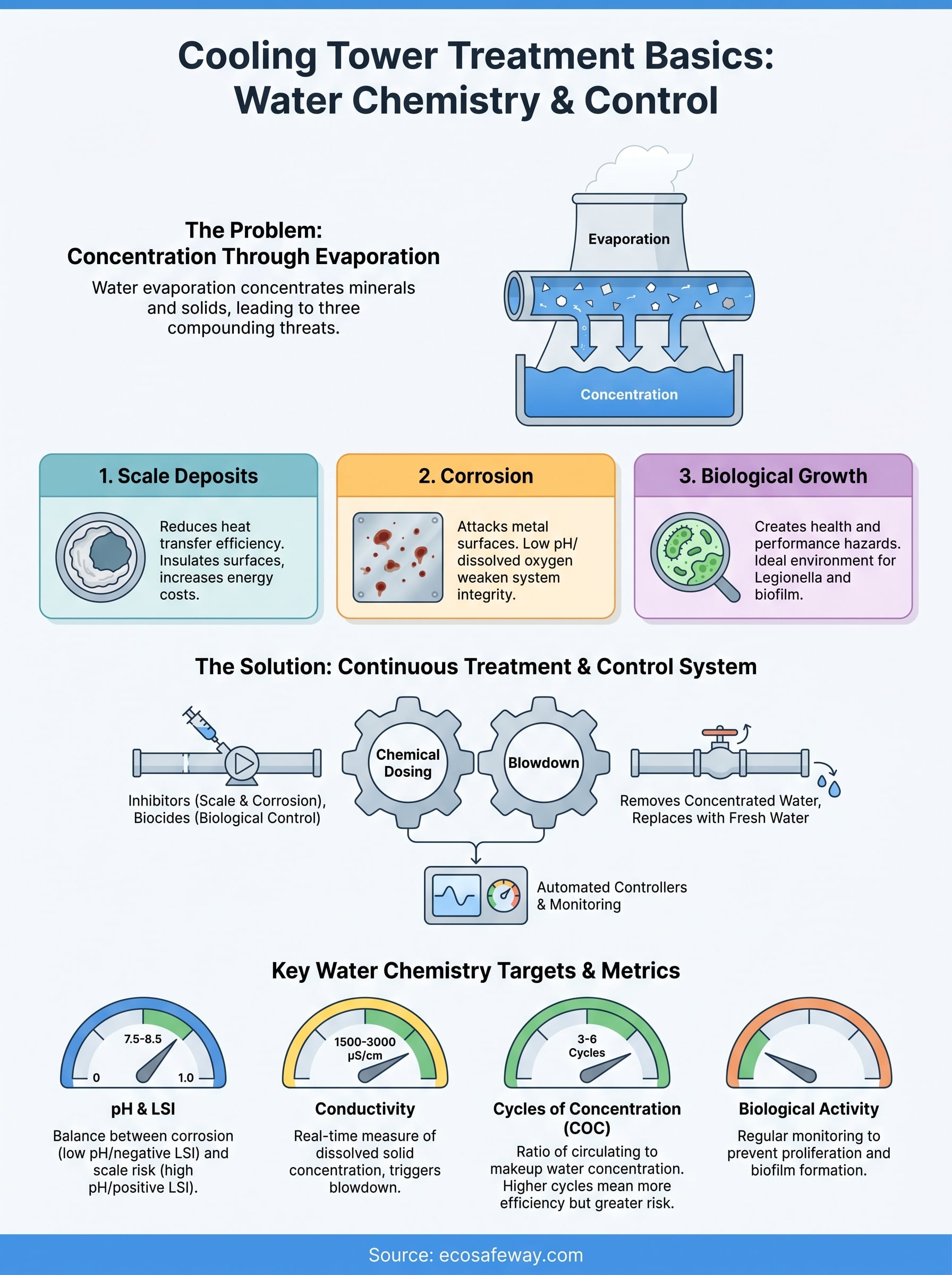
Cooling towers lose roughly 2–4% of their circulating water to evaporation every hour. As that water leaves, it concentrates everything it carried, minerals, dissolved solids, biological contaminants, into what remains. Without proper management, those concentrations climb fast, and the results are predictable: scale buildup, corrosion, and microbiological growth that choke system performance and shorten equipment life. Understanding cooling tower treatment basics is the first step toward preventing all three.
Whether you manage a commercial HVAC system, a data center, or an industrial process loop, water treatment isn't optional, it's the difference between reliable operation and expensive emergency repairs. The chemistry isn't complicated once you see how the pieces fit together, but ignoring it leads to fouled heat exchangers, pitted metal surfaces, and potential health hazards like Legionella.
This guide breaks down the core principles of cooling tower water treatment: what's actually happening in your water, how scaling and corrosion develop, what biological risks exist, and how to control them. At Eco Safeway, we manufacture non-toxic, biodegradable descalers and cleaners built specifically for cooling tower and HVAC applications, formulated to deliver professional-grade results with an HMIS 0-0-0 safety rating and no hazmat shipping headaches. That perspective shapes how we approach this topic: effective treatment shouldn't require trading performance for safety.
Why cooling tower water needs treatment
Cooling towers work by evaporating a small portion of water to cool the rest. That process is efficient, but it creates a concentration problem that compounds every hour the system runs. Minerals that entered with the makeup water stay behind when water evaporates, and over time those concentrations reach levels that actively damage your system. Cooling tower treatment basics exist specifically to address three compounding threats: scale, corrosion, and biological growth.
Scale deposits reduce heat transfer efficiency
When calcium and magnesium concentrations rise in circulating water, they precipitate out as hard mineral deposits on heat exchanger surfaces, inside fill media, and along pipe walls. Scale acts as an insulator, and even a thin layer causes measurable performance loss. A quarter-inch layer of calcium carbonate scale can cut heat transfer efficiency by 20% or more, forcing equipment to run harder and driving up energy costs with no improvement in output.
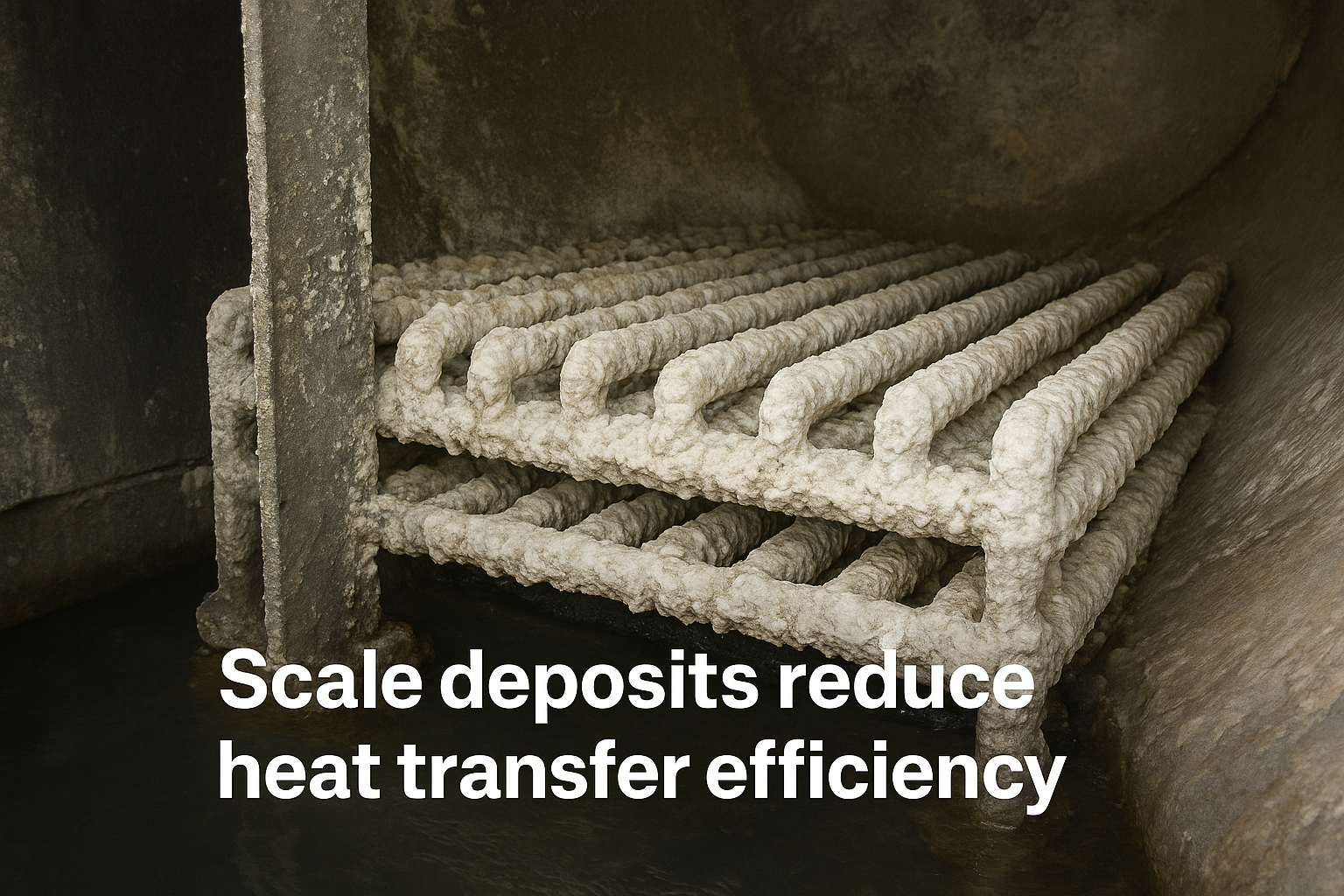
Scale doesn't just hurt efficiency; it traps corrosive ions and biological matter beneath its surface, accelerating both of the other threats simultaneously.
Corrosion attacks metal surfaces throughout the system
Low pH and dissolved oxygen create aggressive corrosion conditions inside the tower basin, heat exchangers, and piping. Corrosion generates metal ions that further destabilize water chemistry and cause pitting, which weakens structural integrity over time. Without corrosion inhibitors and consistent pH control, you can expect accelerated component failure regardless of how recently the equipment was installed.
Biological growth creates health and performance hazards
Warm, oxygen-rich water in a cooling tower is an ideal environment for bacterial proliferation, including Legionella pneumophila, the organism responsible for Legionnaires' disease. Biofilm forms on internal surfaces, reduces heat transfer, and shields bacteria from disinfectants. Controlling biological growth protects not just your equipment but also worker and public health, which is a compliance obligation under ASHRAE 188 and OSHA guidelines.
How cooling tower water treatment works
Cooling tower water treatment is a continuous control process that runs in parallel with system operation. You add treatment chemicals to counteract scale, corrosion, and biological growth, while removing concentrated water through blowdown to prevent dissolved solids from accumulating beyond safe levels.
The treatment process is not a one-time fix; it's an ongoing cycle of monitoring, dosing, and controlled water removal that keeps chemistry within target ranges.
Chemical dosing and blowdown work as a system
Scale inhibitors, corrosion inhibitors, and biocides each target a different threat, but they all act on the same water. Chemical feed systems inject these compounds at programmed intervals or based on real-time conductivity readings. Automated controllers adjust dosing rates as water chemistry shifts, responding to changes in makeup water quality, system load, or seasonal conditions.
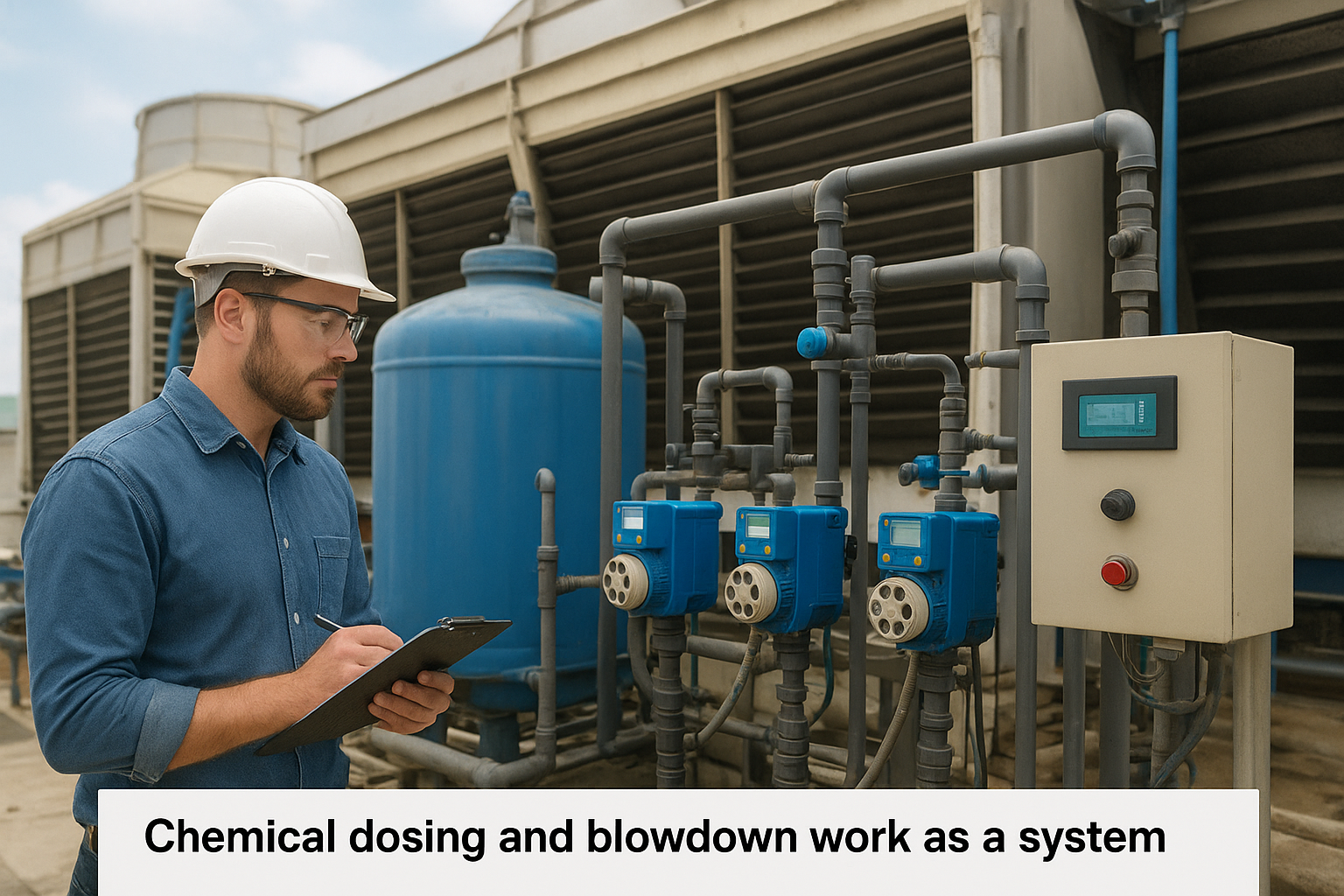
Understanding cooling tower treatment basics helps you see why blowdown matters as much as chemical dosing. When conductivity rises beyond your setpoint, the controller opens a blowdown valve, draining concentrated water and replacing it with fresh makeup water. This dilution keeps mineral concentrations manageable and reduces the chemical load needed to maintain control across scale, corrosion, and biological threats simultaneously.
Key water chemistry targets and setpoints
Running a cooling tower without defined setpoints means you have no way to confirm your treatment program is holding. You need specific numerical targets for each parameter you're monitoring, and you need to know what those numbers actually represent. Most programs track pH, conductivity, alkalinity, calcium hardness, and Langelier Saturation Index (LSI) as the core variables that predict scale risk and corrosion tendency.
Core parameters and target ranges
pH control sits at the foundation of every treatment program. Most cooling towers target circulating water pH between 7.5 and 8.5, which balances corrosion risk on the low end against scale precipitation on the high end. The Langelier Saturation Index builds on pH by factoring in calcium hardness, alkalinity, total dissolved solids, and temperature to predict whether your water will deposit scale or actively corrode metal surfaces.
An LSI near zero means your water is balanced; positive values indicate scaling tendency, and negative values signal corrosion risk.
Conductivity is the fastest real-time signal you have for system health, measuring how concentrated dissolved solids have become in your circulating water. Most systems maintain conductivity between 1,500 and 3,000 microsiemens per centimeter, depending on makeup water quality. Tracking calcium hardness alongside conductivity keeps cooling tower treatment basics working in your favor by confirming your blowdown program is holding scale-forming ions below the precipitation threshold.
Common treatment methods and equipment
Putting cooling tower treatment basics into practice requires both the right chemicals and the right delivery equipment. Chemical selection alone doesn't protect a system; you also need reliable dosing hardware, filtration, and physical controls that keep treatment consistent even when conditions shift.
Chemical feed systems
Automated chemical feed controllers monitor conductivity in real time and trigger dosing pumps when readings drift outside your target range. These systems inject scale inhibitors, corrosion inhibitors, and oxidizing or non-oxidizing biocides through separate injection points, keeping each chemical at effective concentrations without manual guesswork.
Consistent automated dosing outperforms manual addition in every measurable way, reducing both chemical waste and treatment gaps.
Filtration and physical treatment
A side-stream filtration unit pulls a continuous portion of circulating water through a sand or cartridge filter, removing suspended solids and debris that would otherwise accumulate in the basin and support biofilm growth. Filtration reduces the biological load your biocide must handle and keeps heat transfer surfaces cleaner between scheduled maintenance cycles.
Physical controls like drift eliminators and proper basin design reduce water loss and limit the airborne release of contaminated droplets. Combining effective filtration with well-maintained physical components extends chemical treatment intervals and lowers your overall operating costs.
Monitoring, blowdown, and cycles of concentration
Consistent monitoring ties every part of cooling tower treatment basics together. Without regular readings on conductivity, pH, and biological activity, you're dosing chemicals without confirming whether those chemicals are actually working. Most facilities check these parameters at least weekly, with automated controllers providing continuous conductivity tracking in between manual readings.
Cycles of concentration explained
Cycles of concentration (COC) measure how much more concentrated your circulating water has become relative to your makeup water. If your makeup water contains a calcium hardness of 100 ppm and your circulating water reads 300 ppm, you're running at three cycles of concentration. Most systems target between three and six cycles, balancing water conservation against the scaling and corrosion risk that rises with higher mineral concentrations.
Running too few cycles wastes makeup water and treatment chemicals; running too many lets dissolved solids climb past the threshold your treatment program can handle.
Blowdown keeps cycles in check
Blowdown removes a controlled volume of concentrated circulating water and replaces it with fresh makeup water, which directly lowers your cycles of concentration. Your controller triggers blowdown automatically when conductivity hits your preset setpoint, keeping dissolved solids within the range your chemical treatment program was designed to manage effectively.
Practical next steps
You now have a working understanding of cooling tower treatment basics: how evaporation concentrates dissolved solids, why scale, corrosion, and biological growth develop, and how chemical dosing combined with controlled blowdown keeps your system running within safe parameters. The next move is applying that knowledge to your specific system.
Start by documenting your current water chemistry readings against the target ranges covered in this guide. If your pH, LSI, or conductivity numbers are outside those ranges, your treatment program needs adjustment before small problems compound into expensive repairs. Check whether your chemical products are actually equipment-safe and environmentally compliant, not just labeled green. Many conventional descalers rely on harsh acids that damage metal components over time and create hazardous waste disposal challenges.
If your cooling tower needs a descaler that delivers professional-grade performance without corrosive chemistry, the Industrial HVAC & Cooling Tower Descaler from Eco Safeway is non-toxic, biodegradable, and HMIS 0-0-0 rated.


