





The fastest route to scale removal is to identify the deposit, choose a remover that suits the material underneath, test it on a hidden spot, apply it as the label directs, and rinse thoroughly. Light limescale on household items usually gives way to vinegar or citric acid. Equipment, heat exchangers and steel need more care, because the wrong chemical can corrode the part you are trying to save.
The trouble is that "scale" covers several different problems. White crust in a kettle is calcium carbonate. Blue-gray flakes on a steel bar are mill scale, an iron oxide formed during hot rolling. People often treat one like the other. They reach for a grinder when a descaler would do, or pour strong acid on equipment that cannot take it. Either mistake costs time and money.
Eco Safeway supplies non-toxic descaling products for commercial, industrial and marine equipment, and this guide draws on that experience. First you will learn to tell the scales apart. Then four steps take you from choosing a method to keeping the deposit from coming back. Throughout, follow the equipment manufacturer's instructions, the product label and the safety data sheet (SDS).
Identify the scale before you choose a fix
Scale is a hard mineral or oxide layer, and its type decides the removal method. Water-borne deposits dissolve in chemistry. Metal oxides on steel usually need abrasion or a dedicated pickling step.
Mineral scale from water
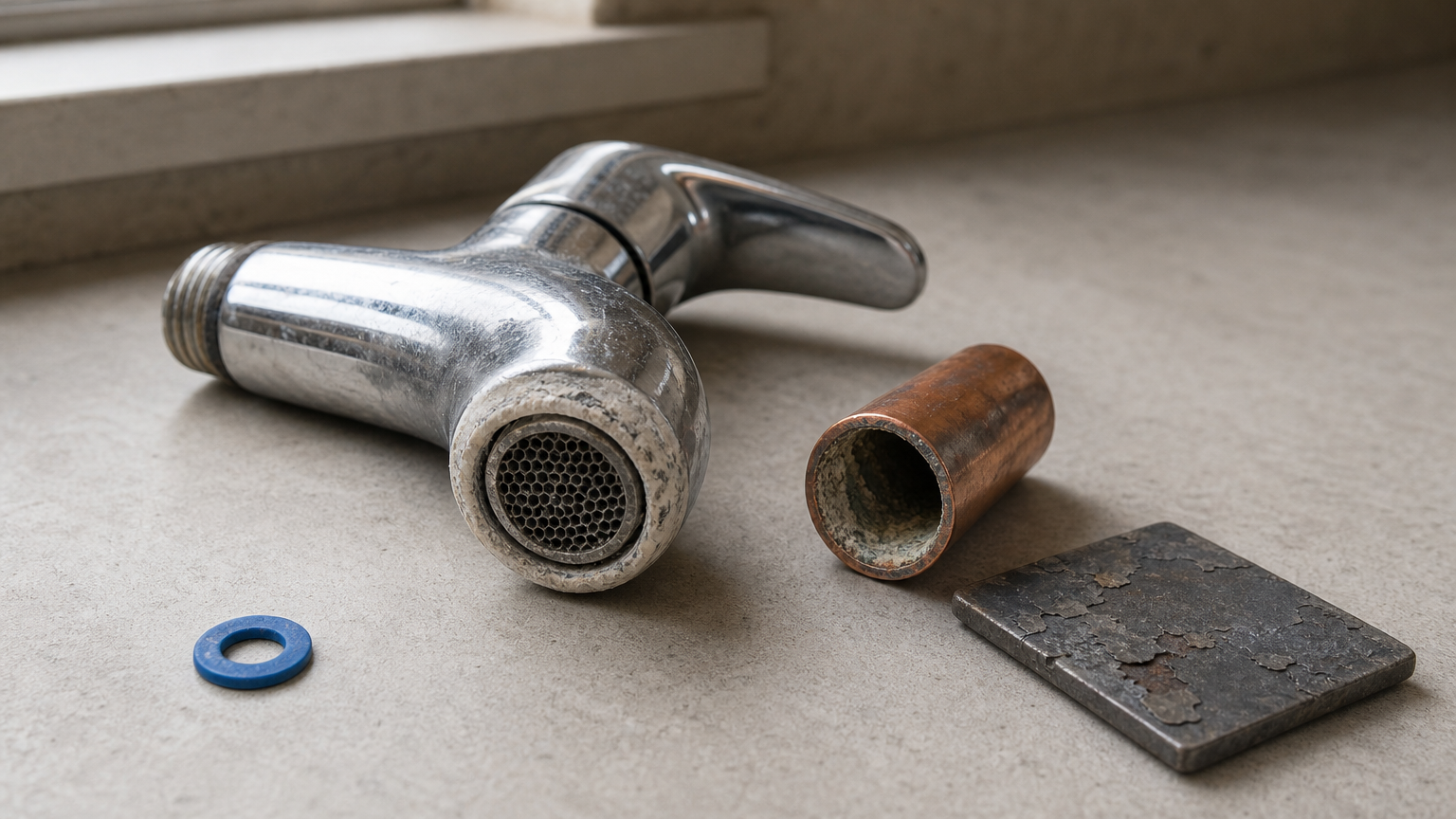
Limescale forms when hard water evaporates or heats up and leaves calcium and magnesium minerals behind. You see it as a chalky white or tan crust on faucets, ice machines, boilers, cooling towers and coils. In marine raw-water systems, salt and marine buildup often join the mineral layer and restrict flow through small passages.
Mill scale and oxide on steel
Mill scale is the dark, flaky oxide layer on hot-rolled steel. Forged steel develops a similar black oxide when you heat it. Acids that dissolve limescale do little to this layer, so a descaler is usually the wrong tool for it.
Quick identification table
| Type | What it looks like | Where it shows up | Usual approach |
|---|---|---|---|
| Hard water film | Cloudy white spots | Glass, shower doors, fixtures | Vinegar or citric acid wipe |
| Limescale | Chalky crust | Kettles, ice machines, coils | Descaler suited to the material |
| Raw-water scale | Mineral, salt and marine buildup | Engine cooling, heat exchangers | Circulated marine descaler |
| Mill scale | Blue-gray flaky oxide | Hot-rolled steel | Grinding, blasting or pickling |
| Forge scale | Black oxide | Heated or forged steel | Wire brush or wire wheel |
Name the deposit first, because the right scale removal method for limescale is the wrong one for mill scale.
Step 1. Choose a remover that suits the material
Pick the mildest chemistry that dissolves your deposit and that your material tolerates. Strength matters less than compatibility.
Acid, chelating and non-acid descalers
Vinegar (acetic acid) and citric acid are the usual answers when someone asks what dissolves limescale. They work on light deposits at home. Commercial products often use stronger acids such as sulfamic or phosphoric, and those work faster. Strong mineral acids can also attack metals, gaskets and masonry. Non-acid, organic-based formulas aim for a similar result with lower corrosion risk. Eco Safeway's descalers are non-corrosive, biodegradable formulas.
Match chemistry to the material
| Surface or equipment | Avoid | Better choice |
|---|---|---|
| Marble, travertine, natural stone | Vinegar and other acids | A stone-specific cleaner |
| Nickel-plated ice machine parts | Aggressive acid descalers | A nickel-safe descaler, such as the Nickel-Safe Ice Machine Cleaner |
| Cooling towers, chillers, heat exchangers | Corrosive acids on steel and rubber | A non-corrosive, CIP-compatible descaler such as the Cooling Tower Descaler |
| Marine raw-water systems | Unverified household acids | A marine descaler like the Raw Water Flush |
| Evaporative cooler pads and basins | Harsh mineral acids | A non-acid evaporative cooler cleaner |
| Rust and calcium on steel or masonry | Bare scraping | An industrial rust, calcium and lime remover |
| Mill scale on steel | Descalers | Mechanical removal or pickling |
If you cannot confirm that a remover is compatible with your material, do not use it until you can.
Step 2. Prepare the surface and test first
Preparation prevents most scale removal damage. Isolate the equipment, read the documents, and test on a hidden area before you treat the whole surface.
Read the label, SDS and manual
The label and SDS give the dilution, contact time and protective equipment for your specific product. Those numbers vary by product, so use the figures printed there and nothing you read elsewhere. Your equipment manual says which cleaners and materials the maker approves. Where the two conflict, the equipment manufacturer's instructions win.
Prepare and spot test
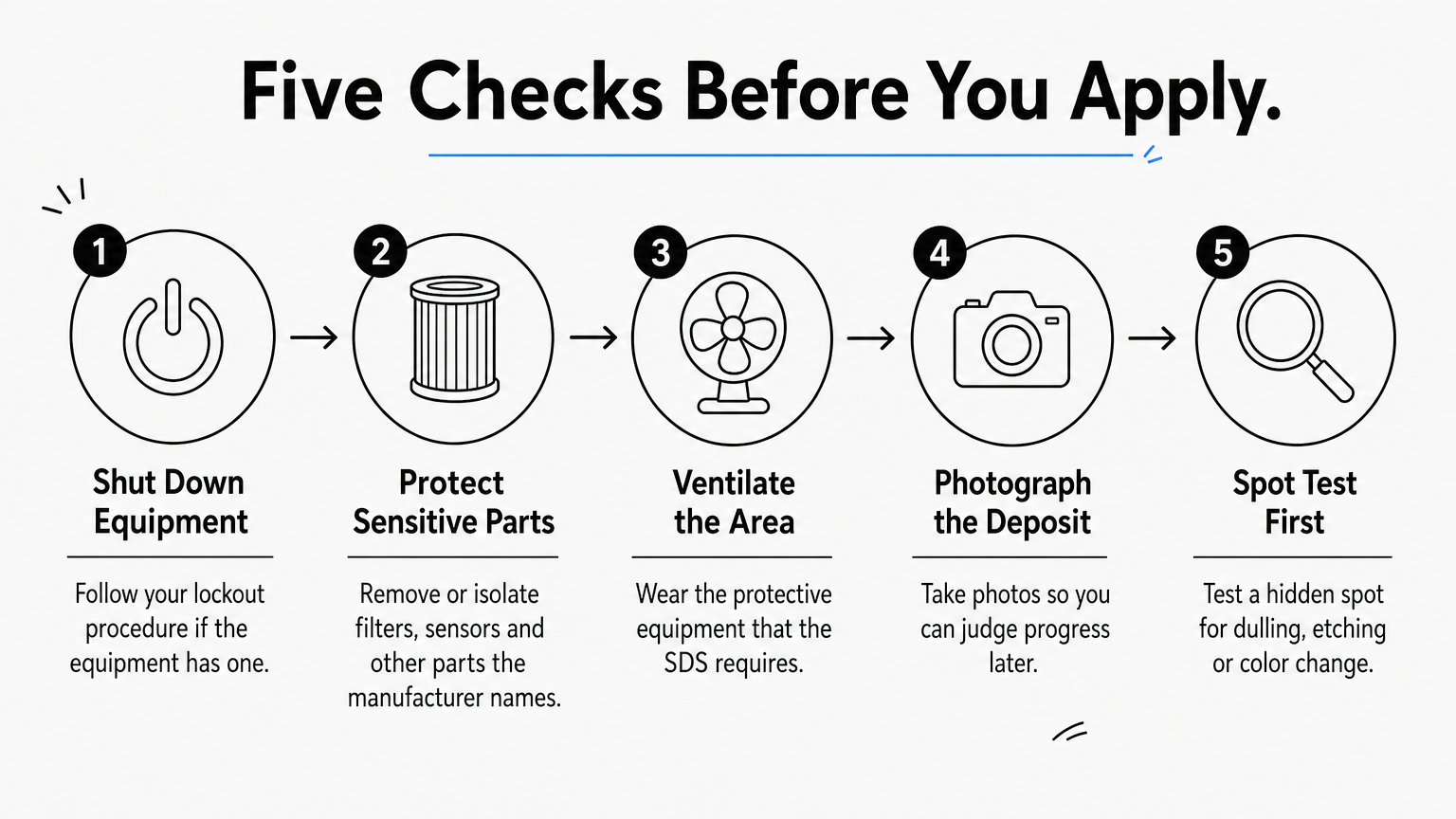
Work through this short list before you apply anything:
- Shut down the equipment and follow your lockout procedure if it has one.
- Remove or isolate parts the manufacturer says to protect, such as filters or sensors.
- Ventilate the area and wear what the SDS requires.
- Photograph the deposit so you can judge progress.
- Test the remover on a small hidden spot and look for dulling, etching or color change.
A thirty-second spot test is cheaper than replacing a damaged part.
Step 3. Apply the remover and loosen the deposit
Apply the remover to the deposit, give it the time the label specifies, then agitate or flush. Repeat the treatment if needed instead of leaving it on longer.
Light deposits at home
For hard water spots, wipe or soak the part in vinegar until the film softens, then rinse. A showerhead can soak overnight in a bag of white vinegar held on with a rubber band. A lemon works on faucets in the same way. Never use vinegar on natural stone, and never mix it with bleach.
Equipment, coils and heat exchangers
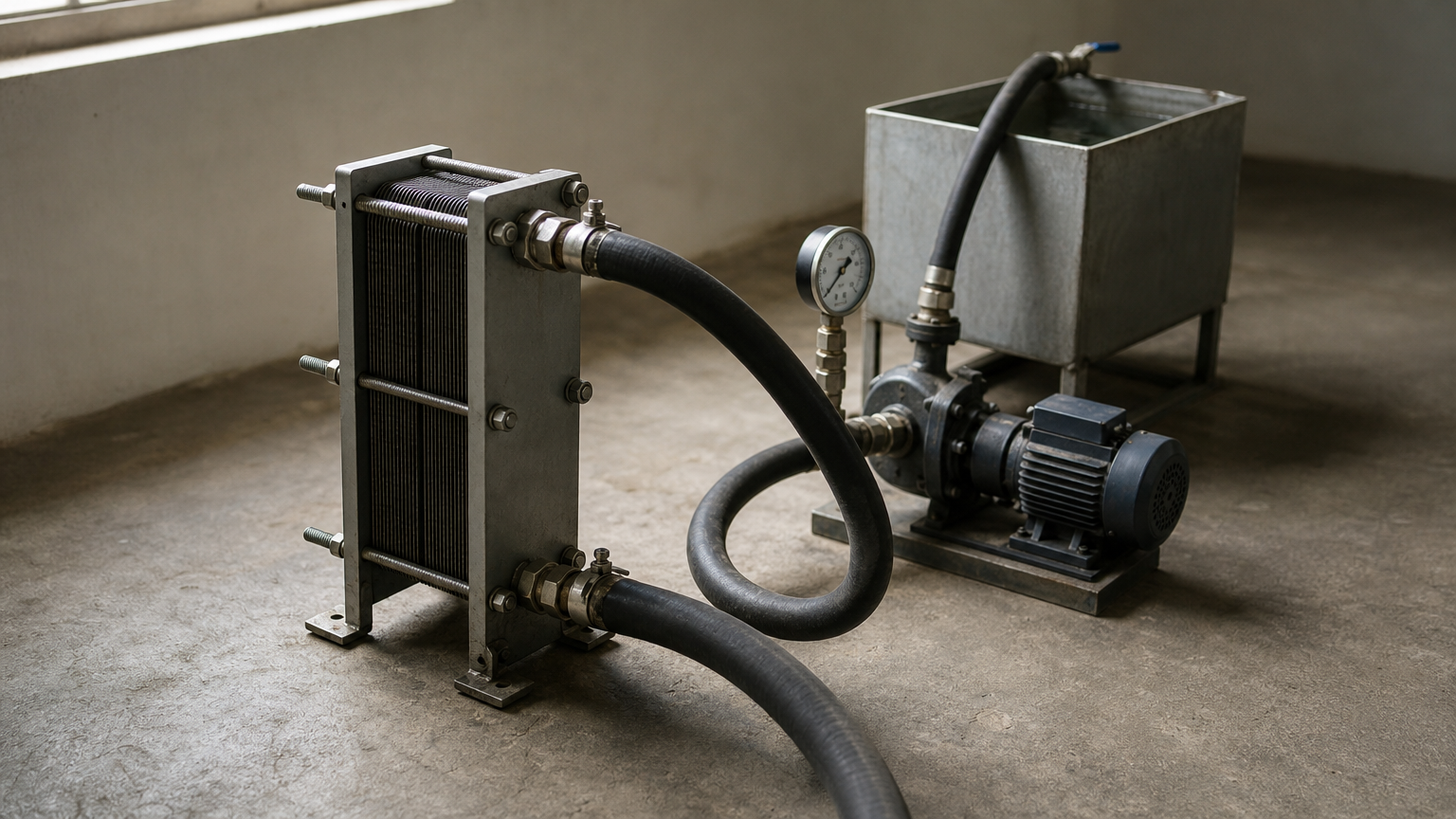
Scaled equipment is usually treated by circulating or soaking the descaler through the system, or spraying it on exposed surfaces. Clean-in-place compatibility lets you do this without disassembly. After treatment, check flow rates, pad condition or heat transfer against your baseline photos and readings. If deposits remain, repeat the treatment as the label allows and consider whether the system needs mechanical help on stubborn areas.
Mill scale on steel
For mill scale, use mechanical removal. An angle grinder with a flap disc or wire wheel works for small jobs, and abrasive blasting suits large surfaces. Phosphoric-acid pickling products can work on small pieces. Bare steel flash-rusts quickly, so prime, paint or oil it soon after cleaning.
Chemistry dissolves mineral scale, but abrasion or pickling removes mill scale.
Step 4. Rinse, verify and stop scale from returning
Rinse every surface with clean water until no residue remains, then confirm the deposit is gone. Leftover remover can keep working or leave a film.
Rinse and verify
Flush the system or rinse the surface fully, then compare it with your before photos. Check for flow restored, pads that wet evenly and a clean metal surface. For food-contact equipment such as ice machines, follow the manufacturer's rinse and sanitizing instructions before returning it to service. Dispose of used solution as local rules and the SDS direct.
Prevent the next buildup
Scale returns when the water stays the same. Test your hardness first. The USGS classes water as soft up to 60 mg/L, moderate at 61 to 120, hard at 121 to 180 and very hard above 180 (USGS water hardness). Water that tests at 150 mg/L is hard and will scale heaters and ice machines on a regular schedule.
Prevention then follows from the result:
- Install softening or filtration where hardness is moderate or higher.
- Descale equipment on a fixed schedule instead of waiting for a failure.
- Follow your water treatment program on cooling towers.
- Wipe fixtures dry after use.
Descaling treats the symptom, and water treatment removes the cause.
Match the fix to the deposit
Good scale removal comes down to three decisions: what the deposit is, what it sits on, and how you will stop it returning. Light limescale yields to mild acids, mineral scale in equipment needs a compatible descaler, and mill scale needs abrasion or pickling. Test first, follow the label and SDS, and rinse well.
If you maintain cooling towers, chillers or HVAC systems, the Industrial HVAC and cooling tower descaler is a non-toxic, biodegradable place to start. Check its page for compatibility and sizes before you order.


