





You've got scale buildup in a cooling tower, condenser coil, or raw water cooling system, and someone on your team wants to reach for muriatic or phosphoric acid. Before you do, it's worth understanding what that choice actually costs you. The acid vs non-corrosive descaler debate isn't just chemistry trivia, it affects equipment lifespan, worker safety, and whether you're stuck with hazmat shipping and disposal headaches down the road.
Here's the short answer: acid descalers work fast but attack metal, rubber, and gaskets along with the scale, while non-corrosive descalers dissolve mineral deposits without degrading the equipment they're cleaning. If you're weighing effectiveness against long-term equipment protection, that difference matters more than raw cleaning speed.
In this article, we'll break down how each type actually removes scale, compare their safety profiles on copper, aluminum, stainless steel, and rubber components, and look at real-world performance on cooling towers, ice machines, condenser coils, and marine cooling systems. By the end, you'll know exactly which descaler fits your equipment and your risk tolerance.
Why the acid vs non-corrosive choice matters
Picking the wrong descaler doesn't just fail to clean, it can quietly wreck equipment worth thousands of dollars. A cooling tower coil or raw water pump that looks fine after an acid treatment can develop pinholes and leaks six months later, long after anyone remembers what product caused it. That delayed damage is exactly why the acid vs non-corrosive descaler decision deserves more thought than grabbing whatever's cheapest at the supply house. The stakes touch equipment lifespan, worker safety, and your facility's exposure to regulatory headaches.
What acid actually does to metal surfaces
Acid descalers work by dissolving mineral scale, but they don't stop there. Muriatic and phosphoric acids strip away the thin passivation layer that protects stainless steel and copper from oxidation, leaving bare metal exposed to future corrosion. Repeated use accelerates pitting corrosion, those tiny pockmarks that eventually become leak points in condenser tubes and heat exchangers. Rubber gaskets, hoses, and seals fare even worse, softening and cracking after just a few acid cleaning cycles.
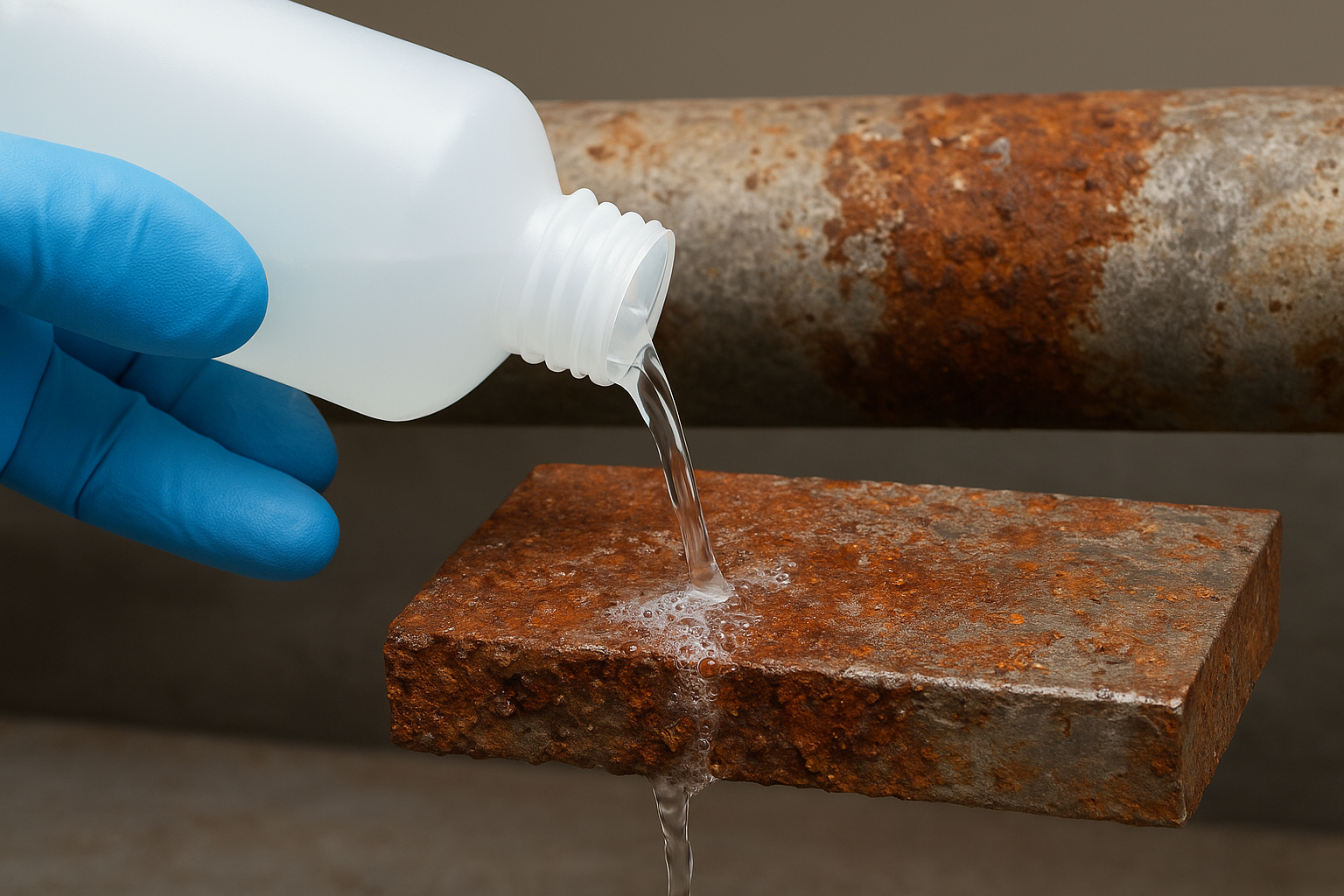
An acid descaler that removes scale in ten minutes can shave years off equipment life you won't notice until it fails.
Worker safety and compliance costs
Acid-based products also carry real handling burdens. Most require PPE requirements like face shields, acid-resistant gloves, and respirators, plus eyewash stations nearby in case of splashback. Many carry hazardous shipping classifications, meaning your hazmat shipping fees and paperwork pile up before the product even reaches your dock or facility. Disposal rules add another layer, since spent acid often can't just go down the drain without neutralization. Products with an HMIS 0-0-0 rating, like Eco Safeway's non-corrosive descalers, skip all of that. According to OSHA's hazard communication standards, employers must document and train workers on chemical risks like these, which adds ongoing compliance work that non-corrosive alternatives simply avoid (https://www.osha.gov/hazcom).
How to decide which descaler type to use
Matching the descaler to the equipment matters more than picking a brand you trust. Start by asking what the scale is sitting on, since metal composition and rubber components react very differently to acid exposure. A cast iron pump housing tolerates acid better than a copper condenser coil or a marine engine's aluminum block, so the same product that's fine in one system can ruin another.
Questions to ask before you choose
Run through this checklist before opening any drum:
- Does the system contain copper, aluminum, or stainless steel components with a passivation layer worth protecting?
- Are there rubber gaskets, hoses, or seals in the flow path?
- Will workers need PPE and eyewash access, or can you skip that setup entirely?
- Does the product need hazmat shipping and special disposal, or can it go down the drain safely?
- Is this a one-time deep clean or a recurring maintenance task?
If your answer to more than one of these raises a red flag, a non-corrosive descaler is the safer default.
When frequency changes the calculus
Frequency changes everything here. A single emergency descale on equipment you're about to replace might tolerate acid's risks. But recurring maintenance, the kind cooling towers, ice machines, and raw water systems need every season, compounds acid damage with every application. That's where non-corrosive descaler chemistry earns its keep, since it won't shorten equipment life the way repeated acid cycles do.
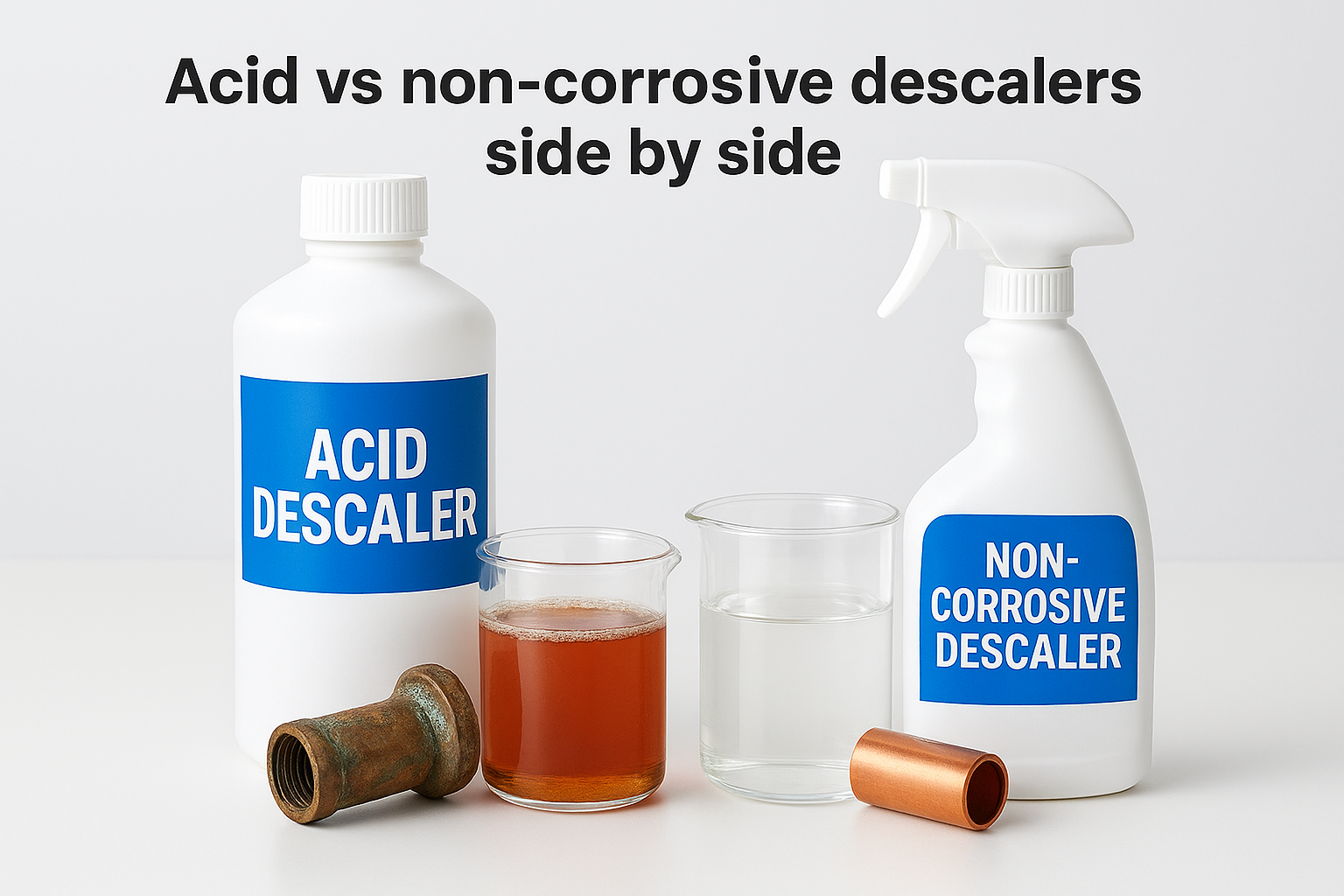
Acid vs non-corrosive descalers side by side
Seeing the numbers next to each other makes the choice easier than any sales pitch. Below is a side-by-side comparison built from how each descaler type actually performs on the materials and tasks facility teams deal with every week.
| Factor | Acid Descaler | Non-Corrosive Descaler |
|---|---|---|
| Speed on heavy scale | Fast, often minutes | Slower, may need longer dwell time |
| Effect on copper/aluminum | Strips passivation layer | Leaves surface intact |
| Effect on rubber gaskets/seals | Softens, cracks over repeated use | No degradation |
| PPE required | Gloves, face shield, respirator | Minimal, often none |
| Shipping classification | Frequently hazmat | Non-hazmat |
| Disposal | Neutralization often required | Drain-safe in most jurisdictions |
| Best for | One-time, non-critical metal | Recurring maintenance, mixed materials |
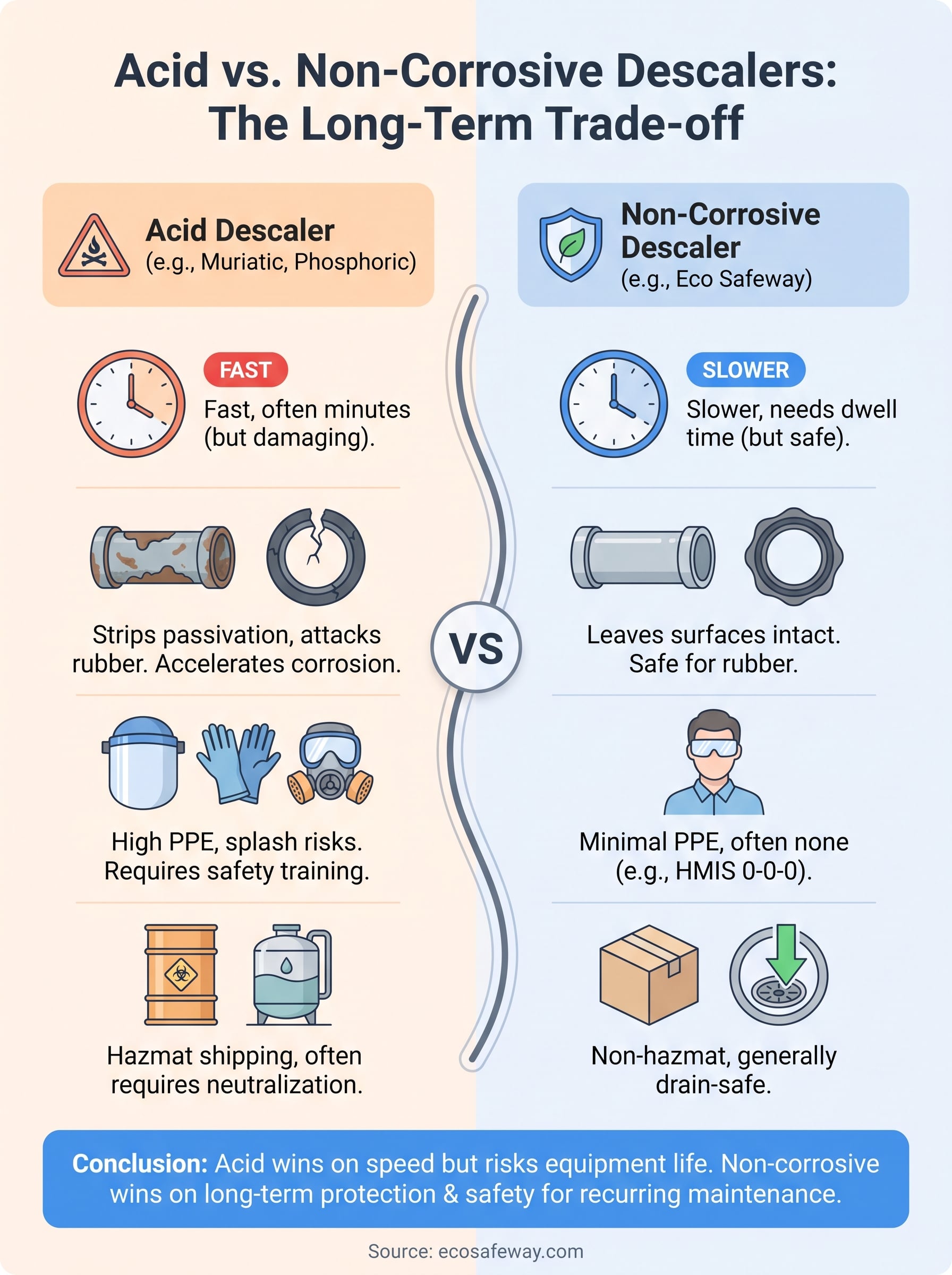
Taking this side-by-side view, you can see acid wins on raw speed but loses almost everywhere else that matters for long-term operations. Non-corrosive formulas need a bit more contact time, but they don't punish you later with pitting, gasket failure, or a hazmat invoice.
Speed that costs you equipment life isn't actually saving you time.
Understanding this acid vs non-corrosive tradeoff table helps you stop treating descaler choice as a commodity decision. Weighing effectiveness comparison data like this against your equipment's material makeup is the real work, and it's the difference between a descaler that cleans once and one that keeps your system running for years.
Best practices for safe, effective descaling
Whatever descaler you choose, technique determines whether you get a clean system or a damaged one. Rushing dwell time, skipping a pre-rinse, or mixing chemicals without checking compatibility causes more equipment failures than the descaler formula itself. Treat the process with the same care you'd give any maintenance task tied to equipment lifespan.
Prep and application steps
Follow this sequence regardless of which descaler type you're running:
- Flush the system with water first to remove loose debris and reduce scale load
- Check manufacturer specs for dwell time guidelines and never exceed them, even with non-corrosive products
- Isolate rubber gaskets and seals from acid contact whenever possible
- Monitor temperature, since heat accelerates both cleaning speed and corrosion risk
- Rinse thoroughly and verify pH before returning the system to service
A descaler only performs as well as the prep work and rinse cycle around it.
Match concentration to scale severity
Guessing at concentration wastes product and risks damage either way. Light scale rarely needs full-strength solution, while heavy buildup in a raw water strainer or condenser coil may call for a stronger mix or a second application cycle instead of forcing one aggressive pass. Verifying results with a simple acid test kit or visual inspection beats assuming the job's done after one rinse. Xylene and other solvent boosters sometimes get added to acid mixes for stubborn scale, but that only compounds the hazmat shipping and handling burden non-corrosive alternatives were built to avoid.
Finding the right fit for your system
The acid vs non-corrosive descaler decision comes down to what you value more: a fast one-time clean or equipment that lasts. Acid gets scale off quickly, but it also strips passivation layers, cracks gaskets, and saddles you with hazmat shipping and PPE requirements. Non-corrosive formulas take a bit more dwell time, yet they protect copper, aluminum, and rubber while skipping the compliance headaches entirely.
Given how often cooling towers, condenser coils, and raw water systems need descaling, the long-term math favors non-corrosive descaler chemistry for nearly every recurring maintenance task. Reserve acid for the rare situation where speed truly outweighs equipment risk.
If you're ready to protect your HVAC or marine cooling system without the corrosion tradeoff, check out Eco Safeway's Industrial HVAC & Cooling Tower Descaler for a non-toxic, HMIS 0-0-0 rated alternative that keeps your equipment running clean, season after season.


