





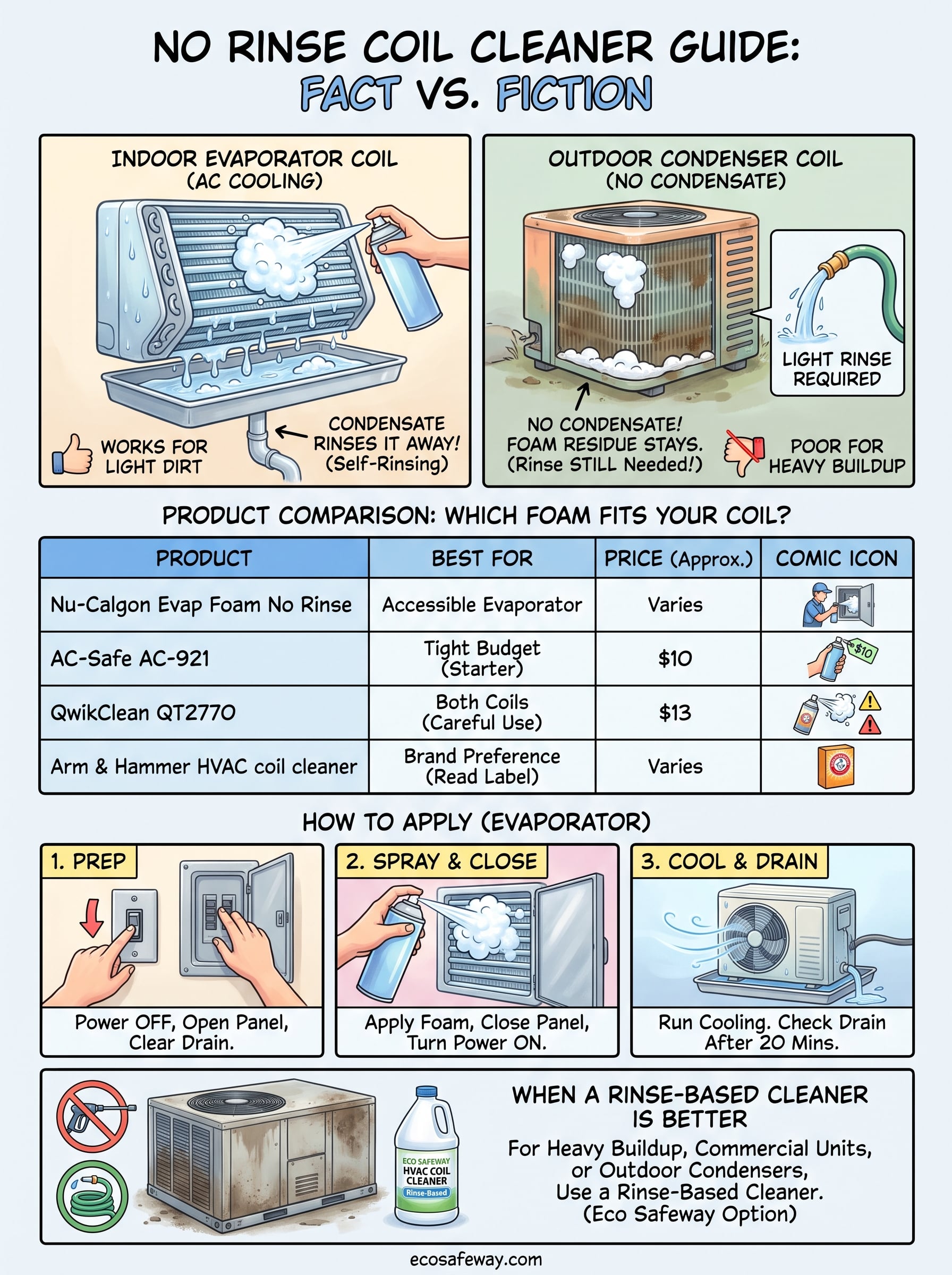
A no rinse coil cleaner for AC works well for one job: loosening light to moderate dust and film on an indoor evaporator coil. There, the condensate your system makes in cooling mode carries the foam out through the drain. It is a poor fit for heavy buildup and for outdoor condenser coils, which make no condensate and still need a rinse. Nu-Calgon Evap Foam No Rinse suits an accessible evaporator coil. AC-Safe AC-921 suits a tight budget. QwikClean QT2770 suits you if you want one can that its seller lists for both coils. Arm & Hammer suits you if you prefer a consumer brand and will read the label closely.
The trouble is that "no rinse" on a can rarely tells you where the claim holds. Spray an outdoor coil and nothing flushes the foam away. The residue can hold onto new dirt, and you end up cleaning twice. Before you buy, you need to know which coil you are cleaning and how dirty it is.
This guide explains where skipping the rinse is safe, then compares four foaming cleaners by use, price and what to check on the label. Eco Safeway supplies coil cleaners for commercial HVAC, so the last section also covers when a rinse-based cleaner is the better tool.
Do no rinse coil cleaners work and where do they fit?
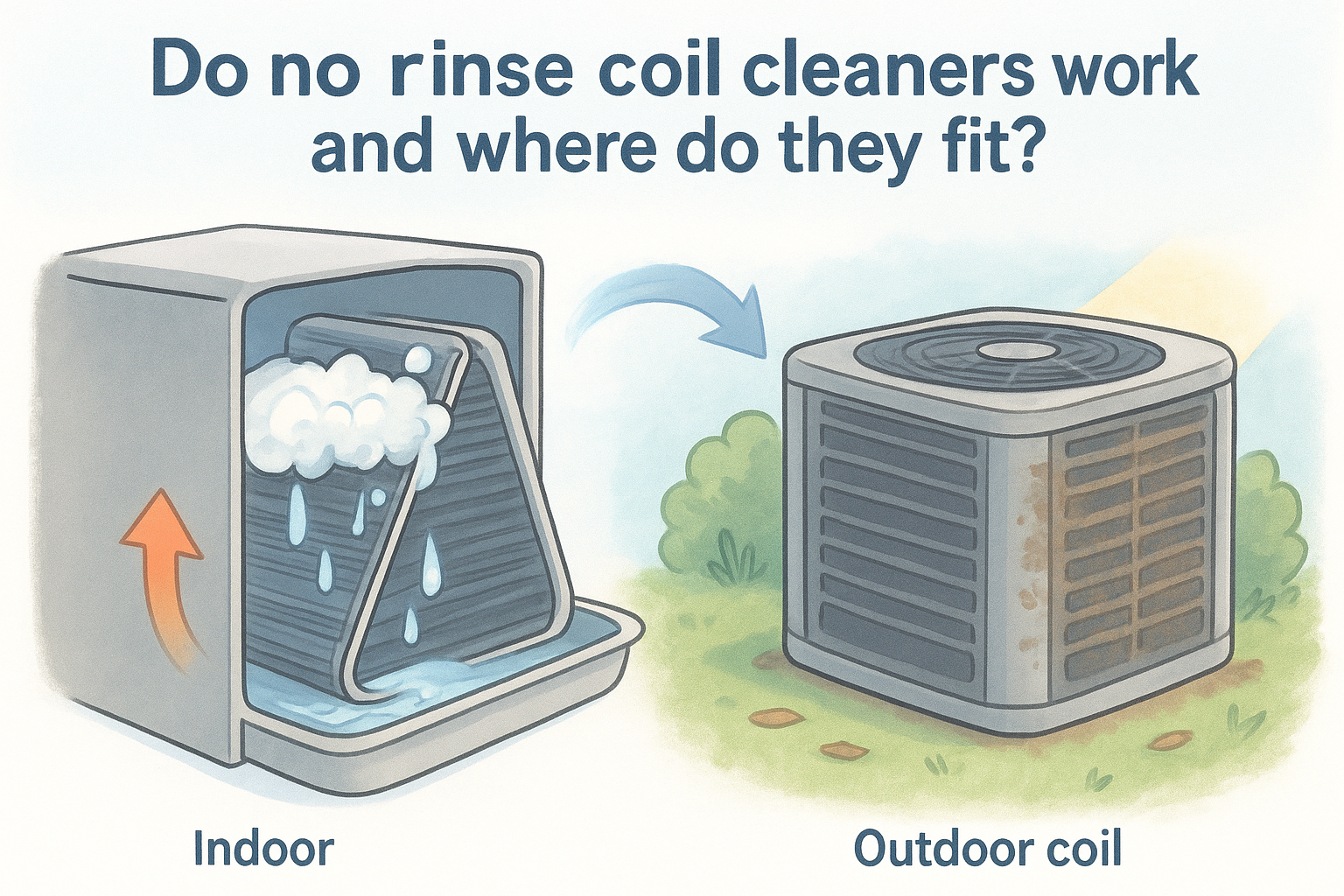
Yes, they work on indoor evaporator coils with light to moderate dirt. The foam breaks down grime, and condensate flushes it into the drain pan. They fall short on thick mats of pollen, cottonwood or pet hair, and on greasy film that needs mechanical removal. On outdoor condenser coils, nothing flushes the foam, so a rinse is still part of the job.
Why the foam rinses itself on an evaporator coil
An evaporator coil sweats whenever the system cools. That condensate runs down the fins into the drain pan, and the dissolved dirt goes with it. This is the whole principle behind "self-rinsing" foams, and it is why technicians on forums say the no rinse claim is only true on the evaporator.
The principle has limits. In dry weather, the coil makes less condensate, so run the system longer and check the pan afterward. If the drain line is partly clogged, the loosened dirt collects in the pan.
| Coil | Location | Does condensate flush the foam? | Rinse needed? |
|---|---|---|---|
| Evaporator | Indoors, in the air handler or furnace plenum | Yes, while cooling | Usually not, for light to moderate dirt |
| Condenser | Outdoor unit | No, it makes no condensate | Yes, a light low-pressure rinse |
| Heavily fouled coil of either type | Either | Partly | Yes, or a professional cleaning |
A no rinse foam only skips the rinse where the system supplies its own water.
Can you use a waterless condenser coil cleaner outdoors?
Not fully. A waterless condenser coil cleaner can handle light surface dust, but the loosened debris has to go somewhere. Some foams are sold for both coils. QwikClean, for example, is listed for evaporator and condenser coils. Even so, outdoor fins collect leaves, cottonwood and grass, and a cleaner cannot remove those.
For a mostly dry approach, brush the fins gently with a soft brush and vacuum off loose debris, with the power off. Straighten bent fins with a fin comb. If the coil is still grimy, apply foam, let it work, and finish with a gentle garden hose rinse. Never use a pressure washer, because it flattens the fins.
1. Nu-Calgon Evap Foam No Rinse
Nu-Calgon Evap Foam No Rinse is the most evaporator-specific pick here. It is the one to buy when your indoor coil is accessible and only moderately dirty.
How it works and where to use it
Nu-Calgon describes it as a fast-breaking, completely self-rinsing foam. You spray it on the coil, and the foam carries the emulsified dirt off. The name points to its target: this is an evaporator product, not an outdoor coil cleaner.
Apply it to an exposed indoor coil during cooling season, with the system running or about to run, so condensate forms. Confirm that the drain line flows before you spray. A blocked line turns the loosened dirt into a pan full of sludge.
Choose this foam when the coil is reachable and the drain line is clear.
Price and who it suits
Retail prices vary, so compare can sizes before you buy. It suits homeowners and technicians doing routine maintenance on a coil they can reach through an access panel.
- Check that the coil face is visible. If you cannot see it, you cannot confirm the foam reached it.
- Check the label for the coil metals it covers.
- Skip it for coils matted with debris, which need a pro.
2. AC-Safe Air Conditioner Foaming Coil Cleaner AC-921
AC-Safe AC-921 is the low-cost pick. It is a common first purchase for a homeowner who wants to try foam before spending more.
How it works and where to use it
The 19 oz can is a heavy-duty detergent foam that the maker says removes dirt, grease and oil. Home Depot lists a self-rinsing design and a 360-degree valve. That valve is meant to make application easier, which matters inside a cramped air handler where you cannot hold the can upright.
Treat it as an evaporator product. The self-rinsing logic depends on condensate, so on an outdoor coil you should expect to rinse. Apply it in cooling season and check the drain pan after.
AC-921 is a sensible low-cost starter for light evaporator maintenance.
Price and who it suits
Home Depot listed it at $9.98, and store prices can differ. That puts it at the low end of the roughly $5 to $20 range that foaming coil cans commonly sell for. It suits someone who wants a single maintenance cleaning for a lightly dirty coil.
- Check the can size against the coil: a larger A-coil may need more than one can.
- Read the label for safe metals and ventilation advice.
- Plan a pro visit if the coil is heavily soiled.
3. QwikClean QT2770 No-Rinse Foaming Coil Cleaner
QwikClean QT2770 is the pick if you want one aerosol that its sellers list for both evaporator and condenser coils. It is the strongest formula of the four, so it needs the most care.
How it works and where to use it
The seller calls it a self-rinsing, heavy-duty, industrial-strength aerosol. Another retailer lists it as a heavy-duty alkaline detergent that does not need rinsing off, and as suitable for evaporator and condenser coils.
On the evaporator, use it like the others and let condensate flush it. On the condenser, remove loose debris first, because foam alone will not lift it. Then finish with a light rinse if the label or the coil condition calls for one. Wear gloves and eye protection, and keep spray off wiring and electrical parts.
QwikClean is the one to try on both coils, but the outdoor coil still earns a rinse.
Price and who it suits
One retailer lists it at $12.55, and prices differ by seller. It suits technicians and confident DIYers who want a stronger foam and will read the label for compatible coil metals before spraying.
- Confirm the label covers your coil metals.
- Keep it off painted cabinets and electrical components.
- Avoid it if you want the gentlest option for a lightly dusty coil.
4. Arm & Hammer HVAC coil cleaner
Arm & Hammer's coil cleaner is the consumer-brand option. It is advertised as no rinse, and technician discussion online focuses on whether that claim holds.
How it works and where to use it
The advertised pitch is simple: spray it on, and no rinse is needed. Technicians in a Reddit HVAC discussion pointed out the catch. Cleaners that advertise no rinse only truly skip the rinse on the evaporator, where condensate does the work.
So read the claim as an evaporator-only promise. On an outdoor coil, plan for a light hose rinse regardless of the label.
Trust a no rinse claim on the evaporator and not on the condenser.
Price and who it suits
Size and price vary by retailer, so compare the listing against the other cans here before buying. It suits buyers who prefer a familiar brand for a light, occasional cleaning.
- Read the label for coil metals and the rinse instructions.
- Look at the can size, because it sets how many coils one can covers.
- Skip it for heavy buildup or mold, where foam is not enough.
How to compare, apply and choose when you must rinse
For a lightly dirty evaporator coil, any of the four foams does the job. Choose by price, can size and label details. For heavily fouled or commercial coils, choose a cleaner that you rinse off.
Side-by-side comparison
| Product | Form | Listed price | Coils per the sellers |
|---|---|---|---|
| Nu-Calgon Evap Foam No Rinse | Self-rinsing foam | Varies by retailer | Evaporator |
| AC-Safe AC-921 | 19 oz aerosol, 360-degree valve | $9.98 at Home Depot | Air conditioner coils, self-rinsing |
| QwikClean QT2770 | Alkaline aerosol foam | $12.55 at one retailer | Evaporator and condenser |
| Arm & Hammer HVAC coil cleaner | Advertised no rinse | Varies by retailer | Evaporator, per technician discussion |
How to apply foam to an evaporator coil in place
Cleaning in place is the easy route, because you never remove the coil. Here is the sequence:
- Switch off power at the breaker and the service switch.
- Open the access panel and look at the coil face and drain pan.
- Clear the drain line and vacuum loose dust with a soft brush.
- Spray the foam evenly from the top down, following the label.
- Close the panel, restore power and run the system in cooling mode.
- Check the drain pan and line after 15 to 20 minutes for dirty drainage.
If the coil ices up, or the system runs constantly without cooling, stop. Those are signs of a refrigerant or airflow problem, and a licensed technician should look at it.
When a commercial coil needs a rinse-based cleaner
Large condenser coils, rooftop units and heavily fouled coils call for a cleaner you apply and rinse. Eco Safeway's HVAC Coil Cleaner is made for commercial and industrial coils, from a 32 oz spray to drums and totes. Prices run $34.99 to $389.99 depending on size. Follow its label and safety sheet.
It ships by standard shipping, which needs no hazmat handling. For mineral scale and hard-water deposits, Eco Safeway has separate descaler products.
Use foam for light evaporator upkeep and a rinse-based cleaner for anything heavier.
Pick the foam that matches the coil
A no rinse coil cleaner is a maintenance tool, not a rescue. It earns its place on light evaporator dirt, where condensate removes the foam, and it needs a rinse on outdoor condenser coils. Nu-Calgon Evap Foam fits an accessible indoor coil, AC-Safe AC-921 fits a tight budget, QwikClean QT2770 covers both coils with care, and Arm & Hammer is a brand option to read closely.
If your coils are heavily fouled, commercial, or outdoors, plan on a rinse. Eco Safeway's commercial HVAC condenser coil cleaner is built for that kind of cleaning. Check its label and safety sheet, and call 561-405-0271 if you are unsure which size fits your equipment.


