






HVAC service is the professional maintenance, repair and installation of the heating, ventilation and air conditioning equipment in a home or building. It covers three jobs: scheduled tune-ups that keep equipment running, repairs that replace failed parts, and installations that put in a new system. To hire a good provider, confirm the license and insurance, collect at least three written quotes from local companies, and book maintenance twice a year, once before cooling season and once before heating season.
This guide explains why HVAC service matters, how to vet a contractor, what a visit includes and what it typically costs, and how often to book. It also shows you how to decide between repairing and replacing an aging system.
One note on who is writing. We supply professional-grade coil cleaners to commercial maintenance teams and HVAC contractors.
Why HVAC service matters for your home or building
HVAC service matters because heating and cooling equipment degrades slowly and then fails suddenly, and regular service catches the slow part. A technician who finds a weak capacitor or a dirty coil in April saves you a no-cool emergency in July.
Efficiency and breakdown prevention
Dirt on a coil acts like insulation. Dirty coils and clogged filters force the system to run longer to reach the temperature you set, which raises energy use and wear on the compressor and fan motors. Failures also cluster in the hottest and coldest weeks, when every company is booked and emergency rates apply.
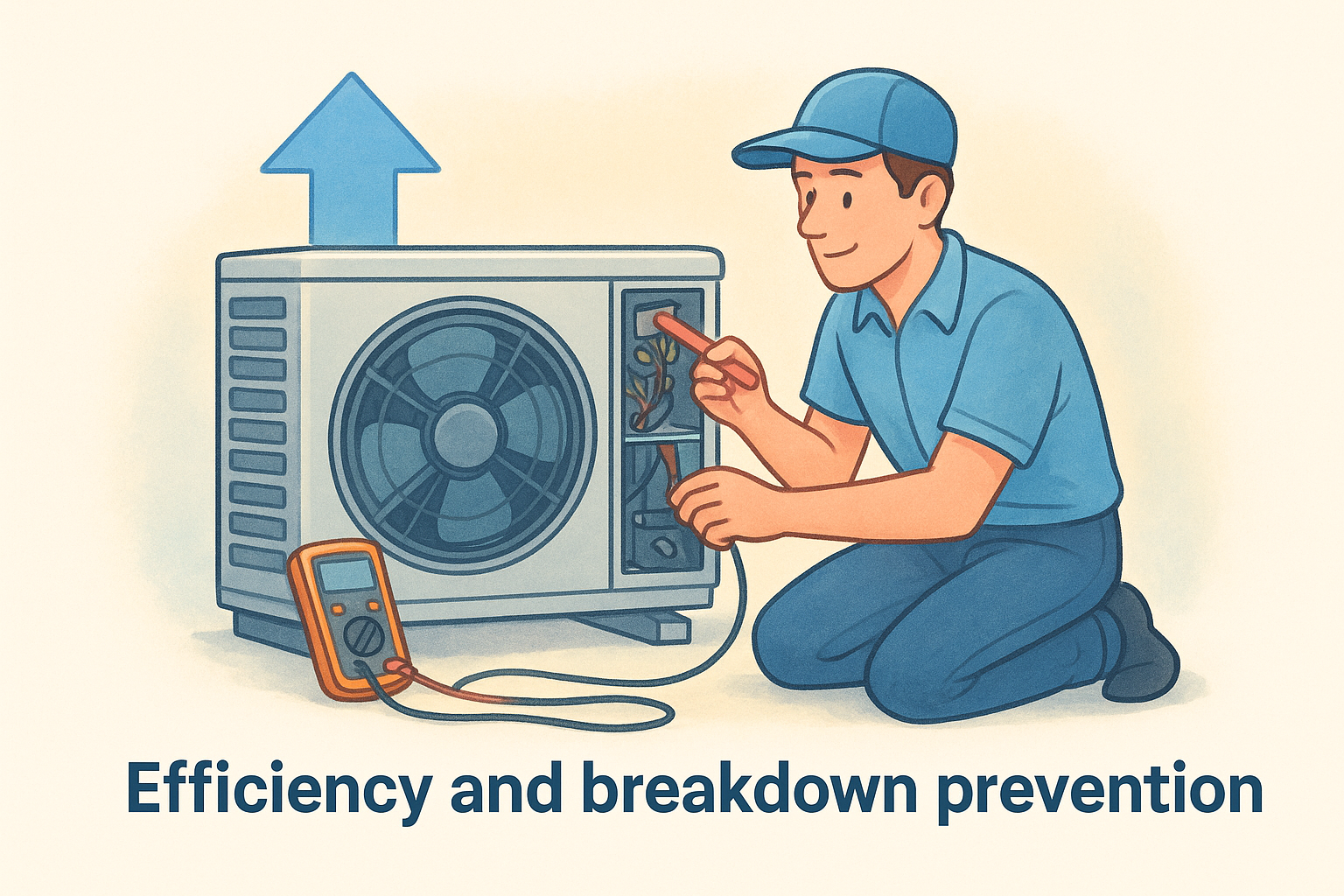
Maintenance changes that timing. Instead of an unplanned breakdown on the worst day of the year, you get a repair scheduled for a mild week, with parts on hand.
Safety and air quality
A gas furnace with a cracked heat exchanger can leak carbon monoxide into living space. A trained technician checks combustion, venting and the heat exchanger during a heating tune-up. Install carbon monoxide detectors regardless, because service reduces risk but does not replace an alarm.
Service also catches problems that cause damage quietly:
- Clogged condensate drains that overflow and stain ceilings
- Loose electrical connections that overheat
- Refrigerant leaks that leave the system low on charge
- Filters so loaded with dust that airflow drops
Regular service is cheaper than the emergency call it prevents.
How to hire a reputable HVAC company
To hire a reputable HVAC company, verify its license, insurance and refrigerant certification, then compare at least three written quotes. Reputation matters, but paperwork is what protects you if something goes wrong.
Check license, insurance and certification
Licensing rules differ by state and sometimes by city, so look up what your state requires and ask to see the contractor's license number. Ask for a certificate of liability insurance as well, and confirm the company carries workers' compensation. Anyone who handles refrigerant must hold EPA Section 608 certification, which you can read about on the EPA's Section 608 page. A technician who cannot name their certification is a reason to move on.
Compare quotes and ask the right questions
Get three written quotes for any repair or installation of real size. Each quote should name the equipment brand and model, the scope of work, the labor warranty and the total price. A quote that is a single number on a business card tells you nothing about what you are buying.
Ask these before you sign:
- Is the diagnostic fee credited toward the repair if I approve it?
- Who does the work, your employees or subcontractors?
- What does the labor warranty cover, and for how long?
- For a replacement, did you run a load calculation to size the unit?
Walk away from pressure to decide on the spot, a demand for full payment up front, or a "replace it now" verdict with no test readings to back it up.
A good contractor shows you the test readings, puts the price in writing and lets you take time to decide.
What an HVAC service visit includes and costs
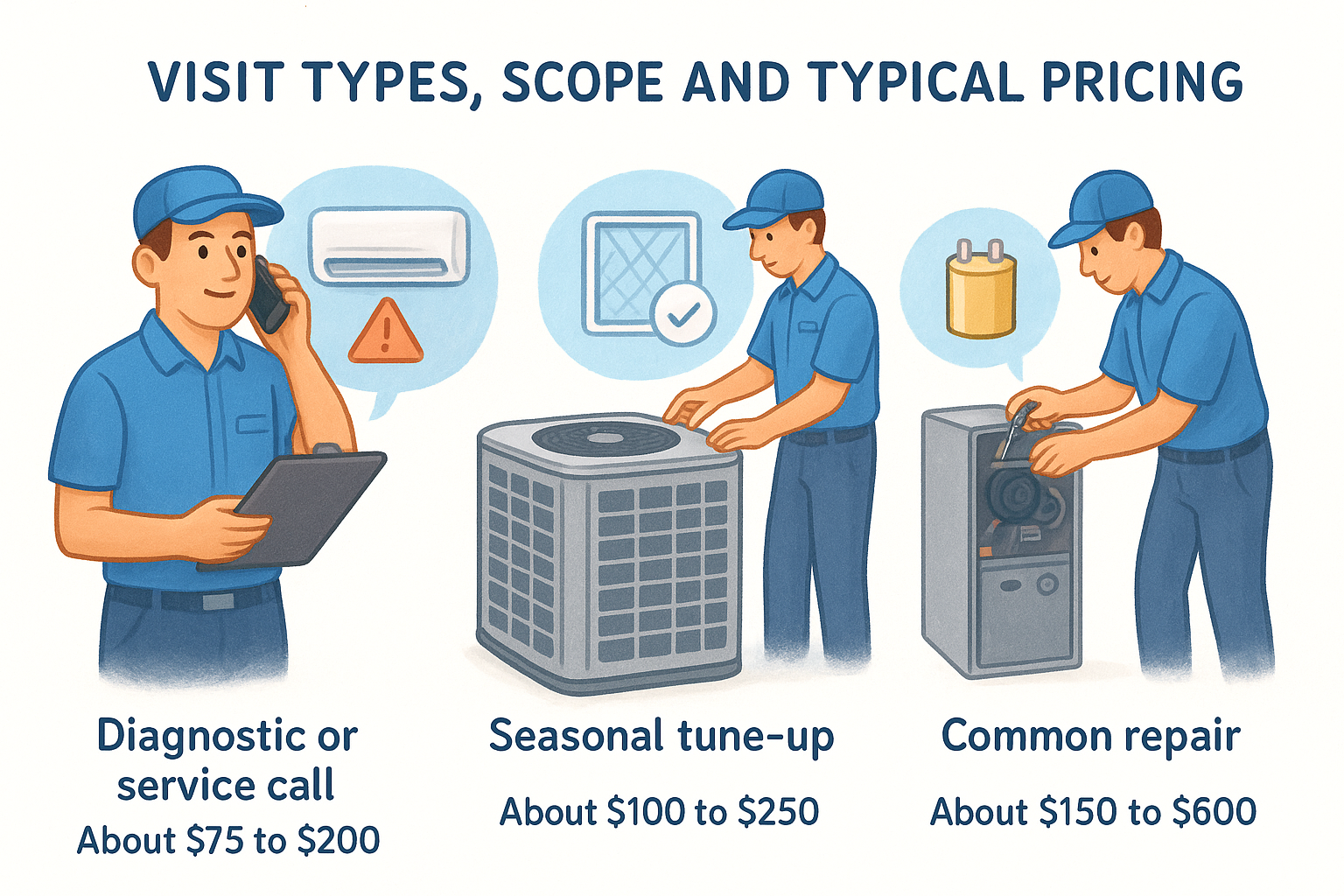
A service visit includes inspection, cleaning, testing and any repairs you approve, and costs vary by job type and region. Treat the ranges below as rough US benchmarks for planning, and use your local quotes as the real number.
Visit types, scope and typical pricing
| Service type | What happens | Typical range |
|---|---|---|
| Diagnostic or service call | Technician finds the fault and quotes the fix | About $75 to $200 |
| Seasonal tune-up | Cleaning, filter check, electrical and refrigerant checks, airflow test | About $100 to $250 |
| Common repair | Part replacement such as a capacitor, contactor or fan motor | About $150 to $600 |
| System replacement | New furnace or central AC, installed and commissioned | Often several thousand dollars, commonly $5,000 to $12,000 |
Here is a simple example. Your AC blows warm air. The company charges a $100 diagnostic fee, finds a failed capacitor and quotes $350 for the part and labor. If the fee is credited, you pay $350 total. If it is not, you pay $450. That is why the credit question matters.
What commercial properties should add
Commercial and industrial buildings need more than a filter change. Condenser and evaporator coils on rooftop units, chillers and data center cooling equipment collect dust, debris and mineral deposits, and the right cleaning method depends on the coil material and the manufacturer's maintenance requirements. Ask your contractor how they clean coils, which products they use and whether those products suit your equipment.
Facility teams and contractors who handle coil cleaning in-house can use a product such as our HVAC Coil Cleaner, which is designed for commercial and industrial coil cleaning.
Ask every contractor how they clean the coils, because that answer shows how thorough the rest of the visit will be.
How often to service HVAC and when to replace it
Service your HVAC system twice a year, with the air conditioner checked in spring and the furnace checked in early fall. Then use a simple rule of thumb to decide when a repair stops making sense.
A practical service schedule
Most residential systems do well with two professional visits a year. Between visits, check the air filter every month and replace it roughly every one to three months, depending on the filter type, pets and dust. Commercial equipment under heavy use, such as in restaurants, hospitals and server rooms, often needs a tighter schedule set with your contractor or by the manufacturer's maintenance requirements.
Book early. Tune-up slots fill fast in the weeks before the first hot spell and the first cold snap.
The $5,000 rule for repair versus replacement
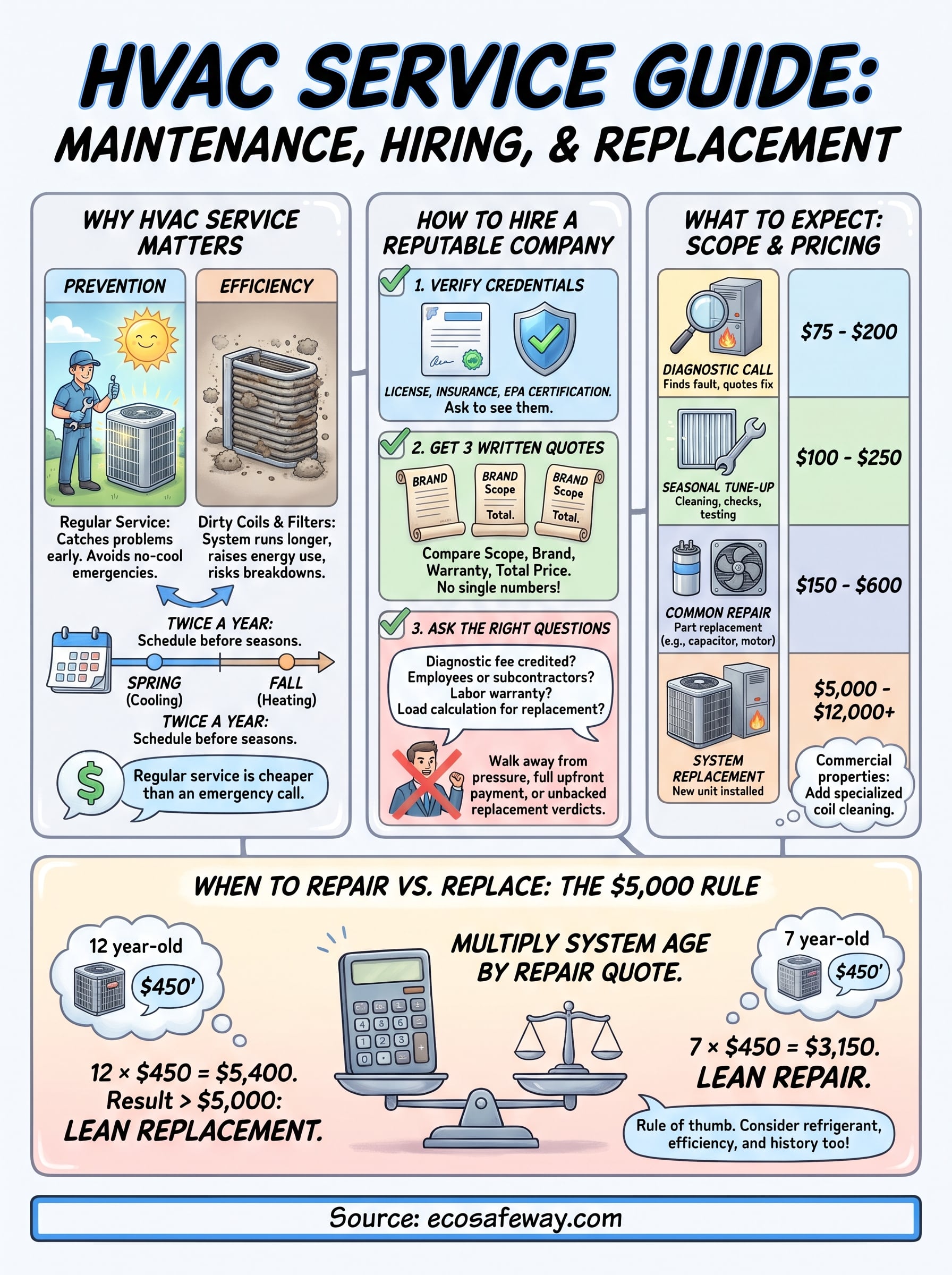
The $5,000 rule is a rule of thumb: multiply the system's age by the repair quote. If the result is above $5,000, lean toward replacement. If it is below, repair.
Take the $450 repair quote from earlier. On a 12-year-old system, 12 × $450 = $5,400, so replacement deserves a serious look. On a 7-year-old system, 7 × $450 = $3,150, so repair is the better bet. Treat the rule as a starting point. Refrigerant type, efficiency ratings and how often the unit has failed before also count, and a second opinion costs little.
Multiply age by repair cost, and let the result tell you whether to fix it or start shopping.
Book service before you need it
HVAC service pays for itself when you treat it as routine. Verify the license, insurance and certification, get three written quotes, schedule two visits a year, and use the age-times-cost rule when a big repair comes up. Do that and you will rarely face an emergency call with no leverage.
If you manage a commercial facility or run a service company and want to handle coil cleaning properly, see our commercial HVAC coil cleaning products and choose the size that fits your maintenance program.


