





Your HVAC system is likely the largest single energy load in your building, and it rarely runs as efficiently as the day it was installed. Dirty coils, scaled heat exchange surfaces, and neglected drains quietly push up run time. That is why HVAC energy efficiency is mostly a maintenance question before it is an equipment question.
Here is the short answer. The biggest savings usually come from keeping heat transfer surfaces clean, then from controls and airflow, and only then from replacement. Ratings like SEER and EER tell you how efficiently a unit performs when new. They say nothing about how it performs after years of fouling.
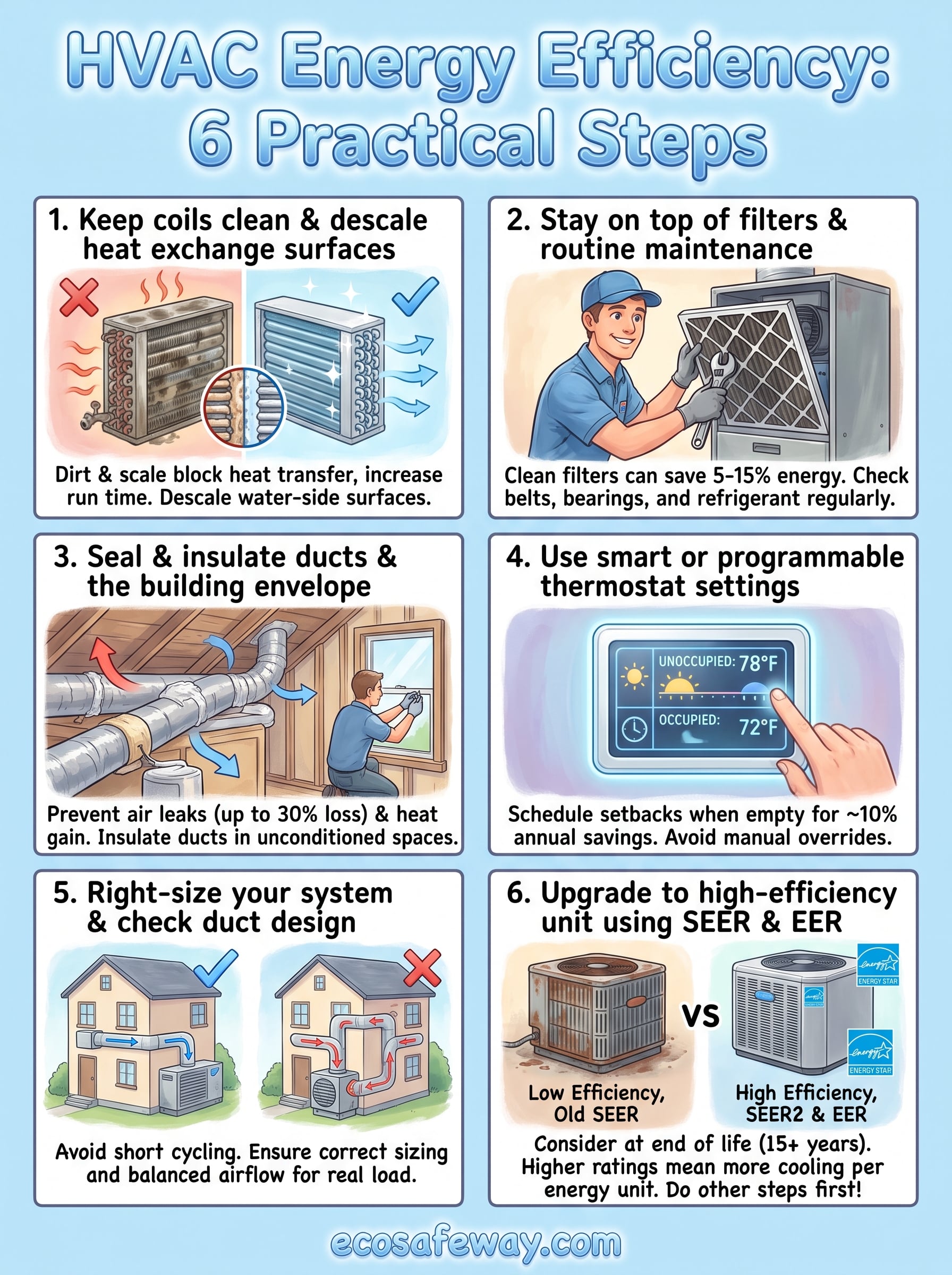
Below you get six practical steps, ordered by how much they typically matter in commercial and marine systems. We cover coil cleaning, descaling, airflow, drain upkeep, controls, and when an upgrade makes sense. At Eco Safeway, we work with HVAC, cooling tower, and marine raw water equipment daily, so the focus is on steps you can act on this season without guesswork.
1. Keep coils clean and descale heat exchange surfaces
How it improves efficiency
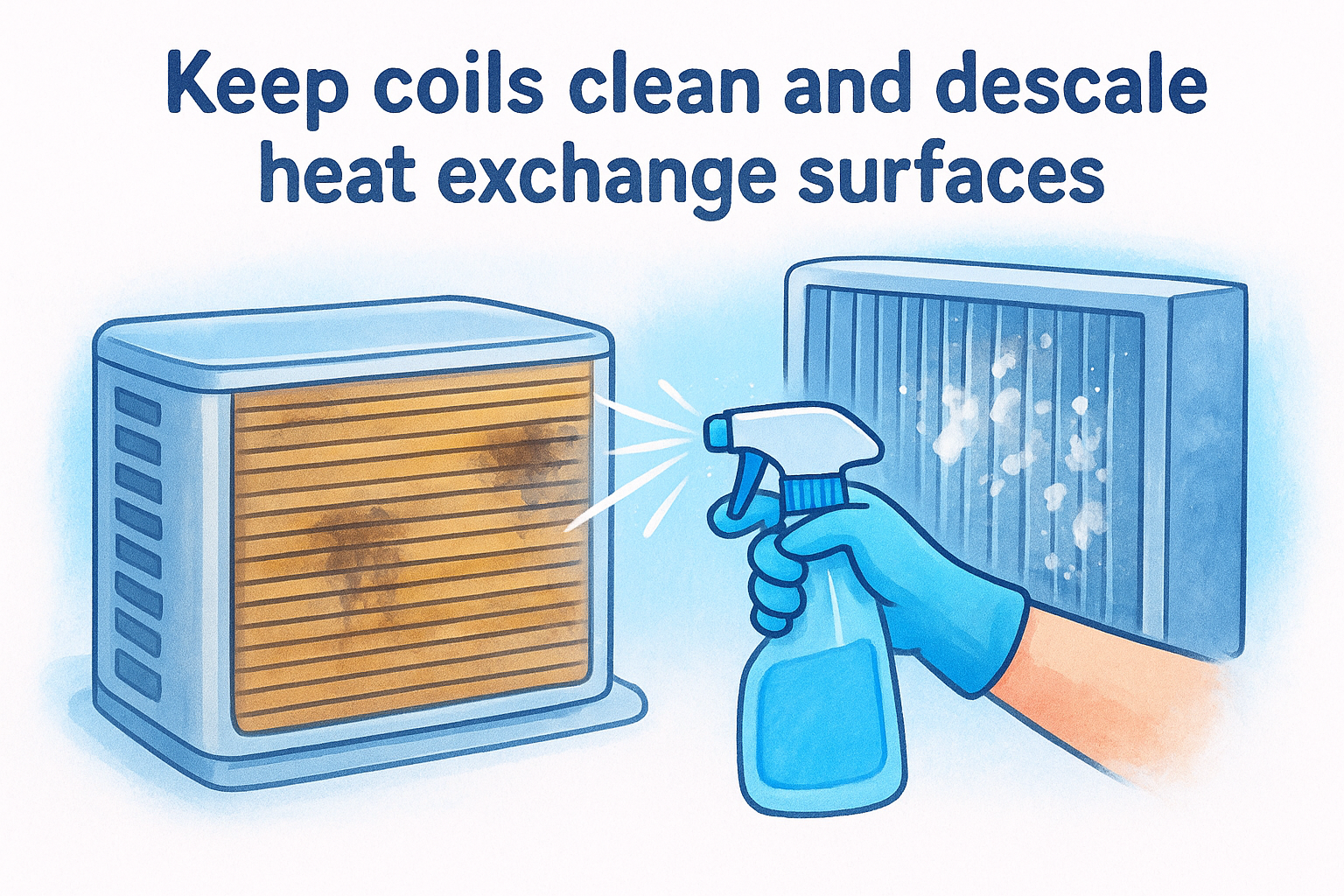
Coils and heat exchangers exist to move heat. Dirt, biofilm, and mineral scale act like insulation on those surfaces, so the system runs longer to deliver the same output. Fouled coils raise run time and energy use, which is why the U.S. Department of Energy lists coil cleaning as a core maintenance task for air conditioners.
Scale causes the same damage on the water side. Cooling towers, chillers, and marine raw water loops build carbonate deposits that restrict flow and block heat transfer. Of all the steps in this article, this is the one that costs the least per point of efficiency recovered.
Clean heat transfer surfaces restore efficiency you already paid for, before you spend a dollar on new equipment.
Who it is for
This step suits facility managers running rooftop units, chillers, or cooling towers, plus yacht engineers with marine AC and raw water heat exchangers. It pays off most in hard-water regions and saltwater environments, where scale and salt film form quickly.
Small split systems benefit too, but the gains are largest where equipment runs many hours a year and coil surfaces are big.
What to do and how often
Start with an inspection, then clean on a schedule that fits your site. Most commercial systems need coil cleaning once or twice a year. Dusty, coastal, or heavy-use sites need it more often.
- Inspect coils and heat exchangers every quarter for dirt, scale, and corrosion.
- Clean evaporator and condenser coils with a cleaner compatible with your coil metals, then rinse thoroughly.
- Descale water-side surfaces with an industrial HVAC descaler when pressure drop or approach temperature starts climbing.
- Log discharge pressure, temperature split, and amp draw before and after, so you can prove the result.
Typical effort and cost considerations
Cleaning a rooftop unit is usually a few hours of labor. Descaling takes more planning, because you need circulation access and some downtime. Both are small expenses next to a compressor replacement, and clean surfaces also lower head pressure, which eases wear.
Chemistry matters. Check the manufacturer's guidance for aluminum fins and copper tubing before using any acid-based product, and choose a cleaner you can handle safely without special protective gear.
2. Stay on top of filters and routine maintenance
How it improves efficiency
Restricted airflow makes fans work harder and coils run colder than designed. The U.S. Department of Energy says swapping a clogged filter for a clean one can cut air conditioner energy use by 5% to 15%. That is a large return for a part that costs very little.
A clean filter is the cheapest efficiency upgrade in any building.
Beyond filters, routine service catches loose belts, worn bearings, low refrigerant, and clogged condensate drains before they become longer run times or a failed unit.
Who it is for
Every system owner needs this, but it matters most at dusty sites, high-occupancy buildings, and spaces near construction, where filters load up fast.
Yacht engineers should also check often. Humid, salty air and tight machinery spaces mean filters and drain pans foul sooner than on shore.
What to do and how often
Use this baseline schedule, then shorten it if your site is harsh. Write each visit into a maintenance log so you can spot trends in run time and amp draw.
| Task | Frequency |
|---|---|
| Check filters | Monthly |
| Replace filters | Every 1 to 3 months, per manufacturer |
| Clear condensate drains and pans | Quarterly |
| Check belts, bearings, refrigerant charge | Twice a year, by a technician |
Typical effort and cost considerations
Filters are inexpensive and take minutes to swap, so there is no good reason to run a dirty one. Buy them in bulk and set calendar reminders.
Plan for a technician visit twice a year. It costs more than a filter, but it is cheaper than an emergency repair in peak season, and it keeps your system close to its rated efficiency.
3. Seal and insulate ducts and the building envelope
How it improves efficiency
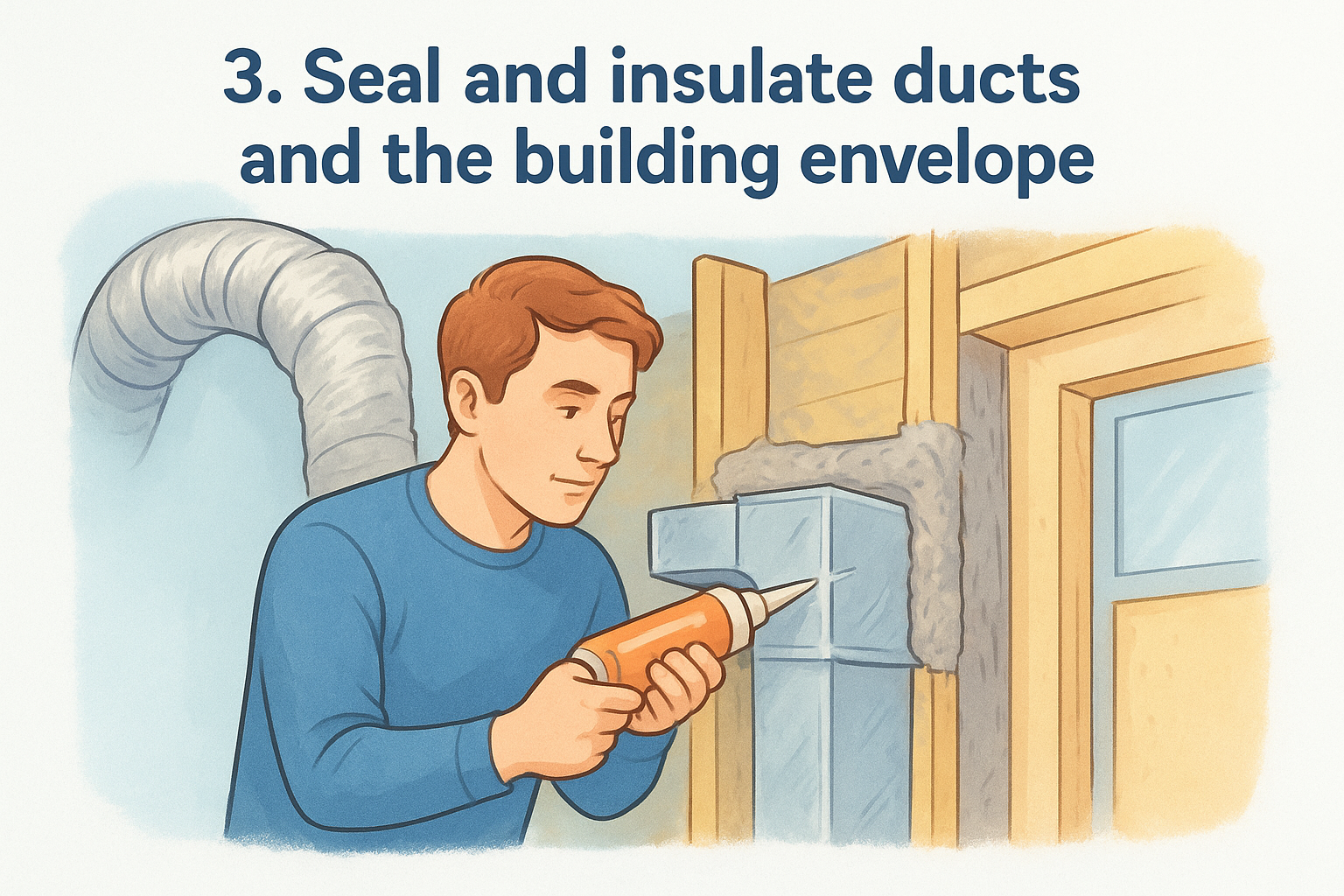
Conditioned air that leaks into an attic, ceiling void, or plenum never reaches the space you are paying to cool. The Department of Energy estimates that duct leakage can waste 20% to 30% of the air moving through a typical system. Uninsulated ducts in hot spaces add heat gain on top of that.
Air you cool and then lose through a leak is energy you bought for nothing.
Envelope gaps work the same way. Leaky doors, worn window seals, and thin roof insulation raise the load, so equipment runs longer to hold the same setpoint.
Who it is for
This step suits owners of ducted systems that run through unconditioned space. Older buildings and past retrofits are the usual offenders.
Yacht owners with ducted marine AC should check duct runs and chilled-water line insulation too. Sweating lines or ducts point to losses and moisture problems.
What to do and how often
Inspect once a year, and again after any renovation or equipment change.
- Visually check duct joints, boots, and connections for gaps or disconnects.
- Seal leaks with mastic or foil tape. Skip standard cloth duct tape, which fails with heat.
- Insulate ducts and cold lines that pass through hot spaces.
- Replace worn door sweeps, gaskets, and window seals, then test duct leakage if the building is large.
Typical effort and cost considerations
Mastic, foil tape, and weatherstripping are inexpensive, and a small building can finish the work in a day. Professional duct testing costs more, but it shows exactly where the air escapes.
Large or hard-to-reach duct networks need a contractor. Even so, sealing often pays back faster than new equipment, because it cuts the load every other component carries.
4. Use smart or programmable thermostat settings
How it improves efficiency
Every hour your system holds a comfort setpoint in an empty space is wasted energy. The U.S. Department of Energy says turning a thermostat back 7 to 10 degrees for 8 hours a day can save up to 10% a year on heating and cooling.
The cheapest hours to save are the ones when nobody is there.
Controls also stop short cycling and overcooling. Good HVAC energy efficiency depends on equipment running when it is needed, not all day.
Who it is for
Offices, retail, schools, and buildings with predictable occupancy gain the most, because schedules map cleanly to real use.
Yacht owners benefit too. Remote monitoring and setback let you hold a safe humidity level while the vessel sits at the dock, without cooling empty cabins to full comfort.
What to do and how often
Set it up once, then review every season as weather and occupancy change.
- Program setbacks for unoccupied hours, with a modest offset rather than a deep one.
- Start the recovery before people arrive, so the system never races to catch up.
- Lock out wide adjustments on shared thermostats to prevent manual overrides.
- Check settings after any power outage or software update.
Typical effort and cost considerations
Programmable thermostats are inexpensive and install in under an hour on most low-voltage systems. Smart models cost more, but they add scheduling, alerts, and usage data that help you spot a failing unit early.
Larger commercial sites usually need a building automation integrator. Confirm compatibility with your equipment first, since heat pumps and multistage units need matching controls.
5. Right-size your system and check duct design
How it improves efficiency
An oversized system cools the space fast, shuts off, and repeats. This short cycling wastes energy at every startup and leaves humidity behind, because the coil never runs long enough to pull moisture out.
A system sized to the real load runs longer, steadier, and cheaper than one that is simply bigger.
Undersized or badly routed ducts add static pressure, so fans draw more power and airflow falls short at the coil. Sizing matters as much for HVAC energy efficiency as the rating on the nameplate.
Who it is for
Buildings that changed use or layout since installation should check first. New walls, upgraded lighting, and different glazing all shift the load away from the original design.
Yacht owners who refit interiors face the same issue. Rooms with uneven temperatures are the clearest warning sign.
What to do and how often
Ask for a calculation before you replace or add any equipment, and repeat it after major renovations.
- Request a Manual J load calculation, not a square-footage rule of thumb.
- Select equipment with Manual S and check duct sizing with Manual D.
- Measure static pressure and airflow across the coil.
Typical effort and cost considerations
A load calculation and duct assessment cost little next to the equipment itself, and they prevent buying the wrong size.
Duct redesign is the expensive part. Get the assessment first, then decide whether targeted fixes such as larger returns or shorter runs capture most of the gain.
6. Upgrade to a high-efficiency unit using SEER and EER
How it improves efficiency
A higher rating means more cooling per unit of electricity. SEER2 measures seasonal cooling output over a range of temperatures, while EER is measured at one fixed hot-day condition, so it shows peak-load performance.
A rating shows what a unit does when new, so pair any upgrade with clean coils, sealed ducts, and correct sizing.
| Rating | What it measures | Best for comparing |
|---|---|---|
| SEER2 | Seasonal cooling efficiency | Annual running cost |
| EER | Efficiency at one hot-day test point | Peak load, hot climates |
Who it is for
Units near the end of their life are the best candidates. If your equipment is past roughly 15 years, needs frequent repairs, or still runs poorly after the steps above, replacement deserves a hard look. Hot climates and long run hours shorten the payback.
What to do and how often
Review your equipment's age and repair history once a year.
- Fix coils, filters, ducts, and controls first.
- Get a Manual J load calculation before choosing a size.
- Compare SEER2 and EER for your climate, not just the headline number.
- Check utility rebates before you buy.
Typical effort and cost considerations
This is the highest upfront cost on the list, and it needs a licensed contractor. Payback depends on your run hours and electricity rates, so ask for a projected savings estimate in writing. A new unit that inherits dirty coils and leaky ducts will not reach its rating.
Where to start saving energy
Start with the cheapest steps. Clean coils, fresh filters, and sealed ducts recover efficiency you already paid for, and they make every later decision easier. Then tune your controls, confirm the system matches the real load, and only then consider replacement. Lasting HVAC energy efficiency comes from that order, because a new unit with dirty coils and leaky ducts will not reach its rating.
Your first move this week is simple. Inspect your coils, log amp draw and temperature split, and clean on a schedule you can keep. Check the same numbers a month later, so you can see what the work actually saved.
If coils are your weak link, a commercial condenser coil cleaner is a practical place to begin. Eco Safeway's formula is made for commercial HVAC systems, so you can start on the step that matters most and build from there.


