




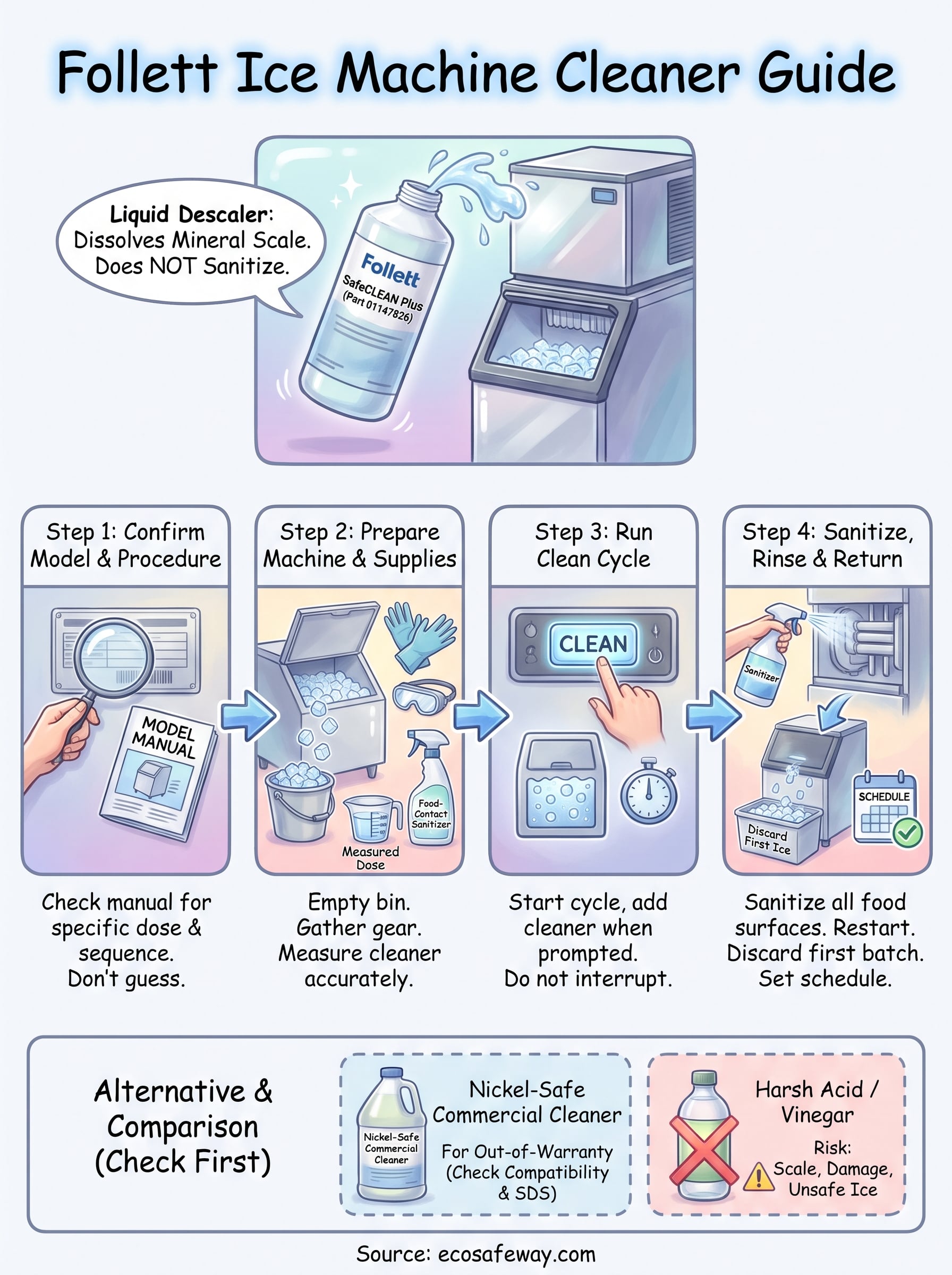
The right Follett ice machine cleaner is Follett's own SafeCLEAN Plus liquid (part 01147826), used according to the cleaning procedure for your specific model. Confirm your model and its manual, empty and prepare the machine, run the clean cycle with the cleaner, then sanitize every food-contact part and discard the first batch of ice. If your machine is out of warranty, a nickel-safe commercial cleaner is a reasonable alternative, but check compatibility first.
The problem is that the advice online is scattered. Forum threads ask whether a cheaper cleaner will do, retail listings mix Follett parts with generic bottles, and the manuals differ from one model to the next. Pick a harsh acid cleaner, skip the sanitizing step, or guess at the dose, and you risk scale left in the machine, damaged plating, or ice that is not safe to serve.
This guide covers what SafeCLEAN Plus is, what to compare when you buy, and four steps to descale and sanitize your machine. At Eco Safeway we supply nickel-safe ice machine cleaners to restaurants, hotels and healthcare facilities, so we also explain where an alternative fits and where it does not.
Why Follett machines call for a specific cleaner
Follett sells SafeCLEAN Plus as its liquid cleaner for dissolving mineral scale in Follett ice machines, and its manuals point you to Follett-specified cleaning. Using the named product keeps you aligned with the manual and with any warranty or service contract.
What SafeCLEAN Plus is
SafeCLEAN Plus is a liquid descaler that Follett positions as a way to extend machine life and improve efficiency. Distributors list it as part 01147826 in 8 oz bottles, sold singly or as two-packs. Listings describe it as non-toxic and biodegradable, so you can handle it without the fumes of a harsh acid cleaner. Still read the label and safety data sheet before you use it.
A descaler handles only half the job. It dissolves mineral deposits. It does not replace the sanitizing step, which Step 4 covers.
Descaling removes mineral scale, sanitizing makes the surfaces safe for ice, and a Follett machine needs both.
What to compare before you buy
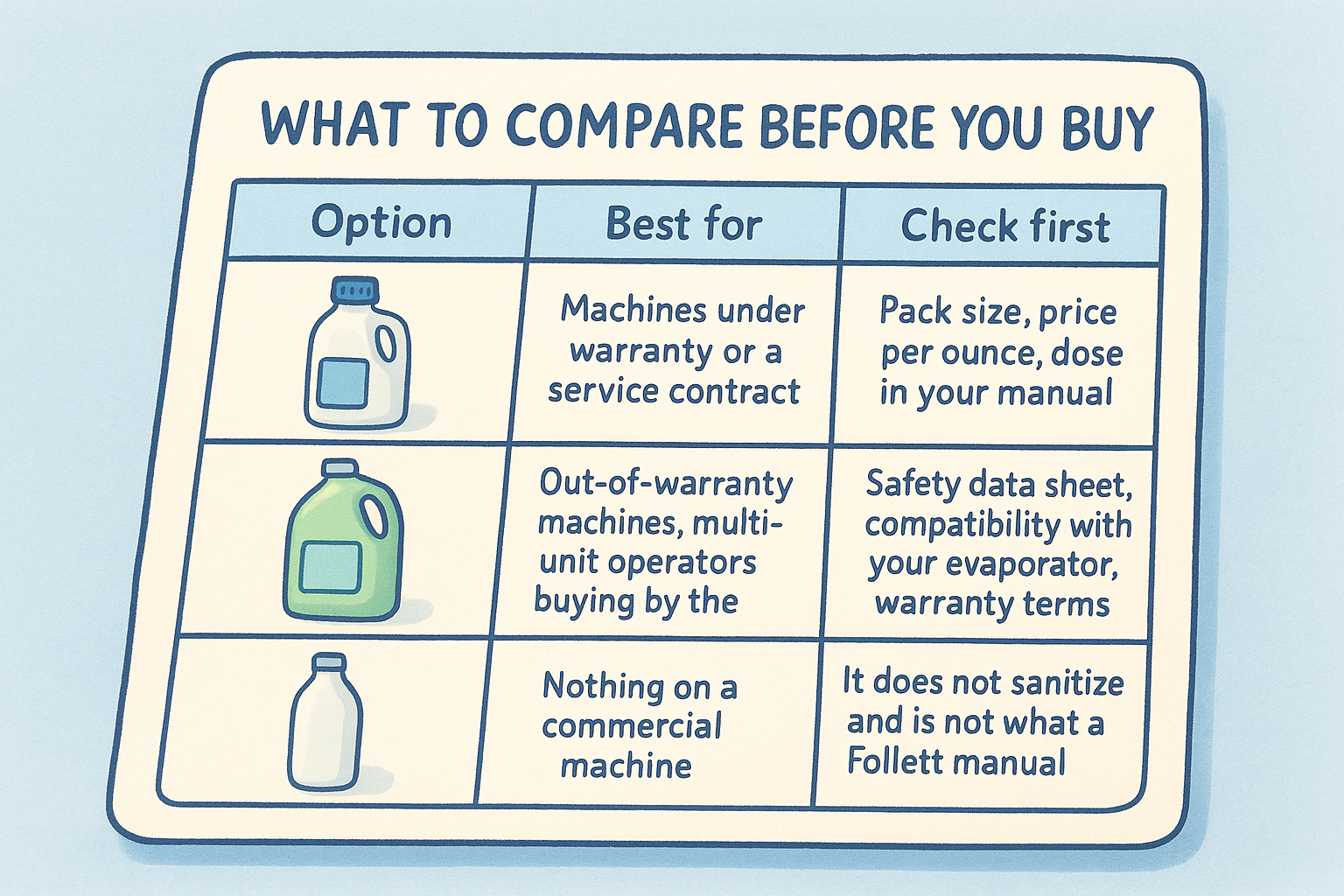
Your options come down to three choices, and the table sets them side by side.
| Option | Best for | Check first |
|---|---|---|
| Follett SafeCLEAN Plus (01147826) | Machines under warranty or a service contract | Pack size, price per ounce, dose in your manual |
| Nickel-safe commercial cleaner, such as Eco Safeway's | Out-of-warranty machines, multi-unit operators buying by the quart or gallon | Safety data sheet, compatibility with your evaporator, warranty terms |
| White vinegar | Nothing on a commercial machine | It does not sanitize and is not what a Follett manual names |
Prices vary by seller. One industrial distributor lists 01147826 at $117.22 each, while ice machine specialists list 8 oz bottles and two-packs. Compare price per ounce, not price per listing.
Eco Safeway's Nickel-Safe Ice Machine Cleaner & Descaler ranges from $38.99 to $399.99 depending on size, from 32 oz bottles up to a 275 gallon tote. It is not marketed as a Follett-specified product. If Follett's warranty or your service agreement matters, use SafeCLEAN Plus.
Step 1. Confirm your model and procedure
Look up the cleaning procedure for your exact model before you buy or open anything. Follett's steps differ between product lines, and the manual is the only source for your dose and sequence.
Find the nameplate and the manual
Check the nameplate for the model and serial number, then pull the matching manual from Follett's website. The Horizon 700 sheet, for example, tells you to remove the cover, press CLEAN, and wait while the machine drains. Other models use different controls and timing, so do not assume yours works the same way.
Write down three things from your manual: the cleaner it names, the amount to use, and the sanitizing instructions. You will need all three in the later steps.
Match the cleaner to the manual
If the manual names SafeCLEAN Plus, buy that. If you want to use a different product, ask for the safety data sheet and written material compatibility for your evaporator and food-contact surfaces. Many commercial evaporators are nickel-plated, and aggressive acids can attack plating. Confirm the warranty position with Follett or your service company before you switch.
Buy the cleaner your manual names, and treat any substitute as a decision to verify in writing, not to guess.
Step 2. Prepare the machine and your supplies
Preparation takes ten minutes and prevents most mistakes. Empty the bin, gather your supplies, and read the product label before you start the cycle.
Empty the ice and stop production
Remove all ice from the bin and discard it. Never serve ice that has touched cleaner, and do not save it for later. Follow your manual for shutting down ice production and power. If the machine feeds a dispenser, empty that path too.
Gather protective gear and supplies
Even a low-hazard cleaner deserves basic precautions. Set out the following before you open the machine:
- Chemical-resistant gloves and eye protection
- The correct amount of cleaner, measured to your manual's dose
- A food-contact ice machine sanitizer
- A soft brush and clean, lint-free towels
- A clean bucket for removable parts and rinse water
- The manual and the cleaner's safety data sheet
Measure the cleaner before you start, because eyeballing the dose is how machines end up under-cleaned or over-treated.
Step 3. Run the cleaning cycle with the cleaner
Start the machine's clean cycle, add the cleaner at the point your manual specifies, and let the full cycle finish. Do not interrupt it to save time.
Start the clean cycle
On a Horizon 700, the sequence begins with the cover removed and the CLEAN button pressed, and the machine drains. Your model may differ, so follow its own procedure. In general:
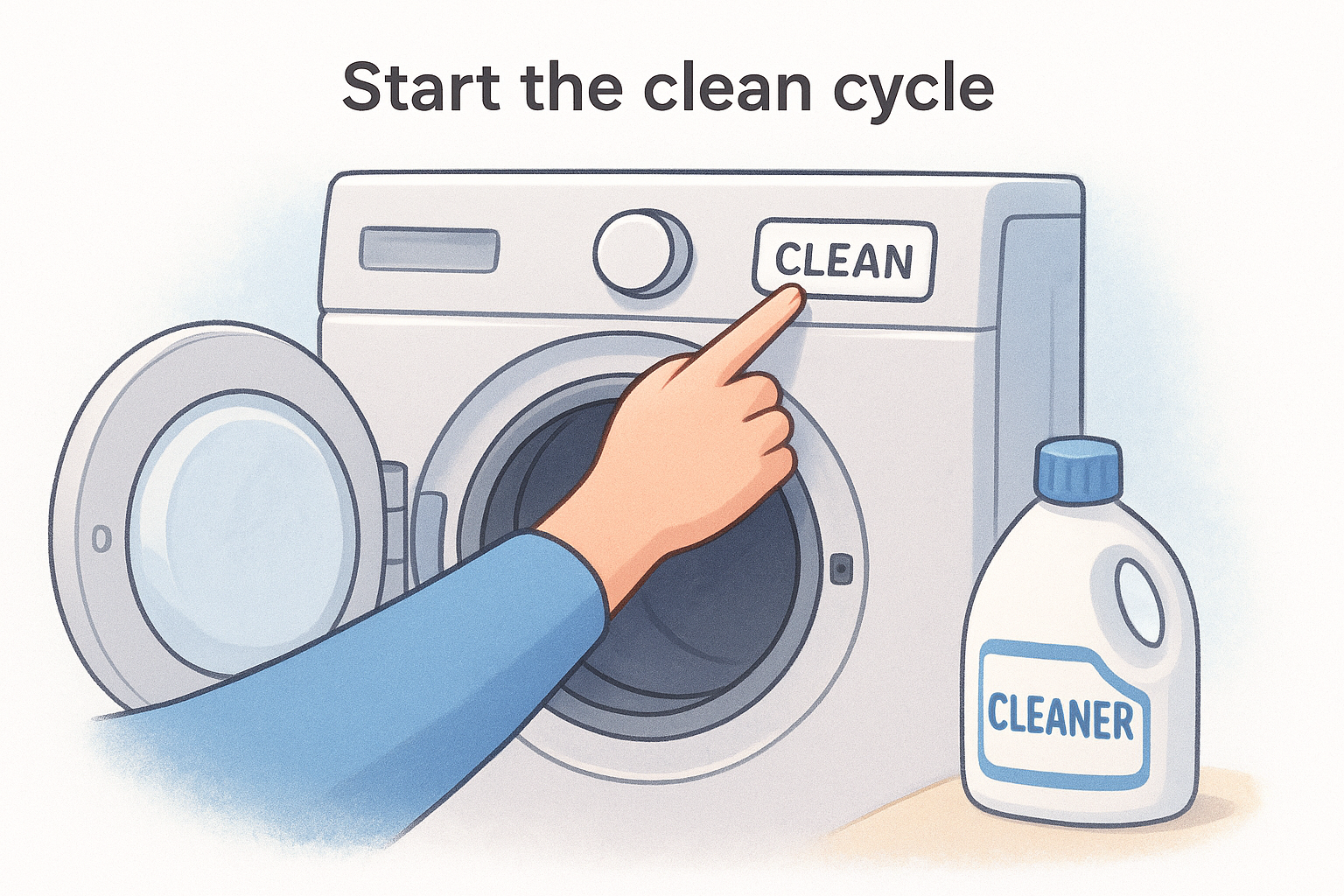
- Put the machine into its clean mode as the manual directs.
- Let it drain if the procedure calls for that.
- Add the measured cleaner where the manual says to add it.
- Let the cycle run for the full time.
- Drain and flush as directed before moving on.
Avoid common cycle mistakes
Never mix the cleaner with sanitizer, bleach or another descaler. Combining chemicals can create hazardous fumes and cancel out what each does. Do not top up with extra cleaner because the water looks hard. If scale is heavy, repeat the cycle once the first one finishes.
If you manage several machines, log the date and result of every cycle. A machine that scales quickly may need a water filter, which prevents more problems than a stronger cleaner.
One full cycle with the correct dose beats two rushed cycles with a stronger mix.
Step 4. Sanitize, rinse and return to service
After descaling, sanitize every food-contact surface, rinse as the sanitizer label directs, restart the machine, and discard the first ice. Cleaner and sanitizer are two separate jobs.
Sanitize the food-contact parts
Spray or wipe all accessible food-contact parts with ice machine sanitizer once the clean cycle ends. Technicians commonly run SafeCLEAN Plus through the cycle and then spray every part with sanitizer before closing the machine. Follow the sanitizer label for contact time and rinsing, since those vary by product. Wipe the exterior too. Follett's manual suggests a stainless steel cleaner on the exterior as a weekly task.
Restart, discard and set a schedule
Put the cover back, restart the machine and let it make ice. The Horizon 700 sheet calls for collecting ice for 10 minutes before the machine goes back into service. Treat that first batch as waste unless your manual says otherwise.
For frequency, follow your manual first. A common commercial practice is descaling about twice a year, and more often with hard water or heavy use. Set a recurring reminder, because skipped cleanings are what lead to scale-related service calls.
The job is not finished until the surfaces are sanitized and the first ice is discarded.
Next steps for your ice machine
Use SafeCLEAN Plus when your manual names it, confirm the procedure for your exact model, and finish every cycle with sanitizing and discarded ice. That sequence protects the machine and keeps your ice safe.
If you maintain out-of-warranty machines or several units, a nickel-safe option can make sense once you have confirmed compatibility in writing. You can review Eco Safeway's nickel-safe ice machine cleaner and descaler for available sizes and the safety data sheet. For questions, call 561-405-0271.


