






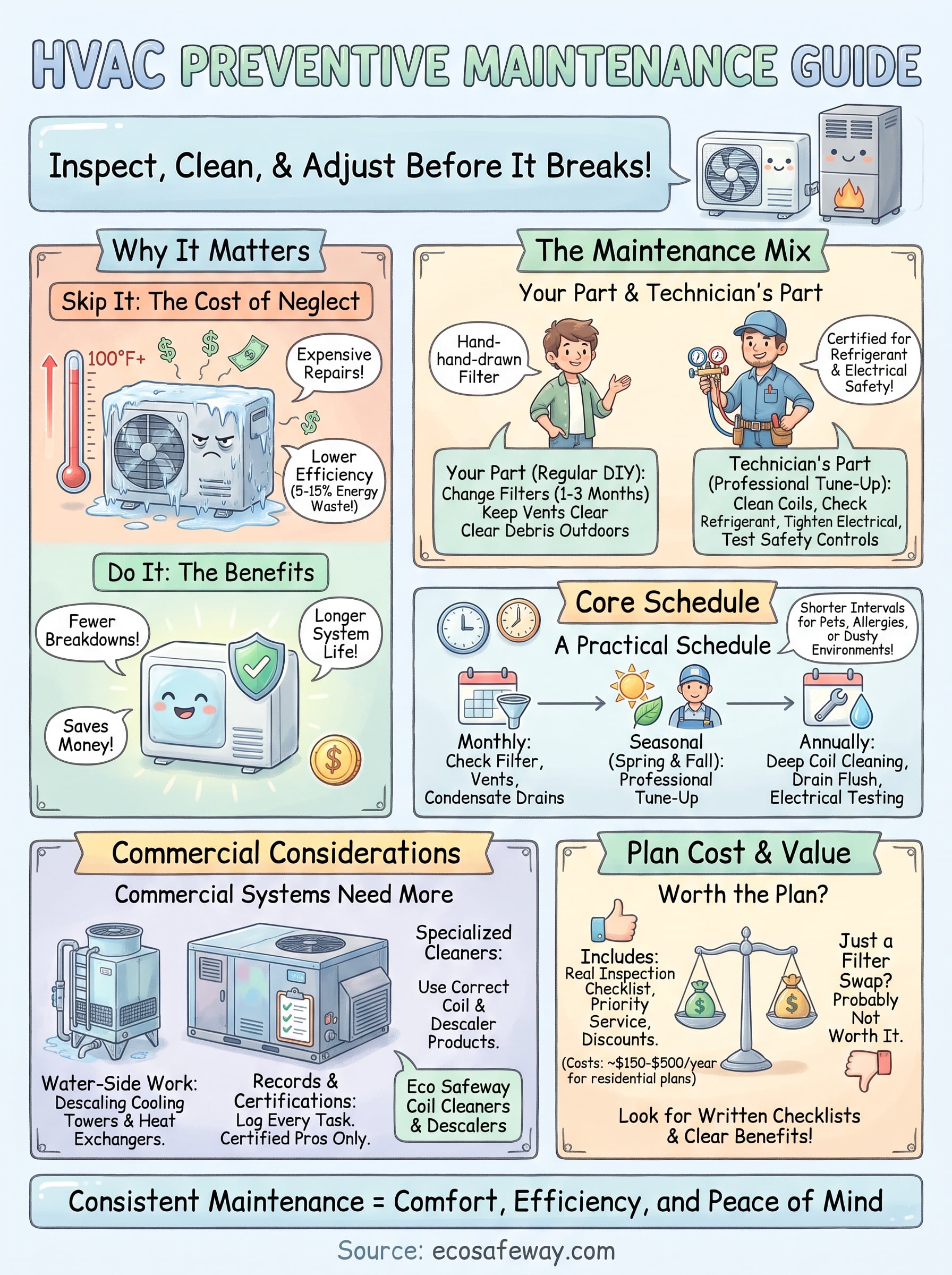
HVAC preventive maintenance is the scheduled inspection, cleaning and adjustment of heating, ventilation and air conditioning equipment before anything breaks. A technician or facility team works through a fixed task list at set intervals: changing filters, cleaning coils, checking refrigerant, tightening electrical connections. For most homes, that means a filter change every one to three months and a professional tune-up once or twice a year. A maintenance plan is usually worth the money when it includes a real inspection checklist and not just a filter swap.
The logic is simple. You find a worn capacitor or a clogged coil on a quiet afternoon instead of during a July heat wave. The work costs far less than an emergency repair, and it keeps airflow, efficiency and safety where they should be.
This guide covers why preventive maintenance matters, which tasks it includes, how often to do each one, how commercial systems differ, and what maintenance costs. Eco Safeway supplies coil cleaners and descalers to facility teams and contractors, so the commercial side gets real attention here.
Why HVAC preventive maintenance matters
Preventive maintenance matters because it reduces breakdowns, protects efficiency and delays the day you have to replace the system. Each of those has a measurable effect on what you spend.
What skipping maintenance costs you
Dirt is the main enemy. A clogged filter restricts airflow, and a dirty coil acts like insulation on the surface that is supposed to exchange heat. The system then runs longer to reach the same temperature. The U.S. Department of Energy says replacing a dirty, clogged filter can lower an air conditioner's energy use by 5% to 15%.
Worn parts fail in a predictable way. A weak capacitor or a loose connection strains the motor or compressor until something gives out. Failures cluster on the hottest and coldest days, when contractors are busiest and you pay the most to wait the least.
Preventive maintenance moves failures from the worst day of the year to a scheduled visit.
How maintenance changes the repair-or-replace decision
People often ask about the "$5,000 rule" for HVAC systems. It is a rule of thumb: multiply the system's age in years by the repair estimate, and if the result is above $5,000, lean toward replacement. A 12-year-old system with a $500 repair scores 6,000, so replacing makes sense. An 8-year-old system with a $400 repair scores 3,200, so repair it.
The rule ignores refrigerant type and efficiency, so treat it as a starting point. Maintenance helps either way. A well-kept system reaches a higher age before repair bills pile up, and a service history lets you judge its real condition instead of guessing.
How to carry out HVAC preventive maintenance
Split the work in two: you handle the routine checks that need no tools or licenses, and a qualified technician handles inspection, cleaning and testing. Both halves matter.
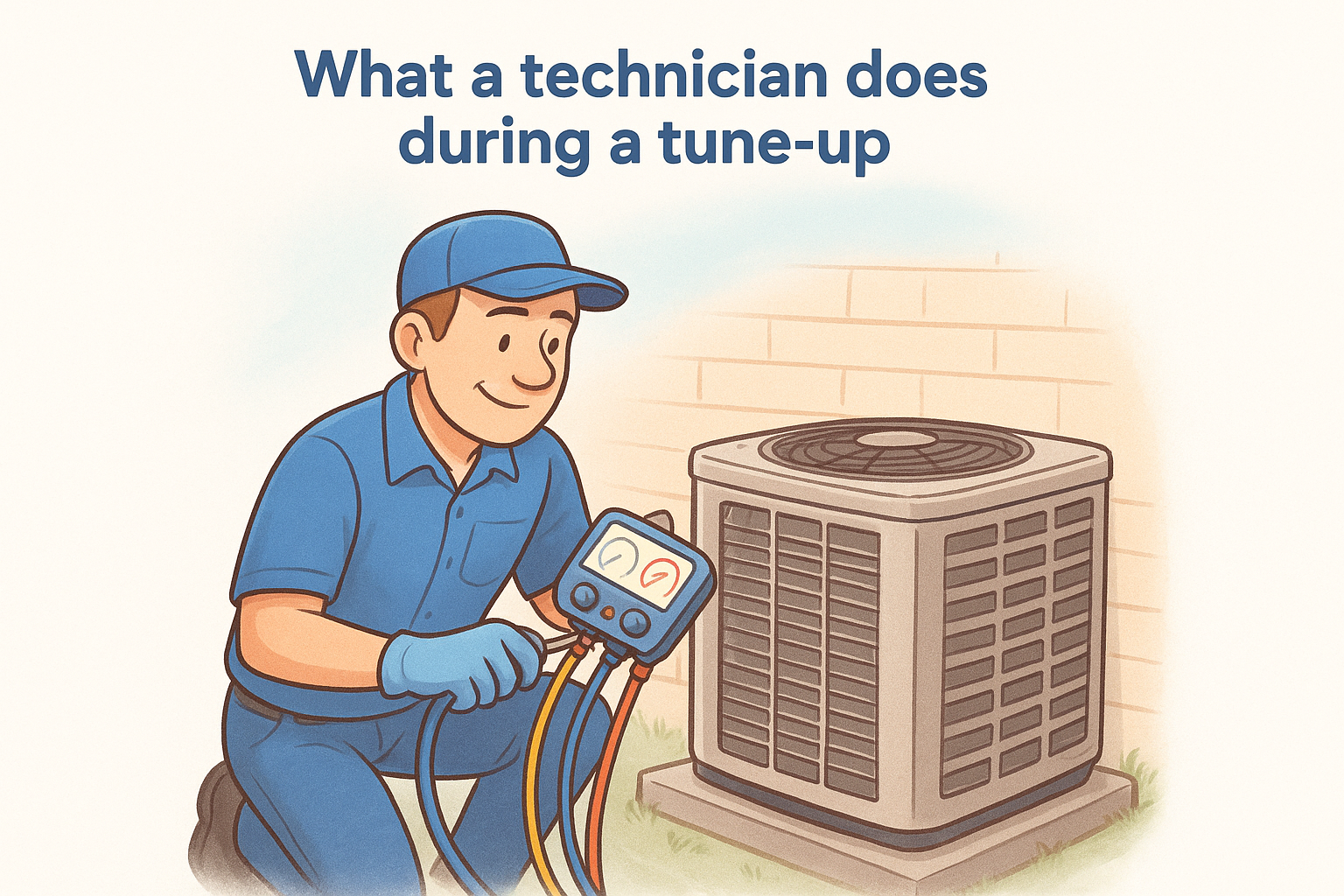
What a technician does during a tune-up
A proper visit follows a checklist. Ask for it in writing before you book.
| Task | What it protects | Who does it |
|---|---|---|
| Replace or inspect the air filter | Airflow and indoor air quality | You |
| Clean evaporator and condenser coils | Heat transfer and efficiency | Technician |
| Check refrigerant charge and look for leaks | Cooling capacity | Certified technician |
| Tighten electrical connections, test capacitors and contactors | Prevents motor and compressor failures | Technician |
| Lubricate moving parts where the design calls for it | Bearing and motor wear | Technician |
| Flush the condensate drain | Prevents water damage and overflow shutoffs | You or technician |
| Test thermostat and controls | Correct temperature and timer settings | Either |
| Inspect gas connections, burners and heat exchanger | Safety in gas furnaces | Technician |
Federal law requires EPA Section 608 certification to handle refrigerant, so refrigerant checks are never a DIY job. A visit that skips the electrical and refrigerant steps is a cleaning, not a tune-up.
What you can do between visits
These tasks take minutes and prevent most dirt-related problems:
- Check the filter monthly and replace it when you can no longer see the pleats clearly.
- Keep return vents and supply registers free of furniture and rugs.
- Keep shrubs and plants about 2 feet away from the outdoor unit.
- Pull leaves and debris off the outdoor unit, and watch for water at the indoor drain line.
Owner tasks handle dirt, and technician tasks handle wear, so you need both.
How often to do each maintenance task
Match each task to its own interval instead of lumping everything into one annual visit. Filters need attention every few weeks, while coils and electrical parts need a yearly look at minimum.
A practical schedule by interval
| Interval | Task |
|---|---|
| Monthly | Check the filter, clear vents, look for drips at the condensate line |
| Every 1 to 3 months | Replace disposable filters |
| Twice a year | Professional tune-up: spring for cooling, fall for heating |
| Yearly | Deep coil cleaning, drain flush, electrical and control testing (part of the tune-up) |
| Each season | Clear plants and debris from around the outdoor unit |
Most manufacturers and contractors cite about 90 days as the typical filter interval. Heat pumps run year-round, so they benefit from both seasonal visits. Check your equipment warranty too, because many manufacturers expect documented annual maintenance.
When to move faster than the schedule
Shorten the intervals when conditions are harsh. Pets, allergies or respiratory issues call for monthly filter changes. Dusty sites, nearby construction, cottonwood season and coastal salt air all load coils faster than average. Systems that run nearly nonstop wear faster, so inspect them more often.
Run hours and environment matter more than the calendar, so shorten the interval whenever the air is dirty.
Commercial HVAC preventive maintenance
Commercial preventive maintenance follows the same logic but adds water-side work, written records and tighter schedules. Scale and regulatory issues rarely come up in a home.
Coils, scale and water-side equipment
Large or continuously running systems often need quarterly or even monthly checks, depending on equipment type and run hours. External coil cleaning and internal descaling are different jobs. Air-cooled condensers and dry coolers need coil cleaning to remove dust and debris. Cooling towers, chillers, heat exchangers and evaporative coolers collect mineral scale on water-side surfaces, which calls for a descaler.
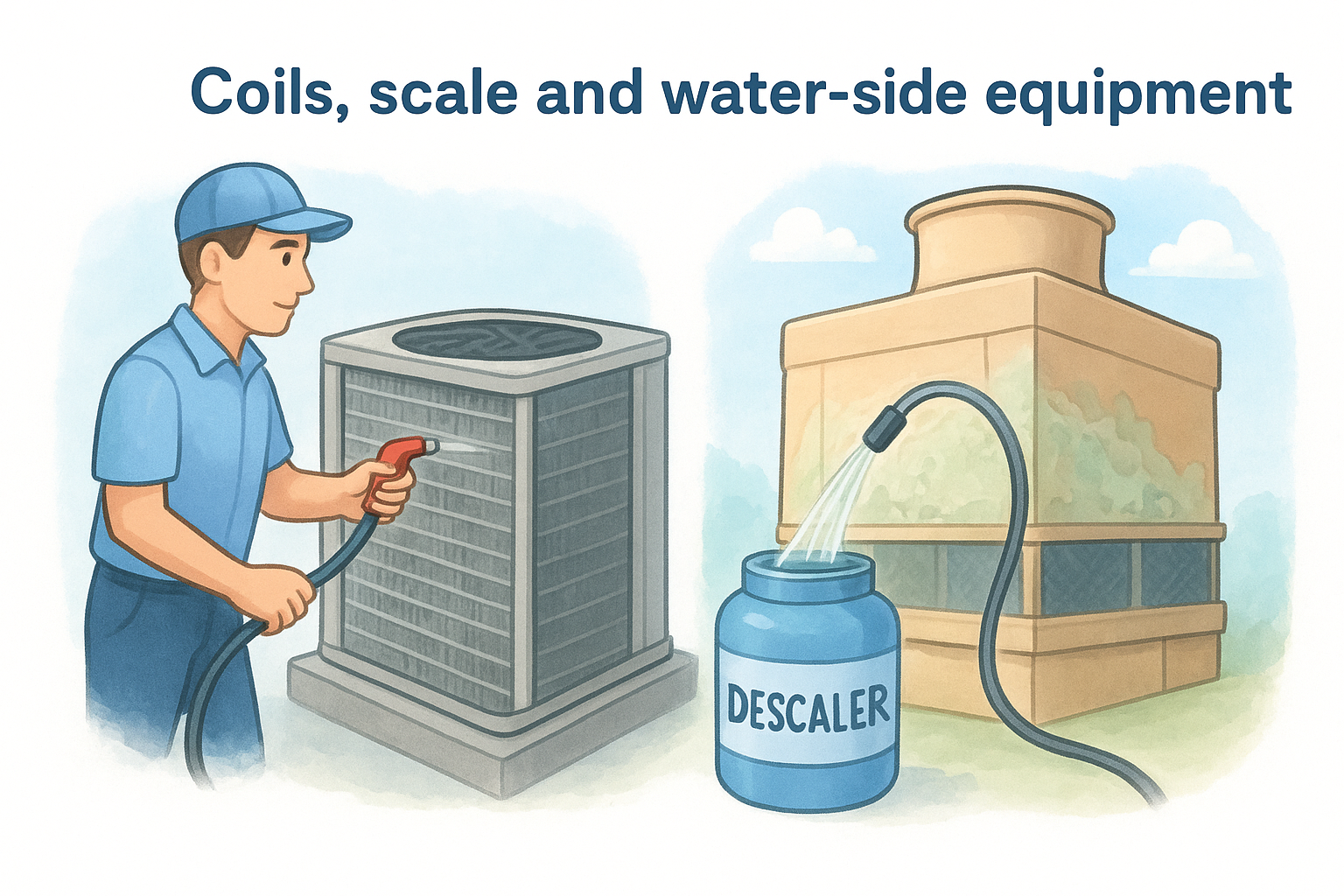
Before you buy any cleaner, confirm the coil or contact materials, the product label and safety documentation, and the equipment manufacturer's procedure. Eco Safeway offers HVAC coil cleaner, cooling tower descaler and data center cleaners for these applications. Match each to its equipment instead of assuming one product fits everything.
Records, certification and requirements
Log every task with a date, a technician name and findings. Logs support warranty claims and show patterns, such as a coil that fouls every quarter. Technicians handling refrigerant need EPA Section 608 certification. Many also hold voluntary credentials such as NATE.
No single rule dictates a commercial schedule. Requirements come from manufacturer terms, insurers and local codes. Cooling towers also carry Legionella risk, so many facilities follow a water management program such as ASHRAE Standard 188.
In a commercial building, a maintenance record is as valuable as the maintenance itself.
HVAC maintenance plan cost and whether it pays off
A maintenance plan pays off when it buys real inspections at a fair price and adds benefits like priority service. It does not pay off when it only sells a filter change. Judge it by what it includes.
What preventive maintenance typically costs
Residential tune-ups commonly run from about $100 to $250 per visit, and annual plans from about $150 to $500, depending on equipment and region. Commercial work is quoted by unit count, tonnage and system type, so get a written scope and price per visit.
Here is a worked example with assumed figures. Say a plan costs $300 a year for two visits that you would otherwise pay $150 each for. You pay the same, and priority scheduling or repair discounts are a bonus. If the plan costs $450 for the same two visits, you pay $150 extra, and the discount would need to save you at least that much on repairs.
What to look for in a plan
Compare plans on content, not on price alone:
- A written checklist that includes coils, electrical testing and refrigerant checks.
- The number of visits per year and when they happen.
- Priority scheduling and any repair discounts, stated in numbers.
- A written report after each visit.
- Clear exclusions, such as refrigerant refills or parts.
A plan is worth buying when you can read exactly what each visit includes.
Keeping your system on schedule
HVAC preventive maintenance comes down to a short list of tasks done on time: filters every one to three months, a professional tune-up once or twice a year, and extra care when the environment is dirty. It costs little against an emergency repair, and it keeps efficiency and equipment life in your favor.
If you manage commercial equipment, start with coil condition, because dirty coils drive most efficiency losses. A commercial condenser coil cleaner from Eco Safeway fits into the yearly coil task on your schedule.


