





If you're researching what it takes to become a facility engineer, you've probably noticed the job title gets used loosely across industries. One employer wants someone who fixes HVAC systems, another expects full-blown mechanical systems oversight for a hospital or data center. That inconsistency makes it hard to know if you're qualified, underpaid, or even looking at the right career path.
A facility engineer keeps a building's mechanical, electrical, and plumbing systems running safely and efficiently, from cooling towers to backup generators. This article breaks down the actual job duties, typical salary ranges across experience levels and regions, and the qualifications employers actually require, from degrees to licenses like the CPE or PE.
We'll also cover where the demand is strongest right now and what separates a good facility engineer from a great one, including the equipment-safe maintenance practices that protect systems and extend their lifespan. At Eco Safeway, we work with facility teams every day, so we know exactly what this role demands on the ground.
Why facility engineers matter to every organization
Every building runs on systems that fail quietly until they fail loudly. A chiller that's losing efficiency doesn't announce itself with an alarm, it just drives up energy bills for months before it finally shuts down during a heat wave. That's the gap a facility engineer fills: catching the slow failures before they become emergency calls at 2 a.m. Without someone monitoring mechanical, electrical, and plumbing systems on a schedule, organizations end up managing crises instead of preventing them.

The real cost of deferred maintenance
Skipping preventive maintenance feels cheap right up until it isn't. A cooling tower that goes three years without proper descaling can lose 20-30% of its heat transfer efficiency, according to research from the U.S. Department of Energy on commercial HVAC performance. That inefficiency shows up as higher electric bills every single month, plus a shorter equipment lifespan that forces early replacement. Facility engineers who build preventive maintenance schedules and use non-corrosive, equipment-safe treatments like Eco Safeway's cooling tower descaling chemical can stretch that equipment life by years instead of watching it degrade on an accelerated timeline.
A facility engineer's real job isn't fixing what broke, it's making sure nothing breaks in the first place.
Compliance, safety, and liability
Hospitals, government buildings, and data centers operate under regulatory requirements that don't leave room for guesswork. Ice machines need sanitation protocols built around a reliable ice machine cleaner and descaler. Backup generators need load testing. Fire suppression systems need documented inspections. Facility engineers carry the responsibility for keeping these systems compliant, which protects the organization from fines, lawsuits, and in the worst cases, actual harm to occupants. Getting this wrong isn't just expensive, it's a liability question that keeps facility directors up at night.
Government facilities and healthcare campuses in particular face audits that can shut down operations if documentation gaps show up. A facility engineer who tracks maintenance logs, calibration records, and safety inspections isn't doing paperwork for its own sake, they're building the evidence trail that keeps the organization operating legally and safely.
Energy efficiency and sustainability pressure
Owners and tenants now expect measurable progress on energy use, not just a vague commitment to sustainability. Facility engineers sit at the center of that push because they control the systems that consume the most power: chillers, boilers, air handlers, and pumps. Small adjustments, like recalibrating a building automation system or switching to a phosphate-free, biodegradable condenser coil cleaner instead of a harsh acid wash, add up to real savings across a large campus.
Here's a quick look at where facility engineers typically move the needle:
| System | Common Problem | Facility Engineer's Fix | Typical Impact |
|---|---|---|---|
| Cooling towers | Scale buildup reduces heat transfer | Scheduled non-corrosive descaling | 15-25% efficiency gain |
| HVAC condenser coils | Dirt and grime restrict airflow | Regular coil cleaning with safe chemistry | Lower compressor strain |
| Boilers | Mineral deposits slow heat exchange | Descaling and water treatment | Reduced fuel consumption |
| Backup generators | Fuel degradation, untested loads | Routine testing and fuel management | Reliable emergency power |
Why this role keeps growing in demand
Organizations are realizing that a skilled facility engineer pays for themselves through avoided downtime alone. Insurance companies increasingly ask for proof of maintenance history before issuing or renewing coverage on commercial properties. Property managers overseeing multiple buildings can't afford reactive maintenance models when a single equipment failure can shut down operations for days. That's why demand for qualified facility engineers has climbed steadily across healthcare, data centers, manufacturing, and commercial real estate, even as overall construction hiring has slowed in some regions. The role has shifted from a back-office maintenance job to a front-line position that directly affects an organization's bottom line and reputation.
How to become a facility engineer
Getting into this field doesn't require a single fixed path, but employers do look for a consistent pattern: technical education, hands-on trade experience, and at least one recognized certification. Some facility engineers start as HVAC technicians or electricians and work their way up through years of building-specific experience. Others come in through a mechanical or electrical engineering degree and pick up the practical skills on the job. Both routes work, but the fastest way in combines classroom knowledge with real equipment time.
Education paths that employers accept
Most job postings ask for one of three things: an associate's degree in facilities management or HVAC technology, a bachelor's degree in mechanical, electrical, or industrial engineering, or a documented trade apprenticeship with several years of verified experience. Hospitals and data centers, where the stakes are higher, tend to prefer candidates with a four-year engineering degree plus a professional license. Smaller commercial properties and property management firms often hire based on trade experience alone, especially if the candidate already holds a journeyman license in electrical or plumbing work.
Licenses and certifications you'll need
Certifications separate a candidate who can talk about maintenance from one who can prove they know it. The Certified Plant Engineer (CPE) credential from the Association for Facilities Engineering signals broad competency across mechanical, electrical, and safety systems. A Professional Engineer (PE) license carries more weight for senior roles, particularly in states that require a stamped signature on certain building modifications. Beyond those two, look at:
- BOMI International's Facility Management Administrator (FMA) certification, useful for commercial real estate roles
- EPA Universal Certification for handling refrigerants, required for anyone touching HVAC equipment
- OSHA 30-Hour General Industry training, which many hospitals and industrial employers require before you're even allowed on site
- Building Automation System (BAS) vendor certifications, since most large facilities run on Siemens, Johnson Controls, or Honeywell platforms
The certifications that matter most are the ones tied to the equipment you'll actually touch, not the ones that look best on paper.
Gaining hands-on experience
Experience is where most candidates either close the gap or get stuck. Entry-level roles like maintenance technician or building engineer assistant give you direct exposure to cooling towers, boilers, and electrical panels, which is exactly what hiring managers want to see before promoting someone into a full facility engineer title. Volunteering for overnight shifts, shadowing senior engineers during equipment failures, and asking to sit in on vendor training sessions all speed up that timeline. Facility teams that use non-corrosive, equipment-safe products, like the descalers and coil cleaners built for daily maintenance rather than emergency chemical strikes, also give newer engineers a safer environment to learn hands-on troubleshooting without the risk of damaging expensive systems.
Core duties and responsibilities of a facility engineer
Day-to-day work for a facility engineer rarely looks the same twice, but the responsibilities fall into a handful of predictable categories. You're managing the systems that keep a building livable and functional, tracking their condition over time, and stepping in fast when something breaks. Employers write job postings around these categories, so knowing them helps you match your resume to what hiring managers actually want.
Mechanical, electrical, and plumbing oversight
Most of the job centers on keeping HVAC systems, electrical panels, and plumbing infrastructure operating within spec. That means daily walkthroughs, adjusting building automation settings, and responding when a chiller trips offline or a pump loses pressure. A facility engineer at a hospital or data center also monitors backup power systems, since a generator that fails during an outage isn't a minor inconvenience, it's a safety event.
Preventive maintenance and inspections
Scheduled maintenance is where facility engineers earn their salary long before anything breaks. That includes descaling cooling towers, cleaning condenser coils, testing fire suppression systems, and calibrating sensors on building automation platforms. Using non-corrosive cleaning products instead of acid-based treatments matters here because harsh chemicals can pit metal surfaces and shorten the exact equipment life you're trying to protect.
Preventive maintenance done right means the emergency call never happens.
Vendor and contractor coordination
Facility engineers rarely fix everything themselves. They manage relationships with HVAC contractors, electricians, elevator technicians, and specialty vendors, reviewing bids, verifying work quality, and making sure contractors meet safety and compliance standards before signing off on invoices.
Compliance documentation and reporting
Regulatory bodies expect proof, not promises. Facility engineers maintain logs for equipment inspections, refrigerant handling under EPA rules, and safety drills. This documentation protects the organization during audits and insurance renewals, and it's often the first thing a facility director asks for when something goes wrong.
Budget and capital planning input
Senior facility engineers contribute to capital budgets, recommending when to repair versus replace major equipment like boilers or chillers. They calculate the cost of deferred maintenance against replacement costs, giving finance teams real numbers instead of guesses.
Here's how a typical week breaks down for a commercial facility engineer:
| Task Category | Approximate Weekly Time |
|---|---|
| Preventive maintenance and inspections | 30% |
| Emergency repairs and troubleshooting | 20% |
| Vendor coordination and oversight | 15% |
| Compliance documentation | 15% |
| Budget and planning meetings | 10% |
| Training and certification upkeep | 10% |
Specific duties shift depending on the building type, but the underlying job stays consistent: protect the systems, document the work, and catch problems before they turn into emergencies.
Skills and certifications that set candidates apart
Certifications get you an interview, but skills get you hired and promoted. Hiring managers can spot the difference between a resume padded with credentials and one backed by someone who's actually diagnosed a failing pump or read a wiring diagram under pressure. The strongest facility engineer candidates pair technical depth with the soft skills that keep a building running when three systems fail at once.
Technical skills employers screen for
Building automation systems sit at the top of almost every job posting now, since most large facilities run their HVAC, lighting, and security through a centralized platform. Beyond that, employers want proof you understand electrical troubleshooting, refrigeration cycles, plumbing systems, and basic blueprint reading. Facility engineers who also understand water treatment chemistry, specifically how mineral scale and biofilm damage cooling towers and boilers over time, tend to move into senior roles faster because they can explain the why behind a maintenance schedule, not just the what.
The engineers who advance fastest aren't the ones who fix things quickest, they're the ones who explain why the problem happened.
Soft skills that matter more than people expect
Communication separates a good facility engineer from a great one. You're translating equipment failures into plain language for facility directors who don't care about compressor cycles, they care about whether the hospital wing stays cold. Project management skills matter too, since you're often juggling three vendor visits, a compliance deadline, and an emergency repair in the same week. Calm decision-making under pressure isn't optional when a data center's cooling system starts throwing alarms at midnight.
Certifications worth pursuing beyond entry level
Once you've got the CPE or a journeyman license, the next tier of credentials signals specialization. Consider these based on where you want your career to go:
- Certified Energy Manager (CEM) from the Association of Energy Engineers, valuable if you're steering toward sustainability-focused facility roles
- LEED Green Associate, useful for property portfolios pursuing green building certifications
- Infrared Thermography certification, which helps with predictive maintenance on electrical panels and insulation
- Water treatment specialist training, directly relevant if you're managing cooling towers and want to reduce reliance on non-corrosive descaling products rather than harsh acid treatments
Why equipment-safe practices belong on your skill list
Candidates who can speak knowledgeably about equipment-safe maintenance stand out during interviews, especially at facilities that have already dealt with corrosion damage from aggressive chemical cleaners. Understanding phosphate-free, biodegradable treatment options, and being able to explain how they protect metal surfaces compared to acid-based descalers, shows a hiring manager you think about long-term equipment life, not just the fastest fix available today. That kind of judgment is exactly what separates a technician from an engineer.
Facility engineer salary and career outlook
Pay for a facility engineer varies more by industry and building complexity than by geography alone. A facility engineer managing a small office park earns less than one running mechanical systems for a hospital or data center, even in the same city. Nationally, the U.S. Bureau of Labor Statistics groups this role under facilities managers and stationary engineers, both of which show steady wage growth as buildings get more complex and equipment more expensive to replace.

Salary by experience level and industry
Entry-level facility engineers typically start in the $50,000 to $65,000 range, while engineers with five or more years of experience and a CPE or PE credential often clear $85,000 to $110,000. Senior facility engineers overseeing multiple buildings, or working in mission-critical environments like data centers, frequently push past $120,000.
| Experience Level | Typical Salary Range | Common Setting |
|---|---|---|
| Entry-level (0-2 years) | $50,000-$65,000 | Commercial office, retail |
| Mid-level (3-7 years) | $65,000-$90,000 | Property management, light industrial |
| Senior (8+ years, certified) | $90,000-$120,000+ | Hospitals, data centers, manufacturing |
Certifications and building complexity move the salary needle far more than years on the job alone.
Regional and industry differences
Geography still matters. Facility engineers in major metro areas like New York, Chicago, or San Francisco earn 10-20% above national averages, largely because commercial real estate density drives demand. Healthcare and data center employers consistently pay above the market rate for facility engineers because downtime in those environments carries real financial and safety consequences. Manufacturing plants fall somewhere in between, often offering strong base pay plus overtime for engineers who handle production-critical equipment.
Career outlook and growth trajectory
Growth in this field tracks closely with the size and complexity of the built environment. According to the U.S. Bureau of Labor Statistics, employment for facilities and building operations managers is projected to grow steadily through the next decade, driven by aging infrastructure and rising energy costs that push owners toward proactive maintenance. Facility engineers who build expertise in preventive maintenance programs and equipment-safe treatment practices, rather than relying on reactive chemical fixes, position themselves for promotion into facility director or regional operations roles. Advancement usually depends less on tenure and more on documented results: energy savings delivered, downtime avoided, and equipment lifespan extended through proper care rather than aggressive short-term chemical strikes.
Facility engineer vs. related job titles
Job titles in this field overlap so much that two postings for the same actual work might say "facility engineer" and "building engineer" and pay differently for identical responsibilities. Knowing how these titles differ helps you negotiate salary and avoid applying to roles that don't match your skill set.
Facility engineer vs. facilities manager
A facilities manager typically oversees budgets, vendor contracts, and staffing decisions across an entire property or portfolio, while a facility engineer focuses on the technical systems themselves: chillers, electrical panels, plumbing, and controls. Some organizations combine both roles into one title, especially at smaller properties where headcount is limited. Larger operations usually split them, with the facilities manager reporting on strategy and the facility engineer handling hands-on system performance.
Facility engineer vs. building engineer
"Building engineer" and "facility engineer" get used almost interchangeably in commercial real estate, though building engineer often implies a single-property assignment rather than oversight across multiple sites. A building engineer at a high-rise office tower spends most of the day on that one building's HVAC and electrical systems, while a facility engineer might rotate between three or four properties in a portfolio.
Facility engineer vs. plant engineer
Plant engineers work almost exclusively in manufacturing and industrial settings, focused on production-line equipment, compressors, and process systems rather than general building comfort systems. The Certified Plant Engineer credential actually covers both titles, since the technical knowledge overlaps heavily. The difference comes down to environment: a plant engineer keeps a factory running, a facility engineer keeps a building running.
Facility engineer vs. stationary engineer and chief engineer
A stationary engineer operates and maintains boilers, generators, and other stationary equipment, often under a specific license required by state or municipal code. Chief engineer usually marks a senior tier above facility engineer, with direct responsibility for the entire engineering team and final sign-off on major repairs or capital decisions.
Titles change by industry, but the core job stays the same: protect the equipment that keeps a building running.
| Title | Typical Scope | Common Setting |
|---|---|---|
| Facility engineer | Building systems across mechanical, electrical, plumbing | Commercial, healthcare, data centers |
| Facilities manager | Budgets, staffing, vendor oversight | Property portfolios |
| Building engineer | Single-property system operation | High-rise, commercial towers |
| Plant engineer | Production equipment, process systems | Manufacturing, industrial plants |
| Stationary engineer | Licensed operation of boilers, generators | Municipal, industrial, healthcare |
| Chief engineer | Team leadership, capital sign-off | Larger facilities, hospitals |
Understanding these distinctions matters most during a job search, since a listing labeled "building engineer" might pay less than "facility engineer" for nearly identical duties, or vice versa depending on the employer's internal structure.
Where to find facility engineer job opportunities
Job boards flooded with generic "maintenance" postings won't get you in front of the right hiring managers. Facility engineer roles tend to hide behind inconsistent titles, so your search strategy has to be broader than typing one phrase into a search bar. Knowing which sources actually surface these openings saves weeks of scrolling through unrelated listings.
Industry-specific job boards and associations
General job sites work, but specialized boards from the Association for Facilities Engineering and BOMI International list roles that never make it to mainstream platforms. Government positions, especially at VA hospitals, military bases, and municipal buildings, run through USAJOBS and typically require documented experience plus a security clearance for sensitive sites. Healthcare systems and university campuses often post directly on their own career portals, bypassing third-party boards entirely, so checking those sites weekly beats waiting for a listing to appear elsewhere.
The best facility engineer openings rarely show up on the first page of a generic job search.
Direct employer career pages and staffing agencies
Data centers, manufacturing plants, and large property management firms hire facility engineers constantly, but they often route openings through internal career pages before ever posting publicly. Staffing agencies that specialize in skilled trades and engineering placements, rather than general labor, tend to have relationships with employers looking for CPE holders or licensed stationary engineers specifically. Reaching out directly to a facilities director at a target employer, even without an open posting, works more often than candidates expect, since turnover in this field creates openings faster than HR departments can advertise them.
| Source Type | Best For | Example |
|---|---|---|
| Association job boards | Certified, experienced candidates | AFE, BOMI International |
| Government portals | Public sector, healthcare, military | USAJOBS |
| Employer career pages | Data centers, hospitals, manufacturers | Direct company sites |
| Trade-focused staffing agencies | Licensed technicians and engineers | Regional trade placement firms |
Networking and professional communities
Word of mouth still fills a large share of facility engineer roles before they're ever posted publicly. Vendor reps, equipment distributors, and local AFE chapter meetings put you in contact with facility directors who are already thinking about their next hire. Understanding equipment-safe maintenance practices, like the non-corrosive descaling and coil cleaning approaches Eco Safeway builds for daily upkeep, gives you something concrete to talk about with hiring managers who've dealt with corrosion damage from harsh chemical treatments in the past. That kind of specific knowledge sticks in a hiring manager's memory far longer than a generic resume line about "preventive maintenance experience."
The facility engineer role at a glance
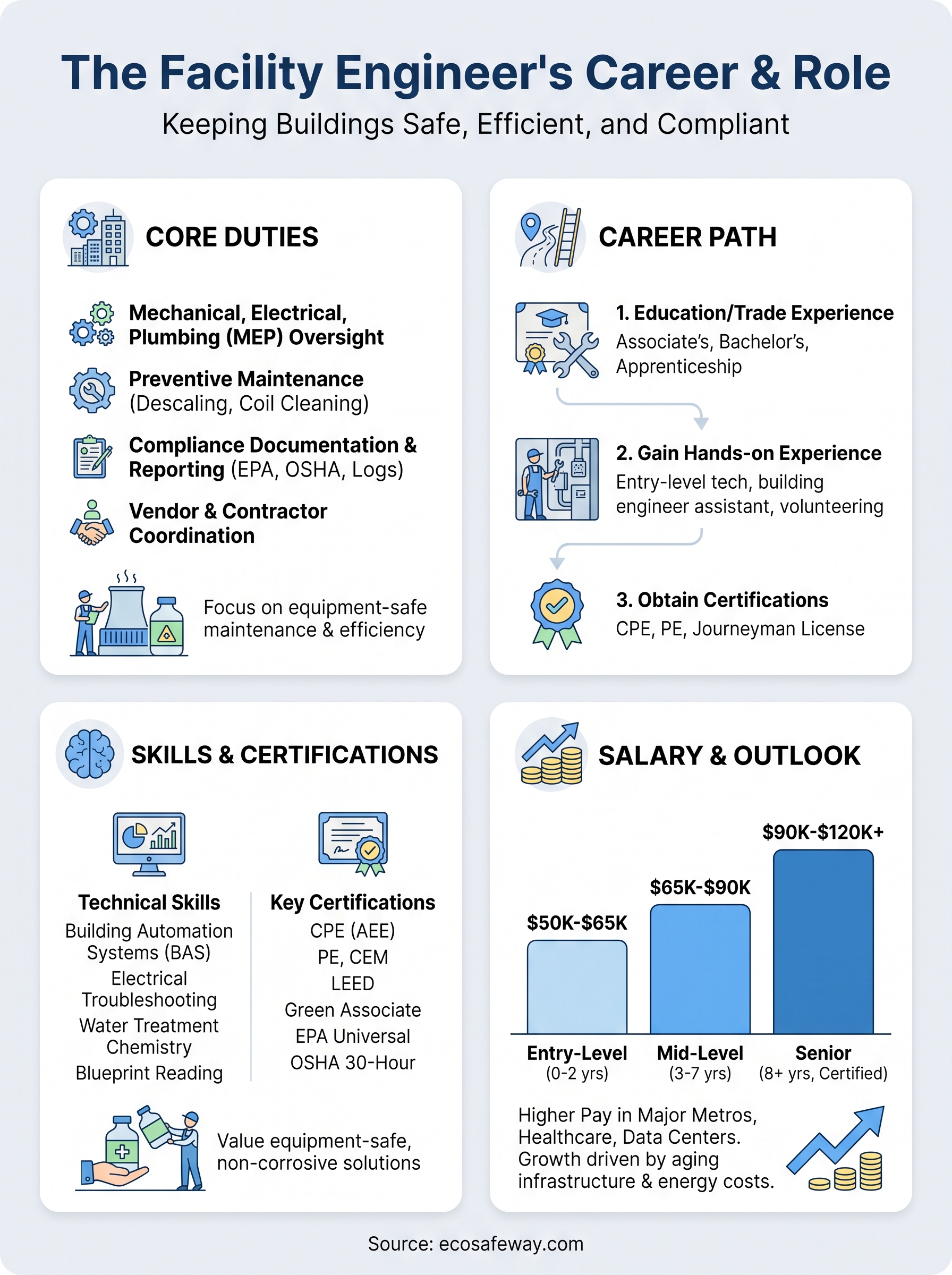
A facility engineer's job comes down to one thing: keeping a building's mechanical, electrical, and plumbing systems running before anyone notices a problem. Getting there takes a mix of technical education, hands-on trade time, and certifications like the CPE or PE that prove you can handle the equipment, not just talk about it. Pay scales with complexity and certification, not just years worked, and titles like building engineer or stationary engineer often describe the same core work under a different label. Landing the right role means looking past generic job boards toward association listings, employer career pages, and the professional network you build along the way.
Whichever path you're on, the equipment-safe habits you build early protect the systems you'll manage for decades. If you're ready to put that into practice, start with Eco Safeway's non-corrosive cooling tower descaler built for the exact maintenance schedule this role depends on.


