





If you manage a building, plant, or data center, you've probably heard someone mention the chillers without ever getting a clear answer on what the equipment actually does. That gap matters when you're the one signing off on maintenance contracts or troubleshooting a cooling failure at 2 a.m.
A chiller is a machine that removes heat from a liquid, usually water or a water-glycol mix, and sends that cooled liquid through your building or process equipment to absorb heat and keep temperatures stable. This article explains how chiller systems work, walks through the refrigeration cycle in plain terms, and breaks down the main types you'll encounter, including air-cooled, water-cooled, absorption, and centrifugal chillers.
You'll also see why chiller maintenance determines how long the system lasts and how much it costs to run. Scale buildup, dirty condenser coils, and corrosion inside the loop are the usual culprits behind rising energy bills and early equipment failure. We'll point out where non-toxic, non-corrosive cleaning approaches fit into a maintenance plan, so you can protect the equipment without introducing hazardous chemicals into your facility.
Why chillers matter for industrial and commercial cooling
Cooling isn't optional in most commercial and industrial settings. Chillers keep server rooms from overheating, hold hospital operating suites at precise temperatures, and stop production lines from grinding to a halt when equipment runs hot. Without reliable chilled water or glycol circulating through the system, you're not just uncomfortable, you're looking at spoiled product, failed equipment, or a shutdown that costs far more than the electricity bill ever would.
The financial stakes behind a failed chiller
Downtime is where the real damage happens. A chiller failure at a data center can trigger server throttling or shutdowns within minutes, and a facility running cold storage can lose an entire batch of inventory before a technician even arrives on site. Hospitals face similar exposure, since HVAC failures can compromise infection control in sensitive areas. These aren't hypothetical risks; they're the reason facility managers budget for preventive maintenance instead of waiting for a breakdown.
A chiller failure rarely stays a mechanical problem for long, it becomes a financial one fast.
Where chillers carry the most weight
Some environments simply can't tolerate temperature swings, and that's where chiller reliability matters most:
- Data centers, where server rack temperatures need to stay within a narrow band to prevent hardware damage
- Hospitals and labs, where medication storage and sterile processing depend on consistent cooling
- Manufacturing plants, where injection molding, chemical processing, and food production all rely on temperature control
- Commercial buildings, where occupant comfort and air quality tie directly to chiller performance
Teams that treat chillers as background infrastructure usually pay for it later, either through emergency repair calls or through the slow creep of higher energy bills as the system loses efficiency. Understanding what a chiller does and how it fits into your broader cooling strategy puts you in a better position to catch small problems before they become expensive ones.
How chillers work: the refrigeration cycle explained
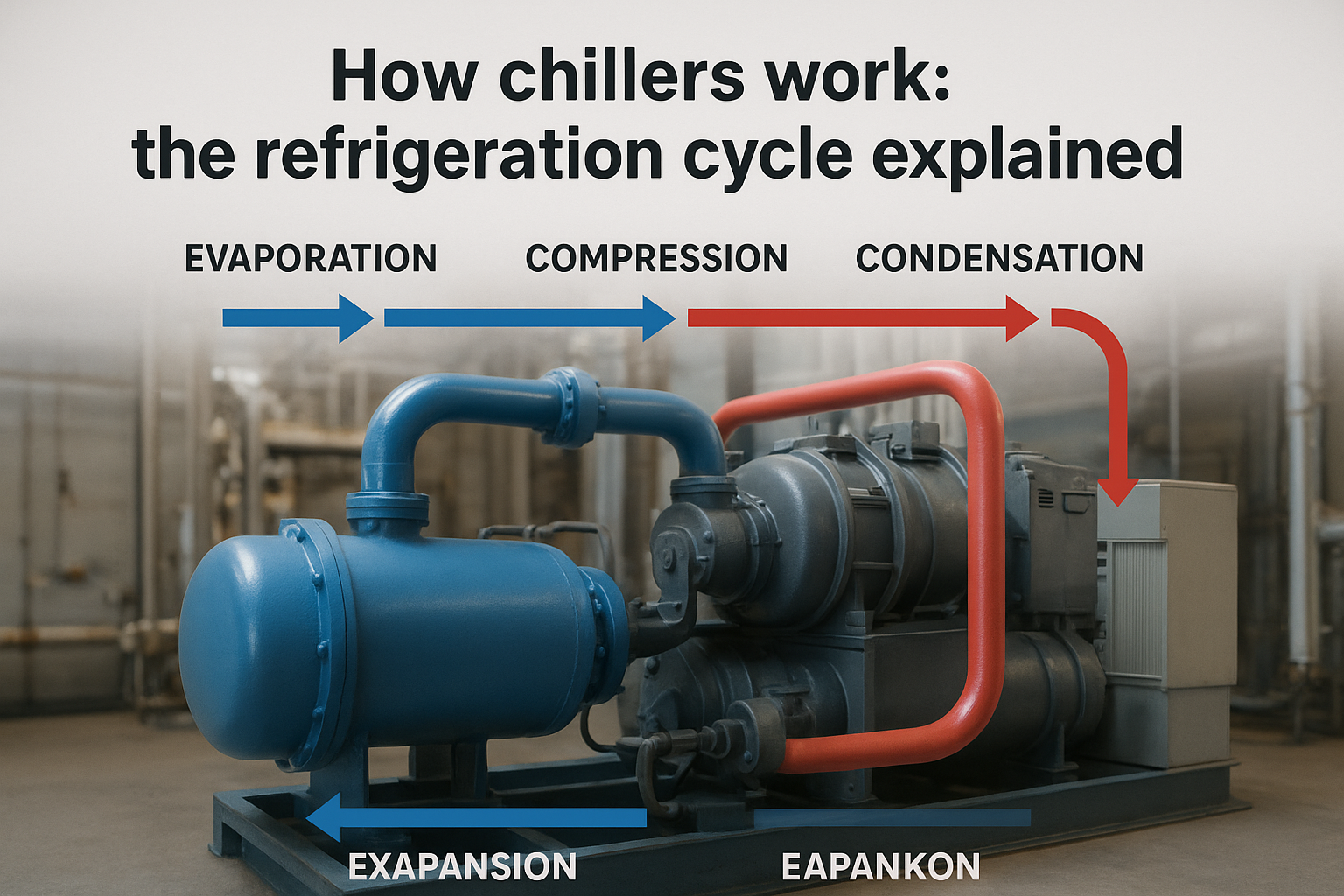
Every chiller runs on the same basic principle: heat moves from a warmer substance to a cooler one, and refrigerant makes that transfer happen efficiently. The refrigeration cycle has four stages, and once you understand them, troubleshooting a chiller stops feeling like guesswork.
The four stages of the cycle
Here's how refrigerant moves through a chiller, absorbing and releasing heat at each step:
- Evaporation: Low-pressure liquid refrigerant absorbs heat from the water loop and turns into a gas, cooling the water in the process.
- Compression: The compressor squeezes that gas, raising its pressure and temperature.
- Condensation: The hot, high-pressure gas releases heat, either to outside air (air-cooled) or a separate water loop (water-cooled), and condenses back into a liquid.
- Expansion: The liquid passes through an expansion valve, dropping in pressure and temperature before returning to the evaporator to start over.
The refrigeration cycle never stops moving heat, it just relocates it from where you don't want it to where you can release it safely.
The compressor is the workhorse in this loop, and it's usually the first component to fail if the refrigerant charge is off or the condenser coils are caked in scale. That's why coil condition and refrigerant levels get flagged first in any chiller inspection. A dirty coil forces the compressor to work harder to reject the same amount of heat, which drives up energy use and shortens the equipment's service life.
Types of chillers and how they differ
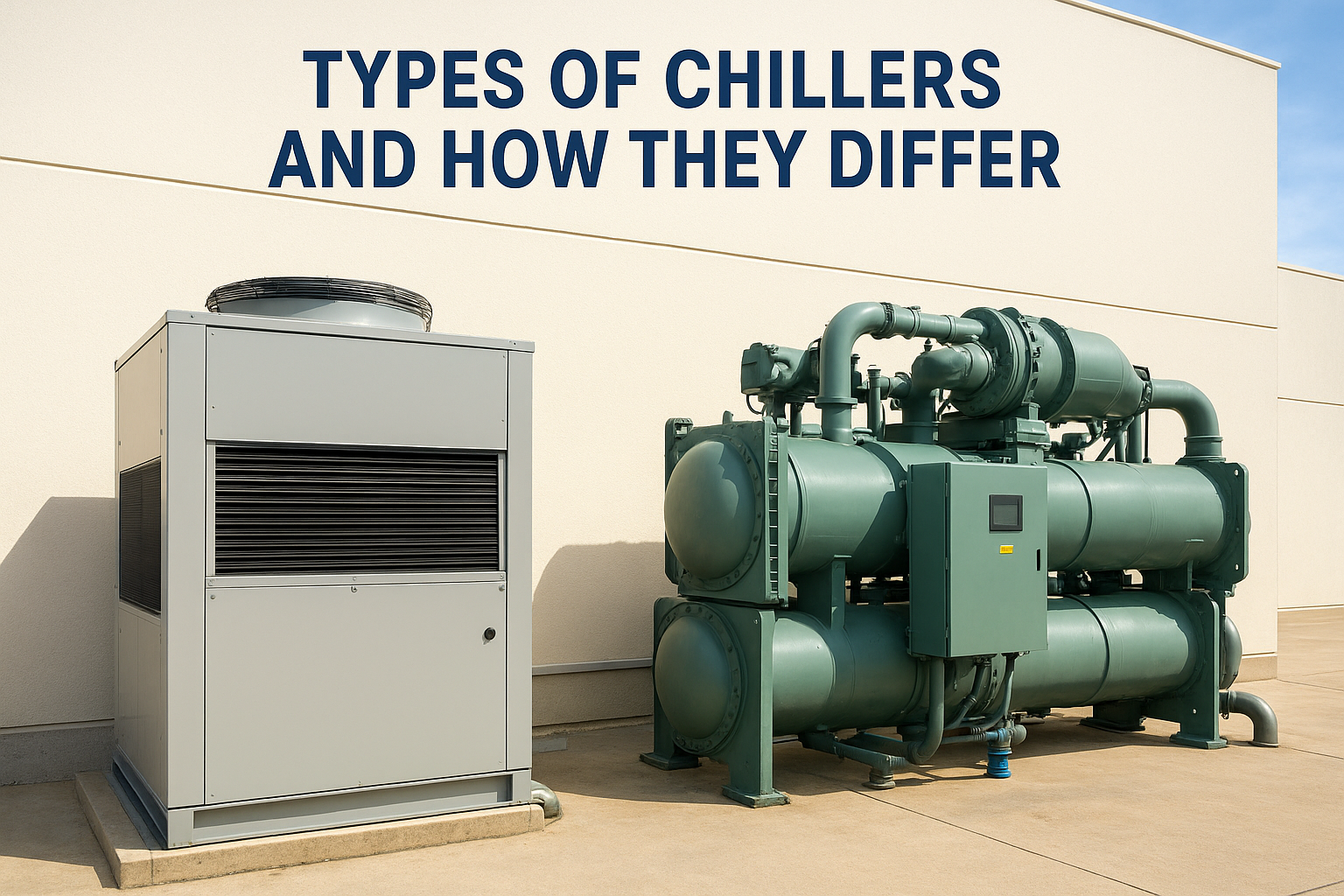
Not every chiller fits every job, and the type you pick depends on available space, water access, and how much heat you need to reject. The two broad categories are air-cooled chillers, which dump heat straight into the outside air through a condenser fan, and water-cooled chillers, which reject heat into a separate water loop tied to a cooling tower. Water-cooled units run more efficiently and last longer, but they need tower maintenance and more plumbing, while air-cooled units skip the tower entirely and install faster in tight spaces.
Compressor design changes the picture too
Within those two categories, the compressor type sets performance and maintenance needs apart. Centrifugal chillers handle large commercial loads efficiently using a spinning impeller, screw chillers use rotating screws for steady mid-size loads, and absorption chillers skip mechanical compression altogether, relying on heat sources like steam or waste heat instead of electricity.
The chiller type you choose locks in your maintenance routine for the next 15 to 20 years, so match it to your actual load, not just your budget today.
| Type | Heat rejection | Best fit |
|---|---|---|
| Air-cooled | Outside air | Smaller buildings, limited water access |
| Water-cooled | Cooling tower loop | Large commercial and industrial sites |
| Centrifugal | Water-cooled | High-tonnage cooling loads |
| Absorption | Water-cooled | Sites with waste heat or steam available |
Each type scales differently against energy costs, so matching capacity to actual demand keeps operating expenses predictable rather than reactive.
Where chillers are used across industries
Chillers show up anywhere a process or building generates more heat than it can shed on its own. Beyond the data centers and hospitals already mentioned, you'll find chilled water loops running through plastics plants, breweries, laser cutting operations, and even the HVAC systems cooling shopping malls. The common thread is a need for consistent, controllable temperatures, whether that's protecting a product batch or keeping people comfortable.
Industrial process cooling
Manufacturing relies on chillers to hold tight tolerances that outdoor air alone can't guarantee. Process cooling shows up in:
- Injection molding, where inconsistent mold temperatures ruin plastic parts
- Metal finishing and laser cutting, where heat buildup warps tolerances
- Food and beverage production, where pasteurization and fermentation both need precise cooling
- Pharmaceutical manufacturing, where reaction temperatures affect product stability
A chiller isn't just climate control, it's often the difference between a product meeting spec and getting scrapped.
Marine and specialty applications
Marine operations depend on chillers too, particularly aboard larger vessels where air conditioning and refrigerated storage both draw from a central chilled water system. Marina facilities and boatyards also run chillers for maintenance shops and parts storage, and the same scale and corrosion issues that plague land-based systems show up faster in a saltwater environment. Facilities managing marine equipment alongside standard HVAC often end up maintaining several chiller types under one roof, which makes a consistent cleaning and inspection routine even more valuable.
Keeping a chiller running efficiently
Efficiency in a chiller loop comes down to one thing: how easily heat moves through the system. Scale buildup on condenser tubes and coils acts like an insulating blanket, forcing the compressor to run longer and harder to hit the same cooling target. That extra runtime shows up directly on your utility bill, and it wears down bearings and seals faster than normal operation would.
Watch these failure points first
A few components account for most chiller efficiency losses, so inspect them on a set schedule rather than waiting for a problem:
- Condenser and evaporator tubes for mineral scale
- Refrigerant charge levels against manufacturer specs
- Water flow rates through the cooling tower loop
- Compressor oil condition and pressure readings
A chiller loses efficiency quietly for months before it fails loudly, which is why scheduled inspections matter more than emergency repairs.
Choosing safer cleaning methods
Harsh acid descalers strip scale but also attack copper tubing and gaskets over time, trading one maintenance problem for another. Non-corrosive, biodegradable cleaners remove mineral deposits without degrading metal surfaces or triggering hazmat handling requirements for your maintenance crew. Selecting a product that carries a solid safety rating, similar to what the EPA's Safer Choice program outlines for chemical formulations, keeps your team out of respirators and gloves while still restoring full heat transfer across the coils.
What to remember about chillers
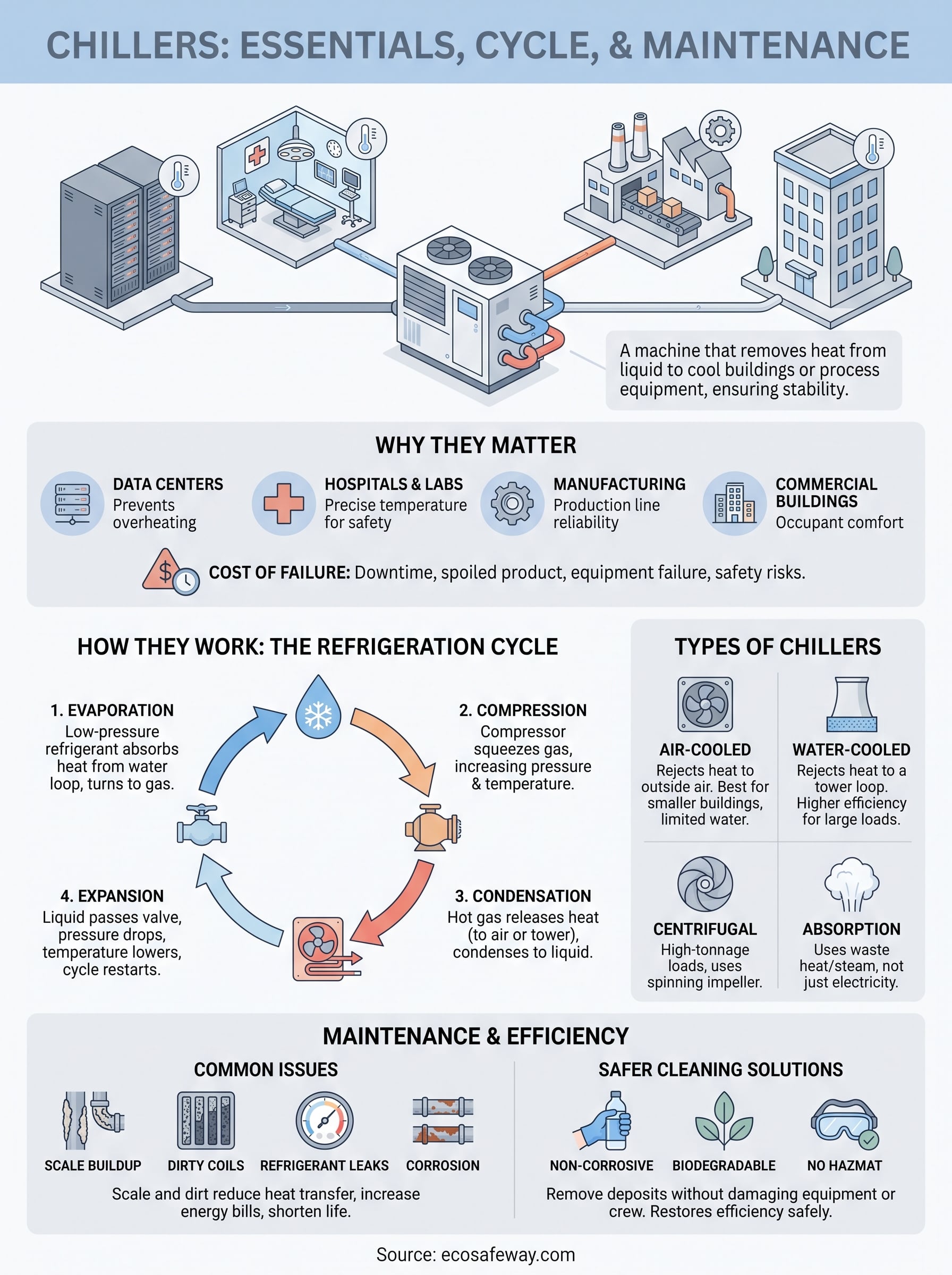
A chiller's job is simple: move heat out of your building or process and reject it somewhere safe. The four-stage refrigeration cycle stays the same whether you're running an air-cooled unit on a rooftop or a centrifugal chiller feeding a hospital campus. What changes is how much maintenance that system demands, and scale buildup on condenser coils is still the fastest route to higher energy bills and early compressor failure.
You don't have to choose between protecting your chiller and protecting your crew from harsh chemicals. Non-corrosive descalers clear mineral deposits and restore heat transfer without the hazmat handling, respirators, or gasket damage that acid-based products bring into your maintenance routine.
If you're maintaining chillers, cooling towers, or CRAC units right now, check out Eco Safeway's industrial HVAC and cooling tower descaler before your next scheduled service.


