





If a piece of equipment is running hot, losing efficiency, or scaling up faster than it should, the problem often traces back to a heat exchanger that isn't transferring heat the way it was designed to. Whether you're managing a cooling tower, a condenser system, or a marine engine, understanding this component matters more than most facility teams realize until something fails.
A heat exchanger is a device built to move thermal energy from one fluid to another without letting the two mix. That's the whole job: transfer heat efficiently while keeping the fluids separated by a wall of metal, usually copper, steel, or aluminum tubing or plates. The design varies depending on the application, but the physics stays the same, and the types of heat exchangers you'll encounter in HVAC and industrial settings each solve that problem differently.
In this article, we'll break down exactly what a heat exchanger is, walk through how heat actually moves across it, and cover the main types you'll find in cooling towers, condensers, chillers, and marine cooling systems. By the end, you'll know enough to spot when a heat exchanger is underperforming and why scale buildup is usually the culprit.
Why heat exchangers matter for efficiency and safety
Every degree a heat exchanger fails to transfer costs someone money, whether that's a facility manager watching utility bills climb or a boat owner running an engine harder than it needs to work. Because heat exchangers sit at the center of nearly every cooling and heating system, their condition directly determines how much energy the whole system consumes. A chiller, cooling tower, or marine engine can look fine from the outside while the exchanger inside is coated in scale, sediment, or biofilm, quietly forcing the equipment to work harder for the same output. That hidden inefficiency is why heat exchangers deserve more attention than most maintenance schedules give them.
Energy costs climb fast when heat transfer slows
Scale and mineral deposits act like insulation on the wrong side of the equation. Even a thin layer of scale dramatically slows how fast heat moves across the exchanger surface, and the system compensates by running longer, hotter, or under more pressure to hit the same setpoint. The U.S. Department of Energy has repeatedly flagged fouled heat transfer surfaces as one of the most common, and most preventable, sources of wasted energy in commercial buildings (energy.gov).
| Scale Buildup Thickness | Approximate Efficiency Loss |
|---|---|
| 1/32 inch | 8–10% |
| 1/16 inch | 15–18% |
| 1/8 inch | 25%+ |
| 1/4 inch | 35–40% |
A quarter-inch of scale on a heat exchanger can waste nearly as much energy as running the equipment with a broken compressor.
Figures like that add up quickly across a building running multiple cooling towers or condenser units around the clock, and they explain why energy bills often climb months before anyone notices a mechanical problem.
Equipment lifespan and unplanned downtime
Overworking a heat exchanger doesn't just raise the electric bill, it shortens the life of everything connected to it. Compressors cycle more often, pumps push against higher resistance, and metal surfaces corrode faster once scale traps moisture and chemicals against the tube walls. Marine engines face the same fate: a raw water cooling system clogged with scale forces the engine to run hotter, accelerating wear on gaskets, seals, and impellers that are expensive and slow to replace mid-season. Property managers and marina operators who ignore early warning signs, like rising discharge temperatures or falling flow rates, often end up replacing entire units years ahead of the manufacturer's rated lifespan, turning a cleaning problem into a capital expense.
Safety risks when heat exchangers fail
Neglected heat exchangers create safety problems that go well beyond wasted energy. Cooling towers with poor heat transfer run warmer than intended, and warm, stagnant water is exactly the environment Legionella bacteria needs to multiply, a risk the CDC has flagged repeatedly for building and facility operators (cdc.gov). Cracked or corroded exchangers in furnaces and boilers can allow combustion gases, including carbon monoxide, to leak into occupied spaces instead of venting outside. Hospitals and data centers depend on reliable heat exchange to keep sensitive equipment and patients safe, and a failing exchanger can mean lost cooling capacity at the exact moment it's needed most.
Given all of that, treating heat exchanger upkeep as optional is a costly bet on both fronts. Properly maintained exchangers protect the budget and the people relying on the systems built around them, which is exactly why understanding how they actually work, and what keeps them clean, matters as much as knowing they exist.
How heat exchangers transfer heat
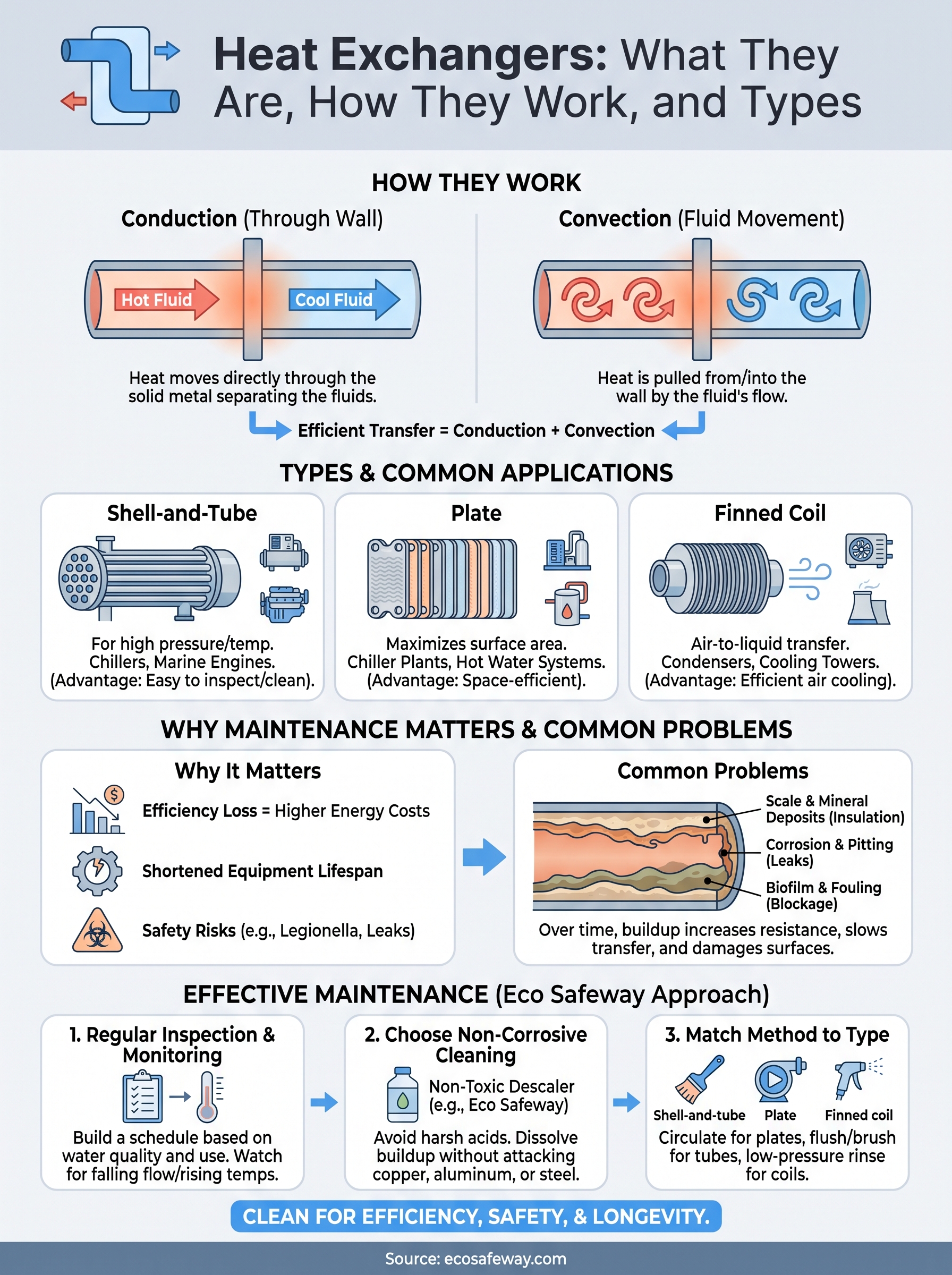
Heat exchangers move thermal energy through two physical processes working together: conduction through the solid wall separating the fluids, and convection as heat moves into and out of that wall from the fluids themselves. Neither process needs the fluids to touch. A hot fluid on one side gives up energy to the wall, the wall conducts that energy through its thickness, and a cooler fluid on the other side picks it up and carries it away. That simple three-step handoff is the entire mechanism behind every cooling tower condenser, chiller barrel, and marine engine cooler on the market.
Conduction through the wall material
Conduction happens the moment heat hits the metal separating the two fluids, and the rate depends heavily on what that metal is and how thick it's built. Copper and aluminum conduct heat far faster than stainless steel, which is why so many condenser coils and plate exchangers rely on those metals despite their higher cost. Wall thickness matters too, since a thinner tube or plate lets heat cross faster, but it also has to hold up under pressure and resist corrosion over years of service. Scale buildup on either surface works against all of this, since mineral deposits conduct heat far worse than the metal underneath and effectively insulate the exchanger from the inside out.
Convection moving heat into and out of the fluid
Convection is what pulls heat away from the wall and into the bulk fluid, and it depends on how fast that fluid is moving across the surface. Faster flow rates disturb the boundary layer of fluid clinging to the wall, which lets fresh, cooler fluid reach the surface more often and pick up more heat per second. Pumps and fans exist largely to maximize this effect, pushing water or air across the exchanger surface at a rate that keeps convection working at full strength. Slow, sluggish flow, often caused by scale narrowing tube openings or fouling clogging fins, cuts convection efficiency even when the metal itself is clean.
Flow arrangement changes overall efficiency
Arrangement decides how much total heat transfer you get out of a given exchanger size, and engineers generally sort designs into three patterns.
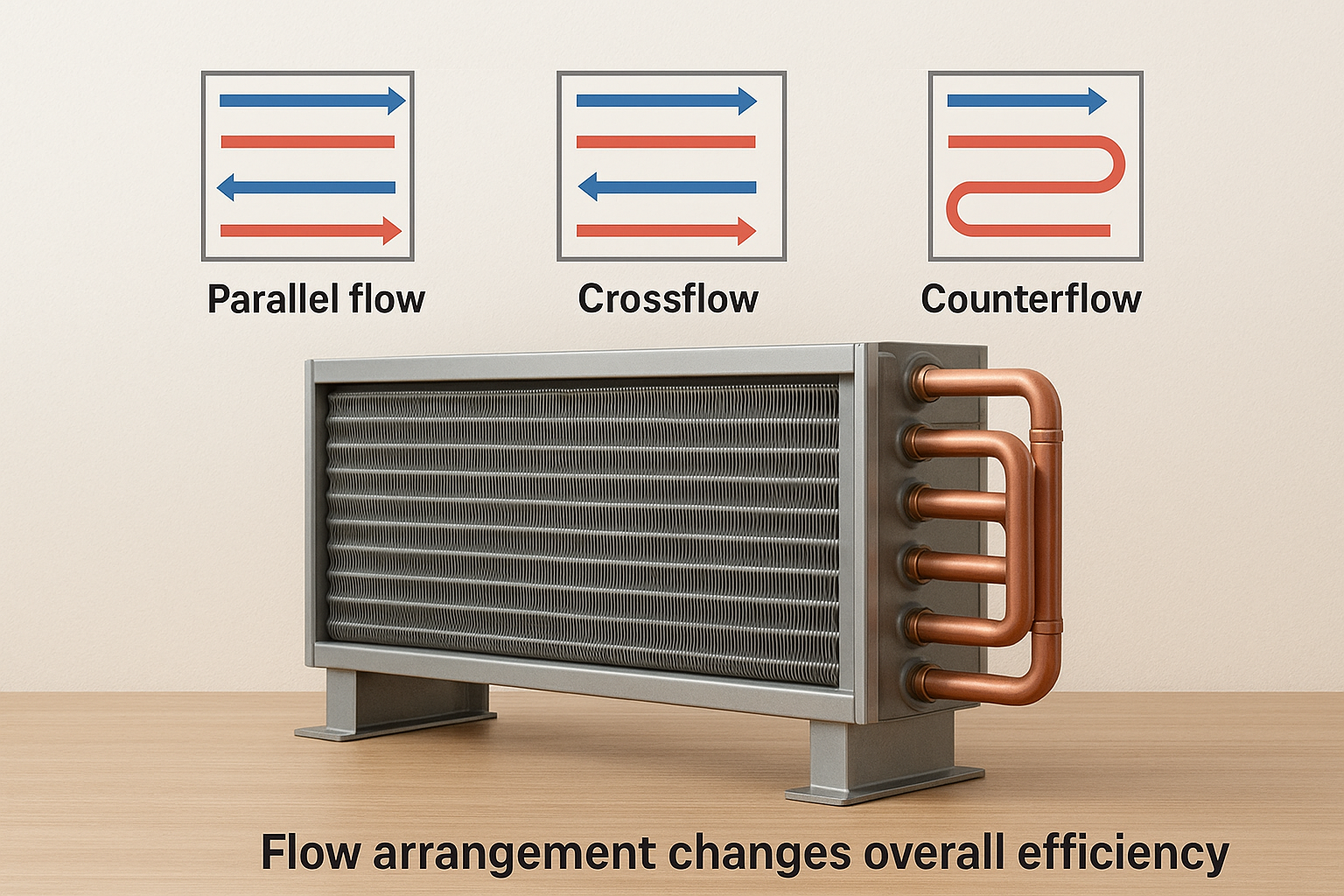
| Flow Arrangement | How Fluids Move | Relative Efficiency |
|---|---|---|
| Parallel flow | Same direction | Lowest |
| Crossflow | Perpendicular paths | Moderate |
| Counterflow | Opposite directions | Highest |
Counterflow arrangements consistently outperform parallel designs because they maintain a bigger temperature difference across the entire length of the exchanger.
That's why most high-performance condensers and plate exchangers favor counterflow or crossflow layouts over simple parallel designs, squeezing more heat transfer out of the same footprint.
Types of heat exchangers used in HVAC and industry
Not every system needs the same kind of heat exchanger, and picking the wrong type for the job usually shows up later as poor efficiency or premature failure. The three designs you'll run into most often across HVAC, industrial, and marine equipment are shell-and-tube, plate, and finned coil exchangers, each built around a different way of packing surface area into a manageable footprint.
Shell-and-tube exchangers
Shell-and-tube designs run one fluid through a bundle of tubes while a second fluid flows around them inside an outer shell. Chillers and steam systems rely on this layout because it handles high pressure and high temperature differences without much trouble, and the tube bundle can be pulled out for inspection or cleaning when scale builds up. Marine engine coolers often use a compact version of this same principle, circulating raw water through tubes while engine coolant passes around them, which is exactly why scale control matters so much in raw water flush routines.
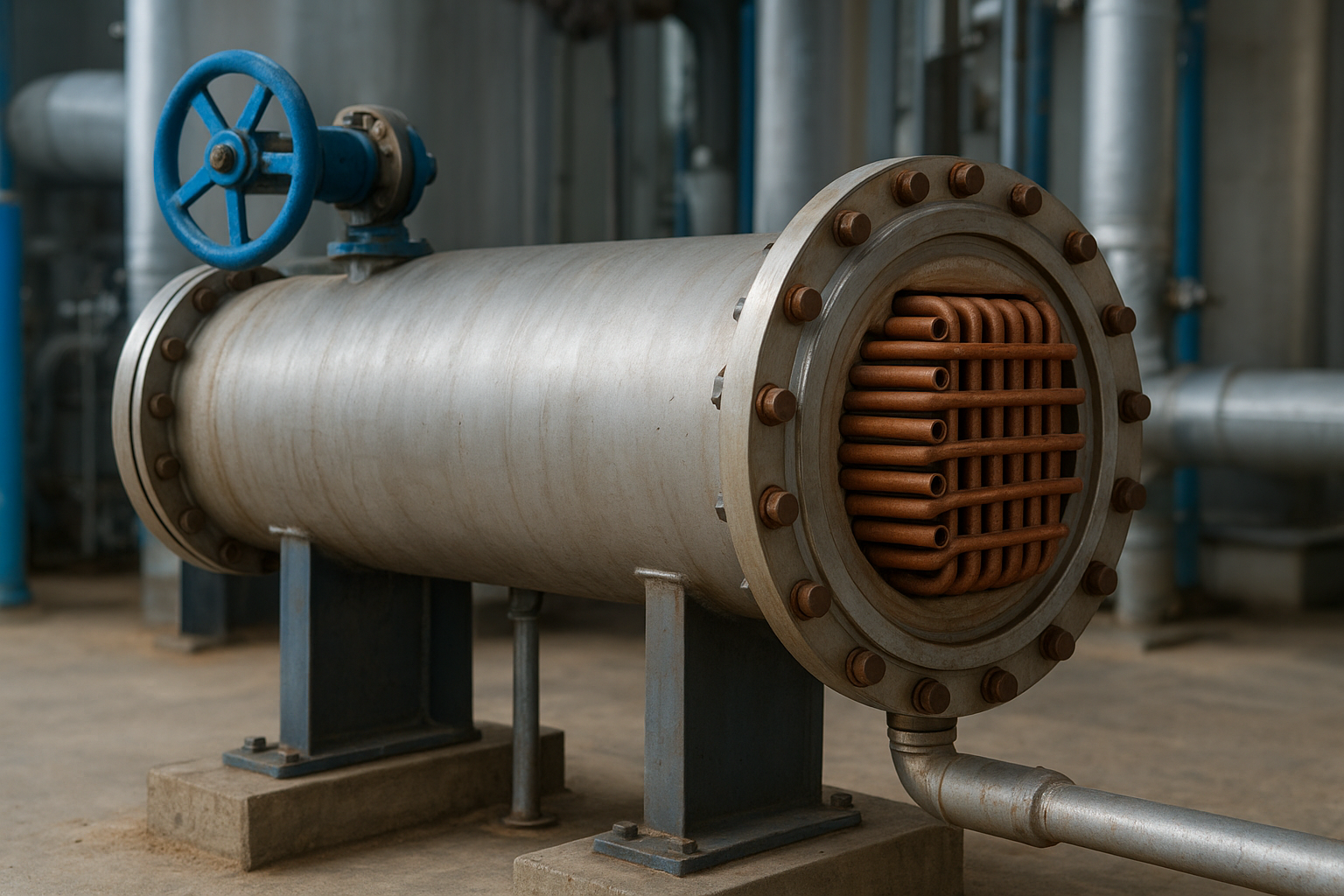
Plate heat exchangers
Plate exchangers stack thin metal plates with channels between them, forcing hot and cold fluids into extremely close contact across a huge surface area for their size. That design makes them the most space-efficient option on this list, and it's why so many modern chiller plants and hot water systems have shifted toward plates over older shell-and-tube units.
Plate exchangers deliver more heat transfer per square foot than any other common design, which is exactly why narrow mechanical rooms rely on them.
The tradeoff is that the tight channels foul faster than wider tubes, so regular cleaning becomes non-negotiable rather than optional.
Finned coil and condenser exchangers
Finned coils show up wherever air needs to exchange heat with a liquid or refrigerant, which covers most condenser units, cooling towers, and air handlers. Metal fins attached to the tubing multiply the surface area exposed to airflow, letting a fan-driven system move a lot of heat without needing liquid on both sides. Dust, debris, and mineral scale on the fins block airflow and insulate the coil at the same time, which is why coil cleaning shows up so often on HVAC maintenance checklists.
| Type | Best Suited For | Key Advantage |
|---|---|---|
| Shell-and-tube | Chillers, steam systems, marine engines | Handles high pressure, easy to inspect |
| Plate | Chiller plants, hot water systems | Maximum surface area per footprint |
| Finned coil | Condensers, cooling towers, air handlers | Efficient air-to-liquid transfer |
Whichever type you're working with, the underlying goal stays the same: keep the surfaces clean enough that conduction and convection can do their jobs without resistance.
Common heat exchanger problems and warning signs
Most heat exchanger failures don't happen overnight. They build slowly through scale, fouling, and corrosion until a system that used to run quietly starts throwing off warning signs. Catching those signs early is the difference between a routine cleaning and a full unit replacement, and it starts with knowing what to watch for on heat exchangers across HVAC and marine equipment.
Scale and mineral deposits
Scale forms when dissolved minerals in water, mainly calcium and magnesium, drop out of solution and cling to hot surfaces. Once that layer starts forming, it grows fast, because rough mineral deposits give new scale even more surface area to attach to. Hard water areas see this problem accelerate within months, while even moderate water hardness can coat a cooling tower condenser within a season of continuous operation. Left alone, scale doesn't just insulate the exchanger, it also narrows tube openings enough to choke flow and drop convection efficiency at the same time.
Corrosion and pitting
Corrosion attacks the metal itself rather than just coating it, and it's usually more dangerous because it can lead to leaks and cross-contamination between fluids. Trapped moisture under scale creates the exact conditions corrosion needs, since mineral deposits hold water and dissolved chemicals against the tube wall long after the surrounding area has dried out. Marine raw water systems face an especially harsh version of this problem, since saltwater accelerates galvanic corrosion on any exposed or poorly protected metal.
A heat exchanger rarely fails because of one big problem. It fails because small deposits were never removed and corrosion had years to work underneath them.
Reduced flow and airflow blockages
Blockages show up on both the liquid and air sides of an exchanger, and either one throttles performance in a hurry. Sediment, debris, and biological growth narrow tube interiors on the liquid side, while dust and mineral scale mat down the fins on finned coil units and choke off airflow. Falling flow rates are one of the clearest early indicators of a developing blockage, and they're worth tracking on a gauge rather than waiting for a temperature complaint.
Typical warning signs to watch for include:
- Rising discharge or return water temperatures without a change in load
- Unexplained increases in energy consumption month over month
- Visible white, green, or rust-colored deposits on accessible surfaces
- Reduced airflow or a musty smell coming from coils and cooling towers
- Slower flow rates or rising pump pressure at the same setpoint
- Unusual noise, vibration, or cycling from compressors and pumps
Biological growth and fouling
Organic fouling from algae, biofilm, and bacterial growth adds a layer that behaves a lot like scale but grows even faster in warm, stagnant conditions. Cooling towers and marine cooling systems are especially prone to this kind of buildup, since both offer the warm water and steady nutrient supply biofilm needs to spread across tube and plate surfaces.
How to maintain and clean heat exchangers effectively
Once you know scale, corrosion, and fouling are the enemies, maintenance becomes a matter of routine rather than guesswork. Regular inspection and cleaning keeps conduction and convection working the way they were designed to, and it costs far less than replacing a unit that was allowed to scale over for years. The goal isn't a one-time fix, it's a schedule that catches buildup before it narrows tubes or traps corrosive moisture against the metal.
Build a cleaning schedule based on water quality and use
How often you clean a heat exchanger depends on your water hardness, run hours, and system type, not a generic calendar reminder. Hard water systems need attention every one to three months, while softer water or lower-duty units might stretch to twice a year without much risk. Marine raw water systems deserve their own schedule tied to how often the vessel runs, since saltwater accelerates scale and corrosion far faster than freshwater cooling loops.
Sample inspection checklist:
- Check discharge/return temperatures against baseline
- Record flow rate or pump pressure
- Visually inspect accessible tubes, plates, or fins for deposits
- Note any unusual noise, vibration, or odor
- Log findings and compare month over month
Choose a cleaning method that won't damage the metal
Mechanical brushing and acid cleaning have been the default for decades, but both carry real downsides. Aggressive acid descalers strip scale fast, then leave behind pitting and weakened metal that shortens the exchanger's service life, which just trades one problem for another down the road. A better approach uses a non-corrosive, non-toxic descaling treatment that dissolves mineral buildup without attacking copper, aluminum, or steel, so you get clean surfaces without the hazmat handling, off-gassing, or disposal restrictions that come with harsh acids.
The best descaler is the one that removes scale without also removing years off the equipment's life.
Match the cleaning approach to the exchanger type
Shell-and-tube units usually allow the bundle to be pulled for a thorough soak or flush, while plate exchangers often need a circulated cleaning solution pushed through the tight channels since they can't be easily disassembled in the field. Finned coil units respond best to a coil cleaner that penetrates between fins without bending them, paired with a low-pressure rinse to clear loosened debris. Eco Safeway's non-toxic descalers and coil cleaners are built around this exact requirement, delivering professional-grade cleaning power with an HMIS 0-0-0 rating so facility teams and marine operators can clean equipment-safe surfaces without acids, fumes, or special shipping restrictions.
Whatever method you choose, treat cleaning as prevention rather than repair. Waiting until performance visibly drops means scale has already been working against the exchanger for months, and by then you're paying for both the energy waste and the cleaning job at once.
Keeping heat exchangers running at their best
A heat exchanger only does its job when conduction and convection can work freely across a clean surface. Scale, corrosion, and biological fouling all attack that surface in the same way, by adding resistance where there shouldn't be any. Understanding how heat transfer actually works gives you a reason to take cleaning schedules seriously instead of treating them as an afterthought once temperatures climb or bills spike.
Whether you're managing a cooling tower, a condenser bank, or a marine raw water system, the fix is the same: catch buildup early and remove it without damaging the metal underneath. Non-corrosive descaling protects both the exchanger and the equipment connected to it, which is exactly the tradeoff harsh acid cleaners fail to make. If your cooling tower or chiller system is due for attention, look into an industrial HVAC cooling tower descaler built to clean without corroding what it touches.


