





Not every product labeled "green" or "natural" actually breaks down the way you'd expect. If you manage HVAC systems, ice machines, cooling towers, or marine equipment, you've probably noticed that a biodegradable cleaner claim on a label doesn't always come with real evidence behind it. That gap between marketing language and verified performance matters when you're trying to meet environmental regulations, protect equipment, or avoid disposal headaches for hazardous residue.
A truly biodegradable cleaner breaks down into water, carbon dioxide, and biomass within a defined timeframe, without leaving behind toxic byproducts. That distinction separates genuine eco-friendly formulas from products that simply avoid a few restricted chemicals while still harming waterways or requiring hazmat handling during disposal. Understanding the certification standards and testing methods behind these claims puts you in a much stronger position when comparing products.
This article breaks down what makes a cleaner biodegradable, the certifications worth trusting, and how to evaluate options for facility maintenance or marine applications where regulatory compliance and equipment safety both matter.
Why biodegradable cleaners matter
Facility managers and marine professionals don't switch to biodegradable formulas for marketing reasons. They switch because the alternative creates real, measurable problems: contaminated discharge water, hazmat disposal fees, and equipment that corrodes faster than it should. When a conventional degreaser or acid-based descaler washes down a drain or gets rinsed off a hull into a marina, it doesn't just disappear. It persists in soil, groundwater, or coastal water long enough to harm the organisms living there, and long enough for regulators to notice.
Regulatory pressure is only increasing
Government agencies at every level are tightening rules around what commercial operations can discharge into public waterways and sewer systems. The EPA's Clean Water Act permitting programs already restrict what facilities can legally release, and many municipalities layer on their own pretreatment standards for cooling tower blowdown, condensate, and wash water. Marinas face similar scrutiny under state and local marine sanitation rules, especially in states like Florida where boat traffic concentrates in sensitive coastal zones. Facilities caught discharging non-compliant wastewater don't just pay fines. They lose operating permits, and that shuts down business.
A biodegradable cleaner isn't a courtesy to the environment. It's a compliance strategy that also happens to protect your equipment.
That single sentence captures why so many procurement teams have shifted their specifications in the last five years. It's not idealism. It's risk management.
Equipment protection is a bigger factor than most people expect
Harsh acid-based descalers and solvent-heavy degreasers don't just threaten the environment outside your facility. They attack the metal, gaskets, and coatings inside your HVAC coils, cooling towers, and ice machines while they clean. Aggressive chemistry pulls double duty: it strips scale and biofilm, but it also pits copper coils and degrades rubber seals over repeated use. A well-formulated biodegradable industrial descaler or coil cleaner does the job without that collateral damage, which is why so many of Eco Safeway's HVAC coil cleaning and industrial descaling customers made the switch after seeing premature coil failures tied to conventional chemistry.
Marine equipment faces the same trade-off. Raw water systems, heat exchangers, and marine AC units run saltwater or brackish water through tight tolerances every day. A cleaner that leaves acidic residue behind accelerates corrosion in exactly the components you're trying to protect. Choosing an eco-friendly marine descaler built around biodegradable chemistry reduces that long-term wear while still clearing scale and mineral buildup effectively.
Worker safety and disposal costs add up fast
Hazardous cleaning chemicals require protective gear, ventilation, and specialized disposal procedures under OSHA and EPA hazardous waste rules. Every one of those requirements costs money and time. Workers need training on handling procedures. Facilities need documented disposal manifests for anything classified as hazardous waste. A genuinely biodegradable formula that meets non-toxic thresholds often sidesteps those requirements entirely, which simplifies daily operations for maintenance crews who'd rather spend their time cleaning than filling out compliance paperwork.
| Factor | Conventional cleaner | Biodegradable cleaner |
|---|---|---|
| Waterway impact | Can persist and harm aquatic life | Breaks down into water, CO2, biomass |
| Disposal requirements | Often hazmat handling and manifests | Typically standard disposal |
| Equipment corrosion risk | Higher with acid/solvent formulas | Lower with balanced pH formulas |
| Worker PPE needs | Frequently extensive | Usually minimal |
| Regulatory exposure | Higher, especially near waterways | Lower when properly certified |
Understanding these trade-offs helps you see why the term biodegradable cleaner carries real operational weight, not just an environmental label. Facilities that operate near coastlines, in data centers with strict discharge permits, or in commercial kitchens juggling eco-friendly drain maintenance and health codes all have a direct financial reason to verify what's actually in the bottle. The next question, and the one most buyers get wrong, is how to tell a genuinely biodegradable product from one that just uses the word loosely.
How to choose a genuinely biodegradable cleaner
Reading a label closely tells you more than any marketing claim on the front of the bottle. Look for the actual test standard referenced on the packaging or safety data sheet, something like OECD 301B or ASTM D5864, rather than a vague phrase like "plant-based" or "eco formula." Manufacturers that have actually run the testing will cite the standard and the percentage of biodegradation achieved within a specific window, usually 28 days. If a product only says "biodegradable" with no reference to a method or timeframe, treat that as a marketing claim until proven otherwise.
Requesting the safety data sheet (SDS) before you buy in volume saves you from surprises later. The SDS lists the active ingredients, pH range, and disposal guidance, and it tells you whether the product still qualifies as hazardous waste despite the biodegradable claim on the front label. Some formulas biodegrade eventually but still carry acute toxicity to aquatic organisms in the short term, which matters if your discharge goes straight into a storm drain or marina basin. Cross-checking the SDS against your local discharge permit is the single most reliable step in this whole process.
If a manufacturer can't produce a test standard, a percentage, and a timeframe, the biodegradable claim is marketing, not data.
Match the formula to your actual application
A cleaner that's genuinely biodegradable in a lab test still needs to perform on your specific equipment. An HVAC coil covered in years of biofilm needs different chemistry than a marine hull dealing with salt scale, and a product formulated for one won't necessarily work as well on the other. Before committing to a large purchase, run a small batch test on the actual surface or system you're treating, and confirm the pH and dilution ratio match the manufacturer's documented use case rather than a generic "all-purpose" claim.
Use a short checklist before you buy
Working through a consistent checklist keeps you from getting talked into a product based on packaging alone. Before you approve a new biodegradable cleaner for facility or marine use, confirm:
- The label or SDS cites a recognized biodegradation test standard (OECD, ASTM, or ISO)
- The stated biodegradation percentage and timeframe are disclosed, not just implied
- Ingredient disclosure is available on request, even if the full formula is proprietary
- Disposal guidance matches standard wastewater rules rather than hazardous waste handling
- The product has been tested or used successfully on your specific equipment type
Applying that checklist consistently protects you from paying a premium for a product that offers no real advantage over conventional chemistry. It also gives you documentation to show inspectors, auditors, or facility owners when they ask why you selected a particular cleaning product. Eco Safeway's own product pages list the relevant test data and safety information for exactly this reason, since procurement teams increasingly expect that level of transparency before they'll approve a switch.
Biodegradable vs. non-toxic vs. green: what's the difference
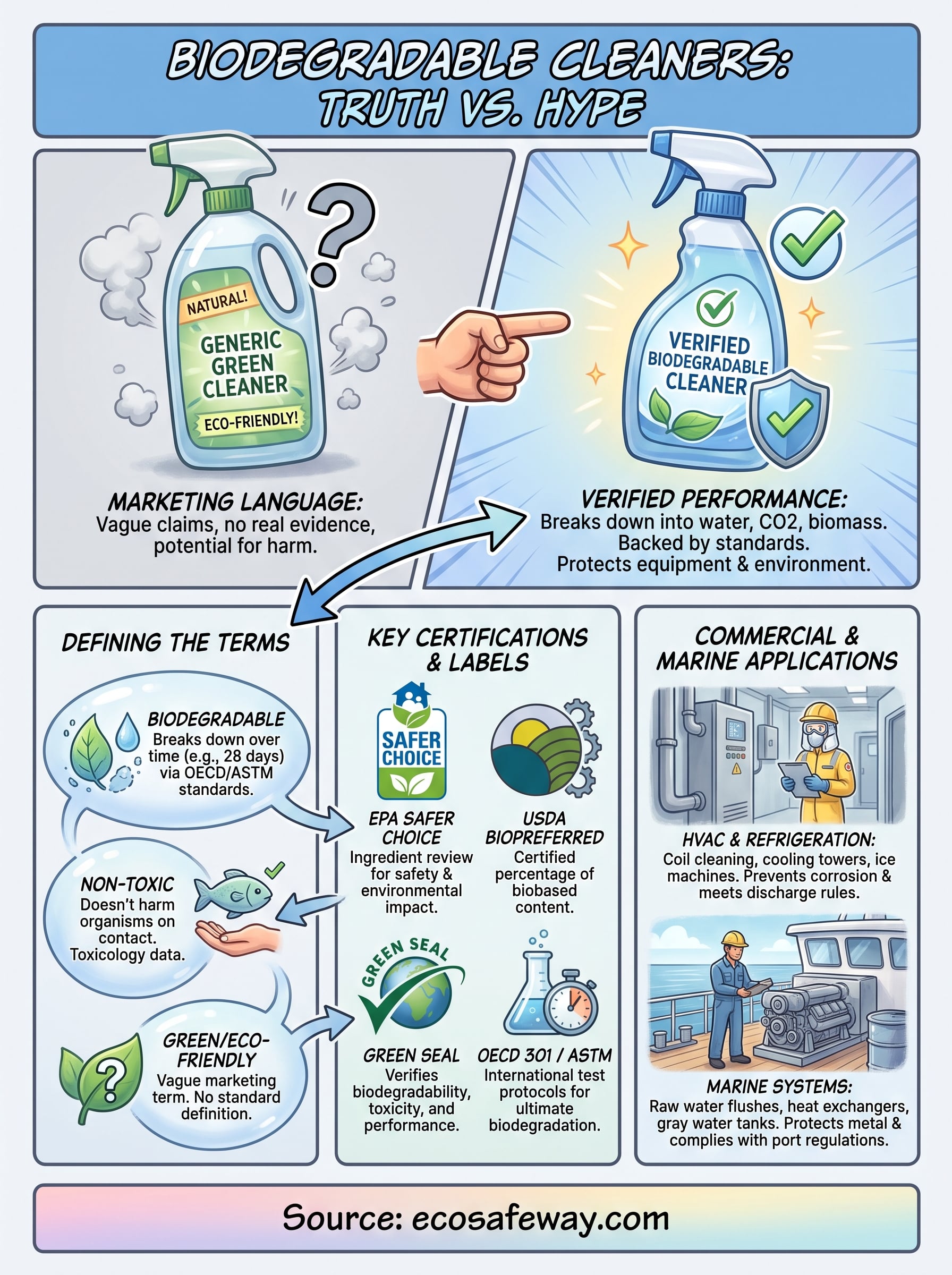
Marketing teams treat these three words as interchangeable, but they describe completely different properties, and confusing them leads to bad purchasing decisions. Biodegradable describes how a substance breaks down over time, whether that's days or years, into water, carbon dioxide, and biomass. Non-toxic describes how a substance interacts with living organisms on contact, meaning it doesn't poison, burn, or otherwise harm people, fish, or wildlife at the concentrations used. Neither term guarantees the other, and a product can legitimately claim one without qualifying for the second.
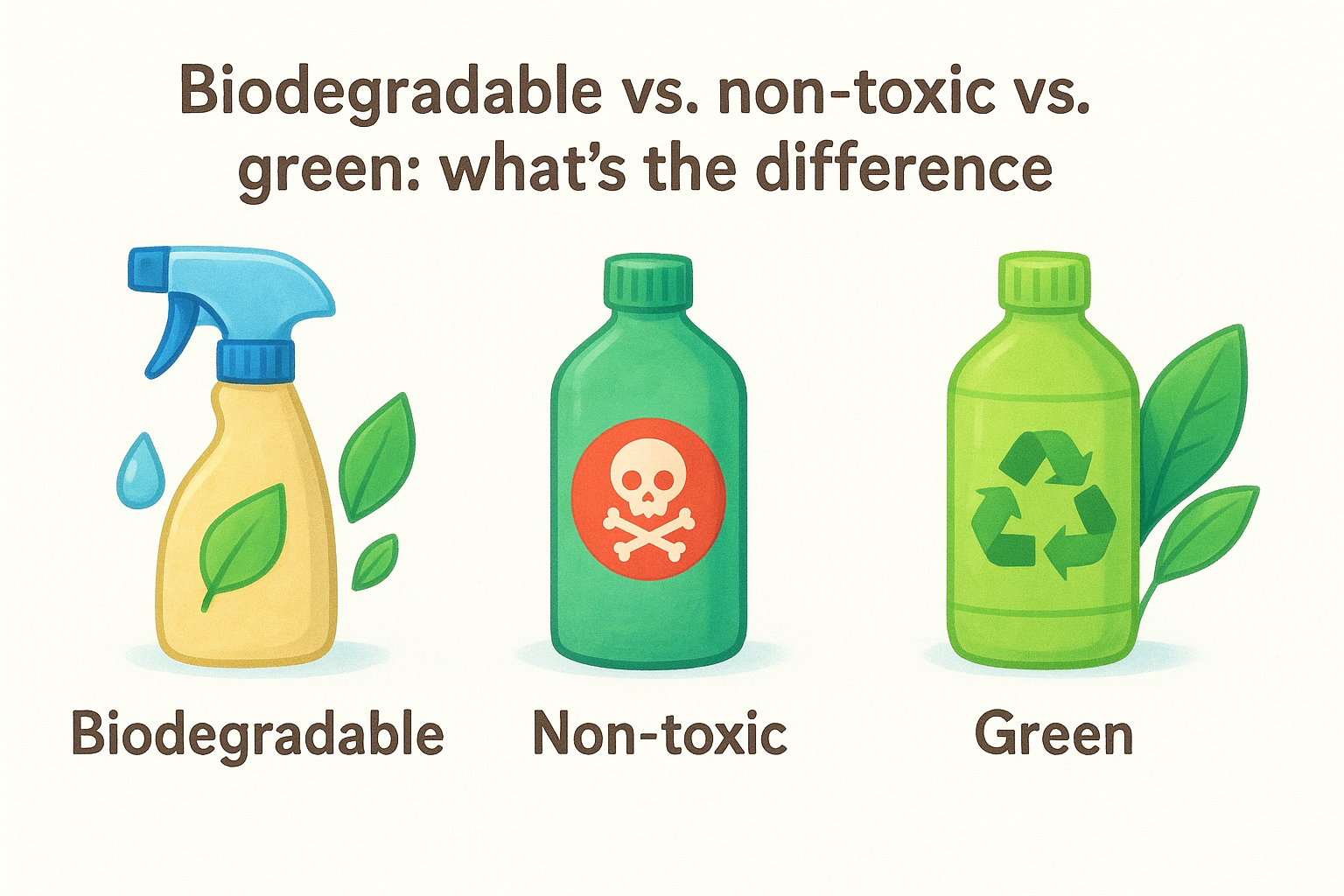
A cleaner can be biodegradable and still harmful, or non-toxic and still persistent. You need both properties verified, not one assumed from the other.
Consider a cleaner that eventually breaks down over 90 days but kills fish within hours of contact. It technically qualifies as biodegradable under a loose definition, yet it's far from safe for a marina discharge or storm drain runoff. Flip that scenario around: a compound might be non-toxic on contact, gentle enough to handle without gloves, but resist breakdown in the environment for years, accumulating in soil or waterways long after use. Facilities near sensitive coastal zones, like the marinas and boatyards across South Florida, need both properties confirmed, not one substituted for the other.
"Green" is the vaguest term of the three
Green and eco-friendly carry no legal or scientific definition in the United States. Any manufacturer can print those words on a bottle regardless of what's inside, since no regulatory body enforces a standard meaning behind them. That's why relying on the word "green" alone tells you almost nothing about biodegradability, toxicity, or environmental impact. The FTC's own Green Guides exist specifically because vague environmental marketing claims mislead buyers so often, and the guidance explicitly warns companies against unqualified general claims like "eco-friendly" without supporting evidence.
Here's how the three terms actually compare when you break them down by what they measure and how they're verified:
| Term | What it measures | How it's verified | Common pitfall |
|---|---|---|---|
| Biodegradable | Breakdown into water, CO2, biomass over time | OECD, ASTM, or ISO test standards | No timeframe or percentage disclosed |
| Non-toxic | Harm to organisms on contact or exposure | Toxicology data, SDS classification | Confused with "natural" ingredients |
| Green/eco-friendly | No fixed definition | No standard verification method | Used as a catch-all marketing term |
Understanding this table matters more than it looks. When you're comparing a biodegradable degreaser against a competing product labeled simply "green," you're not comparing equivalent claims. One has a testable, verifiable standard behind it. The other has whatever the marketing department decided sounded appealing that quarter.
Sourcing decisions get easier once you stop treating these terms as synonyms. Ask specifically whether a product is biodegradable, whether it's classified as non-toxic, and whether those claims come with test data or a safety data sheet backing them up. Products that check all three boxes with actual documentation, rather than a single vague label, are the ones worth paying a premium for.
Certifications and labels that verify biodegradability
Certifications exist because self-reported claims aren't enough. A third-party certification puts a manufacturer's product through independent testing against a fixed standard, and that testing gets repeated periodically to keep the certification current. Without that outside verification, you're trusting a company's own marketing copy, and companies rarely have an incentive to fail their own tests. Knowing which certifications carry real weight, and which ones are just logos slapped on a bottle, saves you from paying a premium for nothing.
EPA Safer Choice and biobased labeling
Products carrying the EPA Safer Choice label have gone through ingredient-by-ingredient review against strict human health and environmental criteria, and the EPA maintains a public list of every certified product so you can verify a claim before you buy. Facilities that need documentation for auditors or health inspectors often lean on this label specifically because it's backed by a federal agency rather than a private marketing arm. Beyond Safer Choice, the USDA's BioPreferred program certifies biobased content percentages, meaning a set share of the formula comes from renewable agricultural or forestry sources rather than petroleum, though biobased content alone doesn't guarantee biodegradability or low toxicity.
Green Seal and industry-specific standards
Green Seal certification requires products to meet criteria covering biodegradability, toxicity, packaging, and performance all at once, and it's one of the few labels that actually tests real-world cleaning effectiveness alongside environmental impact. That combination matters for facility managers who've been burned before by a product that's gentle on the environment but useless on actual scale or biofilm. Marine-specific standards work a bit differently, since most saltwater and hull-cleaning products get evaluated under ASTM or OECD biodegradation protocols rather than a single consumer-facing seal.
| Certification | What it verifies | Issued by |
|---|---|---|
| EPA Safer Choice | Ingredient safety and environmental impact | US EPA |
| USDA BioPreferred | Percentage of biobased ingredients | USDA |
| Green Seal | Biodegradability, toxicity, and performance | Green Seal, Inc. |
| OECD 301 series | Ultimate biodegradation percentage over time | International test protocol |
A logo on a bottle means little without a public database or test report behind it. Verify before you trust.
Reading the fine print instead of the front label
Front-of-bottle claims rarely tell the whole story, so flip the bottle over and check the safety data sheet or the manufacturer's technical documentation before assuming a certification applies to the exact product you're buying. Some companies certify one formula in a product line and then market the whole line under that same green halo, even though only one SKU actually passed testing. Verifying which specific product carries which specific certification, rather than assuming a family-wide claim, is the difference between real compliance documentation and a false sense of security when an inspector asks for proof.
Where biodegradable cleaners are used in commercial and marine settings
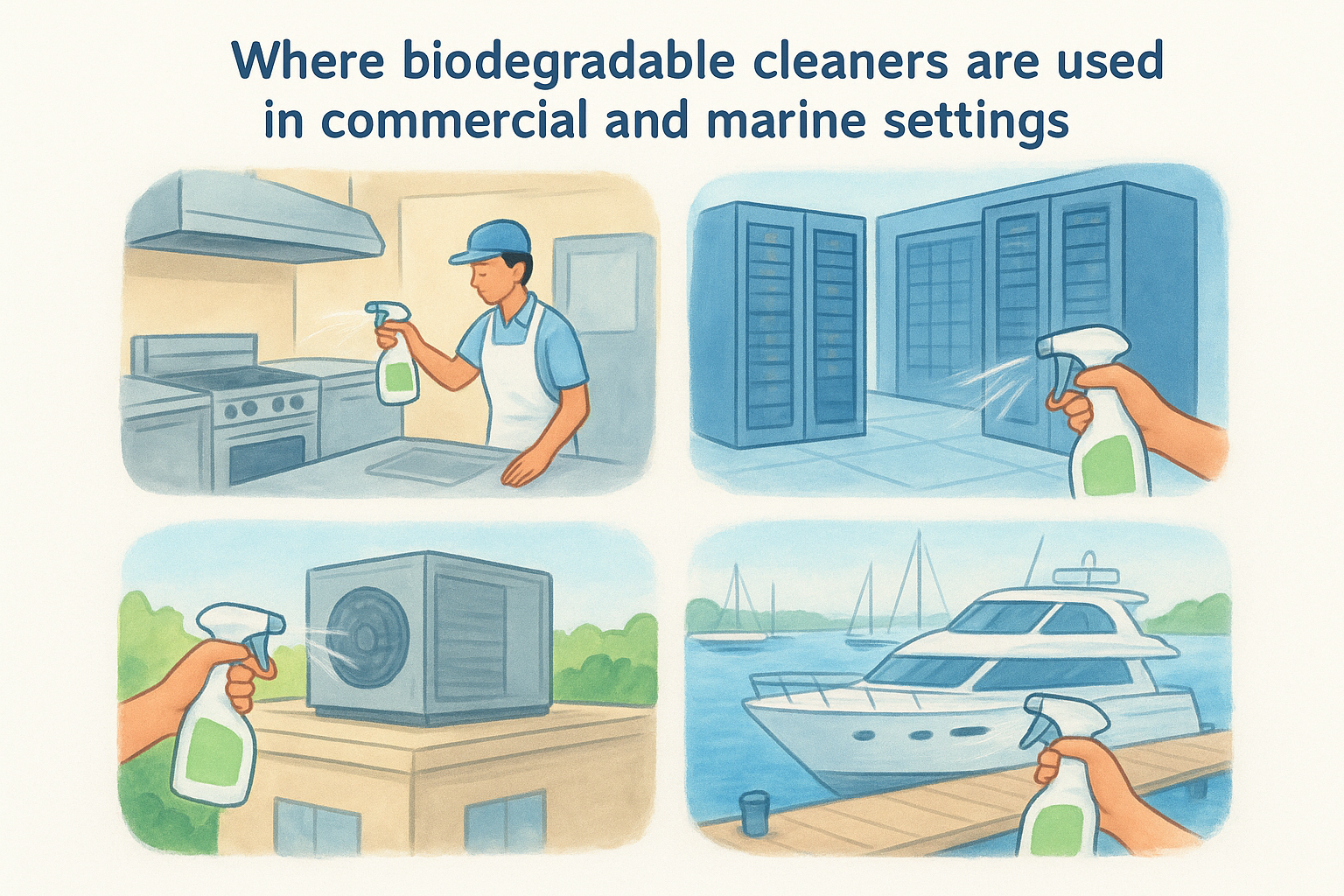
Biodegradable cleaners aren't a niche product anymore. They show up in commercial kitchens, hospital HVAC rooms, data center mechanical bays, and the engine rooms of yachts docked along the Fort Lauderdale waterfront. Each setting has its own reason for the switch, but the common thread is the same: these facilities operate under some form of environmental or safety oversight, and conventional chemistry creates liability they'd rather avoid. Looking at where these products actually get used tells you more about their real-world value than any label copy ever could.
Commercial HVAC, refrigeration, and foodservice equipment
Facility teams running programs on air handlers and rooftop units with a commercial coil cleaning solution need a formula that clears biofilm and grime without corroding aluminum fins or triggering a discharge violation when the rinse water hits a floor drain. The same logic applies to cooling towers, where biodegradable formulas for mineral scale removal in cooling towers cut deposits off condenser tubing without the acid runoff that used to require a permitted discharge event. Ice machines and other foodservice equipment raise the stakes further, since any residue left behind ends up in contact with food or ice destined for a drink. A nickel-safe ice machine descaler that is also biodegradable matters here because health inspectors check both sanitation logs and chemical safety data during routine visits.
Facilities near sensitive discharge zones, like commercial kitchens and coastal marinas, can't treat cleaning chemistry as an afterthought. It's part of their compliance record.
Data centers add a different layer of pressure. Air-cooled and water-cooled data center chillers and cooling towers both generate condensate and blowdown water that's often subject to strict discharge permits, especially in municipalities that meter cooling tower water separately from domestic use. Operators managing these systems increasingly specify biodegradable descalers up front, since a documented spill or discharge violation at a data center can trigger regulatory scrutiny far beyond a simple fine.
Marine systems and shipboard maintenance
Marine environments concentrate all of these concerns into a smaller, more visible space. Raw water systems, heat exchangers, and marine AC units run seawater through tight metal passages every day, and scale buildup inside them reduces cooling efficiency fast. A biodegradable raw water flush for marine engines and heat exchangers clears that scale without leaving acidic residue that accelerates corrosion in bronze fittings or copper-nickel tubing, which matters on vessels where a heat exchanger replacement can sideline a boat for weeks. Onboard drain systems and gray water tanks benefit from the same approach, since a liquid enzyme marine holding tank treatment controls odor without introducing chemicals that complicate discharge compliance in marina basins.
Settings where you'll typically find biodegradable cleaning products in active use include:
- Rooftop and split-system HVAC coils in office buildings and hospitals
- Cooling tower basins and condenser tubing in commercial and industrial plants
- Air-cooled and water-cooled data center cooling loops
- Ice machines and beverage dispensers in restaurants and hotels
- Raw water strainers, heat exchangers, and marine AC condensers aboard yachts
- Onboard gray water systems and drain lines in marine engine rooms
Operators in each of these settings share a practical concern: they need a product that performs on real scale and biofilm, not just in a lab test, while still meeting the discharge and safety standards their facility or vessel operates under.
Common mistakes when switching to biodegradable cleaners
Switching to a biodegradable cleaner isn't as simple as swapping one bottle for another on the shelf. Facility managers and marine crews who rush the transition often end up with disappointing results, then blame the chemistry instead of the process. Most of these problems trace back to a handful of predictable mistakes, and knowing them ahead of time saves you from a failed pilot program or a coil that still looks dirty three cleanings later.
Assuming weaker chemistry means weaker cleaning
Buyers frequently assume biodegradable formulas can't match the cutting power of acid-based descalers or solvent degreasers, so they either avoid switching altogether or apply the new product the same way they used the old one. That assumption misreads the chemistry. Biodegradable formulations often rely on different mechanisms, like enzymatic action or surfactant chemistry, that need proper dilution ratios and contact time to work. Spraying a biodegradable coil cleaner and rinsing it off in thirty seconds, the way you might with an aggressive acid wash, skips the dwell time the product actually needs to break down biofilm and scale.
Judging a biodegradable cleaner by the habits you formed with harsher chemistry almost always ends in a false verdict.
Skipping compatibility testing before a full rollout
Crews sometimes commit to a facility-wide or fleet-wide switch before confirming the new product performs on their specific equipment. A cleaner that handles mineral scale beautifully on a cooling tower might behave differently on an ice machine evaporator plate or a marine heat exchanger with tighter tolerances. Testing on one small unit first, then scaling up once you've confirmed performance and compatibility, protects you from a costly mistake across an entire building or vessel.
Treating disposal as a solved problem
Some teams assume that once a product is labeled biodegradable, disposal rules no longer apply, and they stop documenting how they handle rinse water or spent solution. That assumption can backfire during an inspection, since a formula that's biodegradable over 28 days can still carry short-term toxicity that keeps it under local discharge rules. Confirming disposal guidance against your specific permit, every time, beats assuming a label solves the paperwork for you.
A short list of the mistakes worth avoiding:
- Applying biodegradable products with the same dilution and contact time used for harsher chemistry
- Rolling out a new cleaner facility-wide before testing it on your actual equipment
- Ignoring SDS disposal guidance because the front label says biodegradable
- Failing to train crews on why application steps differ from conventional products
- Choosing a cheaper, unverified product because it uses the word "biodegradable" without test data
Teams that work through this list before a full switch tend to see faster results and fewer callbacks. Vendors familiar with both commercial and marine applications, like Eco Safeway, can usually walk you through the correct dilution and contact time for your specific equipment before you commit to a large order, which cuts out most of the guesswork on the first attempt.
What this means for your cleaning choices
Choosing a genuinely biodegradable cleaner comes down to verification, not vocabulary. A test standard, a disclosed percentage, and a safety data sheet tell you more than any word printed on a bottle. Once you understand the difference between biodegradable, non-toxic, and green, and you know which certifications actually carry independent testing behind them, you stop paying for marketing and start paying for documented performance.
Applying that same standard protects your equipment, keeps your discharge compliant, and saves your crew from disposal headaches down the line. If you're ready to put verified chemistry to work on grease, grime, and marine buildup without the corrosion risk or hazmat paperwork, try the aluminum-safe degreaser spray for marine and aircraft surfaces and see how a properly tested formula performs on your own equipment.


