





Every megawatt you add to a data center makes the next megawatt harder to cool. That's the uncomfortable truth behind why scale reduces data center cooling efficiency, and it's why so many facility managers watch their PUE numbers creep upward even after investing in newer chillers and CRAC units. The physics doesn't scale linearly, but your rack density does, and that mismatch is where efficiency goes to die.
The short answer: as you add racks, heat load grows faster than your ability to move air or water past it, and thermal bottlenecks compound at the edges of hot aisles long before your total capacity is maxed out. Add mineral scale buildup in cooling towers and condenser coils, and heat transfer surfaces lose effectiveness exactly when you need them working hardest. Scale doesn't just mean bigger, it means dirtier heat exchangers fighting a losing battle against rising thermal load.
This article breaks down the mechanics behind that efficiency drop, why legacy descaling methods often make the problem worse, and what actually works: from airflow redesign to liquid cooling adoption and non-corrosive descaling that keeps coils and towers running at rated capacity instead of degraded ones.
Why scale reduces data center cooling efficiency as you grow
Rack density grows faster than your airflow can follow
Add ten racks to a data hall and your cooling load doesn't grow by ten units, it grows by whatever multiplier your hot aisle configuration allows. Air has to travel further, mix with more warm exhaust, and fight more resistance before it reaches a CRAC unit or economizer. Facilities that started at 4kW per rack and pushed to 15kW or 20kW per rack for AI and high-performance computing workloads often discover their original airflow design simply can't keep pace. The rack density climbed, but the physical path air takes to remove heat stayed the same, and that mismatch is the first crack in cooling efficiency.
The math behind heat load and cooling capacity
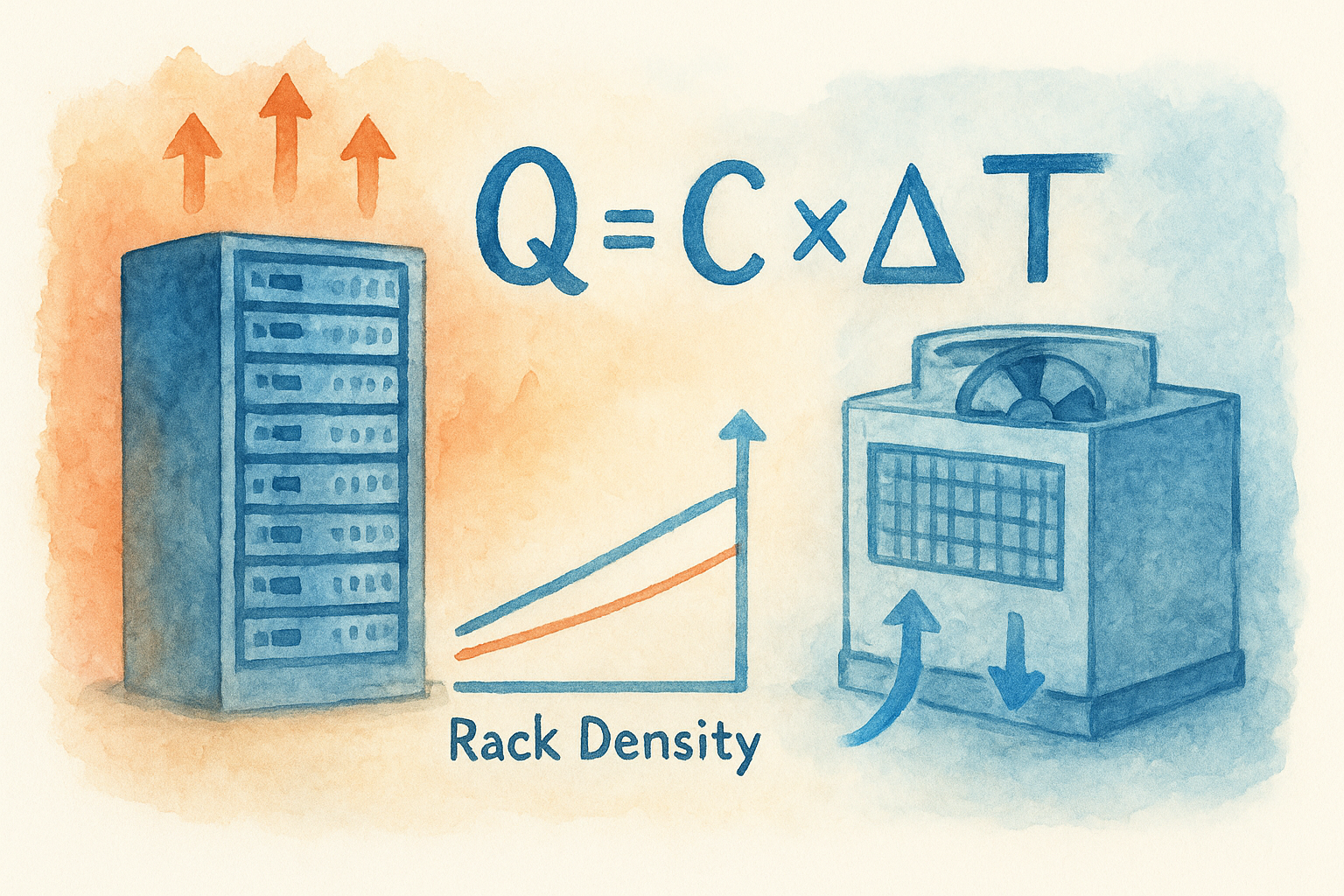
Heat load and cooling capacity don't scale on the same curve. Doubling square footage doesn't double airflow delivery, because ductwork, raised floor plenum height, and chiller plant capacity all have fixed ceilings that require capital investment to raise. Here's a simplified look at what happens as density increases without a corresponding cooling redesign:
| Rack Density | Typical Cooling Approach | Common Result |
|---|---|---|
| 4-6 kW/rack | Standard CRAC/CRAH air cooling | Adequate, low bottleneck risk |
| 8-12 kW/rack | Same air cooling, added units | Hot spots at rack tops, uneven return air temps |
| 15-20 kW/rack | Air cooling stretched to limit | Frequent thermal throttling, rising PUE |
| 20+ kW/rack | Requires liquid or hybrid cooling | Air alone can't remove heat fast enough |
Once you're past roughly 15kW per rack, air movement stops being the limiting factor and becomes the bottleneck itself. That's the density threshold where why scale reduces data center cooling efficiency stops being an abstract concern and starts showing up on the utility bill, and it's why so many operators scaling for AI workloads are forced into liquid cooling conversations years earlier than they planned.
Mineral scale attacks your heat exchangers right when you need them most
While rack density climbs, something quieter is happening inside your cooling towers and condenser coils: mineral scale buildup. Calcium and magnesium deposits form an insulating layer on heat transfer surfaces, and even a fraction of a millimeter of scale can cut heat exchange efficiency by 10 to 15%. That loss shows up as higher condenser pressures, longer compressor run times, and chillers working harder to hit the same leaving water temperature they used to hit easily.
Scale doesn't wait for your busiest season, it builds every day you're not cleaning it off.
This is the part facility teams underestimate. Scaling up usually means running cooling equipment closer to its rated capacity more of the time, which means:
- Higher water flow rates through towers and coils, accelerating mineral deposition
- Less downtime available for descaling maintenance, since redundancy gets consumed by growth
- Harsher legacy descaling chemicals used under time pressure, which can pit metal and create rougher surfaces where scale reattaches faster
- Delayed detection, because rising energy bills get blamed on the new load instead of degraded coils
A cooling tower descaler or aluminum-safe condenser coil cleaner that's non-corrosive matters more, not less, once you're scaling, because you can't afford to damage the same equipment you're now leaning on harder.
PUE creep: the compounding cost of inefficiency
This is the compounding mechanism behind why scale reduces data center cooling efficiency: every inefficiency stacks on the last one. Reduced airflow effectiveness forces chillers to run longer. Scaled coils force those same chillers to work at higher head pressure to hit target temperatures. Longer runtimes plus higher pressure means your power usage effectiveness (PUE) creeps from 1.4 toward 1.6 or worse, even though nothing on paper changed except total load. Facility managers who track PUE month over month often see the trendline bend upward right around the point their density crossed a threshold their original cooling design never anticipated, confirming that scale itself, not just total power draw, is what's driving the loss. It's the clearest data-driven proof of why scale reduces data center cooling efficiency: the load curve and the PUE curve stop moving together.
How to offset cooling losses as your data center scales
Redesign airflow before you add another rack
Fixing an airflow problem after it exists costs far more than designing around it early. Before you rack up more equipment, walk your hot and cold aisles and check for containment gaps, missing blanking panels, and cable bundles blocking underfloor plenum flow. Aisle containment alone can recover 10 to 20% of stranded cooling capacity without touching a single chiller. Facilities that treat airflow audits as routine, rather than a one-time build step, catch thermal bottlenecks months before they show up as thermal throttling on the compute side.
Bring liquid cooling in before air maxes out
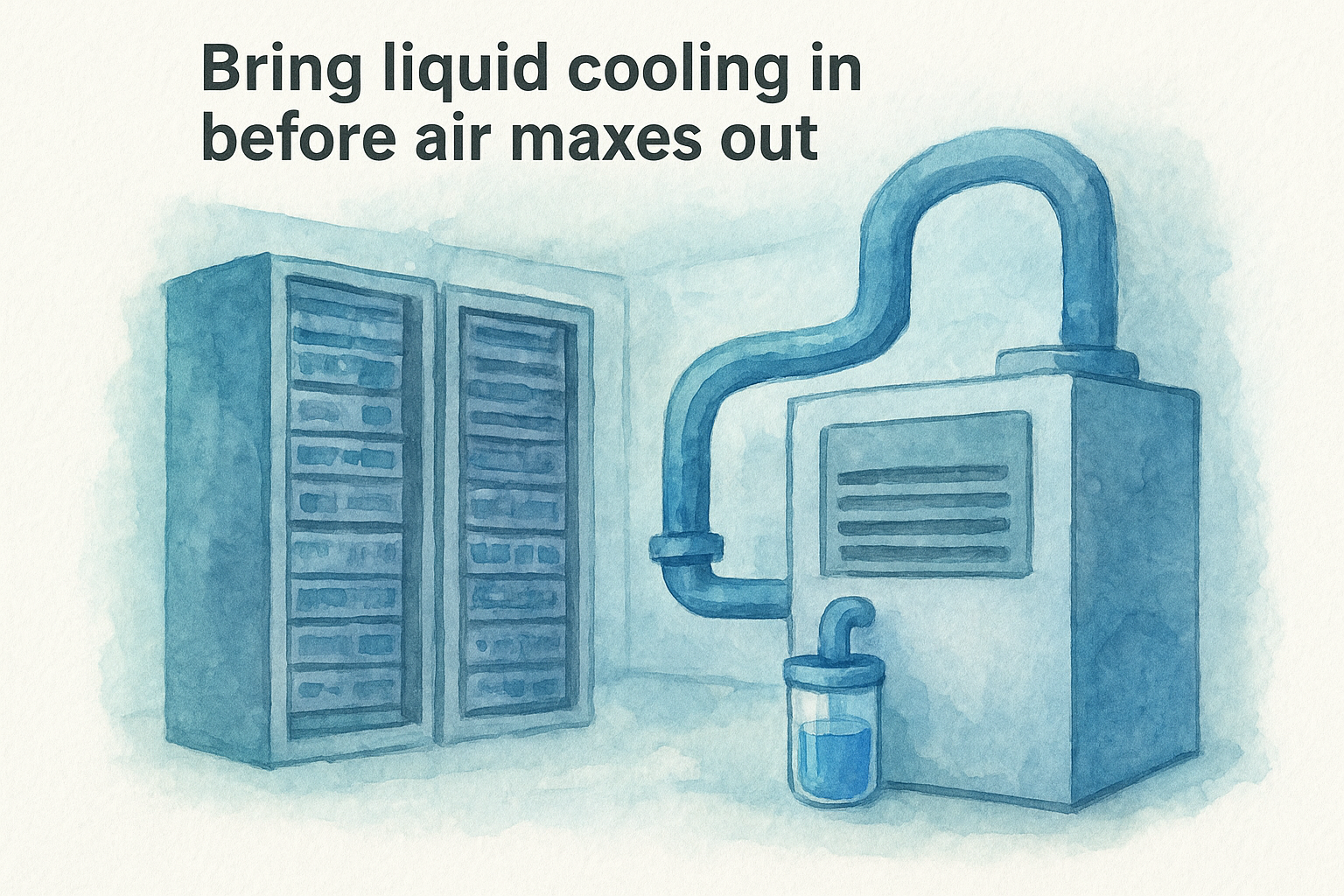
Waiting until rack density hits 25kW to consider liquid cooling almost always means retrofitting under pressure. Direct-to-chip loops, rear-door heat exchangers, and immersion tanks all pull heat off components before it ever becomes room-level air load, which takes pressure off your existing CRAC and CRAH fleet. Hybrid deployments, where liquid handles the densest racks and air still manages the rest of the hall, let you scale rack density without a full cooling plant overhaul. Planning the transition at 12 to 15kW per rack, rather than 20kW-plus, gives your team room to test and tune before liquid cooling becomes mandatory rather than optional.
Protect the heat exchangers you already have
More capacity on paper means nothing if your cooling towers and condenser coils are running at 85% of rated efficiency because of mineral buildup. A program built around a non-corrosive cooling tower descaling chemical, run on a fixed schedule rather than reactively, keeps heat transfer surfaces working at the capacity your cooling design assumed they'd have. This matters even more once you're scaling, because harsh acid-based descalers that pit copper and aluminum leave rougher surfaces where scale reattaches faster next cycle, undoing the gain within weeks.
You can't out-build a cooling problem that's actually a maintenance problem.
Eco Safeway's water-side data center cooling descaler is formulated to dissolve calcium and magnesium deposits in towers, chillers and CRAC loops without the corrosive side effects that shorten equipment life, so the capacity you paid for stays available as you scale.
Build monitoring into the growth plan
Growth without instrumentation is a guessing game. Track return air temperature, condenser approach temperature, and PUE by zone, not just facility-wide, so you can see exactly where density is outpacing cooling before it becomes an outage risk. Sensors at rack level cost far less than the downtime caused by a hot spot nobody was watching.
- Audit airflow containment before adding density
- Plan liquid cooling transitions at 12-15kW/rack, not 20kW+
- Run non-corrosive descaling on a fixed schedule
- Monitor temperature and PUE by zone, not just facility-wide
Signs your cooling system is losing efficiency at scale
Most facility teams don't notice cooling decline until it shows up as an outage risk, but the warning signs appear months earlier if you know where to look. Scaling amplifies small inefficiencies into measurable losses, so catching early efficiency signals matters more once your rack count climbs than it did when the room ran half empty. The patterns below show up consistently across facilities that scaled without matching their cooling maintenance to the new load.
Rising energy bills without a matching load increase
Watch your utility bills against your actual IT load, not just your total square footage. If power draw for cooling climbs faster than the compute load you added, something in the mechanical chain is compensating for lost efficiency. Compressors running longer to hit the same leaving water temperature, condenser fans cycling more often, or chillers holding higher head pressure are all symptoms of the same root cause: heat transfer surfaces that used to move heat easily now need more energy to do the same job, and knowing how a refrigeration system works makes those symptoms easier to trace.
If your energy bill is growing faster than your rack count, your cooling system is compensating for something you haven't found yet.
Temperature spreads that widen instead of narrow
Check the delta between supply and return air, and between condenser inlet and outlet water temperature, on a fixed schedule rather than only during complaints. A widening spread over several months, even a gradual one, points to reduced heat transfer efficiency rather than a sudden failure. Hot spots that appear at the top of racks in previously balanced rows often mean airflow that used to reach that height now gets diverted or mixed with warm exhaust before it arrives, a classic sign that rack density has outpaced the original cooling design.
Physical inspection clues you can catch early
During routine walkthroughs, a handful of physical clues tell you more than any dashboard will:
- Visible scale flaking or white mineral crust on cooling tower fill and condenser coil fins
- Reduced water flow through fill media, visible as channeling or dry spots during operation
- Corrosion pitting on coil fins after previous descaling cycles, which speeds up future buildup
- Compressor short-cycling or unusually long run times logged in your BMS
- Return air temperatures creeping upward at the same rack positions month over month
Each of these signals shows up well before a full outage, and each one gets harder to fix the longer you wait. Facilities that log these observations against a maintenance calendar, rather than relying on memory or gut feel, catch degraded heat exchangers while a non-corrosive descaling cycle can still restore full rated capacity instead of requiring equipment replacement.
Comparing air, liquid, and hybrid cooling at scale
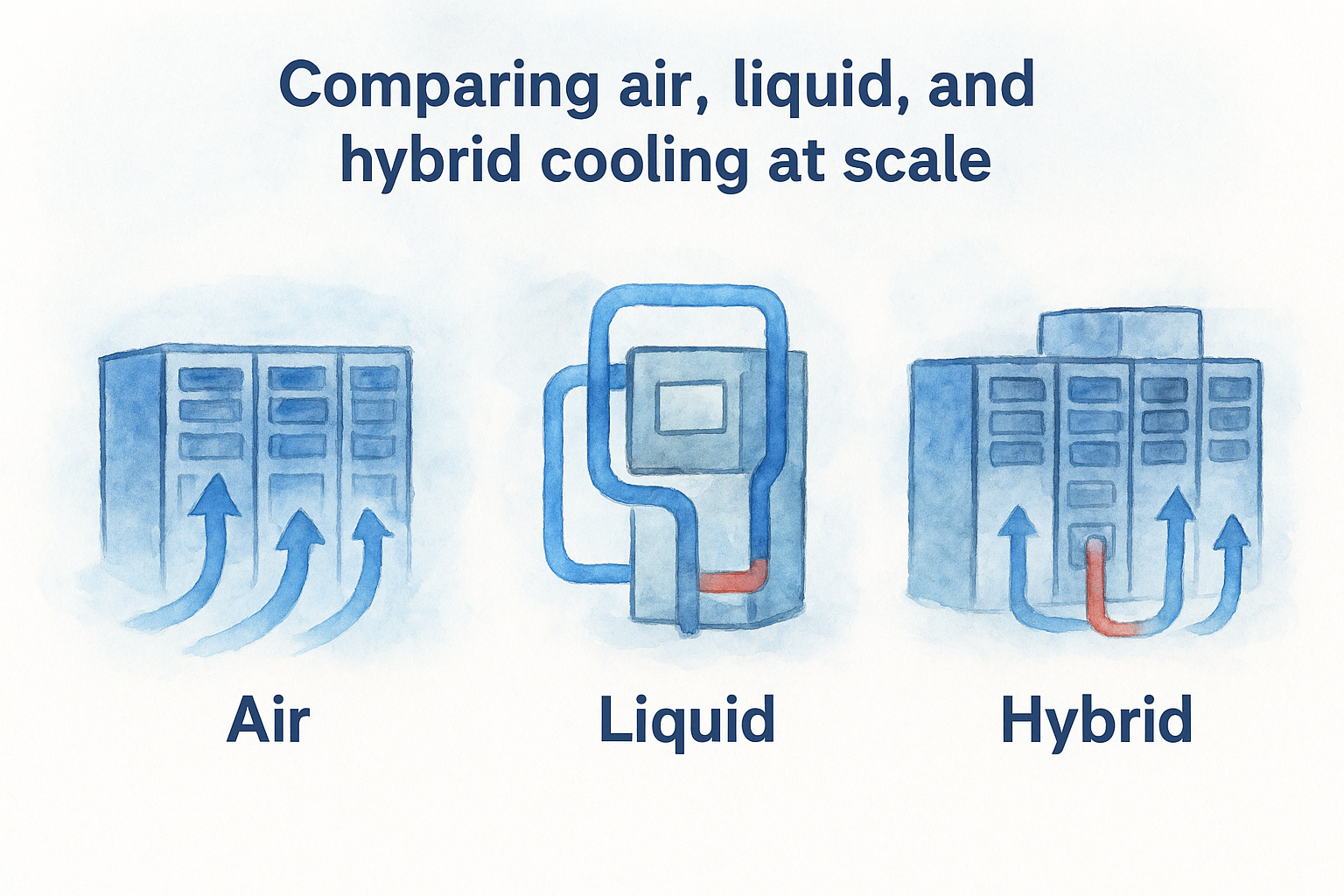
Choosing a cooling architecture isn't a one-time decision, it's a moving target that shifts as your rack density climbs. Each approach, air, liquid, and hybrid, carries different tradeoffs in cost, complexity, and how much heat it can actually remove before thermal bottlenecks reappear. Understanding where each one breaks down helps you plan the transition before a hot aisle forces your hand.
Air cooling still works, until density outruns it
Air cooling remains the simplest and cheapest option for facilities running under roughly 8-10kW per rack, and it's the system most data centers were originally built around. Below that threshold, CRAC and CRAH units paired with good containment handle heat load without much drama. Past it, air has to travel further and fight more mixing before it reaches an intake, and no amount of added blower capacity fully compensates for the physics of moving air through a crowded, high-density hall.
Liquid cooling solves density at the cost of complexity
Liquid cooling, whether direct-to-chip, rear-door heat exchangers, or full immersion, pulls heat off components before it becomes room-level air load, which is exactly why it scales so much better at 20kW-plus per rack. The tradeoff is real: plumbing, leak detection, and a maintenance skill set most facilities teams haven't built yet. It also demands cleaner water loops, since scale buildup inside a liquid system is harder to inspect than a coil you can see and touch.
The cooling method that scales best is the one that removes heat closest to the source, not the one that moves the most air.
Hybrid cooling is the practical middle ground
Hybrid setups, where liquid handles the densest racks and air still manages the rest of the hall, let most operators scale without a full plant rebuild. This is where the majority of facilities crossing 15kW per rack actually land, because it spreads capital cost over time instead of forcing an all-or-nothing conversion. Retrofitting a handful of high-density rows with liquid cooling while leaving lower-density areas on air buys you years of runway before your original cooling plant needs replacing.
| Cooling Type | Best Fit | Key Limitation |
|---|---|---|
| Air | Under 8-10kW/rack | Airflow travel distance limits density |
| Liquid | 20kW/rack and up | Higher install complexity, new maintenance skills |
| Hybrid | 12-20kW/rack mixed loads | Requires managing two systems side by side |
Matching the method to your actual, measured density, not your projected one, keeps you from overbuilding one system while underbuilding the other.
Maintenance practices that protect cooling efficiency
Schedule descaling by water chemistry, not the calendar
Generic quarterly schedules ignore the one variable that actually predicts scale formation: your water hardness. A tower running on 300 ppm hardness water builds deposits far faster than one running on 100 ppm, so a fixed six-month interval leaves one facility over-cleaning and another badly under-cleaning. Water chemistry testing every 30 to 60 days gives you the data to set a descaling interval that matches actual mineral load instead of a generic calendar guess.
| Water Hardness | Recommended Descaling Interval | Risk if Skipped |
|---|---|---|
| Under 100 ppm | Every 4-6 months | Slow buildup, manageable |
| 100-250 ppm | Every 2-3 months | Noticeable efficiency loss within a season |
| Over 250 ppm | Monthly to every 6 weeks | Rapid coil fouling, PUE creep |
A descaling schedule built on your actual water hardness beats a calendar that was never designed around your equipment.
Train staff to spot early buildup during routine checks
Beyond scheduled cleanings, the people walking your data hall every day are your earliest detection system if they know what to look for. Give maintenance staff a short checklist to run during normal rounds, not a separate inspection they'll skip when things get busy:
- Feel condenser water lines for temperature differences that suggest reduced flow
- Check tower basin water for cloudiness or visible mineral flaking
- Log return air temperature at the same rack positions each week
- Note any compressor short-cycling flagged in the BMS
Catching these signs during a routine walk costs nothing extra. Missing them for three months costs a descaling cycle that now has to fight months of compounded buildup instead of a light layer.
Use non-corrosive products so maintenance doesn't create new damage
Here's where a lot of maintenance programs undo their own progress: harsh acid-based descalers strip mineral deposits but also pit copper tubing and aluminum fins, and pitted metal collects scale faster than smooth metal ever did. Non-corrosive descaling breaks that cycle, because the surface you're left with after cleaning is as smooth as the one your cooling design assumed you'd have. Eco Safeway's air-cooled data center coil cleaner for condenser coils, dry coolers and CRAC units is built around this principle, so every cleaning cycle restores capacity instead of quietly setting up the next round of buildup.
Document every cycle so patterns become visible
Finally, log every descaling event alongside the temperature and pressure readings that triggered it. Six months of records turns guesswork into a pattern: you'll see exactly how many weeks a given hardness level buys you before efficiency starts slipping, and that number becomes the real schedule your team should follow going forward. Pair that log with your PUE trendline and rack density history, and you get a running record of why scale reduces data center cooling efficiency at your specific site, not a generic industry average, which is what lets you plan the next expansion around real numbers instead of guesswork.
Small facilities sometimes assume this level of documentation only matters once they're running hundreds of racks, but the pattern shows up just as clearly at a few dozen. A single hot aisle logged consistently for two quarters usually reveals the exact density point where your original design stopped keeping up, which is far cheaper information to have before you sign off on the next expansion than after.
Staying efficient as your data center grows: recapping why scale reduces data center cooling efficiency
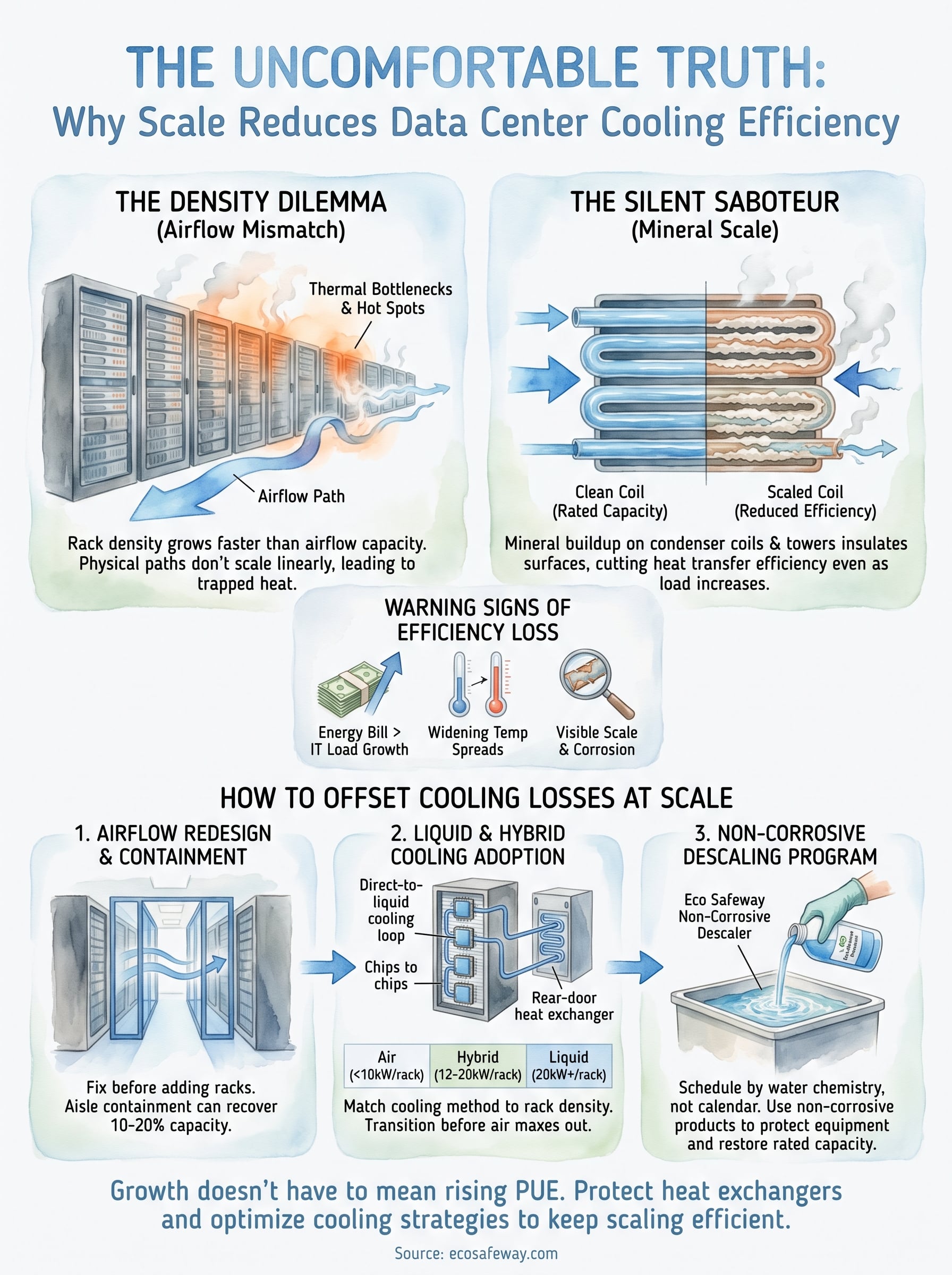
Scale will always outpace a cooling system that hasn't been redesigned or maintained to match it. The physics behind why scale reduces data center cooling efficiency doesn't change: rack density climbs faster than airflow paths adapt, and mineral scale builds fastest exactly when your towers and coils are working hardest. What you control is whether you catch that drift early through monitoring, close the gap with the right mix of air, liquid, and hybrid cooling, and protect the heat exchangers you already own with a non-corrosive descaling program instead of harsh chemicals that pit metal and invite faster buildup next cycle.
Growth doesn't have to mean rising PUE. Get your water-side equipment back to rated capacity with Eco Safeway's industrial HVAC and cooling tower descaler, and let your next megawatt cool as efficiently as your first.


