





If you're weighing Finsulate and Propspeed for your next haul-out, you've probably noticed both get pitched as biocide-free alternatives to traditional bottom paint. That's where the similarity ends. One is a physical film applied to the hull, the other is a foul-release coating typically used on props, shafts, and running gear. Mixing them up when you're planning a project can mean the wrong product on the wrong surface, or paying for coverage you didn't need.
This article breaks down what each product actually is, how they work, and where they're each best suited on a vessel, whether you're protecting a full hull or just trying to keep props and drive legs free of growth. We'll walk through the real differences in application method and expected service life, using manufacturer-stated specs rather than marketing claims.
As the official Finsulate dealer for the US based in Fort Lauderdale, we get this comparison question constantly from South Florida yacht owners and captains. So we'll give you a straight, specific comparison you can use to decide whether Finsulate, Propspeed, or a combination of both makes sense for your hull and prop setup.
Why pairing Finsulate and Propspeed makes sense
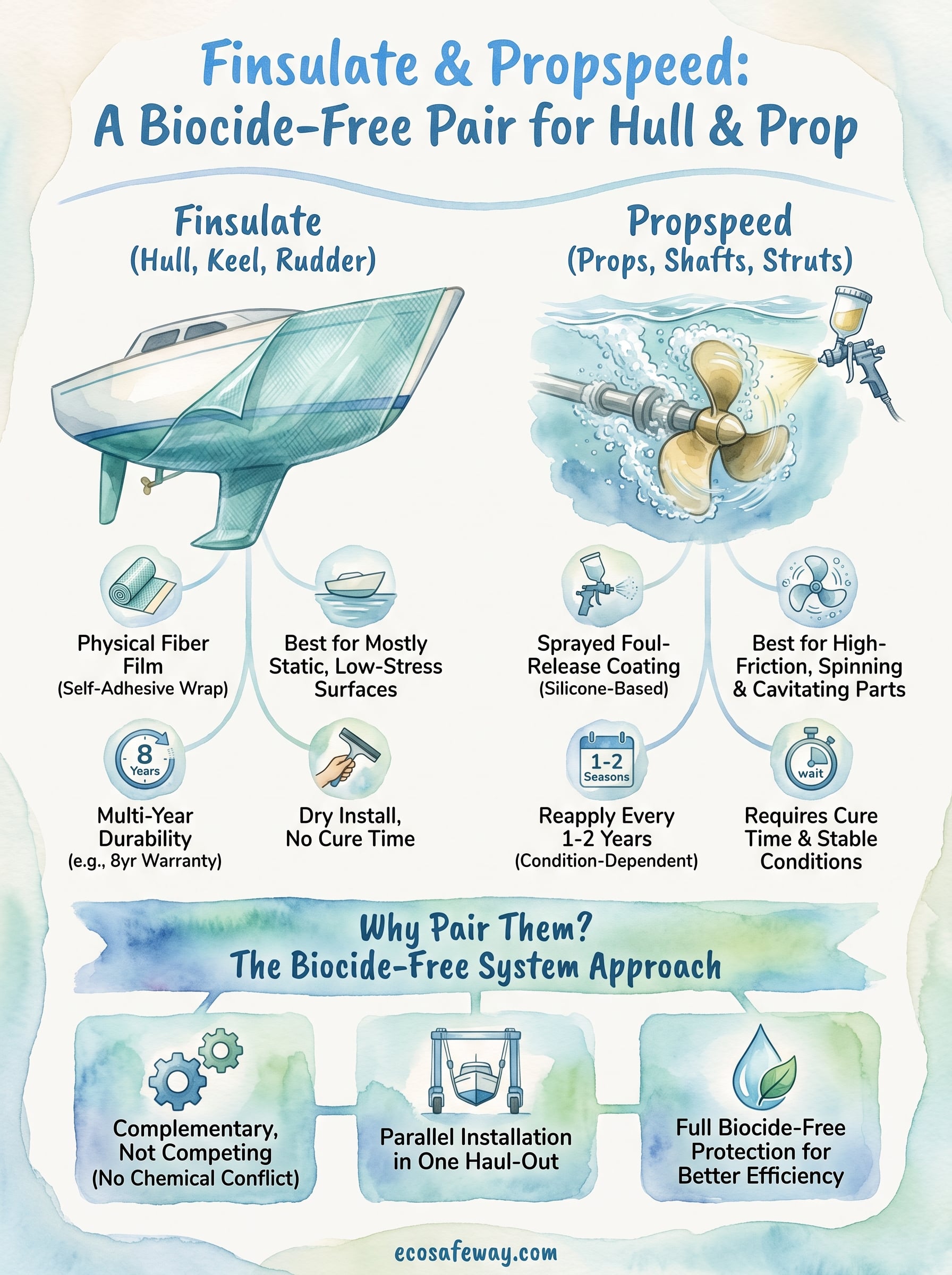
Owners who research hull and prop protection eventually land on the same conclusion: Finsulate and Propspeed aren't competing for the same real estate on your boat. Finsulate is a self-adhesive fiber film built for large, mostly static surfaces like the hull, keel, and rudder. Propspeed is a sprayed foul-release coating engineered for fast-spinning, high-friction metal parts like propellers, shafts, struts, and trim tabs. Pairing the two isn't a compromise. It's using each product for the job it was actually designed to do.
Different surfaces, different stresses
Think about what a propeller endures compared to a hull panel. A prop spins at thousands of RPM, generates cavitation, and heats up from friction. A hull sits mostly still in the water, flexing slightly but never rotating. Finsulate's fiber structure resists fouling through its physical texture, which works well on a stationary surface but wasn't built to survive the abrasion and rotational stress a prop sees. Propspeed's silicone-based coating flexes and sheds growth under that kind of mechanical load, but it isn't practical or cost-effective to apply across an entire hull. Matching the coating to the stress the surface actually experiences is why combining the two makes more sense than picking one and hoping it stretches to cover everything.
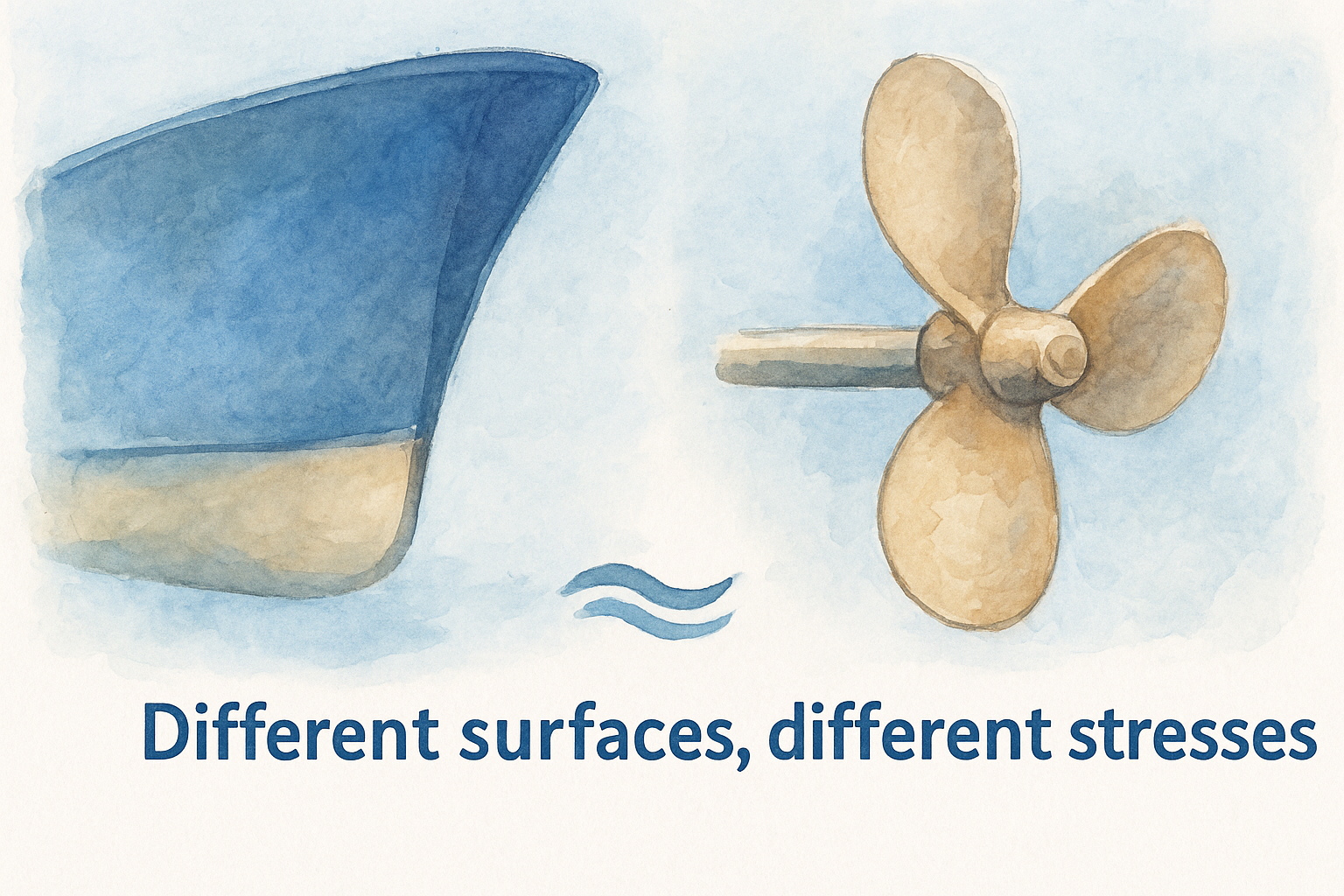
Use Finsulate where the boat sits still, and Propspeed where it spins. That single rule solves most of the confusion.
No chemical conflict between the two
Because Finsulate and Propspeed never touch the same surface, you don't run into the compatibility headaches that come up when mixing bottom paints from different manufacturers. There's no risk of one product's chemistry breaking down the other, no adhesion failure at a seam where two coatings meet, and no warranty complications from applying an unapproved product over another brand's coating. Each system works independently and gets serviced on its own schedule. That separation actually simplifies maintenance planning rather than complicating it.
Aligning with biocide-free goals
Both products appeal to the same type of owner: someone trying to move away from copper-based, biocide-leaching bottom paint without sacrificing performance. If you've already committed to a biocide-free antifouling approach on the hull with Finsulate, leaving your prop coated in old ablative paint or bare metal undercuts that decision. Growth on an uncoated prop increases fuel burn and vibration faster than hull fouling does, since the prop is doing the mechanical work of pushing the boat through water. Rounding out the strategy with Propspeed on running gear keeps the whole underwater system consistent with the same non-toxic philosophy, rather than solving half the fouling problem and ignoring the other half.
Practical reasons South Florida owners choose both
In warm Fort Lauderdale and South Florida waters, fouling pressure is high year-round, and owners who skip prop protection often see barnacle buildup on shafts and struts within weeks. Combining Finsulate with Propspeed addresses that reality directly:
- Full hull coverage stays biocide-free and doesn't need annual haul-out repainting.
- Props and shafts stay slick and efficient without a separate anode-eating antifouling paint.
- Haul-out schedules can be planned around each product's actual service interval instead of guessing.
- Fuel efficiency improves on both ends, since a clean hull and a clean prop compound each other's benefits.
That combination is why so many of the yacht owners we talk to end up specifying Finsulate for the hull and Propspeed for the prop in the same refit conversation.
How to apply Finsulate and Propspeed on your vessel
Neither product is something you brush on over a weekend. Both require surface preparation and professional application to perform as designed, though the actual process looks nothing alike once you get into the details. Applying Finsulate with Propspeed on the same vessel usually means coordinating two separate specialist teams during the same haul-out window rather than one crew doing everything.
Finsulate installation on the hull
Finsulate goes on as a self-adhesive fiber film, similar in concept to vinyl wrap but engineered for underwater use. A Finsulate-trained applicator cleans and dries the hull, removes old bottom paint if present, and measures the surface to cut film panels to fit. The panels get applied section by section, smoothed to avoid air pockets, and trimmed around fittings, transducers, and through-hulls. Because this is a mechanical application rather than a chemical cure, there's no lengthy drying window before launch, though the yard still needs the boat out of the water long enough to prep and install cleanly.
The film goes on dry and smooth; there's no cure time standing between installation and relaunch.
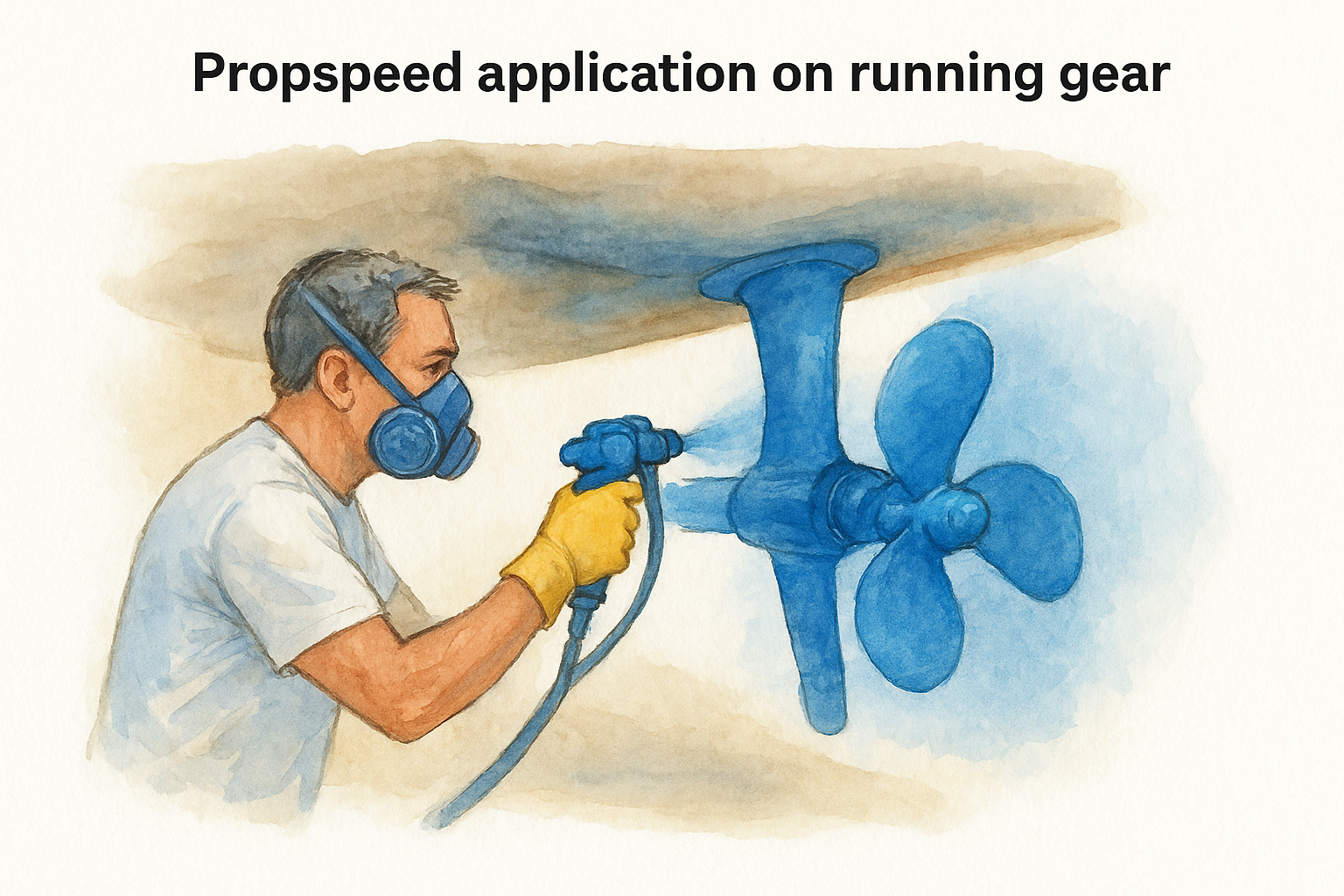
Propspeed application on running gear
Propspeed is a sprayed coating system, and that changes the prep entirely. The propeller, shaft, and struts need to be stripped down to bare, clean metal, usually through sanding or light abrasive blasting, since the coating won't bond over old paint or oxidation. The applicator sprays a base coat, then a tie coat, then the topcoat, with drying time between each layer. This part of the job is more sensitive to weather and humidity than Finsulate's installation, since a sprayed coating needs stable conditions to cure evenly.
Scheduling both during one haul-out
Because the two systems don't interact, most yards can run them in parallel:
- Day 1-2: Hull and running gear cleaned, old coatings stripped as needed
- Day 2-3: Propspeed base, tie, and topcoats applied and cured on props and shafts
- Day 3-4: Finsulate film measured, cut, and installed across the hull
- Day 4: Final inspection before relaunch
Booking both jobs into a single yard visit saves you a second haul-out later and lets both crews work around each other's timeline instead of competing for access to the boat.
Comparing cost, durability, and maintenance needs
Budgeting for Finsulate and Propspeed together means comparing two products with completely different cost structures and service cycles, not just adding up two invoices. Finsulate covers a much larger surface area, so it carries a higher upfront material and labor cost than Propspeed, which only needs to coat props, shafts, and struts. But that larger investment comes with a longer runway: Finsulate's manufacturer warranty runs 8 years when installed by a certified applicator, and actual service life can extend beyond that depending on hull condition and usage. Propspeed's coating covers less area, but running gear takes more mechanical abuse, so reapplication tends to happen more frequently, generally every year or two depending on usage and local fouling pressure.
A hull film measured in years and a prop coating measured in seasons aren't competing costs, they're two different maintenance clocks running side by side.
Side-by-side comparison
| Factor | Finsulate (Hull) | Propspeed (Prop/Running Gear) |
|---|---|---|
| Surface covered | Hull, keel, rudder | Props, shafts, struts, trim tabs |
| Application method | Self-adhesive film, mechanical install | Roller/brush-applied etching primer and clear coat |
| Manufacturer warranty | 8 years (certified install) | Varies; confirm current terms with the applicator |
| Typical reapplication interval | Multi-year, project-specific | 12-24 months, condition-dependent (manufacturer-stated) |
| Upfront cost | Higher, scales with hull size | Lower, scales with running gear size |
Pricing for either system is project-specific, since hull size, running gear complexity, and yard labor rates all shift the final number. That's true whether you're pricing Finsulate alone, Propspeed alone, or both systems in the same haul-out. Requesting a vessel-specific quotation is the only reliable way to compare real numbers instead of guessing from someone else's refit invoice.
Maintenance planning also differs in practice. Finsulate mostly needs periodic inspection and light cleaning between haul-outs, since the film doesn't rely on a wearing chemical layer. Propspeed's performance depends more on the coating staying intact under mechanical stress, so divers or yard crews should check it during routine hull cleanings and flag any bare metal showing through before fouling takes hold there.
Matching the right coating to each part of your boat
Once you strip away the marketing, the choice isn't really Finsulate versus Propspeed. It's Finsulate for the hull and Propspeed for the prop, working as one biocide-free system instead of a single product stretched too thin. Your hull needs a stationary film that resists fouling through texture, and your running gear needs a flexible coating built to survive rotation and cavitation. Trying to make one product do both jobs means accepting a compromise somewhere, whether that's cost, durability, or coverage that isn't actually engineered for the surface.
Common Questions About Using Finsulate and Propspeed Together
Can You Use Finsulate and Propspeed on the Same Yacht?
Yes. Since Finsulate is applied to the hull, keel, and rudder while Propspeed is applied to props, shafts, and struts, the two never share a surface, so there's no compatibility issue running both on one vessel.
Should I Use Finsulate on the Hull and Propspeed on the Propeller?
For most owners pursuing a fully biocide-free underwater strategy, yes: it matches each product to the surface it was engineered for, rather than asking either one to cover territory it wasn't designed to protect.
Does Finsulate Replace Propspeed?
No. Finsulate protects large, stationary surfaces through physical texture, not the rotating, high-friction metal that Propspeed is built for. A hull-only Finsulate installation still leaves props and shafts exposed to fouling.
Does Propspeed Replace Finsulate?
No. Propspeed is scoped to running gear and isn't a practical or cost-effective option for coating an entire hull. Owners who want the hull off biocide-based bottom paint still need a hull-specific solution like Finsulate.
Finsulate and Propspeed for Superyachts
Larger vessels tend to have more running gear (multiple shafts, struts, stabilizers, trim tabs) alongside more hull area, which is exactly the scenario where splitting the work between two purpose-built systems pays off instead of straining one product across the whole boat.
Finsulate and Propspeed During the Same Haul-Out
Because the two systems don't interact, most yards can run Propspeed's coating work and Finsulate's film installation in parallel during a single haul-out window, as outlined in the scheduling breakdown above, rather than requiring two separate yard visits.
If you're planning a haul-out in Fort Lauderdale or anywhere in South Florida and want a hull and prop plan that fits your vessel and budget, talk to us before you book yard time. Get a quote on the Finsulate antifouling wrap and we'll help you scope the full project, prop included.


