




Water hardness is the amount of dissolved calcium and magnesium in water. Labs report it as milligrams per liter (mg/L) or parts per million (ppm) of calcium carbonate, and water softener makers report it in grains per gallon (GPG). Under 60 mg/L (3.5 GPG), water counts as soft. Between 61 and 120 mg/L it is moderately hard, 121 to 180 mg/L is hard, and anything above 180 mg/L (10.5 GPG) is very hard.
This article explains what those numbers mean for you. You will see why hardness matters, how the units convert, how to find your own number, what causes it, and which level calls for treatment.
Eco Safeway supplies descalers for marine, commercial and industrial equipment, so we see the end result of hard water every day: mineral scale in ice machines, cooling towers and engine cooling systems. Understanding the number behind that scale is the first step to managing it.
Why water hardness matters at home and on equipment
Water hardness matters because heat, evaporation and soap turn dissolved minerals into scale, scum and wasted energy. It is a cost and maintenance issue far more than a safety issue.
Hard water is rarely a health problem, but it is almost always a maintenance problem.
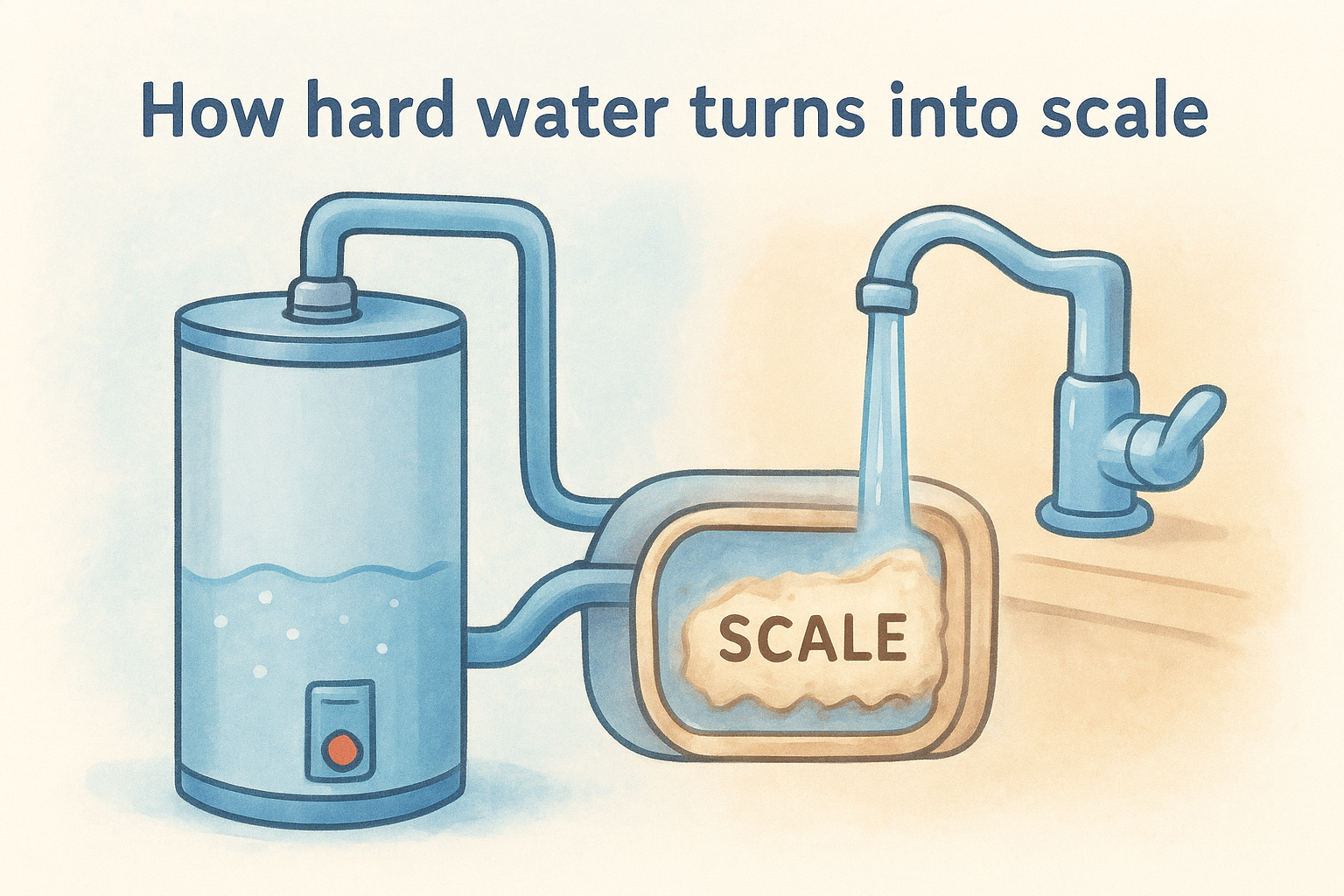
How hard water turns into scale
Calcium carbonate becomes less soluble as water gets hotter. When hard water is heated, the dissolved minerals come out of solution and settle as a hard, chalky layer. You find it inside water heaters, kettles, coffee makers and pipes. According to the U.S. Geological Survey, this scale can shorten equipment life, raise water heating costs, lower the efficiency of electric water heaters and clog pipes. As scale narrows a pipe, flow drops, and so does water pressure.
Evaporation does the same job without heat. Water leaves as vapor and the minerals stay behind, more concentrated each cycle. A quick example shows the scale of it. Water at 10 GPG carries 10 grains of hardness minerals per gallon. Push 1,000 gallons through a system and that is 10,000 grains, or about 1.4 pounds, since a pound holds 7,000 grains. Not all of it deposits, but every gallon that is heated or evaporated leaves a share behind.
What you notice in daily use
Soap is where most people first notice hardness. Soap reacts with calcium to form soap scum, so you get less lather and need more soap or detergent for your hands, hair and laundry. Glasses come out of the dishwasher spotted, shower doors turn cloudy and faucets crust over. Hard water can also shorten the life of fabrics.
On health, hard water is not considered a risk. The World Health Organization notes that drinking water can contribute calcium and magnesium to your diet. Some people find that hard water leaves skin feeling dry or hair looking dull, but that is a comfort issue, not a hazard.
Where scale costs the most
Commercial and marine equipment pays the highest price, because it moves large volumes of water across heat exchange surfaces. Scale acts as an insulating layer, so equipment works harder to deliver the same result. These are the usual trouble spots:
- Ice machines: scale builds on evaporator surfaces and water lines and calls for regular descaling with a descaler made for ice machines.
- Cooling towers and chillers: evaporation concentrates minerals, and deposits on heat transfer surfaces cut efficiency.
- Evaporative coolers: mineral crust on pads, basins and pump lines restricts airflow and water flow, and a non-acid descaler for evaporative coolers can clear it.
- Marine cooling systems: scale in heat exchangers and engine cooling passages restricts flow and heat transfer, which a marine engine descaler is made to address.
How water hardness is measured and graded
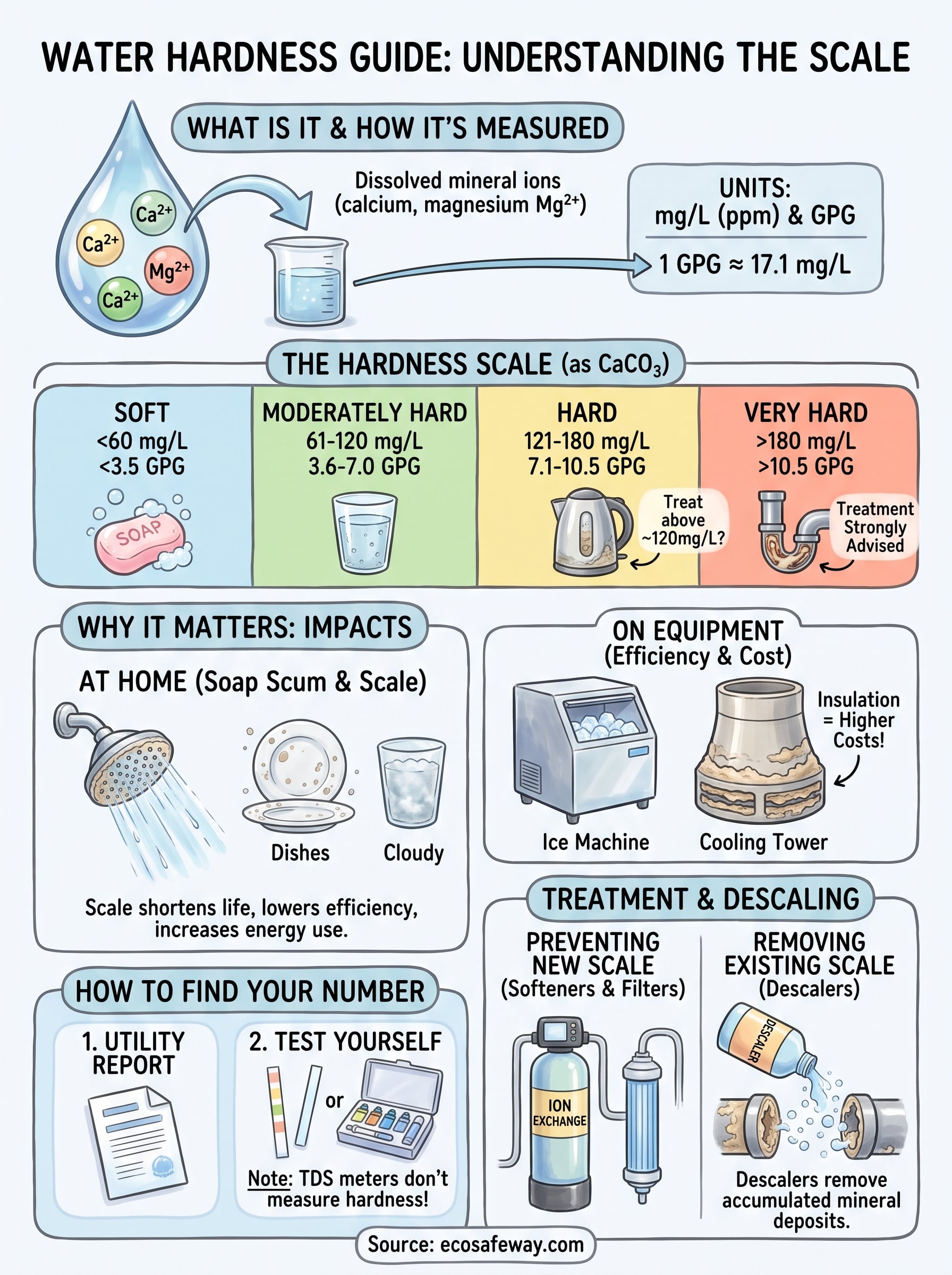
Water hardness is measured by adding up the calcium and magnesium in a sample and expressing the total as an equivalent amount of calcium carbonate (CaCO3). The result appears in mg/L, ppm or GPG, and the three units convert cleanly into one another.
One grain per gallon equals 17.1 mg/L, so multiply GPG by 17.1 to get mg/L.
mg/L, ppm and GPG
For water, mg/L and ppm are effectively the same number, because a liter of water weighs about a million milligrams. A reading of 120 mg/L is 120 ppm. GPG is the traditional US unit. One grain is 64.8 mg of calcium carbonate dissolved in one US gallon (3.79 L), which works out to 17.1 mg/L. Multiply GPG by 17.1 to get mg/L, or divide mg/L by 17.1 to get GPG.
Calcium and magnesium weigh differently, so labs convert both to a calcium carbonate equivalent. That gives one comparable number. When a report says "as CaCO3", this is what it means. Lab reports usually use mg/L, while softeners and many dishwashers ask for GPG, so you will need both.
The hardness scale
The USGS classification is the most widely cited. The GPG column below is the same scale converted with the 17.1 factor.
| Classification | mg/L or ppm as CaCO3 | Grains per gallon (GPG) |
|---|---|---|
| Soft | 0 to 60 | 0 to 3.5 |
| Moderately hard | 61 to 120 | 3.6 to 7.0 |
| Hard | 121 to 180 | 7.1 to 10.5 |
| Very hard | Over 180 | Over 10.5 |
Cut-offs vary slightly between sources. Some water treatment companies split the soft range and call 1 to 3.5 GPG "slightly hard". Always check the unit before you judge a number. A reading of 7 is hard in mg/L terms only if you have mistaken it for GPG, and a reading of 7 mg/L is extremely soft. The two scales differ by a factor of 17.
A worked example from a lab report
Many lab reports list calcium and magnesium separately and leave out total hardness. You can calculate it yourself with this formula:
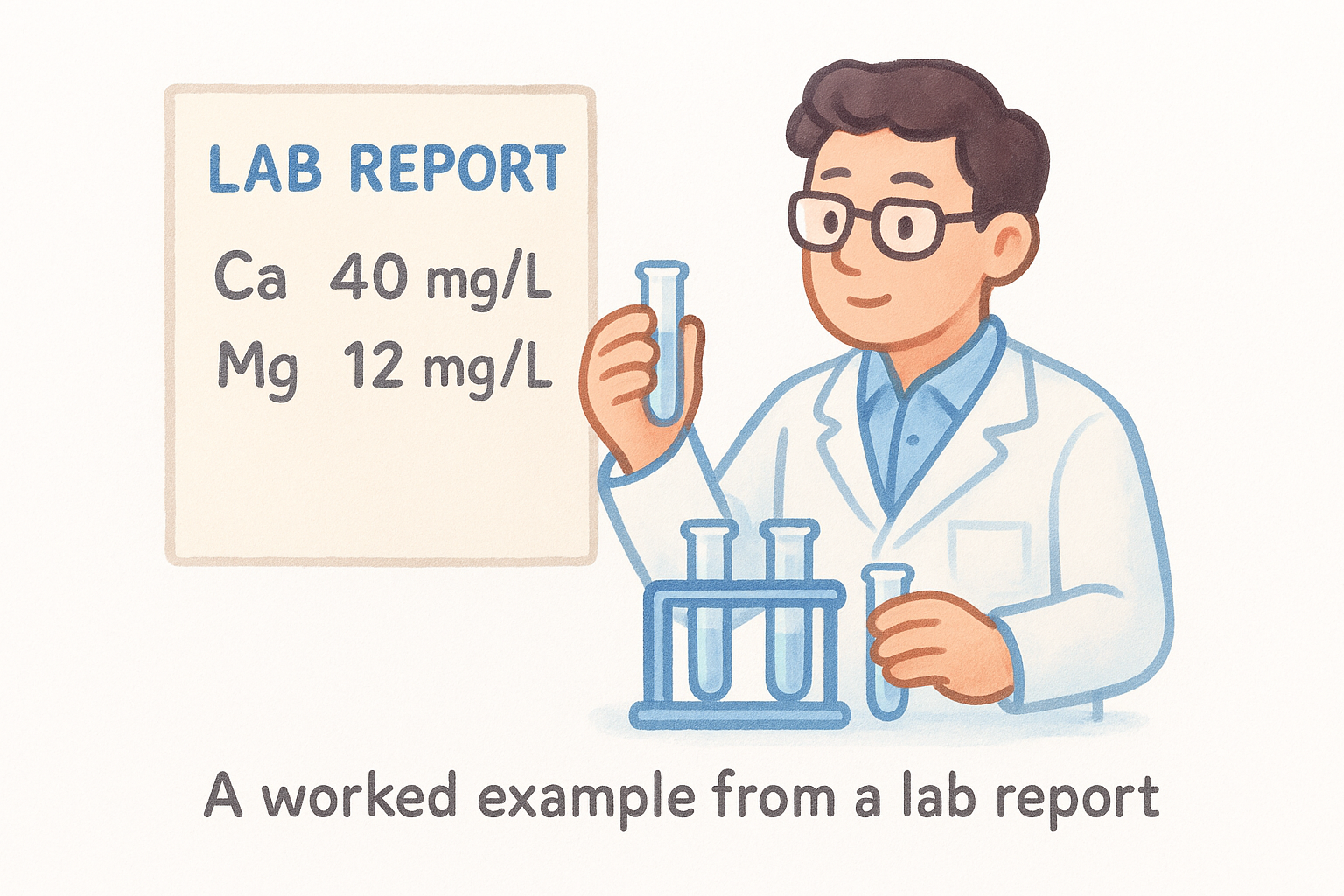
Hardness (mg/L as CaCO3) = 2.497 x calcium (mg/L) + 4.118 x magnesium (mg/L)
Say a report shows 40 mg/L calcium and 12 mg/L magnesium. Calcium contributes 40 x 2.497 = 99.9. Magnesium contributes 12 x 4.118 = 49.4. The total is 149.3 mg/L as CaCO3, which falls in the hard range. Divide by 17.1 and you get 8.7 GPG, the number to enter into a softener.
How to find your own water hardness
Start with your water utility's annual water quality report. Then confirm the number with a test strip, a titration kit or a lab test, depending on how precise you need to be.
The only number that counts is the one measured at your tap, not the regional average.
Start with your utility report
Public water systems publish annual water quality reports, and many list hardness or calcium and magnesium. If yours does not, call the utility and ask. Utilities that switch or blend sources can see their hardness shift, so look at the most recent report.
Maps and ZIP code lookup tools give a rough idea, but they rely on regional data. The USGS states that its national hardness map is not designed for decisions at the scale of an individual property. If you use a private well, there is no utility report, so you need to test. Groundwater picks up minerals as it moves through rock, and wells are often harder than treated surface water.
Test it yourself
Which method fits depends on how exact you need to be. Here is how the common options compare:
| Method | What you get | Best use |
|---|---|---|
| Soap shake test | Rough hint: little foam and cloudy water suggest hard water | Quick sanity check |
| Test strips | Color-matched range, often in GPG or ppm | Fast home screening |
| Drop-count titration kit | A number you count by drops, finer than strips | Setting a softener or equipment |
| Lab analysis | Calcium, magnesium and total hardness in mg/L | Wells, commercial systems, disputes |
A few habits keep results honest. Run the cold tap for a minute before sampling. Use a clean container. Test before any softener, not after it, if you want the incoming number. One more warning: a TDS meter does not measure hardness. It reads total dissolved solids, and a high reading does not tell you whether calcium and magnesium are the cause.
What causes water hardness
Water becomes hard when it moves through limestone, chalk, gypsum or dolomite and dissolves calcium and magnesium along the way. Three things decide the result: the rock, the contact time and the acidity of the water.
Hardness is geology carried by water.
How geology sets the number
Rain absorbs carbon dioxide and becomes weakly acidic. As it seeps through soil and rock, it dissolves calcium carbonate from limestone and chalk and calcium sulfate from gypsum. Dolomite adds magnesium. The longer the water stays underground, the more it carries.
That is why groundwater tends to be harder than surface water, and why hardness varies so much across the United States. The USGS notes that the major-ion chemistry of groundwater is relatively stable and generally does not change over time. Calcium and magnesium dominate, though iron, manganese and other metals can add to the total.
Temporary and permanent hardness
Hardness comes in two forms. Temporary (carbonate) hardness comes from calcium and magnesium bicarbonates. Boiling or heating the water drives them out as scale, which is why kettles and water heaters fur up.
Permanent (non-carbonate) hardness comes from calcium and magnesium sulfates and chlorides. These stay dissolved when you boil the water, so boiling does not soften it. Total hardness is the sum of both, and the split tells you how much scale heating will produce and which treatment will work.
What water hardness level is good and when to treat it
No health standard sets an upper limit for water hardness. In practice, water under about 120 mg/L (7 GPG) needs no treatment, treatment starts to pay off above that, and it is strongly advised above 180 mg/L (10.5 GPG).
Treat hardness when scale costs you money, not because a number looks high.
What counts as a good level
Soft to moderately hard water is a good level for most homes and businesses. Use this as a working guide:
- 0 to 60 mg/L (0 to 3.5 GPG): no action needed.
- 61 to 120 mg/L (3.6 to 7.0 GPG): usually fine. Watch for spotting and protect sensitive equipment.
- 121 to 180 mg/L (7.1 to 10.5 GPG): scale is noticeable. Softening or scale control is worth considering.
- Over 180 mg/L (over 10.5 GPG): treatment is strongly advised, especially for water heaters and ice machines.
Softer is not always better. Very soft water can be more aggressive toward some metals, so a lower number is not automatically a goal.
Ways to treat hard water
Ion exchange softeners replace calcium and magnesium with sodium and treat all the water entering a building. Reverse osmosis filters water through a membrane and suits a single tap, because it handles small volumes. Salt-free conditioners change how scale forms rather than removing the minerals, so they reduce adhesion but do not lower the hardness reading. Boiling helps only with temporary hardness.
For commercial equipment, follow the equipment maker's guidance on water quality and filtration. Hardness at the point of use matters more than hardness at the street.
Removing existing scale and raising hardness
Treatment prevents new scale, but it does not remove what is already there. Existing deposits need a descaler. Eco Safeway makes non-corrosive, biodegradable descalers for cooling towers, ice machines and evaporative coolers. Check each product page for compatibility with your equipment before use.
Sometimes the goal runs the other way. Reverse osmosis water, for example, can be too pure for some tastes. Remineralization cartridges or mineral additives made for drinking water add calcium and magnesium back. Pool owners raise calcium hardness with calcium chloride. In both cases, follow the product directions and re-test afterward.
Putting your water hardness number to use
Water hardness is the dissolved calcium and magnesium in your water. Measured in mg/L, ppm or GPG, it tells you whether scale is likely. Find your number from the utility report or a test, convert it with the 17.1 factor, and compare it with the scale. Under 120 mg/L (7 GPG), you can usually leave it alone. Above that, plan for treatment.
If hard water has already left scale in your cooling equipment, a cooling tower and industrial HVAC descaler from Eco Safeway is a place to start.


