





The right cooling tower cleaner depends on what is fouling your tower. Hard mineral scale needs a descaler, dirt and sediment on the fill need a foaming fill cleaner, organic slime responds to enzymes, and a murky or stagnant system needs a dispersant followed by disinfection. Heavily scaled towers on a tight budget are the one case where a strong acid is worth considering, with a water treater supervising.
Most buyers choose wrong because they compare products by name instead of by deposit. A descaler will not remove biofilm, and an enzyme will not dissolve calcium carbonate. Buying the wrong one wastes a shutdown window and can leave the tower dirtier than before.
This list covers five types of cleaner, starting with the non-acid descaler we sell at Eco Safeway. For each type you get how it works, who it suits, and how to use it. A short table at the end matches symptoms to products, so you can pick in one pass.
1. Non-acid cooling tower descaler
A non-acid descaler dissolves mineral scale, lime and rust without the corrosion risk of mineral acids. Eco Safeway's Cooling Tower Descaler is our example here.
How it works
The formula is non-corrosive and biodegradable, and the listing describes it as safe for steel and rubber components. It is CIP compatible, so you circulate it through the system in place instead of dismantling anything. It targets scale, lime deposits and rust accumulation in towers, chillers, heat exchangers and condensers.
Who it suits
Facility managers, mechanical contractors, hospitals, universities and data centers use this type when they want scale gone without handling aggressive acids. It ships by standard shipping, so no hazmat handling is involved. For water-side data center cooling, the data center HVAC cleaner is the closer match.
How to use it and what it costs
Sizes run from 1 gallon to 275-gallon totes, and listed prices run from $89.99 to $349.99 depending on size. Follow the label and safety sheet, and check your tower manufacturer's requirements first. The sequence is:
- Remove loose debris from the basin and fill.
- Apply the product as directed and circulate it.
- Drain and flush with clean water.
- Refill with treated water and watch your approach temperature.
A non-acid descaler trades a little speed for far less risk to your tower's metal and rubber parts.
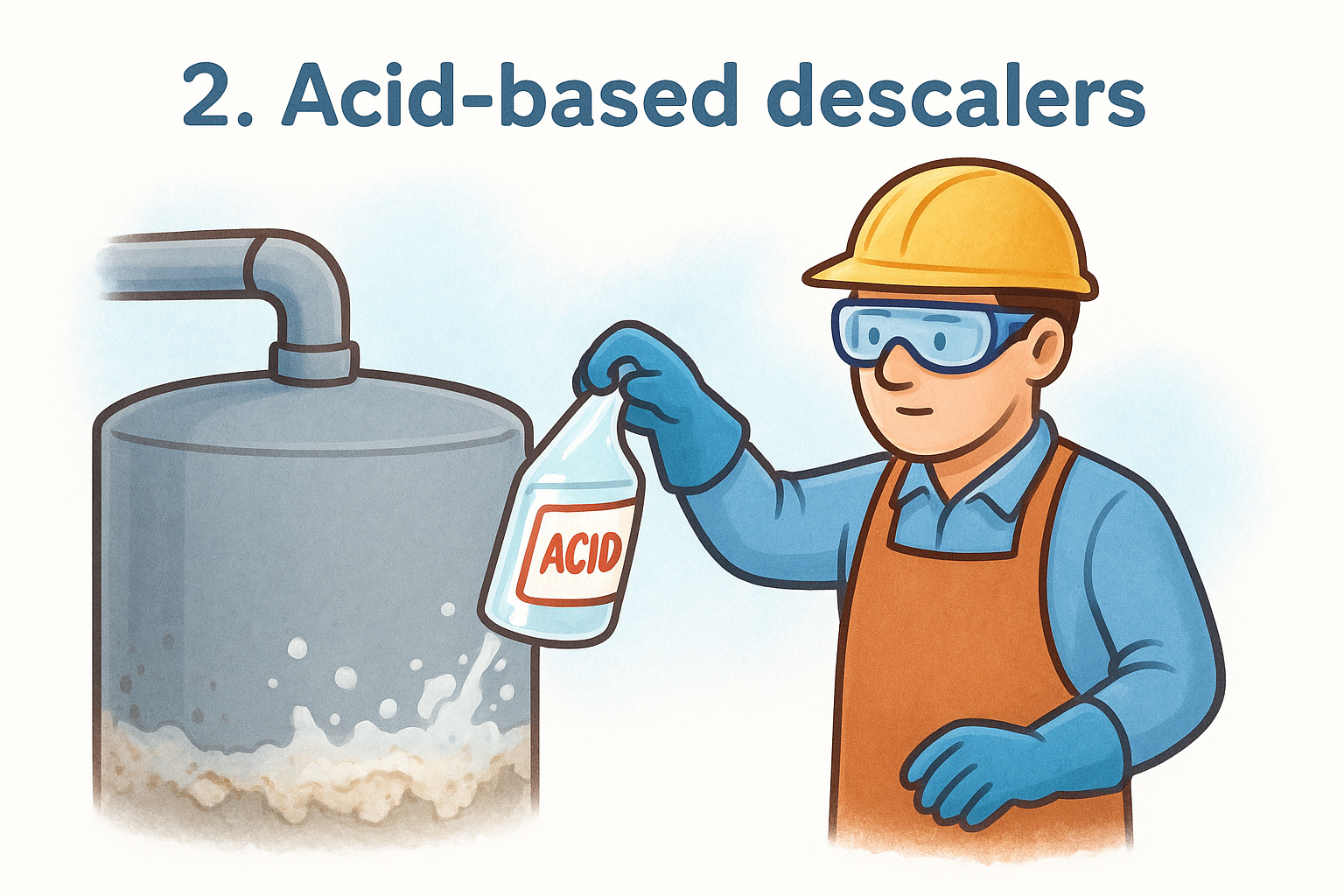
2. Acid-based descalers
Acid cleaners such as hydrochloric or phosphoric acid products are the fastest way to dissolve thick calcium carbonate and iron oxide scale. They are also the hardest on your equipment.
How it works
The acid reacts with mineral deposits and turns them soluble. Water treaters often call this a compromise between dissolving scale and protecting metallurgy. Galvanized steel is especially sensitive, because strong acid can strip the zinc coating that protects it.
Who it suits
This is for towers neglected for several seasons, with falling heat rejection and rising head pressure. If the scale is thick enough to bridge fill sheets, a gentler product may need several passes. Most facilities should let their water treatment provider run an acid cleaning, not do it in-house.
How to use it and what it costs
Have PPE on site, and brief your safety director before you start. Spent acid solution is low-pH water, and discharge rules apply under federal, state and local law. Neutralize it and dispose of it as required. Product cost per gallon is usually low, but add labor, neutralization and disposal.
Use acid when scale is severe, and use a professional when you do.
3. Foaming fill cleaners
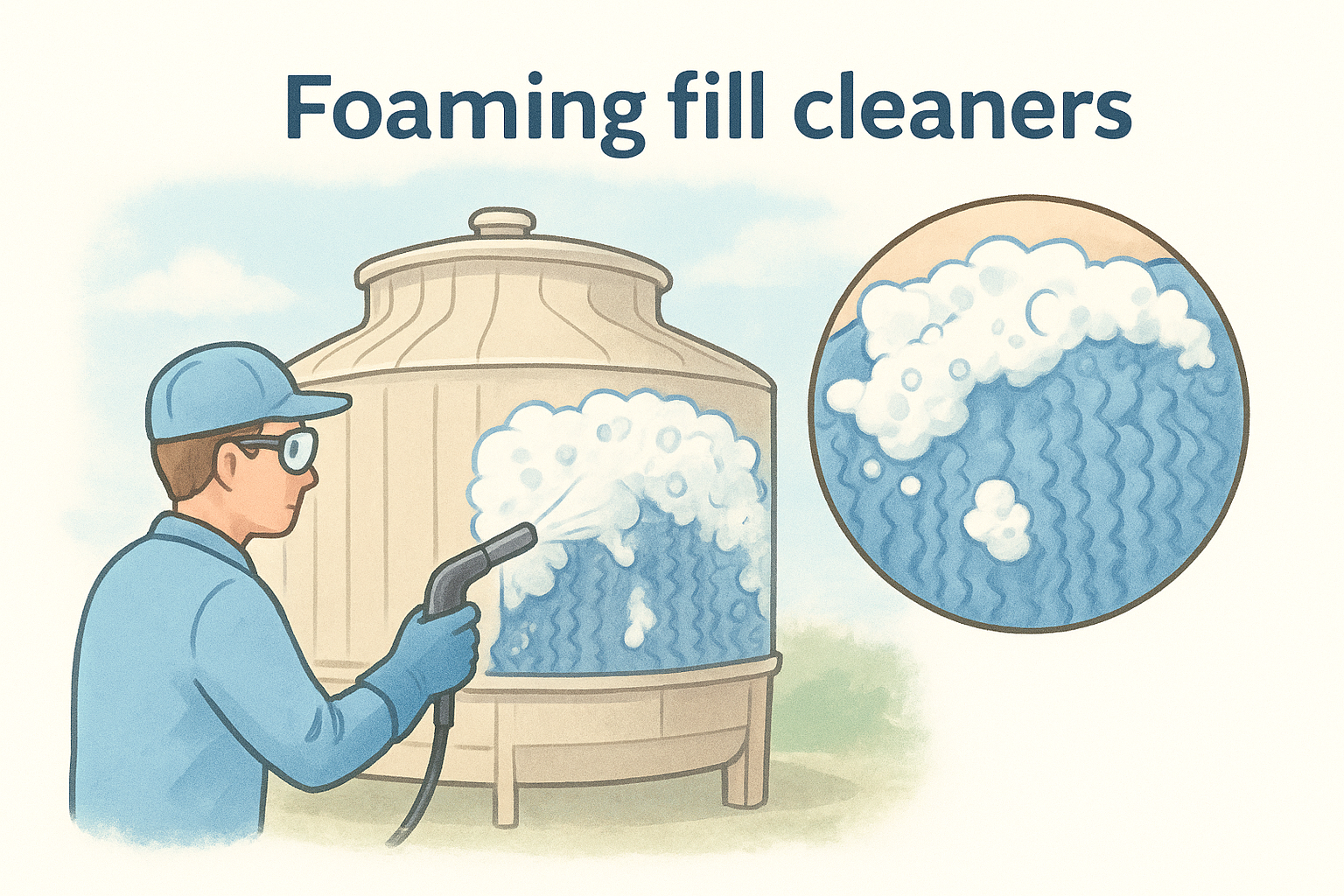
A fill cleaner is an expanding foam detergent that lifts dirt, silt and algae film off the fill media. It is a surface cleaner, not a descaler.
How it works
You spray or apply the foam, let it cling and expand into the fill, then rinse. The foam gives the detergent contact time on vertical surfaces where liquid would just run off. Mechanical rinsing then carries the loosened soil out.
Who it suits
Choose this for towers whose fill is visibly dirty, slimy or clogged with pollen, leaves and sediment but not crusted with hard scale. It suits annual spring startup cleaning and is a good first step before a descaler, since removing loose debris lets the descaler reach the deposits.
How to use it and what it costs
Drain the tower, remove loose debris, and apply the foam per the label. Rinse from the top down with moderate pressure. Film fill can be damaged by aggressive pressure washing, so check your fill manufacturer's guidance. Pay attention to corners and the drift eliminators, then flush the basin.
Clean the fill first, because dirty fill hides scale and wastes every product you add after it.
4. Multi-enzyme cleaners
Enzyme cleaners break down organic matter such as slime, biofilm, oils and decayed debris. They are gentle on metals and a good fit for light fouling.
How it works
Enzymes digest organic films that coat heat-exchange surfaces and insulate them. Removing that film can improve heat exchange on the condenser. Enzymes do nothing to mineral scale, so they sit alongside a descaler, not in place of one.
Who it suits
Choose enzymes for lightly to moderately fouled towers, for sites that want to avoid corrosive chemistry, or as a between-cleanings maintenance step after a descaling. They are a weaker choice when water has stagnated for weeks or Legionella results are high. Those cases need disinfection.
How to use it and what it costs
Dose per the label, circulate for the stated contact time, then drain and flush the system. Enzyme products are often sold in 5-gallon pails, so compare cost per treated gallon of system volume, not cost per container. Check that the product is compatible with any biocide you run, because oxidizers can deactivate enzymes.
Enzymes remove the organic film that scale cleaners ignore, so use them for slime and not for crust.
5. Dispersants and biocide disinfection
Dispersant cleaning loosens silt, loose scale and biofilm, and disinfection with a biocide follows to kill what remains. Together they are the safest routine cleaning method, though neither dissolves hard scale.
How it works
The dispersant is slug-dosed into the circulating water and held for several hours, sometimes overnight. You then drain and flush, and repeat if needed. An oxidizing biocide is typically added a couple of hours after the dispersant, and a validation check confirms the system is ready to return to service.
Who it suits
This route fits towers that sat stagnant for more than two weeks, ran without a treatment program, show a slimy basin or foul odor, or tested high for Legionella. Your water management plan should govern the procedure, so involve your water treatment provider.
How to use it and what it costs
Plan on cleaning and disinfecting at least twice a year, commonly at startup and shutdown, and more often for fouled systems. A worked example: a tower with a murky basin and white crust on the fill needs two passes, a dispersant and disinfection first, then a descaler once the system is clean.
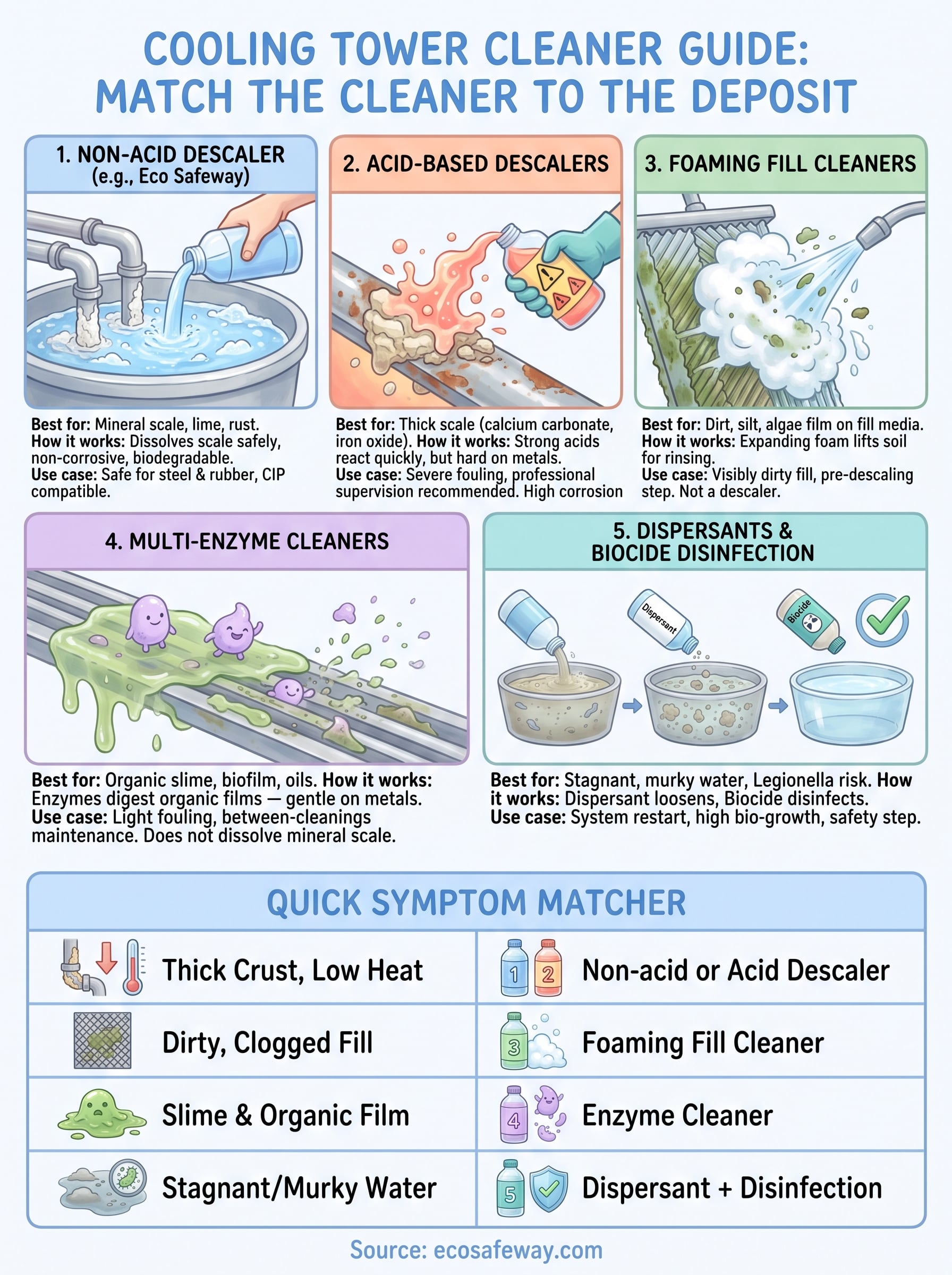
| Symptom | Cleaner type |
|---|---|
| Thick white or brown crust, low heat rejection | Non-acid or acid descaler |
| Dirty, clogged fill | Foaming fill cleaner |
| Slime and organic film | Enzyme cleaner |
| Stagnant, murky or Legionella-positive water | Dispersant plus disinfection |
Disinfection is a safety step, not an optional extra, whenever water has stood or tested high.
Which cooling tower cleaner should you buy?
Match the cleaner to the deposit: descalers for scale, fill foam for dirt, enzymes for slime, dispersant and biocide for contaminated water. Clean the fill first, descale second, and finish with treated water. If you are unsure what you are dealing with, test the water and inspect the fill before you order.
To see sizes and the safety sheet, view the non-acid Eco Safeway cooling tower descaler. You can also call us at 561-405-0271 to talk through your tower before you buy.


