





Every car owner eventually asks the same question: how often do I really need to bring this vehicle in for service? A maintenance schedule answers that question with specifics, not guesswork. It's the manufacturer's roadmap for keeping your engine, brakes, and fluids working the way they should, tied to exact mileage markers or time intervals so nothing gets skipped until it becomes an expensive repair.
This guide breaks down exactly what a maintenance schedule covers and when each service typically falls due, from oil changes every 5,000 to 10,000 miles to bigger jobs like timing belts and transmission fluid swaps at 60,000 miles or beyond. You'll see how mileage and time intervals work together, since a car driven rarely still needs attention on a calendar basis.
Whether you're a new owner trying to protect your investment or someone who's let service intervals slide, the same principle applies here that we apply to yacht hull maintenance at Eco Safeway: consistent, scheduled care beats reactive repairs every time. Read on for a practical breakdown you can actually follow.
Why a maintenance schedule matters for your car
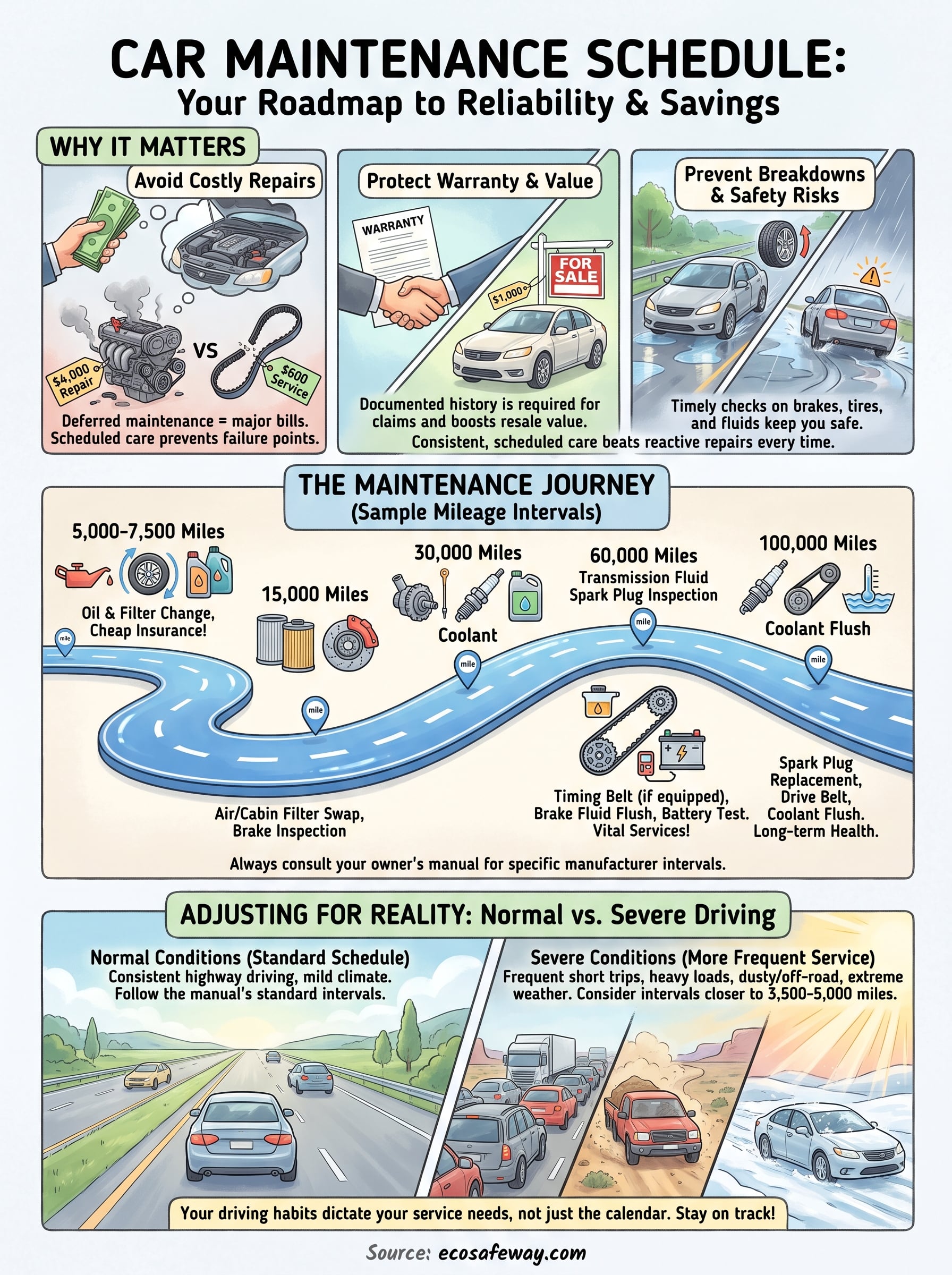
Skipping a scheduled service doesn't just delay a task, it stacks risk on top of risk. Deferred maintenance is the leading reason small issues turn into five-figure repair bills. A worn timing belt that snaps at 90,000 miles instead of getting replaced at 60,000 can bend valves and wreck a cylinder head, turning a $600 job into a $4,000 one. Following the manufacturer's maintenance schedule keeps you ahead of these failure points instead of reacting to them after the damage is done.
Protecting your warranty and resale value
Manufacturers build these intervals into your warranty coverage, and that's not a coincidence. Most powertrain warranties require documented proof that you followed the recommended schedule, and a dealership or manufacturer can legally deny a claim if you can't show service records for oil changes, filter swaps, or fluid flushes. Beyond warranty protection, a full service history adds real dollars to your car's resale value. Buyers and dealers alike treat a stack of maintenance receipts as proof the vehicle was cared for, and CarFax-style reports now surface that history automatically, so gaps stand out immediately to anyone shopping used cars.
A car that's serviced on schedule almost always costs less to own than one that's fixed only when something breaks.
Preventing costly breakdowns and safety risks
Certain services exist purely to keep you safe on the road, not just to keep the engine running smoothly. Brake pads, tire rotations, and steering components wear down gradually, and a scheduled inspection catches the warning signs before they cause a failure at highway speed.
Here's what typically goes wrong when these checkpoints get ignored:
- Brake pads wear past the rotor, requiring rotor replacement instead of a simple pad swap
- Uneven tire wear from skipped rotations shortens tread life by thousands of miles
- Low or degraded transmission fluid causes shifting problems that get progressively worse
- Old coolant loses its ability to protect against overheating in summer traffic
Each of these starts as a minor line item on a service schedule and becomes a major expense, or a safety hazard, once it's neglected long enough.
How to find your vehicle's recommended schedule
Start with the owner's manual, since that's the single source your manufacturer built specifically for your make, model, and engine. Every manual includes a maintenance section broken into mileage tiers, usually 15,000, 30,000, 60,000, and 100,000 miles, with a matching table of exact tasks for each one. If the physical copy got lost in a glovebox cleanout, most manufacturers now post the same service intervals as a free PDF on their official site, searchable by VIN or model year.
Checking your dashboard and dealer records
Your car itself can also tell you what's due. Modern dashboards display a maintenance reminder light or a percentage countdown tied to the onboard computer, which tracks mileage and, in many cases, actual driving conditions rather than a flat calendar guess. Dealerships keep this same data on file, so calling your service department with your VIN pulls up exactly what's due and what's already been done.
Your owner's manual, not a mechanic's guess, is the real authority on when your car needs service.
When manuals and mechanics disagree
Independent shops sometimes push shorter intervals than the manual specifies, particularly for oil changes. That's not always dishonest, but it's not always necessary either. Cross-check any recommendation against the manufacturer's published schedule before agreeing to extra work, especially if the shop can't point to a specific reason tied to your driving conditions or vehicle age.
A sample maintenance schedule by mileage
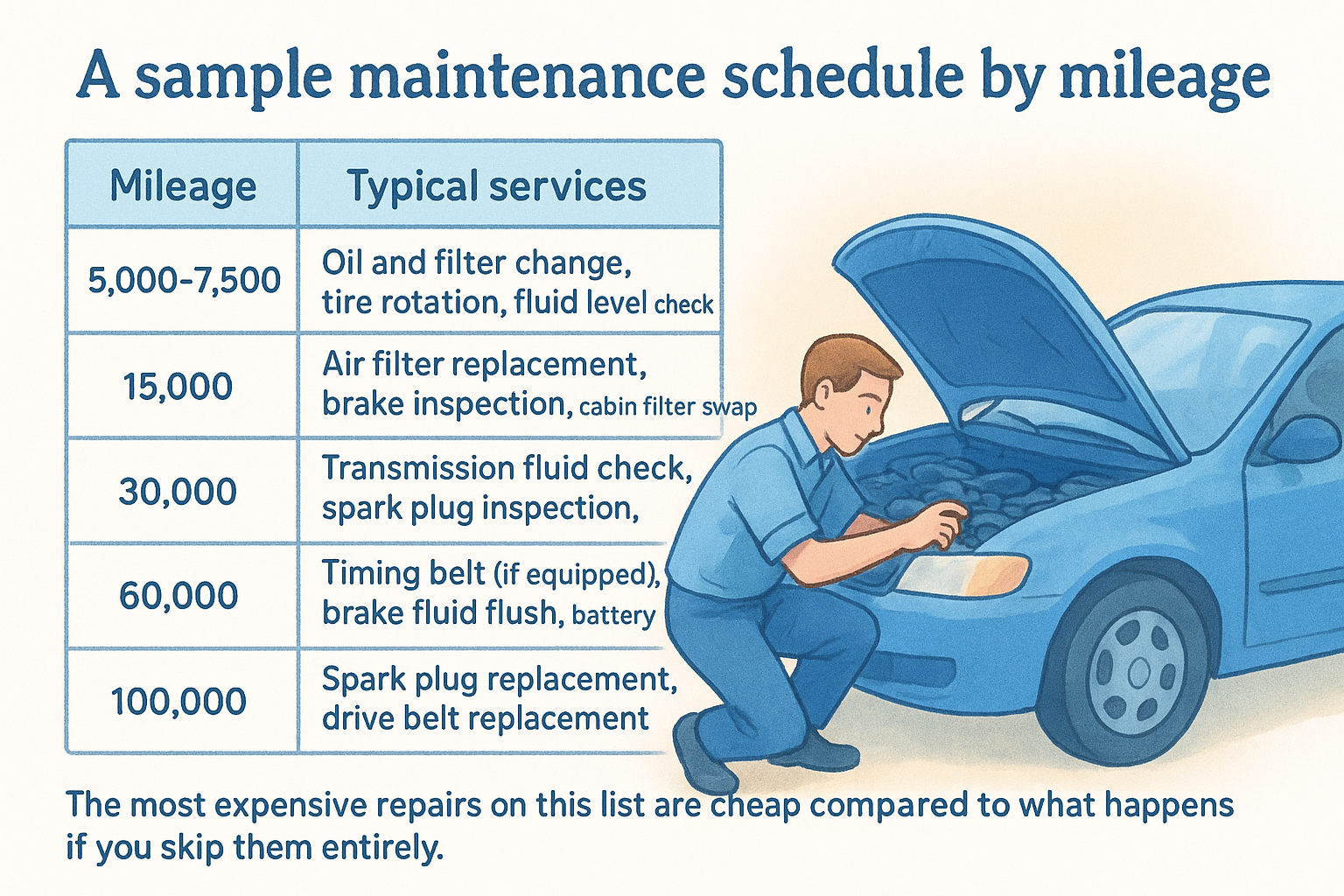
Most owner's manuals organize tasks around round mileage numbers, and while exact intervals vary by make, the pattern below reflects what you'll see across most gasoline vehicles. Use it as a general reference, then confirm the specifics against your own maintenance schedule before skipping or delaying anything.
| Mileage | Typical services |
|---|---|
| 5,000-7,500 | Oil and filter change, tire rotation, fluid level check |
| 15,000 | Air filter replacement, brake inspection, cabin filter swap |
| 30,000 | Transmission fluid check, spark plug inspection, coolant check |
| 60,000 | Timing belt (if equipped), brake fluid flush, battery test |
| 100,000 | Spark plug replacement, drive belt replacement, coolant flush |
Notice how the jobs escalate in cost and complexity as the mileage climbs. Oil changes and rotations are cheap insurance early on, but the 60,000 and 100,000-mile marks carry the parts most likely to fail catastrophically if ignored, especially the timing belt.
The most expensive repairs on this list are cheap compared to what happens if you skip them entirely.
Quartz precision isn't required here. Some manufacturers list these tasks in 30,000-mile blocks instead of splitting them out, and hybrid or diesel vehicles shift several items to different intervals entirely. Treat this table as a starting point for understanding the rhythm of scheduled maintenance, not a replacement for the document that came with your specific vehicle.
How driving habits change your service needs
A maintenance schedule isn't one-size-fits-all. Manufacturers publish two tracks in most owner's manuals: a "normal" schedule and a "severe" one, and most drivers actually fall into the second category without realizing it. Severe driving conditions trigger faster wear on oil, brakes, and transmission components, which means the standard mileage intervals you've been following might already be too generous for how you actually drive.
What counts as severe driving
Your driving pattern matters more than your car's age. Consider whether any of these apply to you:
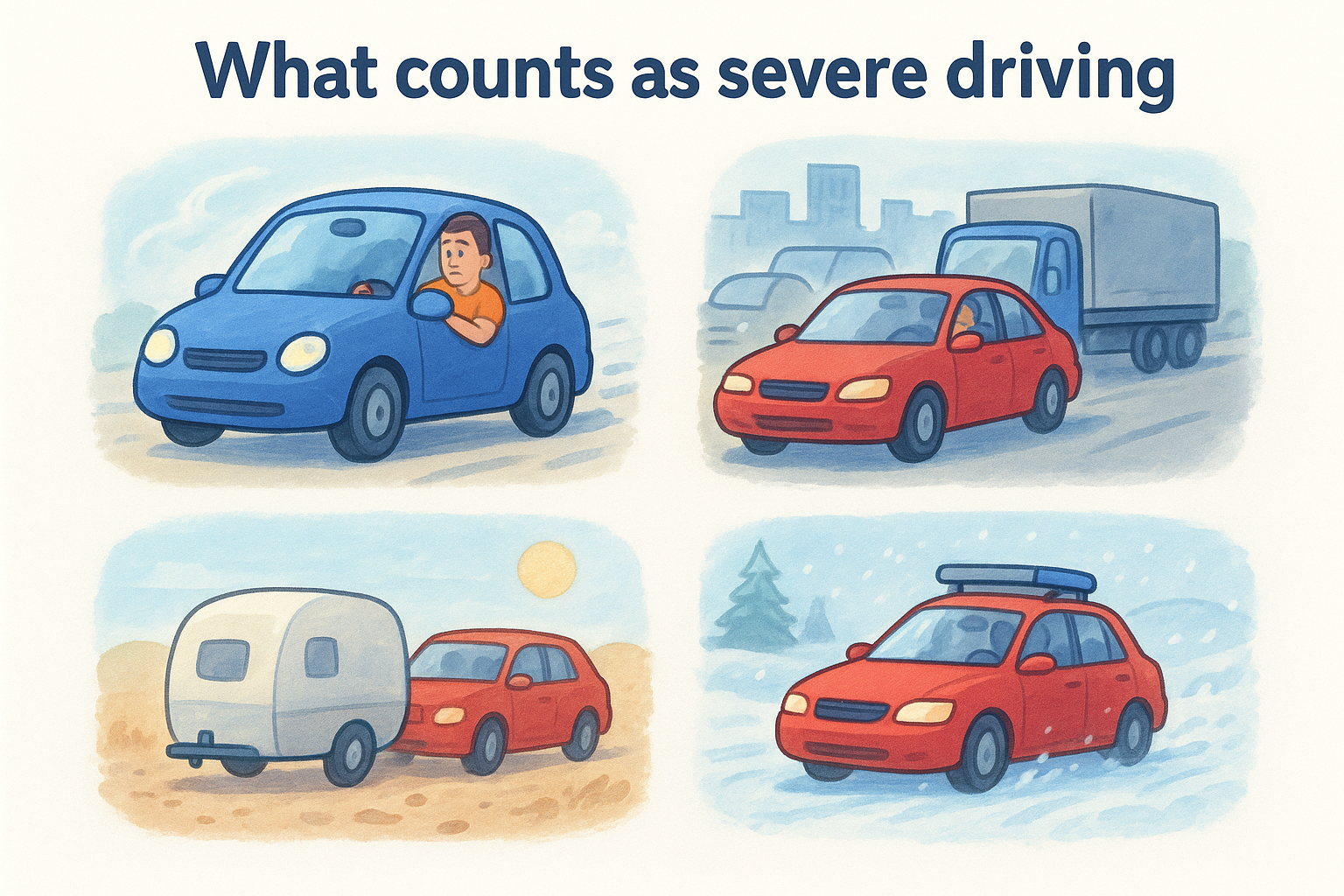
- Frequent short trips under 10 miles, especially in cold weather
- Stop-and-go city traffic or daily commuting through heavy congestion
- Towing a trailer, hauling heavy loads, or driving with a roof rack most of the time
- Dusty, gravel, or off-road conditions on a regular basis
- Extreme heat or extreme cold as your normal climate
If two or more of these describe your routine, you're likely due for oil changes and filter swaps closer to every 3,500 to 5,000 miles rather than the 7,500-mile mark listed for normal use.
If your commute looks nothing like a manufacturer's test track, your service intervals shouldn't either.
Adjusting your schedule accordingly
Salt air, humidity, and coastal driving push corrosion-related wear on brake lines and undercarriage components even faster, which is the same logic that drives our approach to yacht hull protection at Eco Safeway: environment dictates how often you need to intervene, not just the calendar.
Staying on track with your next service
A maintenance schedule only works if you actually follow it, so pick one method and stick with it. Set a calendar reminder, save the mileage tiers from your owner's manual, or let your dashboard's countdown do the tracking for you. Either way, the goal is the same: catch small problems while they're still cheap to fix.
Getting your service intervals right isn't about perfection, it's about consistency. Miss a rotation here or there and your car forgives you. Ignore the schedule entirely, and eventually something expensive fails at the worst possible time.
The same logic applies well beyond your driveway. If you own a boat, hull protection follows the same scheduled-versus-reactive logic that keeps a car running for 200,000 miles instead of 100,000. See how the Finsulate antifouling wrap, an alternative to bottom paint, applies that same scheduled-care thinking to your vessel.


