





If you've ever wondered what keeps factories running, ships afloat, or HVAC systems humming without constant breakdowns, you're looking at industrial maintenance. It's the backbone work that most people never see until something fails, and it covers everything from routine inspections to full equipment overhauls across manufacturing plants, marine facilities, and commercial buildings. Understanding this field matters whether you're considering a career change or trying to figure out who actually handles the technical upkeep your business depends on.
This article breaks down exactly what industrial maintenance involves, the different career paths available, and the skills employers actually look for, from mechanical aptitude to knowledge of preventive maintenance software. You'll get a realistic picture of daily responsibilities, not just a textbook definition.
We'll also cover job outlook, typical certifications, and how specialized niches like marine and facility maintenance differ from general industrial roles. At Eco Safeway, we work daily with facility managers and marine professionals who rely on skilled maintenance teams to protect equipment and vessels, so we know firsthand what separates a strong maintenance career from a dead-end job.
Why industrial maintenance matters
Unplanned downtime costs American manufacturers an estimated $50 billion a year, according to Deloitte research on smart manufacturing. Every hour a production line sits idle, you're paying wages for workers who can't work, missing shipment deadlines, and sometimes losing customers who won't wait around for a fix. That's the blunt reality behind why industrial maintenance exists: it's cheaper to prevent a breakdown than to recover from one, and the entire field is built around avoiding that kind of unplanned downtime.
A well-maintained machine rarely makes headlines, but a broken one always does.
Facilities that treat maintenance as an afterthought pay for it later, whether through equipment failure, safety incidents, or regulatory fines. Preventive maintenance programs flip that equation by catching wear and tear before it turns into a five-figure repair bill or a shutdown that ripples through an entire supply chain.
Safety depends on it, not just uptime
Beyond the balance sheet, maintenance work keeps people safe. A frayed hydraulic line, a corroded pressure vessel, or a malfunctioning safety interlock can injure or kill someone on a factory floor. OSHA has documented countless workplace incidents traced directly to deferred maintenance, from unguarded machinery to failed lockout/tagout procedures. Facility managers and maintenance technicians who inspect and service equipment on schedule are effectively acting as a safety layer that most workers never think about until it's missing.
Government agencies and insurance underwriters also expect documented maintenance compliance. Hospitals, food processing plants, and chemical facilities operate under regulatory frameworks that require proof of inspections, calibrations, and repairs. Skip that paperwork, and you risk fines, shutdowns, or losing your operating license entirely. This is one reason technicians increasingly need to understand recordkeeping software alongside wrenches and multimeters.
Protecting long-term equipment investment
Heavy equipment isn't cheap, and replacing it early because of neglect is one of the most avoidable expenses a company can incur. A properly maintained industrial pump, an HVAC compressor kept clear of buildup with an industrial HVAC and cooling tower descaler, or a marine engine can run for decades past its expected service life if someone actually services it on schedule. Skipping maintenance to save a few dollars today almost always costs far more down the road in replacement parts, emergency labor, and lost production time.
The marine industry offers a clear example of this principle in action. A yacht hull left without proper protection accumulates marine growth that increases drag, wastes fuel, and forces more frequent haul-outs for cleaning and repainting. That's exactly the kind of preventable maintenance burden that specialized coatings like Finsulate hull protection are designed to reduce, cutting the labor-intensive antifouling cycle that traditional bottom paint requires. Whether you're maintaining a factory conveyor or a superyacht hull, the underlying logic stays the same: proactive care always costs less than reactive repair.
Demand for skilled workers keeps growing
Industrial maintenance isn't a shrinking field, it's one of the more stable blue-collar career paths available right now. The Bureau of Labor Statistics projects steady demand for industrial machinery mechanics and maintenance workers as aging equipment and retiring baby boomer technicians create openings faster than schools can fill them. Employers across multiple sectors are competing for the same limited pool of qualified candidates.
You'll find this demand across a wide range of industries, including:
- Manufacturing plants running CNC machines, conveyors, and robotics
- Commercial and industrial HVAC systems in office buildings and hospitals
- Marine facilities maintaining vessels, docks, and marina equipment, including marine engine and heat exchanger descaling
- Data centers requiring 24/7 cooling and power system reliability, where data center chiller and cooling tower descaling keeps heat rejection on spec
- Food and beverage processing plants with strict sanitation requirements
- Power generation and utility infrastructure
This breadth is part of what makes industrial maintenance careers attractive to newcomers and veterans alike. A technician with solid core troubleshooting skills can move between industries without starting over, since the fundamentals of diagnosing a failure transfer even when the specific equipment doesn't.
How to start a career in industrial maintenance
Most people don't stumble into industrial maintenance, they choose it deliberately because the path is shorter and cheaper than a four-year degree. You can land an entry-level maintenance technician job with a high school diploma, some mechanical aptitude, and a willingness to learn on the job, though employers increasingly favor candidates with formal training. Trade schools and community colleges offer associate degrees or certificate programs in industrial maintenance technology, typically running one to two years, and these programs cover the fundamentals that separate a competent technician from someone who just guesses at repairs.
Nobody hands you a wrench and calls you a technician; the certifications and hands-on hours do that.
Apprenticeships beat classroom-only training
Apprenticeships remain the gold standard for breaking into this field because they pay you while you learn, combining paid work hours with structured classroom instruction. Programs registered through the U.S. Department of Labor run anywhere from two to four years and cover mechanical systems, electrical basics, hydraulics, and pneumatics under a journeyman's supervision. Manufacturers, utilities, and even some marine facilities sponsor these programs directly, which means you graduate with real experience instead of just theory, and often a job offer already waiting.
Certifications that actually move the needle
Certifications don't replace experience, but they signal to employers that you've mastered specific technical areas, and some are near-mandatory for advancement. Consider pursuing these based on your specialty:
- CMRP (Certified Maintenance and Reliability Professional) for those aiming at supervisory or reliability-engineering roles
- EPA Section 608 certification if you'll work anywhere near refrigerants or HVAC systems
- OSHA 10 or OSHA 30 safety training, which most industrial employers now require before you set foot on a floor
- NCCER Industrial Maintenance Mechanic credential for a broad, portable qualification recognized across manufacturing sectors
Stacking two or three of these early in your career opens doors that a resume without them simply won't.
Entry points that don't require prior experience
Some employers will train you from zero if you show mechanical curiosity and reliability, so don't assume every door is locked behind a credential. Maintenance helper, machine operator, or facilities assistant roles often serve as feeder positions into full technician jobs within a year or two. Working these entry roles lets you absorb plant-specific knowledge, build a relationship with senior technicians, and prove you can show up and problem-solve under pressure, which matters more to hiring managers than a transcript.
Specialized niches change the entry path
Niche sectors like marine maintenance or hull protection work sometimes require additional, industry-specific training beyond general mechanical skills. Technicians who install or service systems like Finsulate hull coatings, for example, typically get hands-on training directly from certified dealers rather than a general trade school, since the application process and surface preparation differ from standard antifouling work. If you're drawn to marine-specific maintenance, connecting with a company that installs specialized systems can be a faster route than a generic industrial program, since you'll learn equipment nobody teaches in a classroom setting.
Common industrial maintenance strategies and examples
Most facilities blend several maintenance strategies rather than picking just one, and knowing the difference helps you understand what a job posting actually expects from you. The four core approaches are reactive maintenance, preventive maintenance, predictive maintenance, and reliability-centered maintenance, each with its own cost profile and skill demands.
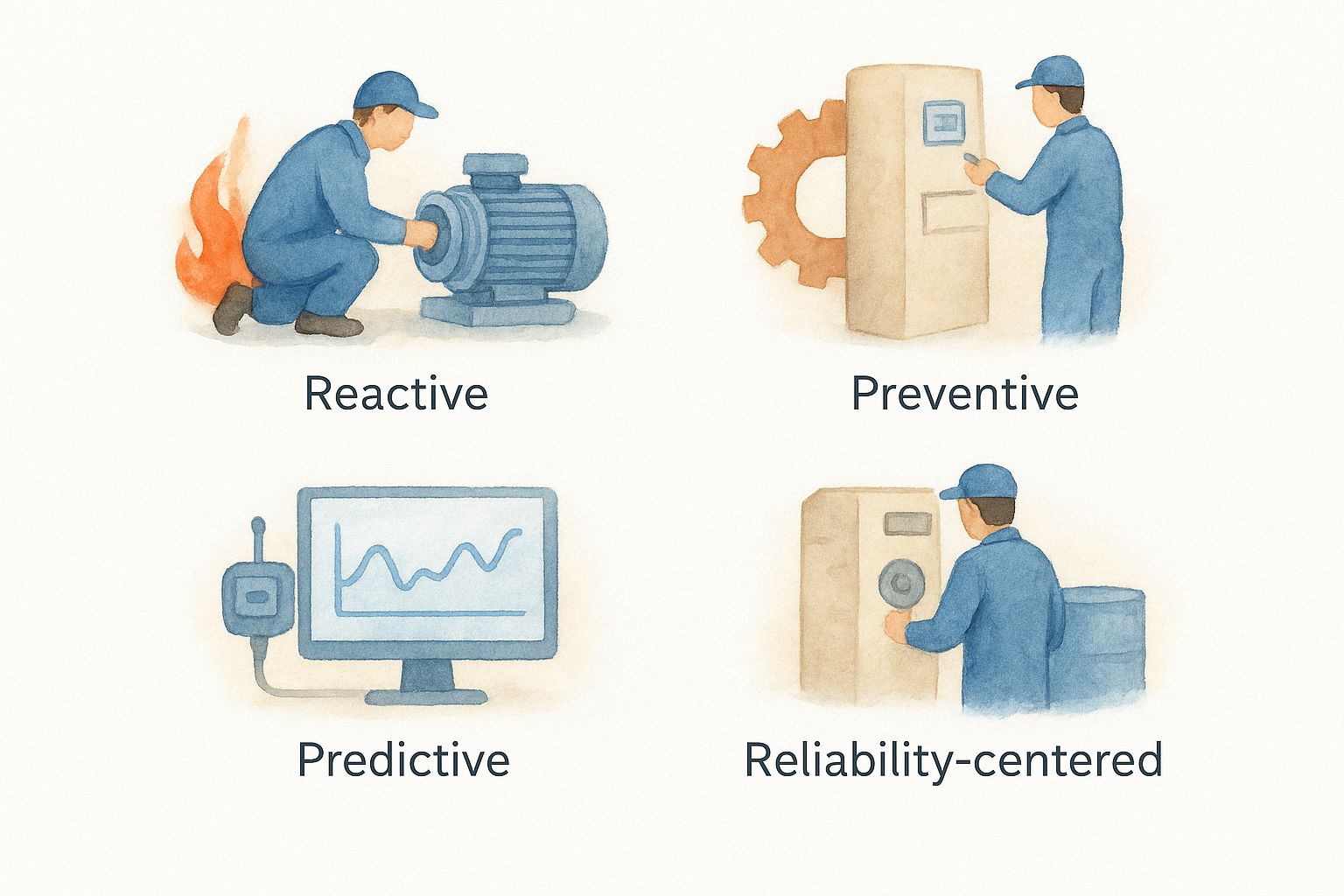
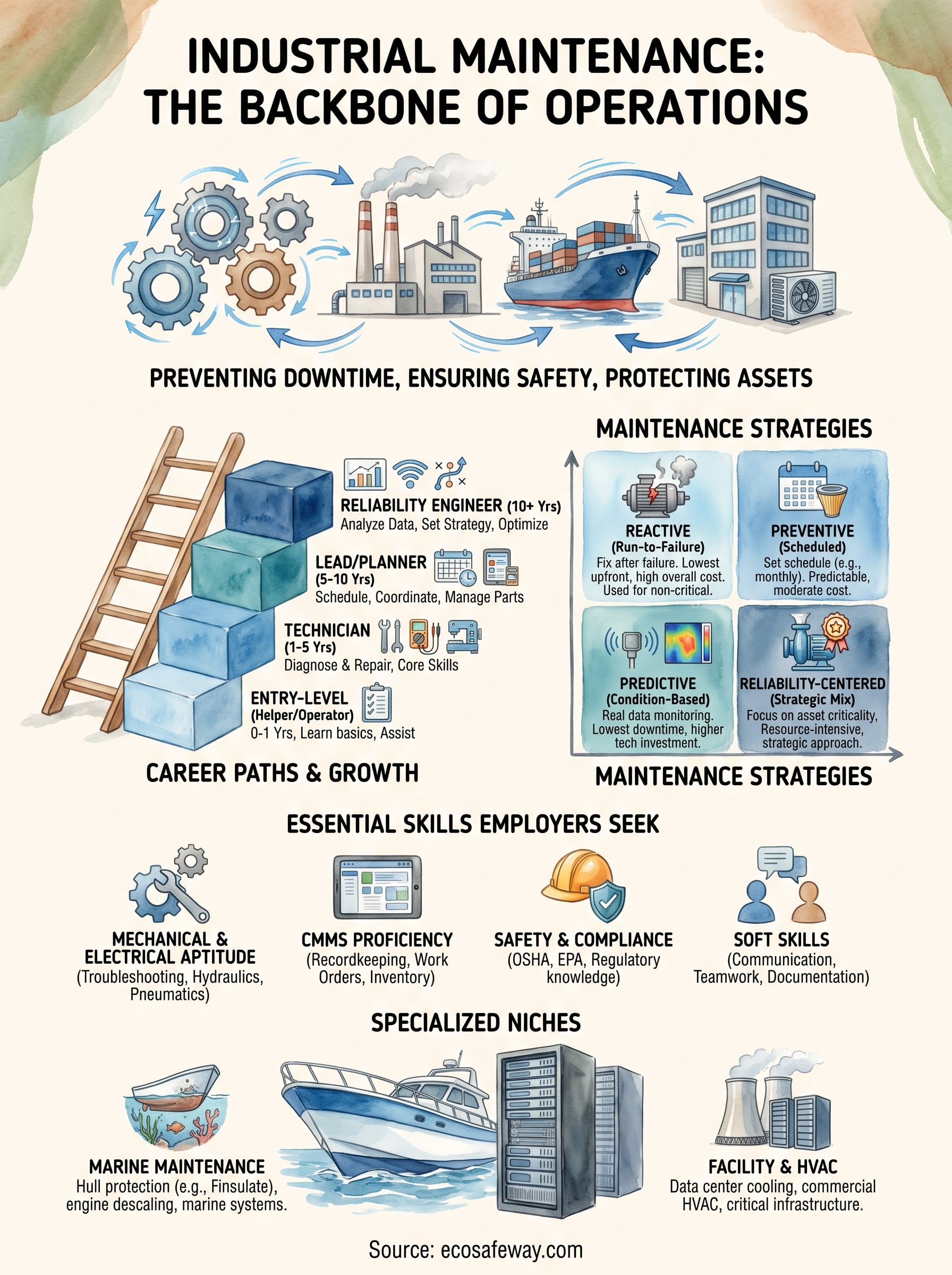
| Strategy | When it's used | Typical example | Cost profile | |---|---|---| | Reactive | After failure occurs | Replacing a burned-out motor | Cheapest upfront, costliest overall | | Preventive | On a fixed schedule | Changing filters every 90 days | Predictable, moderate cost | | Predictive | Based on sensor data | Vibration analysis flags bearing wear | Higher tech investment, lowest downtime | | Reliability-centered | Mix based on asset criticality | Prioritizing spare parts for critical pumps | Strategic, resource-intensive |
Reactive maintenance still has a place
Despite its reputation, reactive maintenance isn't always the wrong call. Repairing a cheap, non-critical part after it fails can cost less than monitoring it constantly, so smart maintenance teams reserve this approach for low-risk equipment. Only in facilities with poor planning does reactive maintenance become the default strategy for everything, which is when downtime and emergency labor costs spiral out of control.
Preventive maintenance runs on the calendar
Preventive maintenance means servicing equipment on a set schedule, regardless of its actual condition, based on manufacturer recommendations or historical failure data. Lubricating bearings monthly, replacing belts annually, or inspecting electrical panels quarterly are all textbook examples. This strategy works well because it's simple to manage and easy to document for compliance purposes, though it can waste money replacing parts that still have useful life left in them.
Predictive maintenance uses real data instead of guesswork
Predictive maintenance relies on sensors, vibration analysis, thermal imaging, and oil analysis to catch problems before they cause failure, timing repairs to actual equipment condition rather than a calendar date. A technician monitoring a bearing's vibration signature can schedule replacement weeks before it fails, avoiding both premature part swaps and unplanned shutdowns.
The best maintenance strategy isn't the one that fixes problems fastest, it's the one that prevents you from needing a fix at all.
This approach demands more technical training, since you're interpreting data trends instead of following a checklist, which is why predictive maintenance technicians tend to earn more than their preventive-only counterparts.
Reliability-centered maintenance ties it together
Reliability-centered maintenance (RCM) asks a harder question for every asset: what happens if this fails, and how critical is it to operations? A backup generator at a hospital gets predictive monitoring and redundant parts on hand, while a non-essential fan might run on reactive maintenance until it dies. Marine facilities apply this same logic when choosing hull protection systems like Finsulate over traditional antifouling paint, since reducing haul-out frequency directly cuts the labor and downtime that reactive antifouling maintenance otherwise demands. Learning to make these tradeoffs is what separates a technician from a maintenance planner, and it's a skill set employers pay a premium for.
Skills, job roles, and career growth
Success in industrial maintenance comes down to a mix of hands-on technical ability and the judgment to know when a quick fix isn't the right fix. Employers hiring for industrial maintenance jobs want candidates who can read a schematic, troubleshoot a control panel, and still communicate clearly with a supervisor about what broke and why. This blend of mechanical skill and clear thinking is what separates someone who fixes machines from someone who actually prevents the next breakdown.

The technical skills employers screen for first
Hiring managers filter resumes for a specific skill set before they even consider soft skills or personality fit. Mechanical aptitude, electrical troubleshooting, and basic hydraulics or pneumatics knowledge form the baseline for almost every technician role. Beyond that, familiarity with computerized maintenance management systems (CMMS) has become nearly mandatory, since most plants now track work orders, parts inventory, and inspection history digitally instead of on paper.
- Electrical and PLC troubleshooting
- Welding and fabrication basics
- Hydraulic and pneumatic system repair
- CMMS software proficiency
- Precision measurement and alignment tools
Job roles map out a clear ladder
Unlike some trades where advancement stalls after a few years, industrial maintenance careers offer a visible path upward if you keep stacking skills and certifications. A maintenance helper becomes a technician, a technician becomes a lead or planner, and a planner can move into reliability engineering or facility management within a decade of steady work.
| Role | Typical experience | Core focus |
|---|---|---|
| Maintenance helper | 0-1 years | Assisting technicians, learning equipment |
| Maintenance technician | 1-5 years | Diagnosing and repairing equipment |
| Lead technician / planner | 5-10 years | Scheduling work, coordinating parts |
| Reliability engineer | 10+ years | Analyzing failure data, setting strategy |
A technician who stops learning new equipment stalls at the same pay grade for years, while one who chases certifications keeps climbing.
Soft skills that quietly decide promotions
Supervisors rarely promote the most technically gifted person on the floor if that person can't communicate under pressure or document their work properly. Written communication matters more than most newcomers expect, since work orders, inspection logs, and safety reports all become part of a plant's compliance record. Teamwork also counts heavily, because most repairs in a factory or on a marine vessel require coordinating with electricians, operators, or outside vendors on a tight timeline.
Where niche specialties pay off
Versatility opens doors, but specialization often pays better once you've built a foundation. Technicians who branch into niche areas like refrigeration, robotics, or marine coatings tend to out-earn generalists because fewer people can do that specific work well. Marine hull protection is a good example: a technician trained to install and maintain systems like Finsulate brings a skill set that traditional bottom-paint crews simply don't have, which makes that expertise valuable to yacht owners and shipyards who'd rather not deal with the recurring labor of antifouling paint.
Finding your path in industrial maintenance
Industrial maintenance rewards people who like solving mechanical puzzles and don't mind getting their hands dirty to keep critical systems running. Whether you land in a factory, a hospital, or a marina, the core skills transfer, and the demand for qualified technicians isn't slowing down anytime soon. Choosing a specialty, whether that's electrical work, predictive maintenance, or marine coatings, is often what separates a steady paycheck from a genuinely rewarding career.
Marine maintenance is one of the clearest examples of a niche that pays off for technicians willing to learn specialized systems. If you're already working on vessels or considering that path, understanding modern hull protection systems gives you an edge over crews stuck doing labor-intensive antifouling work. See how the Finsulate antifouling wrap stacks up against traditional bottom paint, and why more shipyards and yacht owners are making the switch.


