





The short answer to how often to clean a washing machine is once a month, or sooner if you hit 30 loads before the month ends. That applies to front-loaders and top-loaders alike. Light users who leave the door open can stretch it to every two or three months, and anyone washing pet bedding, work clothes or gym gear should clean more often. A hot cleaning cycle with an approved cleaner, plus a wipe of the parts the cycle misses, is all the job takes.
Most people skip it because the machine runs water and soap all day, so it feels self-cleaning. It isn't. Detergent film, body oils, lint and trapped moisture pile up out of sight until a musty smell shows up. By then mildew has usually settled into the gasket or dispenser. The advice online doesn't help, since you'll see "monthly," "every 100 washes" and "twice a year" all stated as fact.
This guide gives you a schedule you can adjust to your own laundry habits, the signs that you're overdue, and four steps for cleaning either machine type. Eco Safeway sells enzyme cleaner tablets for washers, dishwashers and drains, so we mention where a tablet fits. The method itself works with any cleaner your manufacturer approves.
Why your washer needs cleaning and how often
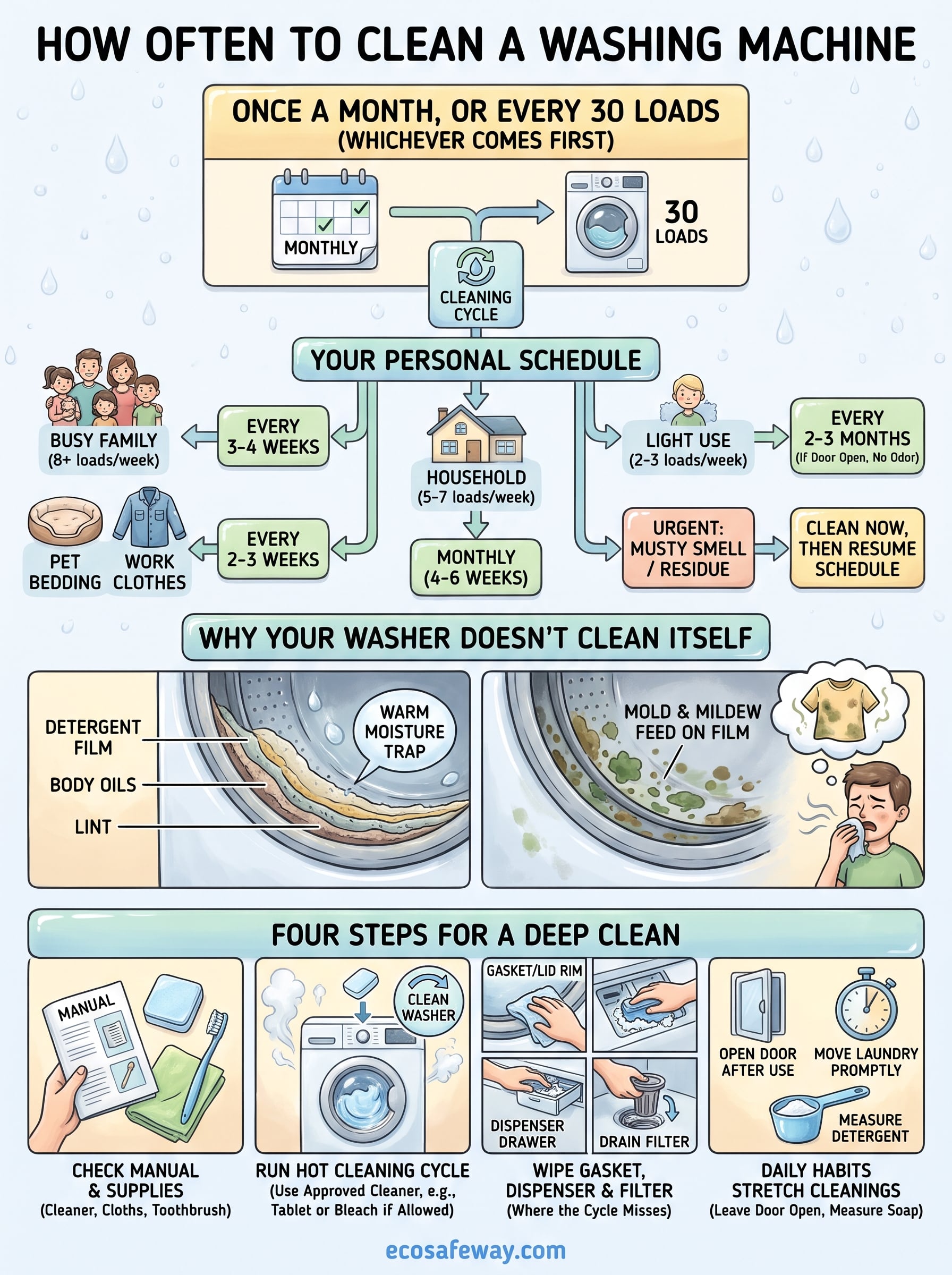
Clean your washer once a month, or every 30 loads if you reach that count sooner, because soap, soil and moisture build up faster than a normal wash cycle flushes them out. Your own schedule depends on how much you wash and what you wash.
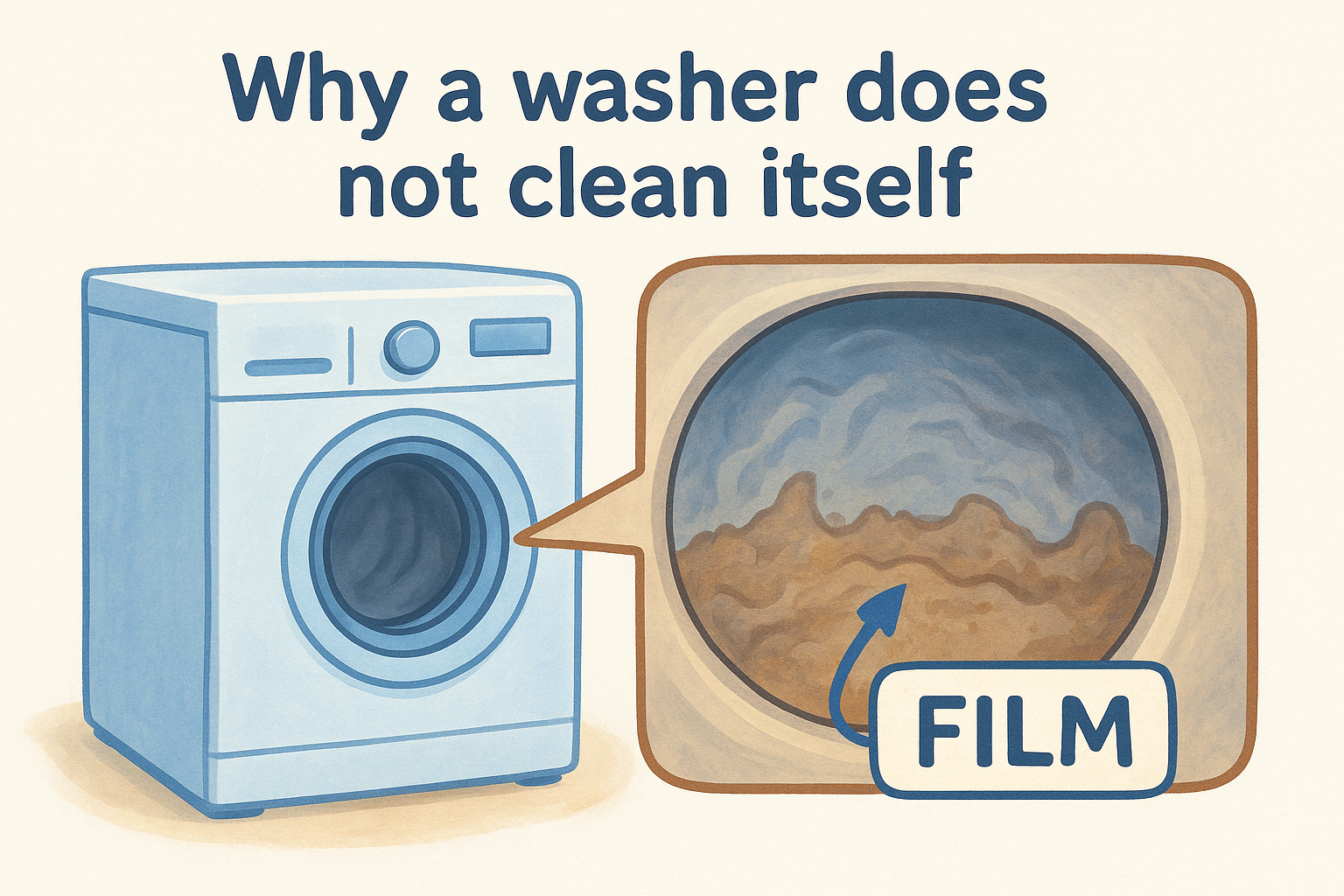
Why a washer does not clean itself
Every load leaves a thin film behind. It is made of undissolved detergent, fabric softener, skin oils, lint and hard-water minerals. Warm moisture sits on that film after the cycle ends, and that is what mold, mildew and bacteria feed on. Front-loaders suffer most because the folds of the rubber door gasket hold water. Top-loaders collect the same film under the tub rim and the agitator cap.
Cold-water washing makes this worse. It saves energy, but it does little to loosen residue or kill bacteria, so a washer that runs cold all year needs its hot cleaning cycle even more. Overdosing detergent has the same effect, because the extra soap has nowhere to go but into the machine.
The schedule: monthly or every 30 loads
Major manufacturers such as Whirlpool and Maytag point to roughly once a month or every 30 cycles. Your manual overrides any general rule, so check it first. The table turns that rule into a schedule you can use.
| Your situation | Clean the washer |
|---|---|
| Typical household, 5 to 7 loads a week | Monthly (30 loads takes 4 to 6 weeks) |
| Busy household, 8 or more loads a week | Every 30 loads, so every 3 to 4 weeks |
| Light use, 2 to 3 loads a week | Every 2 to 3 months, if there is no odor and the door stays open |
| Pet bedding, work clothes, gym gear | Every 2 to 3 weeks |
| Musty smell, slime or visible residue | Right away, then go back to your schedule |
Here is how that works out. A family running 10 loads a week reaches 30 loads in 3 weeks, so it cleans about every 3 weeks. A couple running 3 loads a week reaches 30 loads in 10 weeks, so a reminder every 2 to 3 months fits them. If either household notices a smell between cleanings, the schedule is too loose.
Clean on a calendar reminder, not when the smell arrives.
Signs your washer needs cleaning now
Any one of these signs means you should run a cleaning cycle this week, whatever the schedule says:
- A musty or sour smell in the drum, or on laundry that just came out clean
- Black, brown or pink specks or slime on the gasket or under the lid rim
- Gummy or waxy residue in the detergent drawer
- Gray film or lint on dark clothes
- Water that drains slowly or pools in the drum, which often points to a clogged filter
If the smell is still there after two cleaning cycles, the cause is likely hidden in the drain hose or filter. At that point a technician is worth calling.
Step 1. Gather supplies and check your manual
Before you run anything, read your washer's cleaning instructions and collect a short list of supplies. Manufacturers differ on which cleaners they approve, and the wrong product can leave residue or wear the rubber parts.
What you need
You probably own most of this already:
- A washer cleaner approved for your model, such as a cleaning tablet
- Two microfiber cloths
- An old toothbrush
- A bowl of warm water with a few drops of mild detergent
- A shallow baking pan and a towel, for the filter on front-loaders
- Rubber gloves
The whole kit costs very little. The only item you might need to buy is the cleaner.
What your manual allows
Look up three things in the manual: the name of the cleaning cycle (often "Clean Washer" or "Tub Clean"), the cleaners the maker approves, and where the filter sits. Some makers specify tablets, and others call for a measured amount of liquid chlorine bleach. If you can't find the manual, search for the model number. It is printed on a label, often inside the door frame or on the back panel.
Vinegar is the most popular home option, but it deserves caution. Some manufacturers warn that it can wear down rubber seals and hoses if it isn't rinsed away. If your manual doesn't mention vinegar, use an approved cleaner instead.
Your manual outranks any general cleaning advice, including this article.
Step 2. Run a hot cleaning cycle
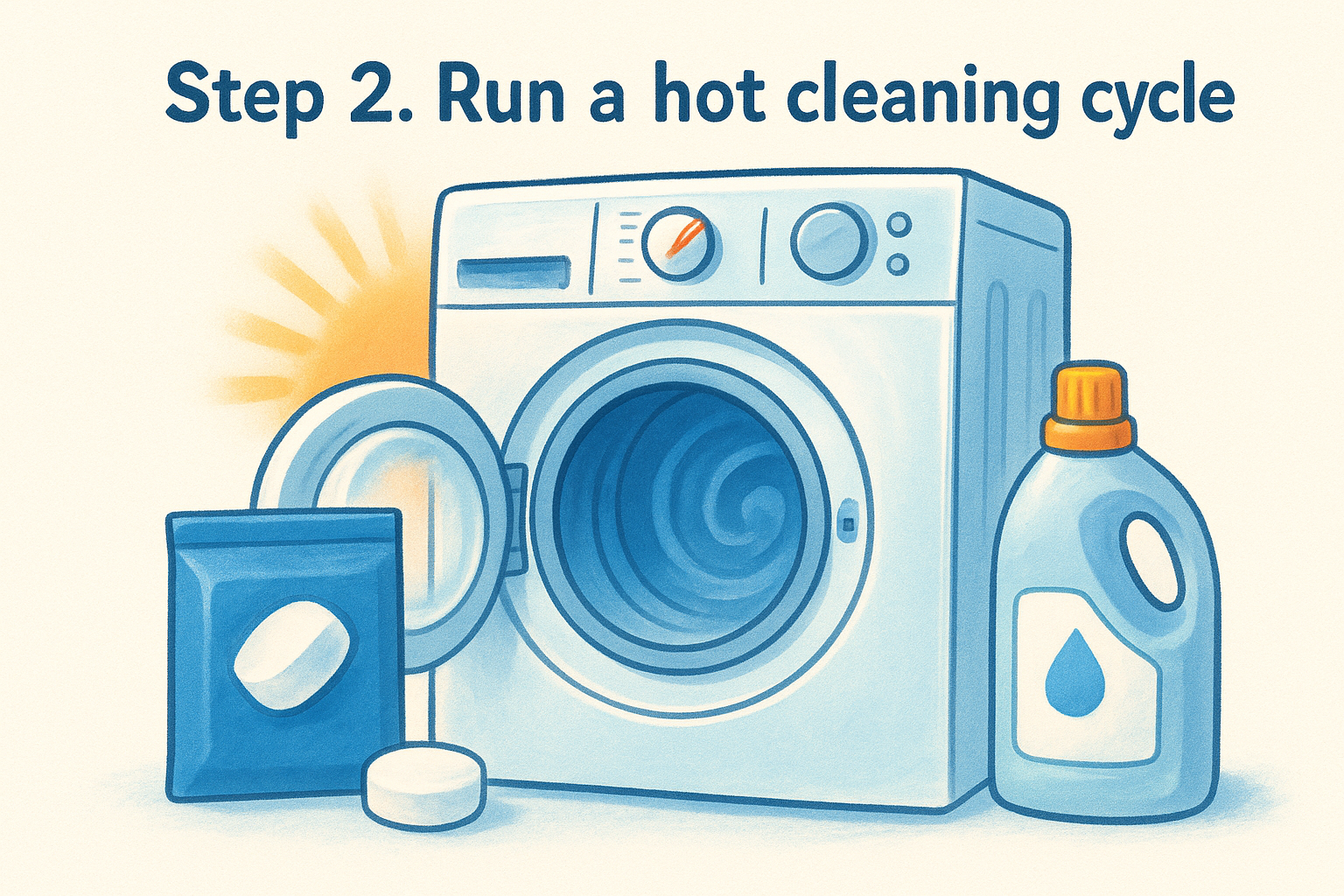
The cleaning cycle is the core of the job, and it works best with one approved cleaner at the hottest setting your washer offers. This is the step that answers "how do you deep clean a washing machine," and it takes a few minutes of hands-on time.
Choose your cleaner
| Cleaner | What to know |
|---|---|
| Cleaning tablets | The simplest option, because the dose is pre-measured. Follow the label for how many to use and where to place them, whatever the brand. |
| Liquid chlorine bleach | Use it only if your manual approves it, and in the exact amount it gives. |
| White vinegar | Use it only if your manual allows it, and rinse well afterward. |
| Baking soda | Optional. Run it as a separate second cycle to cut odor. |
Eco Safeway's enzyme cleaner tablets are an Affresh alternative made for washing machines, dishwashers, drains and disposals. They come in 25, 50, 100 and 250 piece packs. They are about 20 grams and 2.5 inches across, and the formula is septic-friendly. Check your washer manufacturer's guidance before choosing any tablet.
Run the cycle
- Empty the drum and check the pockets of the last load for coins and socks.
- Add the cleaner as the label and your manual direct.
- Select the Clean Washer cycle. If your washer has none, choose the hottest, longest cycle with the highest water level.
- Let the cycle finish without adding laundry.
- When it ends, wipe the drum with a dry cloth and leave the door or lid open.
Never mix bleach with vinegar, ammonia or other cleaners, because the fumes can be dangerous. If a musty odor lingers, run a second cycle with half a cup of baking soda in the drum. Keep it separate from any vinegar cycle, because the two cancel each other out.
One hot cycle with one approved cleaner beats a cocktail of three.
Step 3. Clean what the cycle misses
A cleaning cycle only reaches the surfaces that water touches. The gasket, the lid rim, the dispenser and the filter collect residue that the cycle softens but doesn't remove, so wipe them by hand while everything is still damp.
Clean the dispenser drawer first
Pull the drawer out if your model allows it. Soak it in warm water for a few minutes, then scrub the compartments with a toothbrush, paying attention to the softener slot where waxy residue collects. Rinse it and dry it fully before sliding it back in.
If the dispenser doesn't come out, wipe the visible compartments with a cloth dipped in warm, mildly soapy water. Use the toothbrush on corners, and look into the cavity with a flashlight. A drawer put back wet will grow mildew faster than one you never cleaned.
Front-loaders: gasket and drain filter
Pull the rubber gasket back and look inside the folds, because hair, lint and small items hide there. Wipe the folds and the underside of the inner lip with a cloth and your soapy water, using the toothbrush on any black spots. Then dry the gasket and the inside of the door.
Next, find the filter. It usually sits behind a small panel at the lower front corner of the machine. Put the towel and shallow pan underneath, because water will run out. Unscrew the filter slowly and remove the lint, hair and coins. Rinse it, then screw it back in tightly. Do this about every 3 months, or when the water drains slowly.
Top-loaders: lid, rim and agitator
Wipe the underside of the lid and the tub rim, where splashes dry into a film. If there is an agitator, lift off the cap and clean underneath it and around the base. Use the toothbrush for stubborn spots. Some top-loaders also have a lint filter, so check your manual for its location and how to clean it.
The cycle loosens the grime, and your cloth removes it.
Step 4. Keep it clean between deep cleans
Short daily habits stretch the time between deep cleans, and they stop most odors before they start. The goal is to keep the drum dry and the soap residue low.
Daily and weekly habits
Leaving the door or lid open after every wash does more for odor prevention than any product. A few quick tasks keep the machine in shape:
| Task | How often |
|---|---|
| Leave the door or lid open to dry | After every wash |
| Move finished laundry out | Within a few hours |
| Wipe the gasket or lid rim | Weekly |
| Clean the dispenser and run a cleaning cycle | Monthly, or per your schedule |
| Clean the drain filter | About every 3 months |
How long is too long to leave laundry in the washer? There's no exact cutoff, but wet clothes start to smell musty within a day. If a load sat overnight and smells off, run it through another wash before it goes in the dryer. Keep a closed door in mind too, since a shut washer traps moisture. If children or pets are around, follow your manufacturer's safety advice about leaving it open.
Detergent and loading habits
Use the detergent type your washer calls for. High-efficiency machines need HE detergent, and you should measure the dose instead of pouring by eye. Extra soap doesn't clean better, and it is the main source of residue. Fabric softener is another source, so use it sparingly or skip it.
Don't overload the drum either. Clothes packed tight can't move through the water, and they rinse poorly. A rinse that leaves soap behind brings you back to the first problem, which is the film that feeds mildew.
Put your washer on a schedule
Clean the washer once a month, or every 30 loads if you reach that sooner. Stretch it to every two or three months only if you wash lightly and keep the door open. Run a hot cycle with a cleaner your manufacturer approves. Then wipe the dispenser, gasket or rim, and filter by hand. Between cleanings, dry the drum, measure your detergent and move laundry out promptly.
If you want a tablet that handles the cycle step, Eco Safeway's enzyme cleaner tablets for washing machines also work in dishwashers and drains. Set a reminder on your phone for the next cleaning before you close the washer door.


