





Marine detailing is the thorough cleaning, restoration and protection of a boat, inside and out. It goes well beyond a wash. A detailer removes oxidation, stains and growth, corrects the gelcoat, then seals every surface against salt, sun and moisture. You can hire a detailer, buy the supplies and do it yourself, or build a business around it.
Marine detailing is car detailing under harsher conditions. Saltwater, UV, algae and constant humidity attack finishes faster than road grime ever will. That is why boat detailing has its own products, its own order of work and its own pricing, usually quoted per foot of hull length.
This guide covers why detailing matters, how the work is done step by step, which supplies fit which surface, what hiring a pro costs, and what it takes to start detailing boats for a living. Eco Safeway makes eco-friendly marine cleaning products for boats and yachts, so the product advice comes from the supply side of the job.
Why marine detailing matters for your boat
Marine detailing matters because water, salt and UV attack a boat every day, and detailing is the routine that removes that damage before it turns into a repair bill. A boat that is only rinsed slowly loses gloss, grip and value.
Salt, sun and moisture work on your boat daily
UV light and oxidation turn gelcoat chalky and dull. Salt crystals dry into fittings and corrode stainless steel and aluminum. Moisture feeds mildew in vinyl seams and cushions. A freshwater rinse removes surface salt, but it does not remove oxidation, water spots or contamination that has bonded to the finish.
Detailing adds the layers a wash skips: decontamination, correction and protection. That sequence is what separates a detailed boat from a clean one.
Washing removes dirt, but detailing removes damage and then protects against the next round.
Value, performance and early warning
A well-kept boat sells faster and for more than a neglected one. Buyers read faded gelcoat and stained vinyl as a sign of deferred maintenance in general. Growth and scale on a hull also add drag, which costs speed and fuel.
Detailing also forces a close inspection. The person polishing the hull or scrubbing the bilge is the person who notices cracked seams, weeping fittings and early corrosion. Catching those in the detailing bay is cheaper than finding them at haul-out.
How marine detailing works, step by step
A proper detail runs top to bottom and in a fixed order: clean, decontaminate, correct, protect. Skipping or reordering steps is the main reason detailing jobs fail.
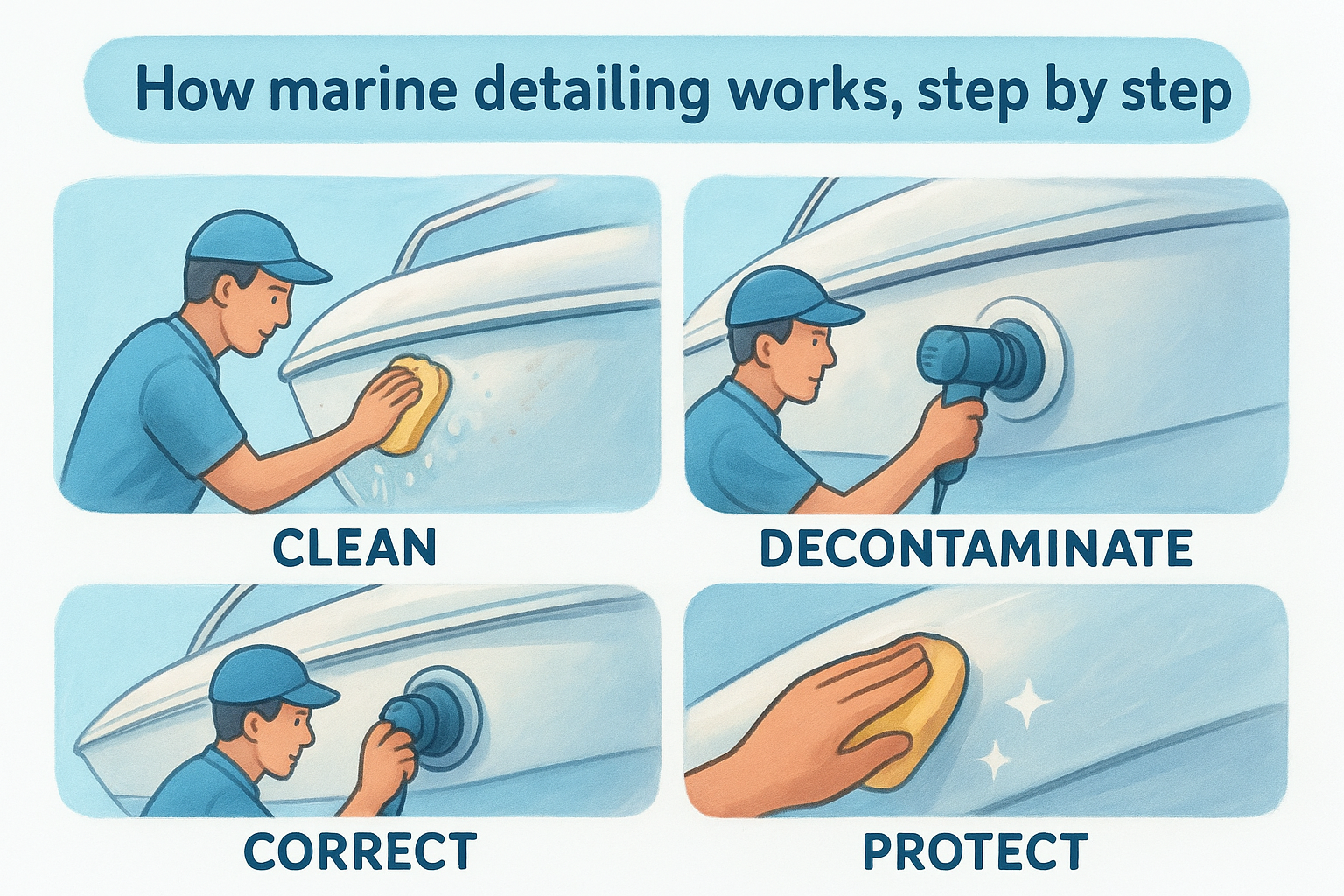
Exterior: wash, decontaminate, correct, protect
Work from the highest surface down so dirty water never lands on finished areas. Follow this sequence:
- Rinse with fresh water, then wash with a marine boat soap.
- Remove stains, scale and barnacle glue at the waterline with a marine hull cleaner.
- Scrub decks and non-skid with a pH neutral boat deck cleaner and a stiff brush.
- Compound oxidized gelcoat, then polish it.
- Seal with wax, a polymer sealant or a nano ceramic coating.
- Polish metal, then clean and protect canvas and clear vinyl.
Never wax over oxidation. The wax seals the dull layer in and the gloss fades within weeks.
Interior, teak and decks
Marine interiors need a dedicated vinyl and upholstery cleaner, not a household product. Sunscreen, body oil and mildew are the usual culprits. Clean, rinse, then apply a UV protectant so the vinyl stays flexible and does not crack.
Teak needs gentler handling than fiberglass. Skip the pressure washer on teak, because it erodes the soft grain. A one-step teak cleaner and brightener with a soft brush does the job. Whatever the surface, test a small hidden spot first.
How often to repeat each task
These intervals suit a boat in regular use. Shorten them for saltwater storage or heavy use.
- Basic wash: every 1 to 2 weeks while in use
- Full detail: at least every 3 to 4 months
- Wax or sealant: 2 to 4 times a year
- Interior deep clean: once per season
Do the steps in order, and give each protective layer a clean, corrected surface to bond to.
Marine detailing supplies and how to choose them
Choose marine detailing supplies by surface first, then by strength and environmental profile. A product made for fiberglass decks can be wrong for teak or vinyl, so the surface decides the product.
Match the product to the surface
This table pairs each job with what to look for, and with the matching Eco Safeway product where one exists.
| Job | What to look for | Eco Safeway product |
|---|---|---|
| Routine wash | Phosphate-free, safe to use in or out of the water | Boat Wash |
| Waterline stains, scale, barnacle glue | Non-corrosive, sprayable or foaming | Hull Cleaner (Marine & Seaplanes), Concentrate |
| Fiberglass and non-skid decks | pH neutral, no bleach, acids or caustics | PH Neutral Boat Deck Cleaner |
| Teak | One-step clean and brighten | Teak Cleaner & Brightener |
| Seats, upholstery, interior plastics | Vinyl-safe, UV protection | Marine Vinyl and Interior Cleaner |
| Long-term gloss and protection | Hydrophobic, clean surface required | Nano Ceramic Coating (One Step), 2 oz and 4 oz |
Most of the cleaners come in sizes from 32 oz up to 5 gallon kits. The hull cleaner also comes in drums and totes for shops that use it daily.
What to check before you buy
Marine-specific formulas protect against salt and UV, and household cleaners often damage finishes or leave residue. If you work at a marina, look for biodegradable, phosphate-free products. Many marinas and Clean Marina programs restrict what can run into the water.
Also check the dilution ratio, since a concentrate costs less per wash. Confirm the product is rated for your surface. Plan the tools too: soft brushes, microfiber towels, a wet/dry vacuum, an extension pole and a dual-action or rotary polisher.
Buy by surface and rinse behavior, not by the strongest label on the shelf.
Hiring a boat detailer and what it costs
Boat detailing is priced per foot of hull length, and the rate depends on how deep the service goes. Expect a small fraction of that rate for a wash and a multiple of it for polishing or ceramic coating.

What to expect to pay
One mobile detailer's published per-foot rates give a useful reference. Your market, boat type and hull condition will move them, so treat the figures as a reference and not a quote.
| Service level | Published rate | 25 ft boat |
|---|---|---|
| Exterior wash only | $5/ft | $125 |
| Wash with interior vacuum | $7/ft | $175 |
| Detailing package (seats, carpet, hull, trailer wash) | $12/ft | $300 |
| Polish and oxidation removal | $22/ft | $550 |
| Ceramic coating | $45/ft | $1,125 |
At the polishing rate, buffing a 20-foot boat comes to $440. Heavy oxidation, a large cabin or a hard-to-reach location usually raises the price.
How long it takes and how to choose
A wash and interior vacuum on a 20-foot boat takes a couple of hours. Compounding, polishing and sealing the same hull usually takes a full day, more if the oxidation is heavy.
When you search for marine detailing near you, compare at least three quotes and ask each detailer:
- Which products will you use, and are they marine-rated?
- Can you show current insurance?
- Is the scope written down, line by line?
- Will you do a test spot before starting?
- Do you work at the dock or yard, and do you bring your own water and power?
Compare quotes by written scope, not by the price per foot alone.
Starting a boat detailing business
You can start a boat detailing business with modest equipment, but your pricing and insurance decide whether it lasts. Most detailers start mobile, working at marinas, yards and storage lots.
What you need to start
You need a polisher, pads, a wet/dry vacuum, brushes, microfiber towels, a pump sprayer and a reliable water source. Your supply costs drop sharply when you buy concentrates by the gallon or by the drum instead of by the bottle. Standardize on a small set of products you know well. Each job should begin with a test spot, since it protects both the boat and your reputation.
How to price and protect yourself
Quote per foot, with tiers like those in the table above, and list the services in writing. Carry liability insurance, because customers and marinas increasingly ask for proof. Start with washes and interior work to build a client base, then add polishing and coatings as your skills and equipment grow.
Tiered per-foot pricing, written scopes and insurance are the foundation of a detailing business.
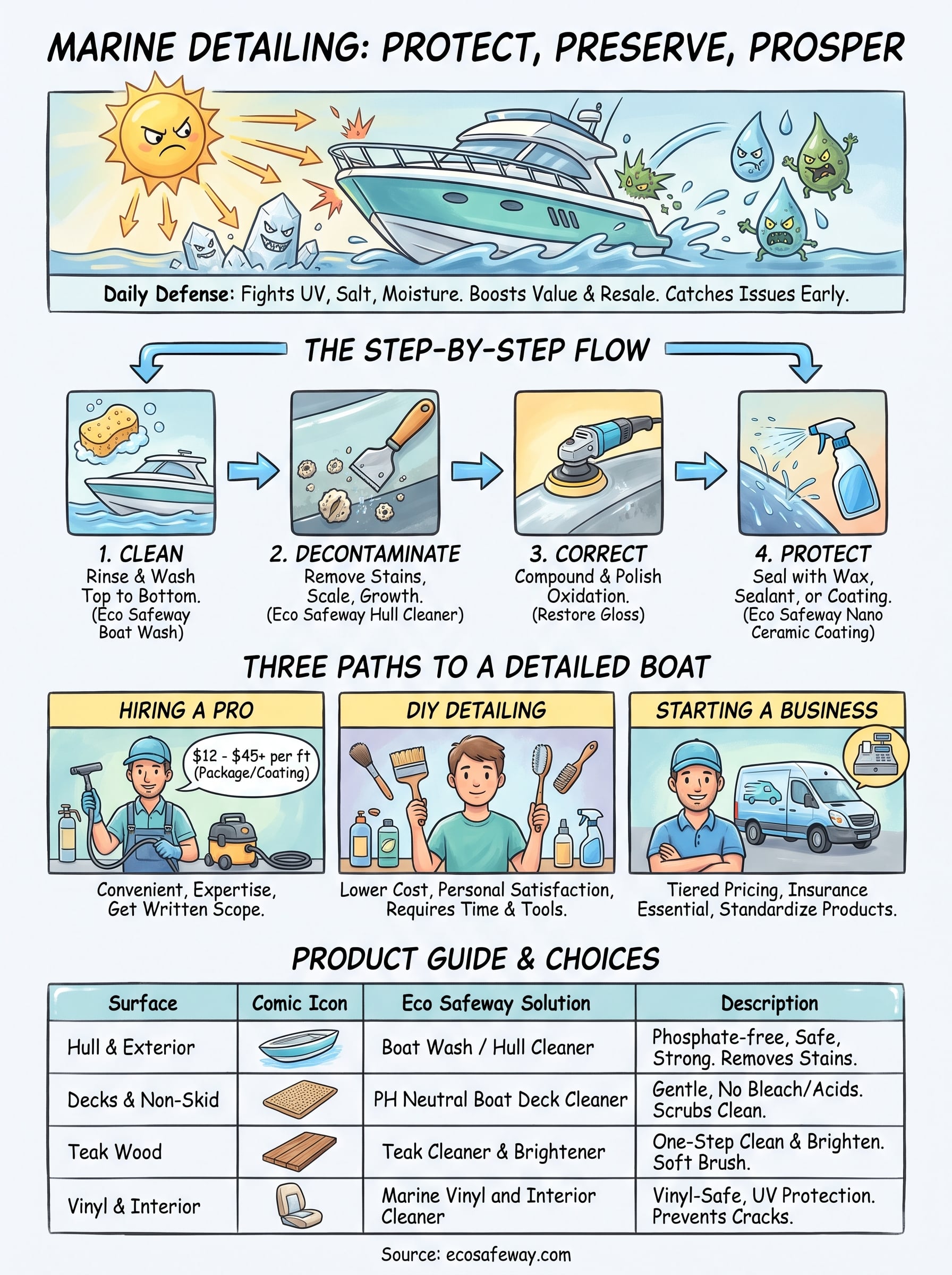
Detail first, repair later
Marine detailing protects a boat against the salt, sun and moisture that wear it down. The work runs in a set order, clean, decontaminate, correct, protect, and it pays back in resale value and early problem spotting. Whether you hire a pro, do it yourself or start a business, match every product to its surface and compare written quotes before you commit.
If your next job is the interior, start with Eco Safeway's marine vinyl and interior cleaner. You can also call 561-405-0271 to ask which products suit your boat.


