





Finsulate yacht hull protection is a biocide-free antifouling film system designed to protect underwater hull surfaces without relying on conventional copper-based bottom paint. Instead of releasing biocides, Finsulate uses a specialized fiber surface that makes it difficult for marine organisms to establish a strong attachment. For yacht owners and captains evaluating alternatives to recurring bottom-paint maintenance, Finsulate offers a fundamentally different approach to underwater hull protection.
Instead of releasing biocides into the water to poison marine growth, Finsulate uses a physical antifouling film made of dense synthetic fibers that make it nearly impossible for barnacles and algae to get a grip on your hull. No copper, no biocides, no toxic runoff into the marina. For owners and captains comparing finsulate for superyachts against traditional paint systems, that difference matters both for compliance and for long-term maintenance costs.
In this article, we'll walk through what Finsulate actually is, how it compares with bottom paint, what finsulate hull preparation and installation involve, and what you can realistically expect to pay. As an official Finsulate dealer based in Fort Lauderdale, we've fielded these questions from owners across South Florida, so we're answering them here directly.
Why Finsulate matters for yacht hull protection
The problem with copper-based bottom paint
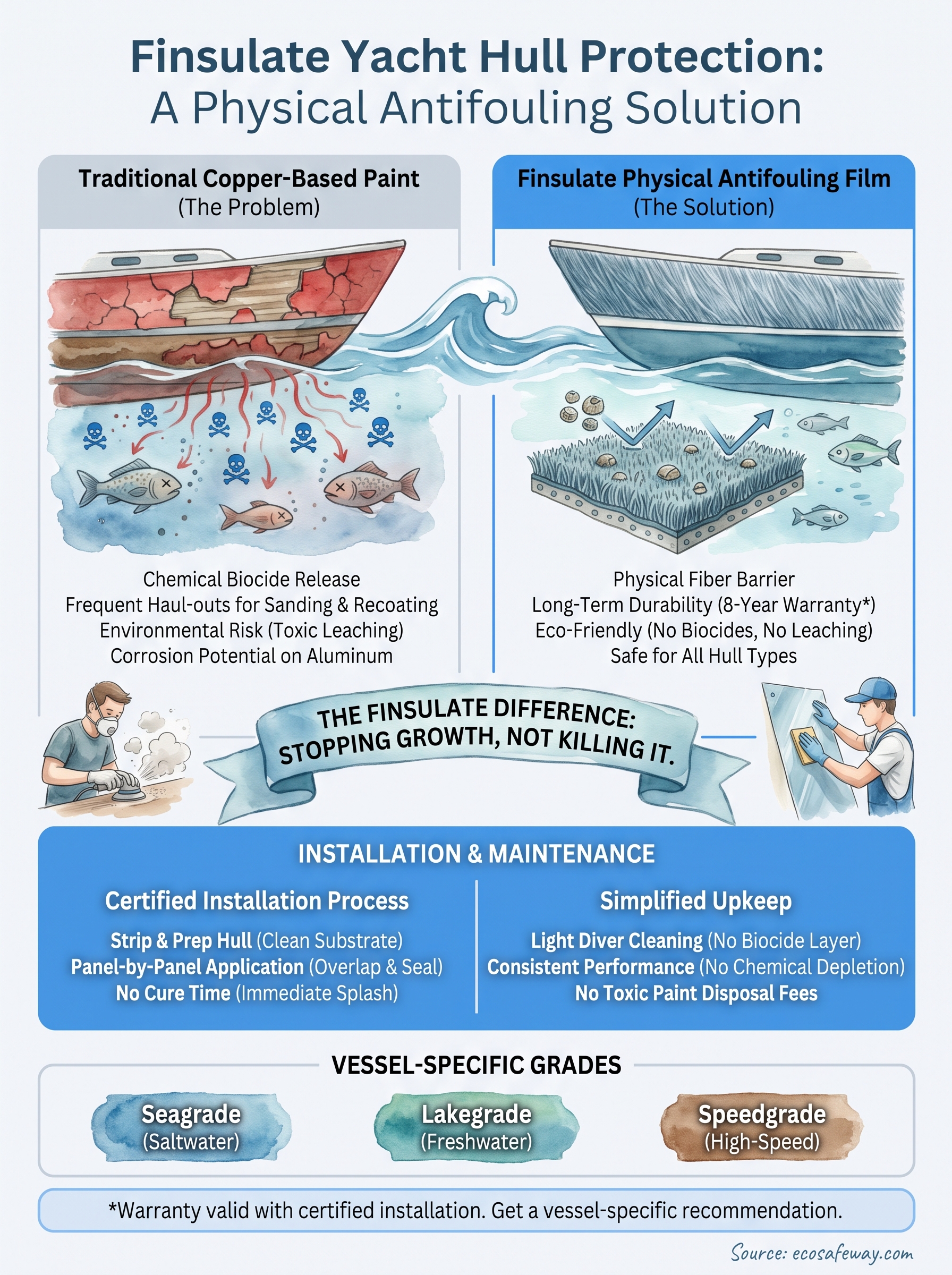
Copper-based antifouling paint has been the default for decades, but it comes with real costs that don't show up until later. Copper oxide leaches into the water column every time your hull moves, and that biocide doesn't just kill barnacle larvae, it accumulates in marina sediment and harbor bottoms where regulators are now taking notice. Marina restrictions on copper leaching are already in place in parts of California and Washington, and more states are watching those results closely. Add in the sanding dust from every haul-out, the disposal fees for hazardous paint chips, and the corrosion risk copper poses to aluminum hulls and running gear, and the math on "cheap" bottom paint starts looking different.
A physical barrier instead of a chemical one
Finsulate flips the approach entirely. Rather than poisoning organisms that try to settle on your hull, the film's dense fiber structure makes the surface physically unsuitable for attachment, similar to how a shag carpet resists a suction cup. Barnacles, algae, and slime need a stable surface to anchor to, and Finsulate's fiber structure is designed to deny them one.
Finsulate doesn't kill marine growth, it's built to resist it sticking.
That single distinction is why owners weighing finsulate yacht hull protection against copper paint see it as more than a green alternative. It's a maintenance strategy that sidesteps biocide depletion, recoat cycles, and the slow chemical degradation that eventually pits gelcoat and aluminum alike.
Where Environmental Regulations Are Heading
Environmental regulations surrounding marine antifouling systems continue to evolve, particularly regarding the release of biocides such as copper into marine environments. Requirements vary by jurisdiction, marina, and vessel type, so yacht owners should evaluate the rules applicable to their operating area. Biocide-free antifouling systems such as Finsulate provide an alternative for owners who want to reduce reliance on conventional biocidal bottom paint.
| Factor | Copper Antifouling Paint | Finsulate Film |
|---|---|---|
| Mechanism | Chemical biocide release | Physical fiber barrier |
| Marina/leaching restrictions | Increasingly limited | Not applicable |
| Hull compatibility | Depends on coating system and vessel | Product/hull suitability must be evaluated |
| Haul-out sanding required | Yes, each recoat | No |
For South Florida owners especially, where warm water accelerates fouling year-round, that gap in maintenance burden and regulatory exposure is exactly why Finsulate keeps coming up in haul-out conversations.
How Finsulate hull preparation and installation work
Prepping the hull surface
Getting a hull ready for Finsulate looks a lot like prepping for a fresh paint job, but with one critical difference: you're building a long-term adhesive bond, not a recoat surface. Finsulate hull preparation starts with stripping old antifouling paint down to a sound substrate, since the film needs a clean, stable base to adhere to for years, not months. Certified applicators sand out pitting, fill imperfections, and confirm the gelcoat or epoxy barrier coat is fully cured before moving forward. Proper surface preparation is critical to achieving reliable long-term adhesion.
A hull wrap is only as good as the surface it's bonded to.
Applying the film
Once the surface passes inspection, installation moves fast compared to a multi-coat paint job. Applicators cut and fit the self-adhesive fiber sheets panel by panel, working around thru-hulls, running gear, and rudder posts with the same attention a vinyl wrap installer gives a hull graphic. Panels overlap at seams to keep water from working underneath, and edges get sealed and trimmed for a smooth finish. Unlike a conventional multi-coat paint system, Finsulate installation does not depend on waiting for multiple antifouling coats to dry and cure before the vessel can proceed to the next stage.
Why certified installation matters
Eco Safeway coordinates installation through Finsulate-trained applicators rather than performing the wrap in-house, since certified installation is what keeps the manufacturer's 8-year warranty valid. Our Fort Lauderdale installation guide walks through what that process looks like day to day, from haul-out to final inspection. A poorly prepped surface or rushed seam can undercut years of expected performance, so this isn't a step worth shortcutting to save a weekend at the yard.
Finsulate for superyachts and large commercial vessels
Scaling up for larger hulls
Larger vessels change the math on antifouling. These factors can make Finsulate particularly relevant for large yachts and superyachts, where haul-out labor, yard time, and recurring antifouling maintenance can represent a substantial operating expense. A 100-foot hull carries far more surface area than a weekend cruiser, which means more copper leaching into the water over a season and more labor hours every time that hull gets hauled and sanded. Superyacht owners and fleet managers who switch to Finsulate aren't just avoiding biocides, they're cutting the recurring haul-out labor that scales with waterline length. Installation still runs panel by panel around thru-hulls, stabilizers, and running gear, but the crew handles it as a coordinated project rather than a weekend job, since larger yachts often have more appendages and running gear to work around.
Commercial compliance and charter considerations
Commercial and charter operators face scrutiny that private owners often don't. Port authorities and some charter management companies are starting to ask about biocide-free hull treatments as part of environmental compliance documentation, and a physical antifouling film answers that question cleanly. Chief engineers managing charter schedules also value the shorter turnaround, since a wrapped hull doesn't need the extended dry time a fresh coat of copper paint requires before splash.
On a superyacht, every day out of the water is a day of lost charter revenue, and that's exactly what a physical antifouling film is built to reduce.
Eco Safeway works directly with captains and yacht managers across South Florida to scope these larger installations, since a 150-foot commercial vessel demands different scheduling, crew coordination, and haul-out logistics than a 40-foot sport yacht, even though the underlying Finsulate hull preparation process stays the same.
What to expect: lifespan, upkeep, and grade selection
How long the film actually lasts
Finsulate's manufacturer warranty currently runs 8 years. Finsulate's warranty requirements include appropriate installation by qualified, certified installers, so owners should follow the manufacturer's current installation and warranty requirements. Some owners report service life beyond the warranty window, but treat that as an estimate from field experience, not a guaranteed number you can bank on for a resale valuation. The honest answer is that lifespan depends heavily on cruising grounds, hull speed, and how consistently the film gets light upkeep.
The warranty only holds if a certified applicator did the installation, so cutting corners there costs you the coverage, not just the quality.
Finsulate Maintenance and Underwater Cleaning
Finsulate does not eliminate the need for underwater hull maintenance. Marine growth can still accumulate on the surface, particularly in warm or high-fouling environments. Finsulate's maintenance approach is different from conventional antifouling paint: the surface can be cleaned when necessary without sanding and recoating the hull with a new biocidal paint layer.
You avoid the multi-day yard visits for sanding and recoating. Owners typically schedule a diver to give the hull a gentle wipe when slime buildup shows up, similar to routine cleaning on a painted boat with an eco-friendly marine hull cleaner, except there's no biocide layer to damage and no toxic paint chips to worry about disposing of. Because the fiber structure resists attachment rather than wearing down chemically, that light maintenance rhythm stays consistent for years instead of tapering off as a coating depletes.
Matching the grade to your vessel
Finsulate offers multiple film grades, including Seagrade, Lakegrade, Speedgrade, and Seagrade EL, each built around different water conditions and hull speeds rather than a one-size-fits-all product:
- Cruising grounds: saltwater, freshwater, or brackish marinas each favor a different grade
- Hull speed: displacement trawlers and high-speed planing hulls see different fouling pressure
- Vessel type: recreational, commercial, and superyacht applications each carry distinct wear patterns
Rather than guessing, request a vessel-specific recommendation before ordering material.
Frequently asked questions about Finsulate yacht hull protection
**What is Finsulate yacht hull protection?**Finsulate is a physical antifouling film, a self-adhesive fiber wrap bonded to a yacht's hull. Instead of releasing biocides like copper-based bottom paint, its fiber structure keeps barnacles and algae from attaching in the first place.
**Is Finsulate better than bottom paint?**It depends what you're optimizing for. Finsulate avoids biocide leaching, sanding dust, and aluminum corrosion risk, and typically needs only occasional diver wipe-downs instead of recoating. Copper paint often remains cheaper upfront. Owners generally choose Finsulate to cut recurring haul-out labor and environmental exposure, not on a guarantee that it costs less over time.
**How long does Finsulate last?**Finsulate carries an 8-year manufacturer warranty when installed by a certified applicator. Some owners report service life beyond that window, but treat that as field experience, not a guaranteed figure, since actual lifespan depends on cruising grounds, hull speed, and upkeep.
**How long is the Finsulate warranty?**The current manufacturer warranty is 8 years, contingent on certified installation. A rushed or improperly prepped installation can void that coverage.
**Does Finsulate need to be cleaned?**Yes, though far less than a painted hull. Most owners schedule a diver for a gentle wipe-down when slime builds up, rather than a full haul-out and recoat.
**Can Finsulate be installed on a superyacht?**Yes. Larger hulls follow the same preparation and panel-fitting process as smaller vessels, scaled up as a coordinated project to account for more surface area, thru-hulls, and running gear.
**Can Finsulate be installed over existing bottom paint?**No. Installation requires stripping old antifouling paint down to a sound substrate first, since the film needs a clean, stable base to bond to for years, not months.
**How much does Finsulate cost for a yacht?**Cost is project-specific: it depends on hull length, current coating condition, prep work required, and Finsulate grade. Request a vessel-specific quote rather than relying on a flat per-foot estimate.
**Does Finsulate work in Florida?**Yes. Warm, biologically active water like South Florida's accelerates fouling, which is one reason Finsulate comes up often in local haul-out conversations; the film's mechanism doesn't depend on water temperature to work.
**What Finsulate grade does my yacht need?**Finsulate offers several grades, including Seagrade, Lakegrade, Speedgrade, and Seagrade EL, suited to different cruising grounds, hull speeds, and vessel types. Rather than guessing, request a vessel-specific grade recommendation before ordering material.
**Can Finsulate be repaired if damaged?**Localized damage can typically be addressed by a certified applicator without redoing the whole hull, though the scope depends on how the film was affected. Check with your installer for vessel-specific guidance.
**Where can Finsulate be installed?**Finsulate is applied to the underwater hull, working around thru-hulls, running gear, and rudder posts. Installation is performed by Finsulate-trained certified applicators.
**Does Finsulate require professional installation?**Yes. The manufacturer's warranty is contingent on certified installation, and proper surface prep and seam work are what keep the film bonded for its full service life.
**Is Finsulate suitable for aluminum yachts?**Finsulate's physical mechanism avoids the copper exposure that contributes to corrosion risk on aluminum hulls, which is one reason aluminum yacht owners weigh it against copper-based paint. Confirm compatibility for your specific hull with a certified applicator.
**How does Finsulate compare with copper antifouling paint?**Copper paint prevents fouling chemically, by leaching biocide, and needs periodic sanding and recoating. Finsulate prevents fouling physically, through fiber structure, and needs only light maintenance between haul-outs. See the comparison table above for a fuller breakdown.
Finsulate Yacht Hull Protection FAQs
How long does Finsulate last on a yacht?
Finsulate currently provides an 8-year warranty under its applicable warranty requirements. Actual service life can vary depending on the vessel, operating environment, product grade, installation quality, and maintenance.
Does Finsulate replace bottom paint?
Finsulate is designed as an alternative to conventional antifouling bottom paint. Instead of relying on a biocidal coating, it uses a specialized fiber film to create a physical antifouling surface.
Does Finsulate require maintenance?
Yes. Finsulate can still require underwater cleaning when marine growth accumulates. The maintenance approach differs from conventional antifouling paint because routine sanding and recoating are not part of the system.
Can Finsulate be used on superyachts?
Finsulate can be considered for yachts and larger vessels, subject to the hull, operating profile, product selection, and installation requirements.
Weighing Finsulate for your vessel
Finsulate isn't the cheapest option at haul-out, but it changes the entire maintenance equation. You're trading a recurring cycle of sanding, recoating, and biocide exposure for a physical antifouling film that holds up for years with light diver upkeep instead of a full yard visit. Whether you're running a weekend cruiser or evaluating finsulate for superyachts with a full-time engineering crew, the calculation comes down to the same question: how much is avoiding copper leaching, corrosion risk, and lost time at the dock worth to you over an 8-year warranty window?
Is Finsulate right for your yacht?
The right recommendation depends on your vessel, not a generic answer. Before quoting grade and installation scope, we typically ask for:
- Vessel length, beam, and draft
- Hull material
- Current antifouling system
- Cruising area
- Typical haul-out schedule
- Preferred shipyard
With those details, we can weigh Finsulate against your current bottom paint routine, recommend a grade, and connect you with certified installers. As the official Finsulate dealer serving Fort Lauderdale and South Florida, we coordinate that evaluation directly. Get a vessel-specific Finsulate evaluation on the Finsulate antifouling bottom paint alternative page before your next haul-out.


