





If you're staring at a haul-out schedule and wondering whether to repaint or wrap, you're not alone. The difference between antifouling paint and hull wrap systems comes down to how each one fights marine growth, how long it lasts, and what it costs you in downtime and disposal headaches. Paint has been the default for decades, but wraps have moved from experimental to mainstream on recreational and commercial hulls alike.
The short answer: antifouling paint uses biocides that leach out to kill barnacles and algae before they attach, while hull wrap systems create a physical barrier that makes the surface inhospitable to growth without releasing chemicals into the water. Paint needs reapplication every one to three years and involves sanding, VOCs, and copper runoff. Wraps can last longer per application and skip the toxic buildup entirely, which matters if you're already using a biodegradable boat wash that's safe to use in the water to maintain the rest of your boat.
Below, we break down application methods, maintenance demands, environmental impact, and real cost over a five-year ownership window, so you can pick the approach that actually fits how you use your boat.
Why the choice between paint and wrap affects your boat
Marine growth doesn't just look bad. Barnacles, algae, and slime attach to a hull within weeks in warm water, and every layer adds drag. A hull with heavy fouling can burn 30% more fuel to hold the same speed, according to Navy research on biofouling's drag penalty. For a weekend cruiser that's an annoyance. For a charter boat or commercial vessel running daily routes, that fuel penalty adds up fast, and it's one reason facility managers who already rely on a non-corrosive marine descaler for engines and cooling systems start asking the same safety questions about hull protection.
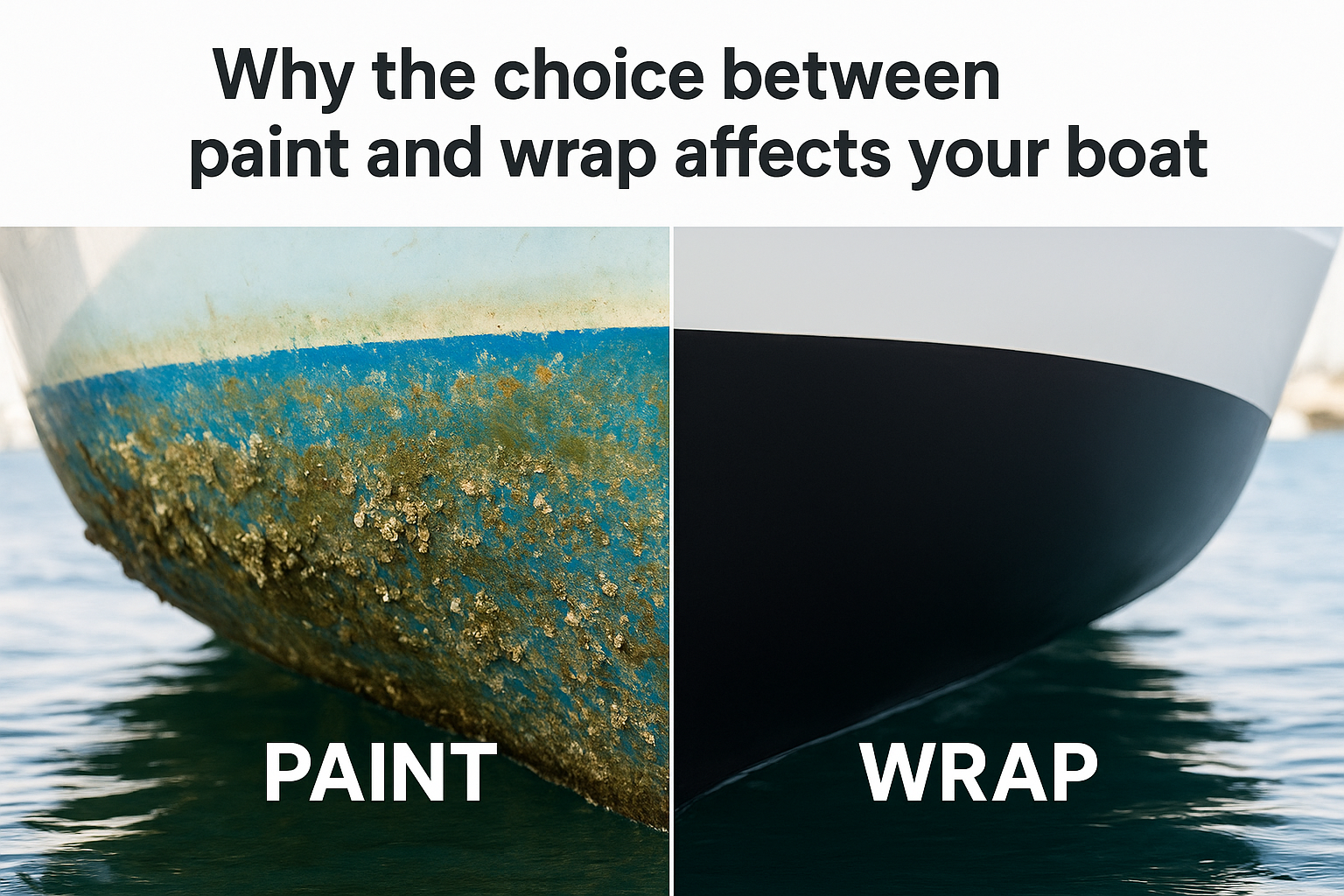
Growth also accelerates corrosion. Barnacles and mussels trap moisture against the hull surface, and on aluminum or steel boats that moisture speeds up galvanic corrosion around fittings, through-hulls, and welds. On fiberglass hulls, prolonged fouling can stress the gelcoat and create the kind of pitting that turns into an expensive repair down the line. Whatever method you pick to fight this has to hold up to constant water exposure, temperature swings, and the abrasion of docking, launching, and hauling out.
The chemistry problem with traditional antifouling paint
Here's where paint and wrap start to diverge in a way that matters beyond looks. Antifouling paint works by leaching biocides, usually cuprous oxide or other copper compounds, into the water around the hull. That slow release is exactly what keeps barnacles from attaching, but it's also what's landed copper-based paints on the radar of state and federal regulators. Washington and California have both restricted copper content in recreational boat paint because of copper accumulation in marinas and its toxicity to fish gills and shellfish larvae. The EPA has published guidance on copper's aquatic toxicity, and several marinas now require lower-leach-rate paints or ban certain formulations outright.
The paint that keeps barnacles off your hull is the same paint releasing metal into the water your boat sits in every day.
Sanding old antifouling paint before a fresh coat creates its own hazard. That dust contains copper and, in older paints, sometimes tributyltin residue, and it needs containment and proper disposal under most yard and OSHA guidelines. Anyone who's stood in a Tyvek suit sanding a hull knows this isn't a five-minute job, and it's not one you want to do without a respirator.
What hull wraps change about the equation
Hull wrap systems sidestep the leaching question entirely. Instead of a chemical that dissolves into seawater, you get a physical barrier, usually a specialty vinyl or film applied directly to the hull, that makes the surface too smooth and too slick for organisms to grip. Nothing leaches out, so there's no copper accumulating in the marina basin and no biocide runoff to track through your discharge permits if you operate commercially. That's a meaningful difference if your marina or municipality has already started restricting copper paints, since a wrap sidesteps the regulation instead of trying to comply with a shrinking leach-rate limit.
Wraps also change your maintenance routine rather than eliminating it. You still need to keep the surface clean, and that's where products matter just as much as the underlying protection method does. Eco Safeway's concentrated hull cleaner for boats and yachts is built to clean slime and light growth off a wrapped or painted hull without introducing the acids or solvents that degrade vinyl film or strip a fresh antifouling coat, which keeps whichever system you choose performing the way it's supposed to for its full service life.
How to choose between antifouling paint and a hull wrap
Once you understand the difference between antifouling paint and hull wrap systems, the real decision comes down to your hull, your budget, and how much time you're willing to spend in a boatyard. There's no universal winner here. A liveaboard sailor who hauls out once a year has different priorities than a charter operator who needs the boat back in the water within 48 hours. Start by matching the method to what your boat actually does, not what sounds more modern.
Match the method to your hull material and age
Fiberglass hulls in good condition are candidates for either system, but a hull with existing gelcoat damage or old, flaking antifouling paint usually needs that surface stripped and repaired before a wrap will adhere properly. Aluminum hulls require extra caution with paint, since copper-based antifouling can trigger galvanic corrosion against aluminum unless you use a barrier coat rated for that combination. Wraps avoid that galvanic risk entirely because there's no metal-to-metal contact from the coating itself, which is one reason aluminum boat owners increasingly ask about film systems.
Factor in how often you haul out
Haul-out frequency drives cost more than most owners expect. If your marina charges by the day for yard time, a wrap's longer service interval reduces how often you're paying for a lift, blocking, and dockage while the work happens. Owners running tight seasonal schedules, especially in charter or rental fleets, often find the reduced haul-out frequency alone justifies the higher upfront wrap cost.
If you're choosing based on downtime, count haul-outs over five years, not the price of a single application.
Weigh your local regulations and marina rules
Regulations increasingly tip this decision for you before cost even enters the conversation. Some marinas in Washington and California now restrict high-leach copper paints outright, and a growing number of municipalities are watching sediment testing results closely enough that a copper-free hull wrap eliminates a compliance question you'd otherwise have to track every season.
A quick decision checklist
- Hull material: aluminum or steel favors wraps to avoid galvanic issues
- Haul-out access: limited yard time favors longer-lasting wraps
- Local rules: copper restrictions in your marina push toward wraps
- Budget timing: lower upfront cost favors paint, lower lifetime cost often favors wraps
- Usage pattern: daily commercial use favors whichever method reduces downtime most
Antifouling paint vs. hull wraps: cost, lifespan, and upkeep
Numbers settle arguments that opinions can't. A single antifouling job typically depends on hull size and paint grade, while a professional hull wrap installation runs higher upfront, often for the same size boat but with a much longer lifespan. That gap makes paint look like the obvious budget choice until you stretch the comparison past one season. Finsulate offers 10 years of antifouling with an 8 year warranty (ecosafeway.com)
Sticker price versus five-year cost
Owners who only compare the invoice from a single haul-out miss the real math. Paint needs reapplication every one to three years, so over five years you're looking at two to four full jobs, plus the labor for sanding and prep each time. Wraps commonly last three to five years per application, meaning many boats need just one wrap cycle in the same window. Run the comparison side by side and the total cost of ownership narrows considerably, sometimes flipping in the wrap's favor for boats that haul out frequently.
| Factor | Antifouling Paint | Hull Wrap System |
|---|---|---|
| Upfront cost | $ | $ |
| Typical lifespan | 1-2 years | 8-10years |
| Reapplications over 5 years | 2-4 | 1 |
| Surface prep required | Sanding, priming each cycle | One-time surface prep |
| Biocide leaching | Yes, ongoing | None |
Compare paint and wraps by the decade, not the invoice, and the cheaper option on day one isn't always cheaper by year five.
Lifespan depends on water conditions, not just the label
Lifespan numbers on a spec sheet assume average conditions, and your marina probably isn't average. Warm, brackish water accelerates fouling and shortens both paint and wrap lifespans, while boats in cooler, less biologically active water get more life out of either system. Speed matters too. Boats that sit at the dock most of the season foul faster than boats that run regularly, since movement through the water disrupts larval attachment for both barnacles and algae.
Upkeep is where wraps actually save you time
Granted, neither system is maintenance-free, but the upkeep looks different day to day. Painted hulls tolerate light scrubbing but degrade faster under aggressive cleaning, since abrasive pads wear through the biocide layer and shorten its effective life. Hull wraps hold up better to routine cleaning because the vinyl film resists abrasion, which means a diver or owner can wipe down slime buildup more often without shortening the wrap's service life the way scrubbing thins a paint coat.
Caring for your hull after paint or wrap application
Getting the coating right is only half the job. What you do in the weeks and months after application determines whether that paint or wrap performs anywhere close to its rated lifespan. Both systems need a cure period before they see heavy use, and both need a cleaning routine that matches what's actually on the hull rather than a one-size-fits-all approach borrowed from whichever method you used last time.
Give fresh paint or wrap time to set
Antifouling paint typically needs 16 to 24 hours of dry time before splashdown, and some formulations need several days of full cure before they reach maximum biocide effectiveness. Hull wraps need a shorter window, usually 24 to 48 hours, for the adhesive to fully bond before the film faces sustained water pressure and current. Rushing either step invites early failure: paint that hasn't cured can slough off in sheets, and wrap edges that haven't set can lift and trap water underneath, which defeats the whole point of a physical barrier.
Cleaning schedule for painted hulls
Painted hulls benefit from light, frequent cleaning rather than infrequent aggressive scrubbing. A soft brush or non-abrasive pad removes slime before it hardens, and cleaning products matter here because harsh degreasers and acid-based hull cleaners strip the biocide layer faster than the water itself would. Eco Safeway's biodegradable marine hull cleaner is formulated without the acids that eat into antifouling coatings, so a routine wipe-down doesn't quietly shorten the paint's service life every time you clean it.
Cleaning schedule for wrapped hulls
Wraps tolerate more frequent cleaning without the same wear penalty, since the vinyl film resists abrasion better than a soft biocide coating does. Divers and owners can hit slime buildup every few weeks without shortening the wrap's effective life, which is one of the practical advantages that shows up over a full season rather than on a spec sheet.
A cleaning routine matched to your coating protects your investment as much as the coating itself does.
What to avoid regardless of coating type
A few habits damage both systems equally:
- Pressure washing at close range, which can strip paint or lift wrap edges
- Metal scrapers or stiff wire brushes for routine slime removal
- Solvent-based cleaners that weren't formulated for marine coatings
- Letting heavy fouling build up before the first cleaning of the season
Getting ahead of growth with gentle, regular attention beats any amount of aggressive scrubbing after the fact, whichever protection method sits under your waterline.
Matching hull protection to how you use your boat
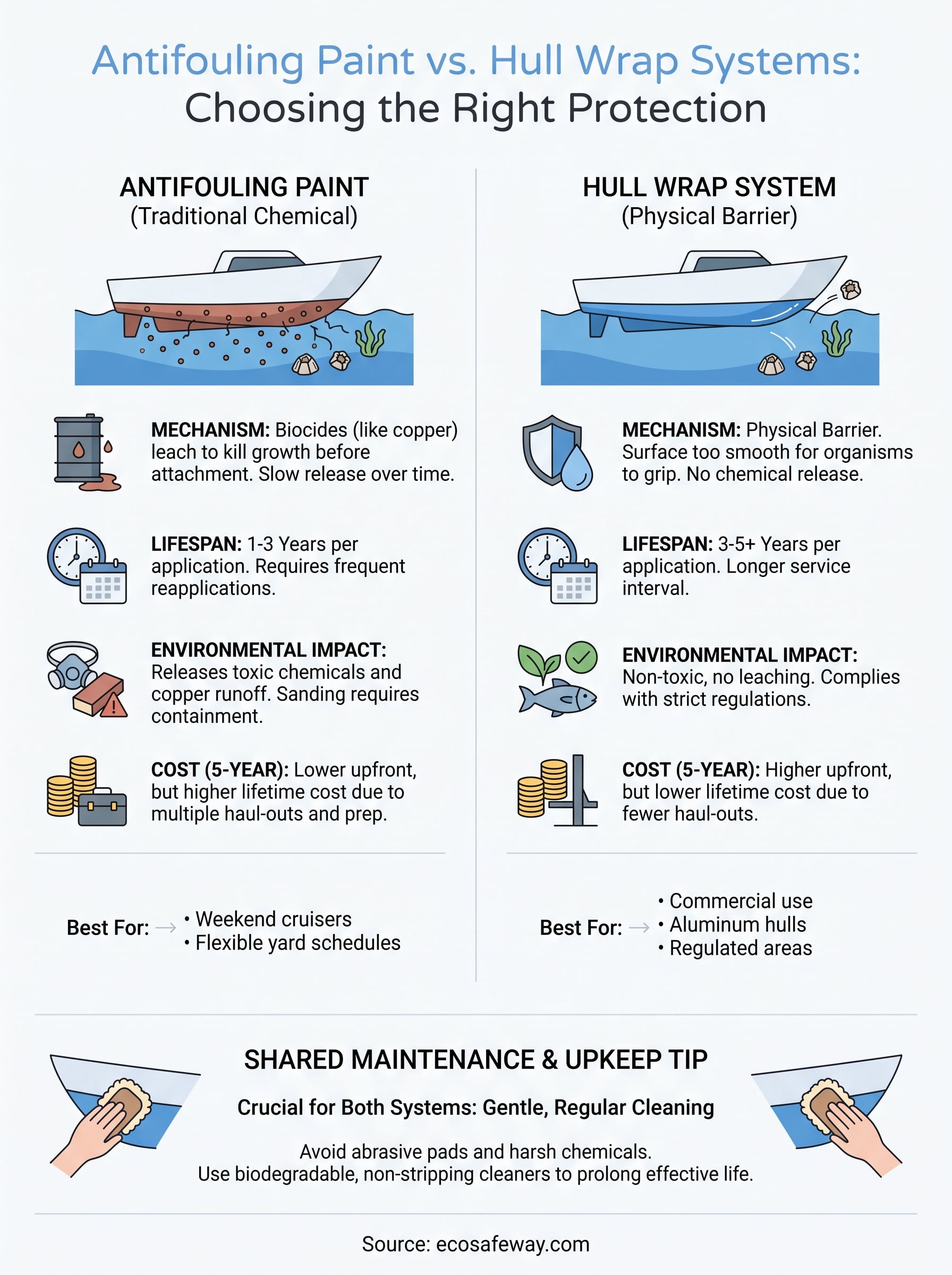
The difference between antifouling paint and hull wrap systems really comes down to how you use your boat and what you're willing to manage between haul-outs. Daily commercial runs, aluminum hulls, or marinas cracking down on copper favor a wrap system with fewer interruptions. Weekend cruisers with tight budgets and flexible yard schedules may still get solid years out of traditional antifouling paint, especially if cleaning stays gentle and regular.
Whichever coating sits under your waterline, the routine care around it decides how close you get to that rated lifespan. Skip the acids and abrasive pads that quietly strip biocide or lift film edges, and you protect the investment you already made in haul-out day.
If you're leaning toward a longer-lasting, non-toxic option, take a look at Finsulate® antifouling wrap, a 10+ year non-toxic alternative to bottom paint, and see how many haul-outs you could skip over the next decade.


