





Every piece of equipment that handles water, from cooling towers and condensers to marine engines and HVAC systems, eventually encounters the same challenge: mineral deposits. These naturally occurring concentrations of minerals form through geological processes that have shaped the Earth for billions of years, and they show up everywhere from mountain ranges to the water running through your facility's pipes.
Understanding what mineral deposits are, how they form, and where they concentrate isn't just academic. For industries that rely on clean, efficient equipment, mineral buildup is a direct operational problem, one that drives corrosion, reduces heat transfer, and shortens equipment life. At Eco Safeway, we develop non-toxic, biodegradable descaling and cleaning solutions specifically designed to remove these stubborn mineral accumulations without damaging equipment or the environment.
This article breaks down the geology behind mineral deposits: how they form through processes like precipitation, hydrothermal activity, and sedimentation, the major types you'll encounter, and where significant deposits are found around the globe. Whether you're researching mineral science or trying to understand what's scaling up inside your equipment, this guide covers the fundamentals.
Why mineral deposits matter
Mineral deposits influence nearly every sector of the modern economy, and they show up in two distinct contexts that matter to different audiences. On a macro scale, they represent the concentrated ore bodies and mineral reserves that mining operations extract to supply raw materials for manufacturing, construction, and technology. On an operational scale, they represent the hard, crystalline scale that builds up inside equipment whenever mineral-rich water heats, evaporates, or sits still. Both forms deserve attention, and understanding the connection between them helps explain why proper maintenance chemistry matters.
Economic and geopolitical importance
The mining industry depends entirely on locating and extracting economically viable mineral concentrations. Countries with large, accessible reserves of copper, lithium, iron, and rare earth elements hold significant advantages in global trade and technology supply chains. Lithium deposits, for example, have become central to battery manufacturing and the energy transition, turning otherwise remote regions into strategic national priorities. The United States Geological Survey tracks domestic mineral production closely because raw material availability directly shapes national manufacturing capacity and long-term economic security.
The USGS has estimated that non-fuel mineral materials added over $106 billion to the U.S. economy in a single recent year, a figure that reflects how deeply mineral resources are embedded in daily industry.
Why scale buildup creates direct operational costs
For facility managers, marine operators, and industrial maintenance teams, the most relevant form of mineral deposits is scale: the calcium carbonate, magnesium silicate, and other compounds that precipitate out of water onto metal surfaces. When water heats up or evaporates inside your equipment, dissolved minerals reach their saturation point and crystallize. Those crystals bond to pipe walls, heat exchanger surfaces, and coil fins, creating a layer that restricts water flow and acts as thermal insulation exactly where you need heat transfer.
Research shows that scale buildup as thin as one-quarter inch can cut heat transfer efficiency by up to 40%, which translates directly into higher energy bills and accelerated equipment wear. Removing this scale without damaging the metal underneath requires the right chemistry, specifically non-corrosive, non-toxic descalers that dissolve mineral bonds while leaving equipment surfaces intact.
How mineral deposits form
Mineral deposits don't appear randomly. They form through specific geological processes that concentrate minerals far beyond their average abundance in the Earth's crust. Understanding these processes helps explain both why major ore bodies exist where they do and why your equipment surfaces attract mineral buildup wherever water flows, heats, or evaporates.
Hydrothermal and magmatic processes
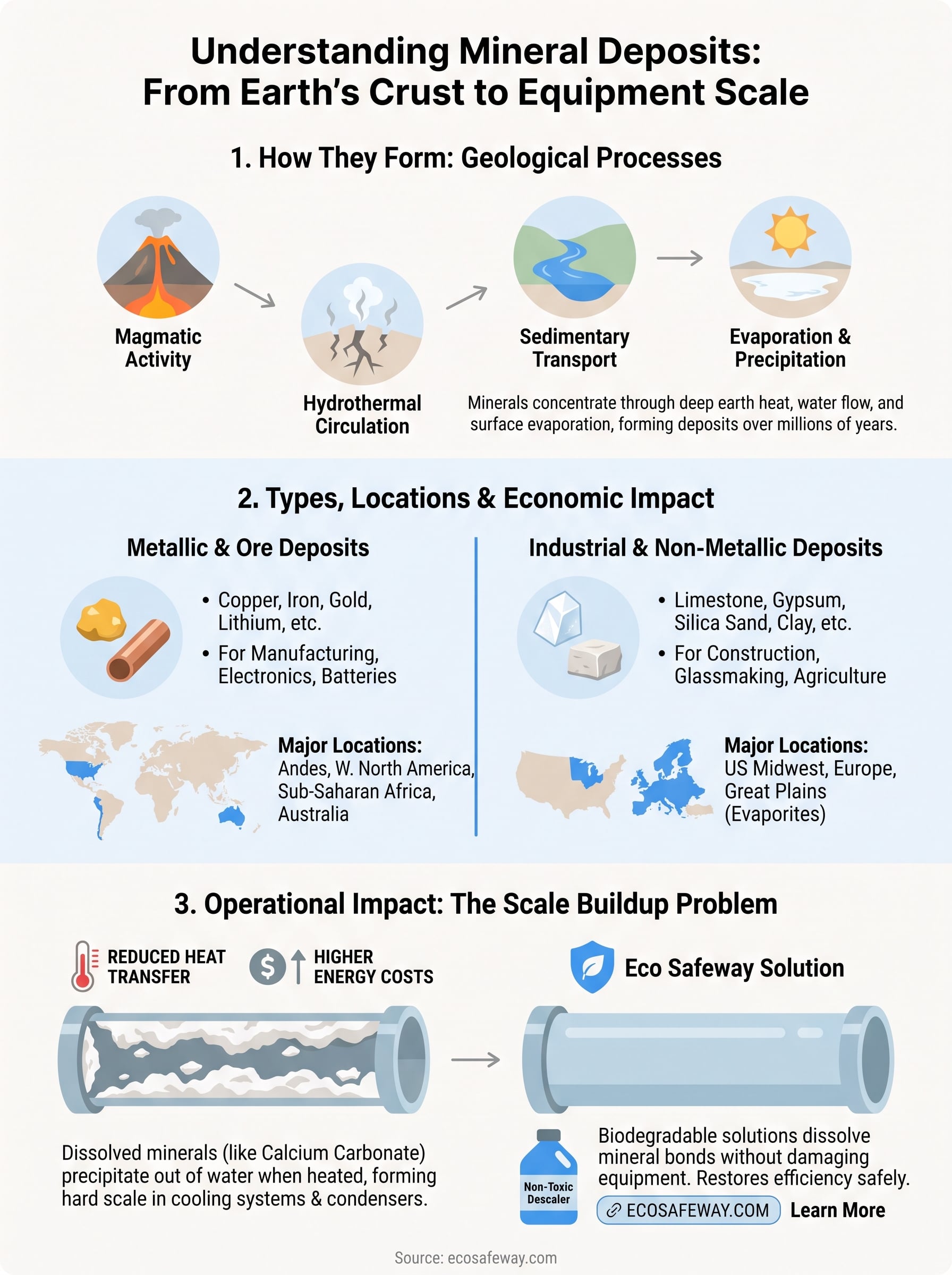
Hydrothermal activity is one of the most significant drivers of mineral concentration in the Earth's crust. Superheated water carries dissolved metals and compounds deep underground, and when that water cools or encounters different chemical conditions, those minerals precipitate out and accumulate in fractures and cavities. This is how many of the world's major copper, gold, and silver deposits formed over millions of years. Magmatic processes work similarly: as molten rock cools, certain minerals crystallize and settle, concentrating into distinct layers and veins.
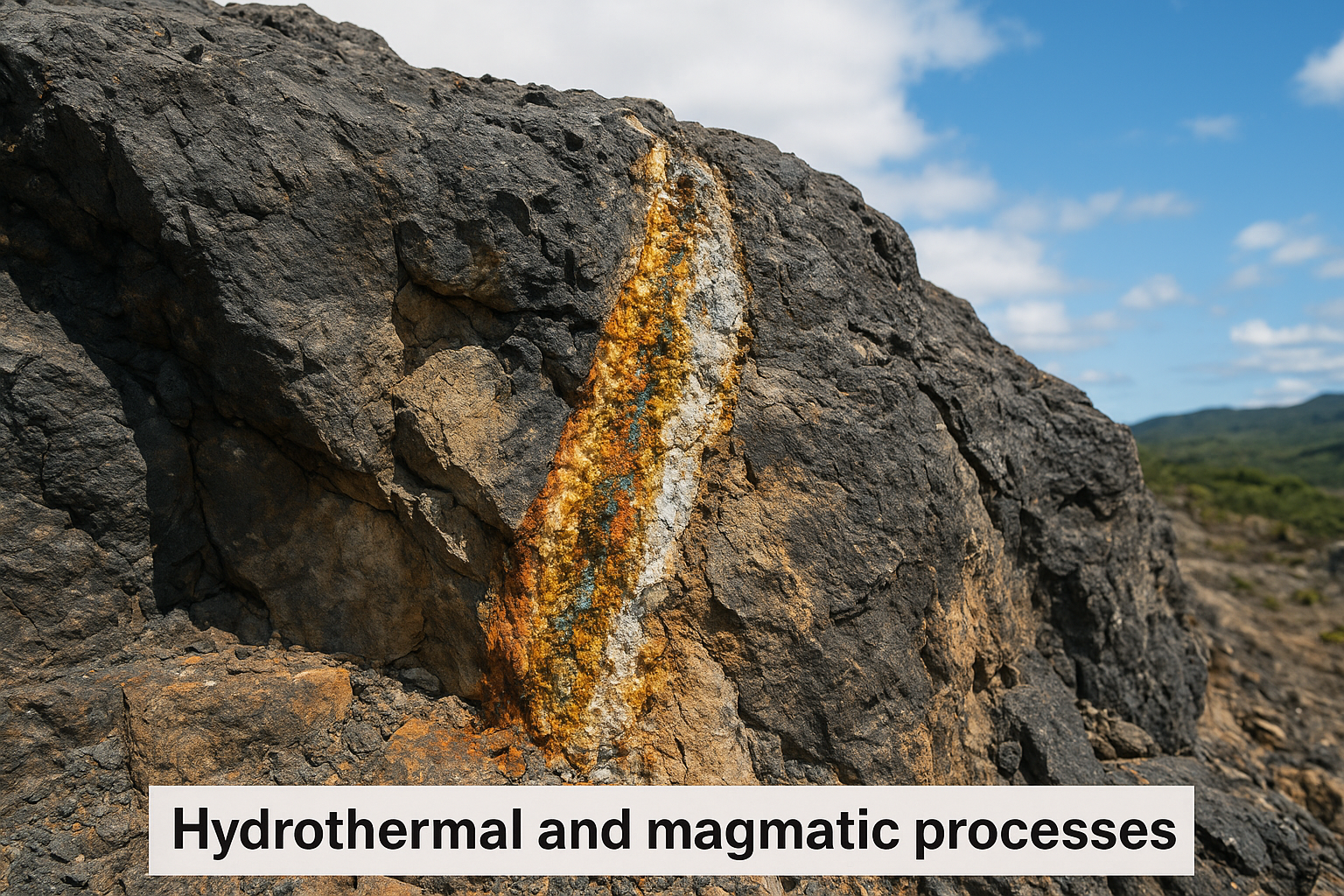
The same basic chemistry that builds ore veins underground also builds scale inside your pipes: dissolved minerals reach a point of saturation and drop out of solution onto the nearest available surface.
Sedimentary and evaporative processes
Sedimentary deposits form when minerals accumulate through water-driven transport and deposition. Rivers carry dissolved and suspended minerals into lakes, basins, and ocean environments, where they settle and consolidate over time. Evaporite deposits, including halite and gypsum, form when mineral-rich water evaporates and leaves concentrated crystalline layers behind. This evaporative process mirrors exactly what happens inside cooling towers and heat exchangers, where water evaporates continuously and deposits calcium, magnesium, and silica onto metal surfaces.
Types of mineral deposits
Geologists categorize mineral deposits based on how they formed, what they contain, and how they concentrate relative to surrounding rock. These categories shape everything from how mining companies target exploration to how maintenance teams expect scale to behave inside pipes and heat exchangers.
Ore and metallic deposits
Metallic deposits contain economically recoverable concentrations of metals such as copper, iron, gold, zinc, and lithium. These deposits form through the hydrothermal, magmatic, and sedimentary processes described above, and they represent the raw material foundation for manufacturing, electronics, and infrastructure. Porphyry copper deposits in the American West and Chile, for example, formed when hydrothermal fluids interacted with cooling magma over millions of years.
Many metallic ore deposits carry trace elements that dissolve into groundwater and contribute directly to the mineral content your water treatment systems must manage.
Industrial and non-metallic deposits
Non-metallic deposits cover a wide range of minerals that don't fit the ore category but serve critical industrial functions. This group includes evaporites like halite and gypsum, phosphate deposits used in agriculture, silica sands used in glassmaking, and calcium carbonate deposits like limestone. Calcium carbonate is particularly relevant for facility operators because it's the primary mineral that precipitates out of hard water and bonds to metal surfaces inside cooling towers, condensers, and marine heat exchangers.
This group also includes clays, talc, and barite, each with distinct manufacturing and chemical applications. Understanding where these minerals originate geologically helps explain why your water supply behaves the way it does and why descaling chemistry targets specific mineral bonds rather than applying a one-size-fits-all approach.
How geologists find and evaluate deposits
Locating economically viable mineral deposits requires combining geological theory with field investigation and modern technology. Geologists don't simply dig where they think minerals might exist; they follow a systematic process that moves from large-scale regional surveys down to precise drilling and sampling programs.
Exploration and remote sensing
Modern mineral exploration starts with remote sensing and geophysical surveys conducted from aircraft or satellites. These tools detect variations in gravity, magnetic fields, and electromagnetic signatures that indicate buried mineral concentrations. Ground-based surveys then confirm what aerial data suggests, using techniques like seismic profiling and electrical resistivity testing to map subsurface geology without breaking ground.
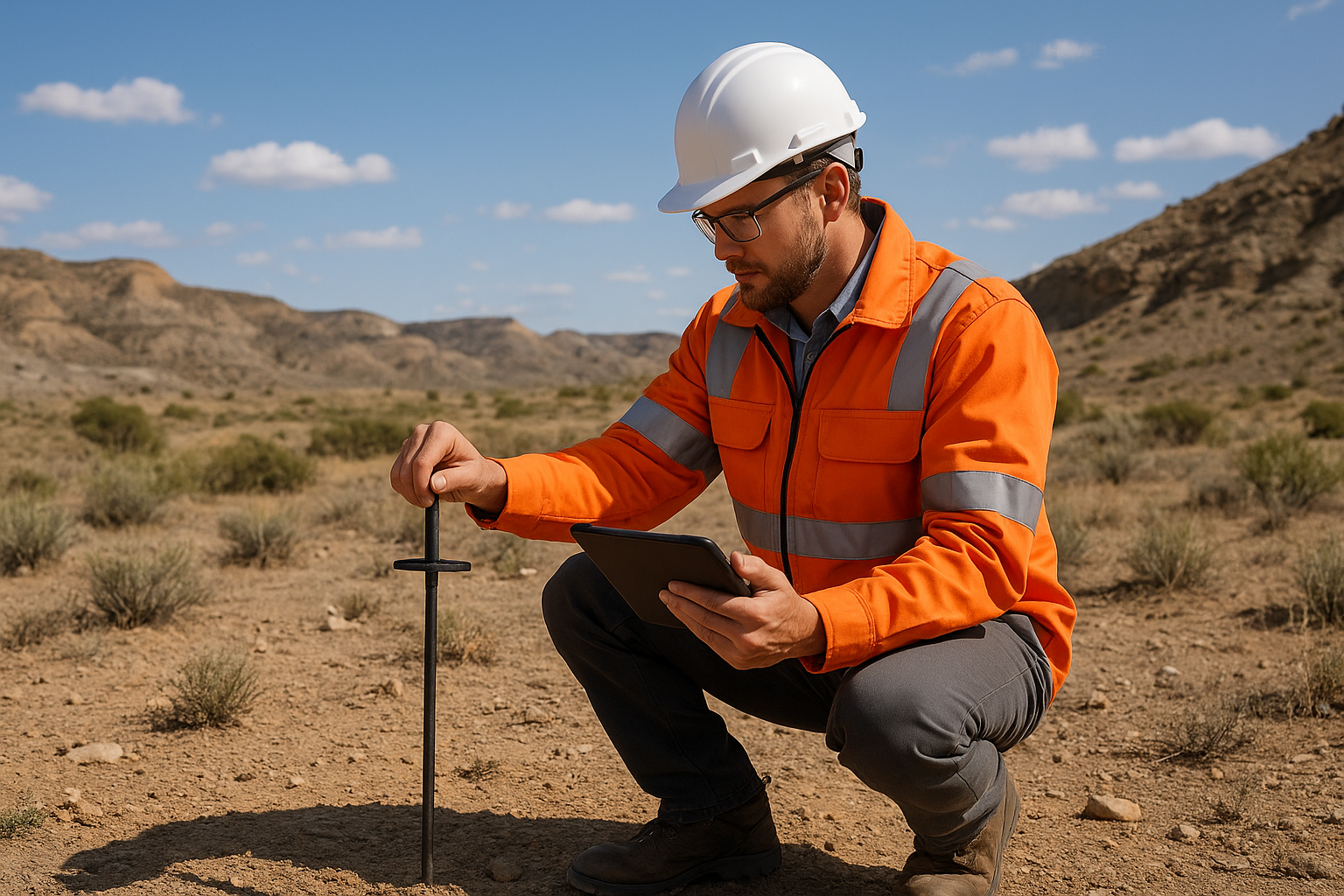
Remote sensing has transformed mineral exploration, allowing geologists to identify promising target zones across thousands of square miles before committing to expensive drilling programs.
Soil and rock sampling follows once a target zone is identified. Geochemical analysis of these samples reveals trace element concentrations that point to mineralization at depth, giving exploration teams the data they need before committing to full drilling campaigns.
Assessing deposit viability
Once drilling confirms a mineral body, geologists evaluate grade, tonnage, and continuity to determine whether extraction makes economic sense. Grade refers to how much of the target mineral exists per unit of rock, while tonnage describes the total size of the deposit.
Continuity describes how consistently the mineral body holds its grade and thickness across the deposit. If you're investigating why water drawn from mineral-rich aquifers carries heavy dissolved mineral loads, this same geological consistency explains why certain regions produce water with predictable scaling characteristics inside your facility equipment.
Where major mineral deposits occur worldwide
Mineral deposits don't distribute evenly across the planet. Geological history, plate tectonics, and ancient sea levels have concentrated specific minerals in predictable regions, and knowing these locations helps explain why water drawn from different geographic areas carries vastly different dissolved mineral loads into your facility's pipes and equipment.
Metal-rich regions
The Andes mountain range running through Chile and Peru holds some of the world's largest copper and lithium concentrations, products of intense volcanic and hydrothermal activity over millions of years. North America's western cordillera, from Nevada and Arizona up through British Columbia, contains significant gold, copper, and molybdenum deposits formed through similar magmatic processes. Sub-Saharan Africa, particularly the Democratic Republic of Congo and Zambia, hosts the Copperbelt, one of the most significant metallic deposit zones on Earth.
Australia's Pilbara region contains some of the world's largest iron ore formations, ancient banded iron deposits that trace back over two billion years to early ocean chemistry.
Non-metallic and evaporite deposits
Limestone and calcium carbonate formations are widespread across the American Midwest, the southeastern United States, and large portions of Europe, which directly explains why facilities in these regions consistently deal with hard water scaling inside cooling systems, condensers, and heat exchangers. The Great Plains region also contains significant gypsum and halite evaporite deposits, remnants of ancient shallow seas that evaporated and left thick mineral layers behind. Understanding your facility's regional geology gives you a clearer picture of what your water carries and why your equipment scales the way it does.
Wrap-up and next step
Mineral deposits shape the world at every scale, from the ore bodies that supply global manufacturing to the calcium and magnesium compounds that crystallize inside your facility's pipes and cooling systems. The same geological processes that build massive copper veins underground also drive the hard scale layers that reduce heat transfer efficiency and shorten equipment life. Knowing where your water originates and what minerals it carries gives you a real advantage in preventing buildup before it becomes a costly maintenance problem.
Your next step is putting that knowledge to work with the right chemistry. If scale buildup inside your HVAC system, cooling tower, or chiller is already cutting efficiency, Eco Safeway's non-toxic, biodegradable formulas dissolve mineral bonds without corroding metal surfaces or creating hazardous waste. Start with our industrial HVAC and cooling tower descaler to restore your system's performance safely.


