




Finding genuine made in the usa products takes more digging than it should. Type the phrase into a search bar and you get flooded with brands that slap a flag on the label while manufacturing overseas, or vague "assembled in USA" claims that mean almost nothing. If you actually want products built, sourced, and finished domestically, you need a list that separates real American manufacturing from marketing.
This article gives you exactly that. We pulled together nine categories, from cookware to cleaning chemicals, where domestic manufacturing still leads on quality and accountability. You'll see what makes each product legitimately American-made, not just American-labeled, and why that distinction affects performance, safety, and how the item is shipped to your door.
We included industrial and marine cleaning solutions alongside household staples because facility managers and boat owners face the same sourcing problem as everyday shoppers: too many claims, not enough proof. Whether you're outfitting a kitchen, a boat, or a commercial facility, this list points you toward brands that manufacture domestically and back it up with real certifications and transparent supply chains.
1. Eco Safeway eco-friendly cleaning products
Eco Safeway manufactures its entire product line in the United States, formulating non-toxic cleaning products for marine, industrial, and commercial customers who can't afford to guess about what's in their chemicals. Every formula carries an HMIS 0-0-0 rating, meaning zero health, flammability, or physical hazard scores, and that rating only happens through domestic quality control and testing that most importers skip entirely.
What it offers
Standing apart from typical made in the usa products in the cleaning aisle, Eco Safeway builds solutions for problems that generic degreasers can't touch: marine descalers, raw water flush treatments, cooling tower and condenser coil cleaners, enzyme drain treatments, and odor control products. Because nothing in the lineup requires hazmat handling, facilities save on shipping and storage while cutting the protective gear budget. The table below shows how the core product categories break down.
| Category | Example Use | Key Benefit |
|---|---|---|
| Marine descalers | Raw water cooling systems | Removes scale without acid corrosion |
| Coil cleaners | HVAC condenser units | Non-corrosive, phosphate-free |
| Enzyme drain treatments | Commercial kitchens, hospitals | Biodegradable, ongoing maintenance |
| Odor control | Facilities, marinas | Eliminates source, not just masks smell |
A cleaner that's genuinely non-toxic shouldn't need a hazmat placard to reach your dock or loading dock.
Who it's best for
Facility managers running cooling towers, ice machines, or HVAC systems will find the coil and descaling products cut maintenance calls and extend equipment life. Marina operators and boat owners get raw water flush and descaling formulas that protect engines without the corrosion risk that acid-based competitors carry. Hospitals, data centers, and government facilities benefit most because EPA compliant formulas simplify procurement approval and reduce liability exposure tied to worker exposure claims.
Price range and where to buy
Pricing runs from roughly $25 for smaller drain and odor control bottles up to $150 or more for concentrated industrial descalers sold in bulk containers, depending on volume and application. Ordering directly through ecosafeway.com gets you the full catalog, technical data sheets, and bulk pricing for facility contracts, which matters if you're comparing formulas against EPA safety data before purchasing. Because shipping doesn't require hazmat documentation, orders move faster and cost less than competing industrial chemicals, a real advantage when you're managing multiple sites or vessels.
2. American-made kitchen and cookware essentials
Cookware is where domestic manufacturing has held on strongest, and brands like Lodge, All-Clad, and USA Pan still cast, stamp, and finish their products in American plants. Made in the usa products in this category usually come from foundries that have run for generations, which explains why the fit, weight, and finish feel more consistent than imported alternatives at the same price point.
What it offers
You get cast iron skillets poured in Tennessee, stainless clad pans bonded in Pennsylvania, and bakeware stamped in Ohio, all built to handle daily commercial or home use without warping. Most of these companies publish their sourcing, down to the steel mills and aluminum suppliers, so you're not guessing about where the raw material originated.
Cookware that lasts decades usually traces back to a factory you can actually name.
Who it's best for
Home cooks who replace nonstick pans every two years will notice the difference immediately once they switch to domestically forged cast iron or clad stainless, since these pieces are built to outlast trends. Restaurant owners and catering operations benefit too, because commercial-grade American cookware handles high heat and heavy rotation better than budget imports.
Price range and where to buy
Expect $20 to $50 for basic cast iron skillets, $150 to $400 for multi-piece stainless clad sets, and $15 to $30 for individual bakeware pieces. Buy directly from manufacturer websites or major retailers like Williams Sonoma and Sur La Table, both of which clearly label country of origin on product pages.
3. American-made bedding and mattresses
Mattress manufacturing shifted overseas for decades, but brands like Saatva, My Green Mattress, and American Mattress still build their cores, coils, and covers domestically. Made in the usa products in this category matter because mattresses sit close to your skin for eight hours a night, and foam or fabric sourced without oversight can carry chemical off-gassing you'd never see on imported labels.
What it offers
Domestic mattress makers typically use certified natural latex, organic cotton covers, and steel coils forged in American mills, then publish third-party certifications like GREENGUARD Gold or CertiPUR-US to prove it. Bedding companies like Boll & Branch and Coyuchi weave sheets from traceable cotton and finish them in US mills, so you know the fabric didn't pass through five countries before reaching your bed.
A mattress built with traceable materials tells you more than any comfort rating ever will.
Who it's best for
Families with young kids or anyone sensitive to chemical odors should prioritize domestically built mattresses with organic certifications, since off-gassing risk drops significantly. Hotel operators and property managers replacing bedding in bulk also benefit, because domestic suppliers offer consistent lead times without the customs delays that plague overseas orders.
Price range and where to buy
Queen mattresses from domestic brands run $900 to $2,500 depending on materials, while sheet sets typically cost $100 to $300 for organic cotton. Order directly from manufacturer websites, where you can review certifications and factory locations before buying, or visit regional showrooms that carry these brands exclusively.
4. American-made clothing and denim
Denim built a big part of its reputation on American mills, and brands like American Giant, Todd Shelton, and Round House still cut and sew jeans, tees, and workwear inside US factories. Made in the usa products in apparel tend to use heavier fabric weights and tighter stitching because domestic labor costs push manufacturers toward durability instead of disposable fast fashion.
What it offers
You get raw or selvedge denim woven on vintage shuttle looms, cotton sourced from American farms, and stitching done by workers earning fair wages rather than overseas subcontractors. Companies like American Giant publish exactly which North Carolina mill wove their fleece, and Round House still runs the same Terre Haute, Indiana factory it opened decades ago.
Denim sewn under one roof, from raw cotton to finished seam, wears differently than jeans assembled across three continents.
Who it's best for
Workers who need denim and canvas pants that survive daily abrasion, welding sparks, or job site wear should look at domestic workwear brands first, since the stitching and fabric weight hold up longer than mass-market imports. Shoppers tired of replacing fast-fashion basics every season also benefit, because heavier American-milled cotton resists fading and thinning far better.
Price range and where to buy
Expect $70 to $150 for raw denim jeans, $40 to $80 for basic tees and henleys, and $60 to $120 for canvas work pants. Buy directly from brand websites, where you'll usually find sourcing details and mill names listed on the product page, or through select regional retailers that stock domestic labels exclusively.
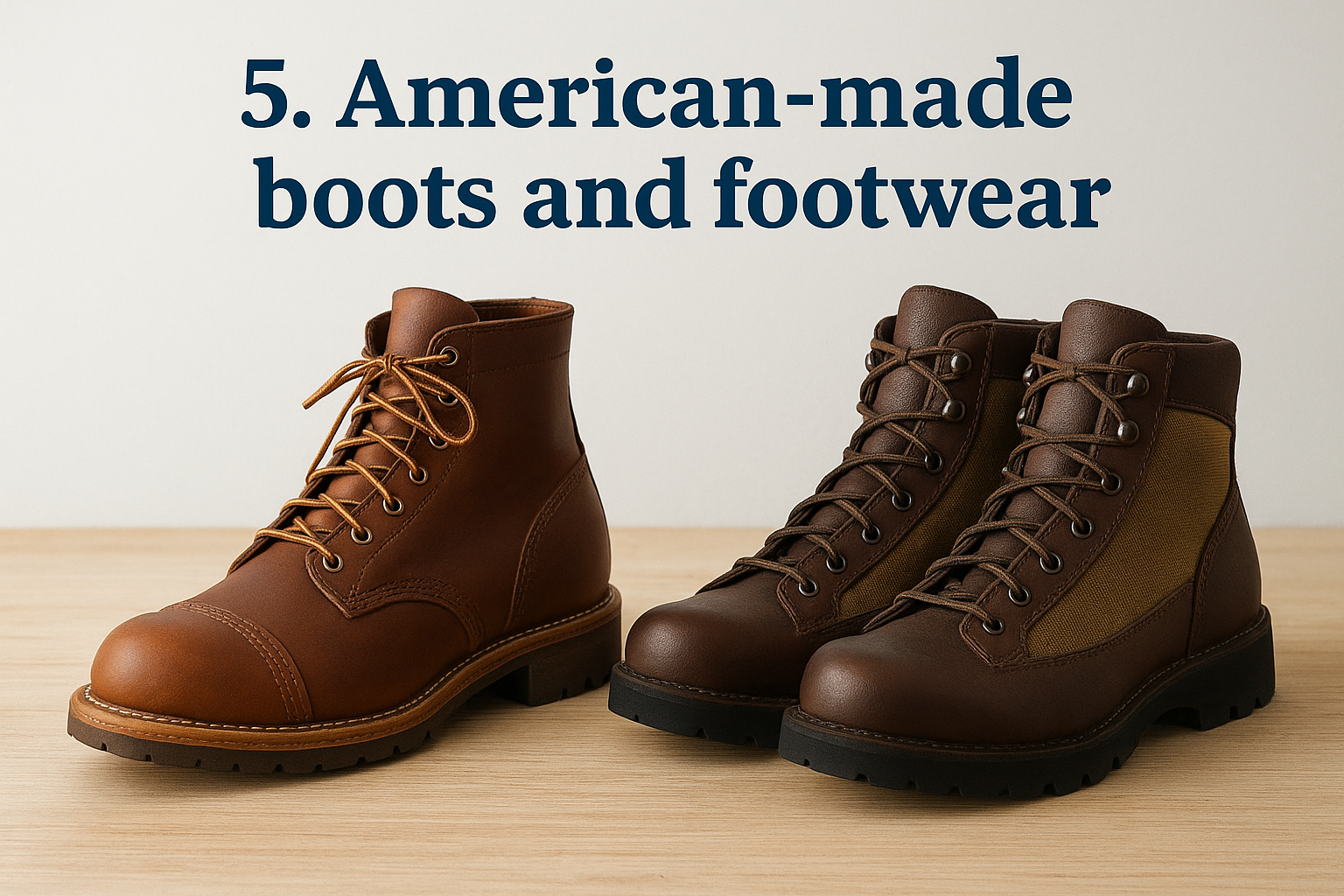
5. American-made boots and footwear
Work boots and leather footwear remain one of the strongest categories for domestic manufacturing, with brands like Red Wing, Danner, and Thorogood still cutting, stitching, and lasting boots inside American factories. Made in the usa products in this space matter because footwear takes direct abuse from job sites, weather, and daily wear, and construction quality determines whether a boot lasts two years or ten.
What it offers
Red Wing still runs its Red Wing, Minnesota factory using Goodyear welt construction, which lets you resole the boots instead of replacing them. Danner sources leather from domestic tanneries and builds hiking and work boots in Portland, Oregon, publishing the factory address right on their site. That level of transparency is rare outside a handful of legacy brands.
A resoleable boot built on American leather outlasts three pairs of disposable imports.
Who it's best for
Construction workers, electricians, and anyone on their feet for ten-hour shifts should prioritize domestic boots with welt construction, since the repairability alone justifies the higher upfront cost. Outdoor enthusiasts who log serious mileage on trails also benefit, because domestically tanned leather breaks in predictably and holds up against repeated wet-dry cycles better than synthetic imports.
Price range and where to buy
Expect $200 to $350 for standard work boots and $250 to $400 for premium hiking boots from these brands. Buy directly through manufacturer websites, where you'll find factory locations and resole programs listed, or visit authorized retailers that carry the full domestic lineup rather than overseas variants sold under the same name.
6. American-made bags and leather goods
Leather goods manufacturing never fully left the United States, and brands like Saddleback Leather, Filson, and Rogue Industries still cut, stitch, and finish bags inside domestic workshops. Made in the usa products in this category rely on full-grain leather tanned in American facilities, which gives bags a structural quality that bonded or split leather imports can't match.
What it offers
Saddleback builds briefcases and backpacks with a 100-year warranty backed by leather thick enough to outlast the stitching on cheaper imports. Filson still sews its waxed canvas totes and duffels in Seattle, using hardware sourced from domestic suppliers rather than overseas subcontractors. That combination of heavy-duty materials and transparent sourcing separates these brands from imported leather goods marketed under similar names.
A bag backed by a 100-year warranty tells you the maker expects it to outlive you.
Who it's best for
Professionals who carry a laptop bag daily for years should prioritize domestic leather goods, since the stitching and hardware hold up under constant zipper and strap stress. Outdoor workers and hunters also benefit from waxed canvas duffels built for rough handling, because the reinforced seams resist tearing in ways mass-produced imports don't.
Price range and where to buy
Expect $150 to $400 for full-grain leather bags and briefcases, and $80 to $250 for waxed canvas duffels and totes. Buy directly through manufacturer websites, where warranty terms and repair programs are clearly listed, or through select outdoor retailers that stock verified domestic inventory rather than licensed overseas production.
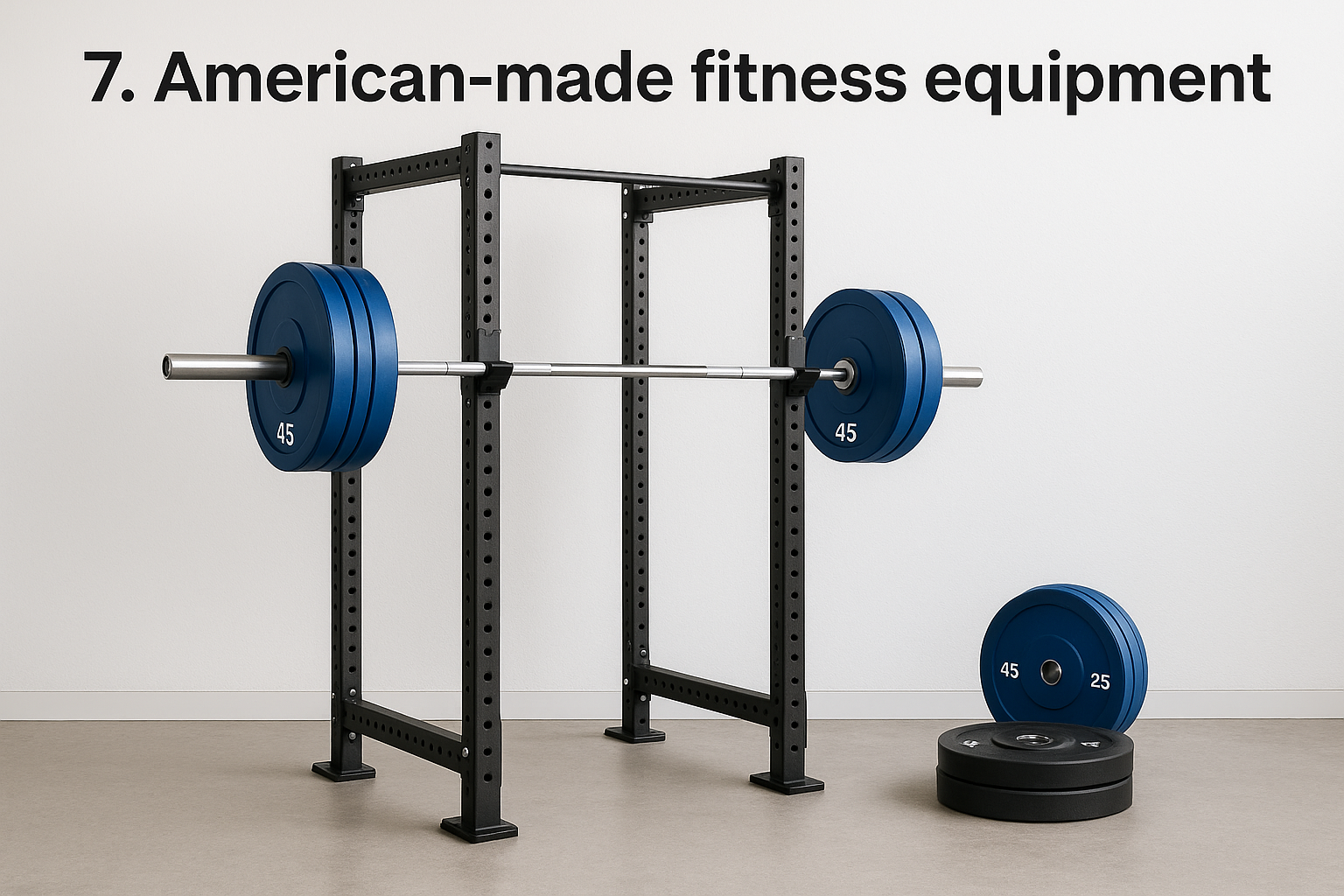
7. American-made fitness equipment
Home gyms boomed over the last few years, and domestic manufacturers like Rogue Fitness, Titan Fitness, and American Barbell answered that demand by keeping their welding, machining, and finishing inside US factories. Made in the usa products in this category matter because barbells, racks, and plates take repeated stress under load, and steel quality determines whether equipment holds tolerances or bends after a few hundred pounds of daily use.
What it offers
Rogue manufactures most of its power racks and barbells in Columbus, Ohio, sourcing steel from domestic mills and publishing tensile strength specs most importers won't disclose. American Barbell machines its bars in California, controlling knurl depth and sleeve tolerances that cheaper imported bars often get wrong. You get equipment engineered for competition-level loads, not just gym decoration.
A barbell machined to exact tolerance holds up under max lifts that bend imported steel.
Who it's best for
Serious lifters building home gyms should prioritize domestic barbells and racks, since tighter manufacturing tolerances translate directly into safer, more consistent lifts. Commercial gym owners also benefit, because domestic equipment brands typically offer faster warranty service and replacement parts than overseas suppliers routing claims through multiple distributors.
Price range and where to buy
Expect $200 to $500 for competition barbells, $400 to $1,200 for power racks, and $1.50 to $2.50 per pound for bumper plates. Buy directly through manufacturer websites, where you can verify steel specs and factory location, or through authorized fitness retailers that stock the true domestic line rather than budget imports sold under similar branding.
8. American-made tools and hardware
Hand tools built for daily job site abuse still come out of American factories, with brands like Klein Tools, Channellock, and SK Hand Tools forging, stamping, and finishing hardware domestically. Made in the usa products in this category carry a reputation for holding tolerances that imported tools often lose after a few hundred uses, which matters when a stripped bolt or slipping wrench costs you time on a job.
What it offers
Klein Tools forges pliers and strippers in Illinois using proprietary steel blends, while Channellock still runs its Meadville, Pennsylvania plant that's forged pliers since 1886. SK Hand Tools machines wrenches and sockets to tighter tolerances than most import lines, publishing chrome-vanadium specs that competitors leave off the label. That kind of domestic forging gives tools a grip and durability imports rarely match at the same price.
A wrench forged to hold tolerance outlasts a drawer full of cheaper imports.
Who it's best for
Electricians, plumbers, and tradespeople who rely on tools daily should prioritize domestic brands, since forged steel resists the rounding and cracking that budget imports develop under repeated torque. DIY homeowners building a lifetime toolbox also benefit, because these tools carry lifetime warranties honored by companies still operating the factories that made them.
Price range and where to buy
Expect $15 to $40 for individual pliers or wrenches, and $150 to $400 for complete socket sets from these brands. Buy directly through manufacturer websites, where warranty registration and factory details are listed, or through hardware retailers like Grainger and Ace Hardware, which stock verified domestic lines alongside imported alternatives.
Why buying American still matters
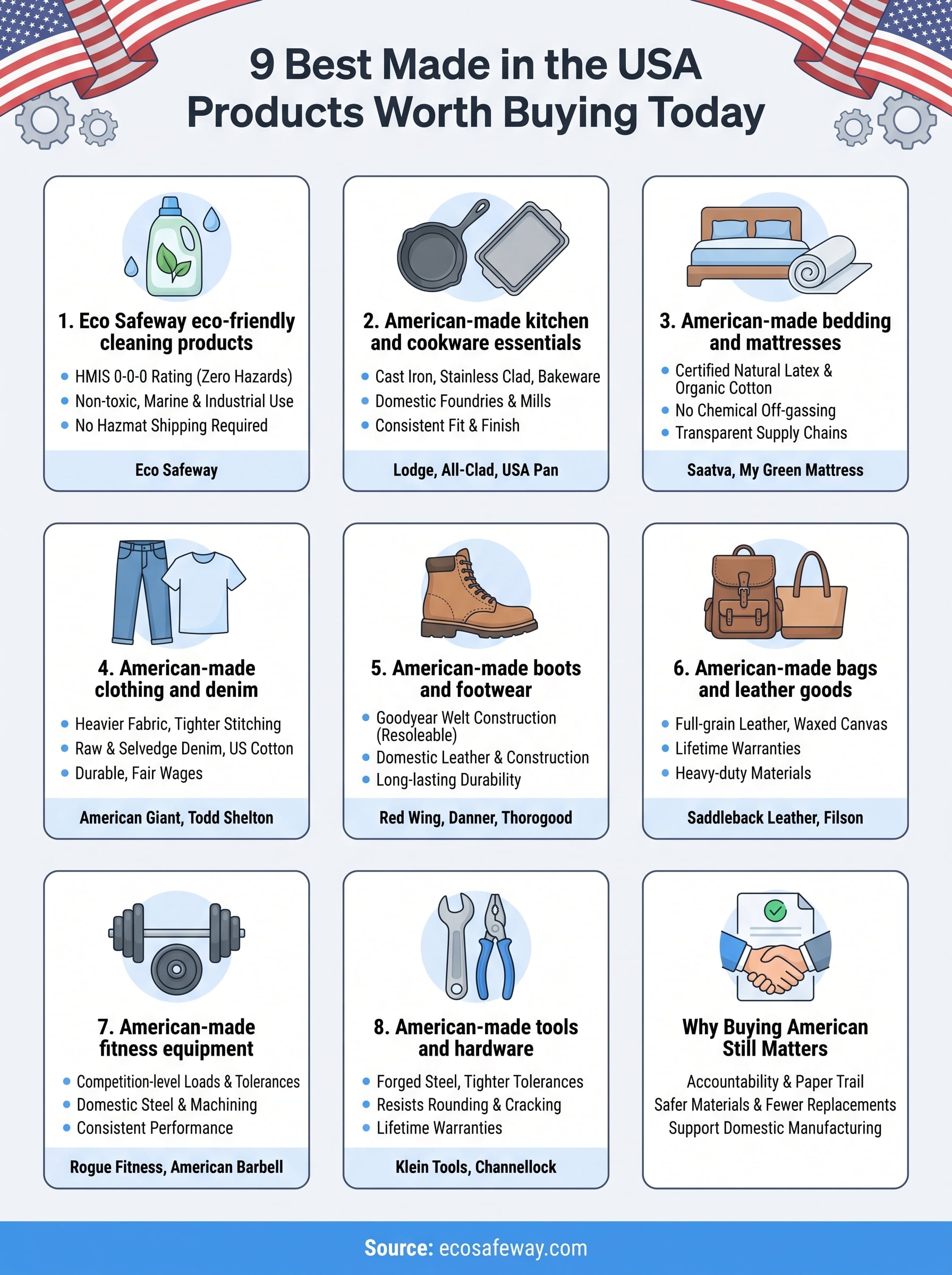
Domestic manufacturing gives you something imports rarely can: a paper trail. You can call the factory, check the certifications, and hold a company accountable when a product fails. That accountability shows up across every category here, from resoleable boots to HMIS 0-0-0 cleaning formulas that skip hazmat shipping altogether. Made in the usa products cost more upfront in most cases, but the tradeoff is fewer replacements, safer materials, and support from companies that actually answer the phone.
If you manage a boat, a marina, or a commercial facility, cleaning chemicals are the easiest place to start applying this standard. Skip the vague "eco-friendly" labels and check for real certifications instead. Eco Safeway builds its entire line domestically and backs every formula with an HMIS 0-0-0 rating, so you're not guessing about what's going down your drains or into your engine's cooling system. Browse the raw water flush for boat engines and see the difference domestic formulation makes on your next maintenance run.


