



Search for an ice cleaner machine and you get three different products. Some results show dry ice blasters, some show ice rink resurfacers, and others show cleaners made for commercial ice makers. They share a name but solve very different problems, so it pays to sort them out before you spend money.
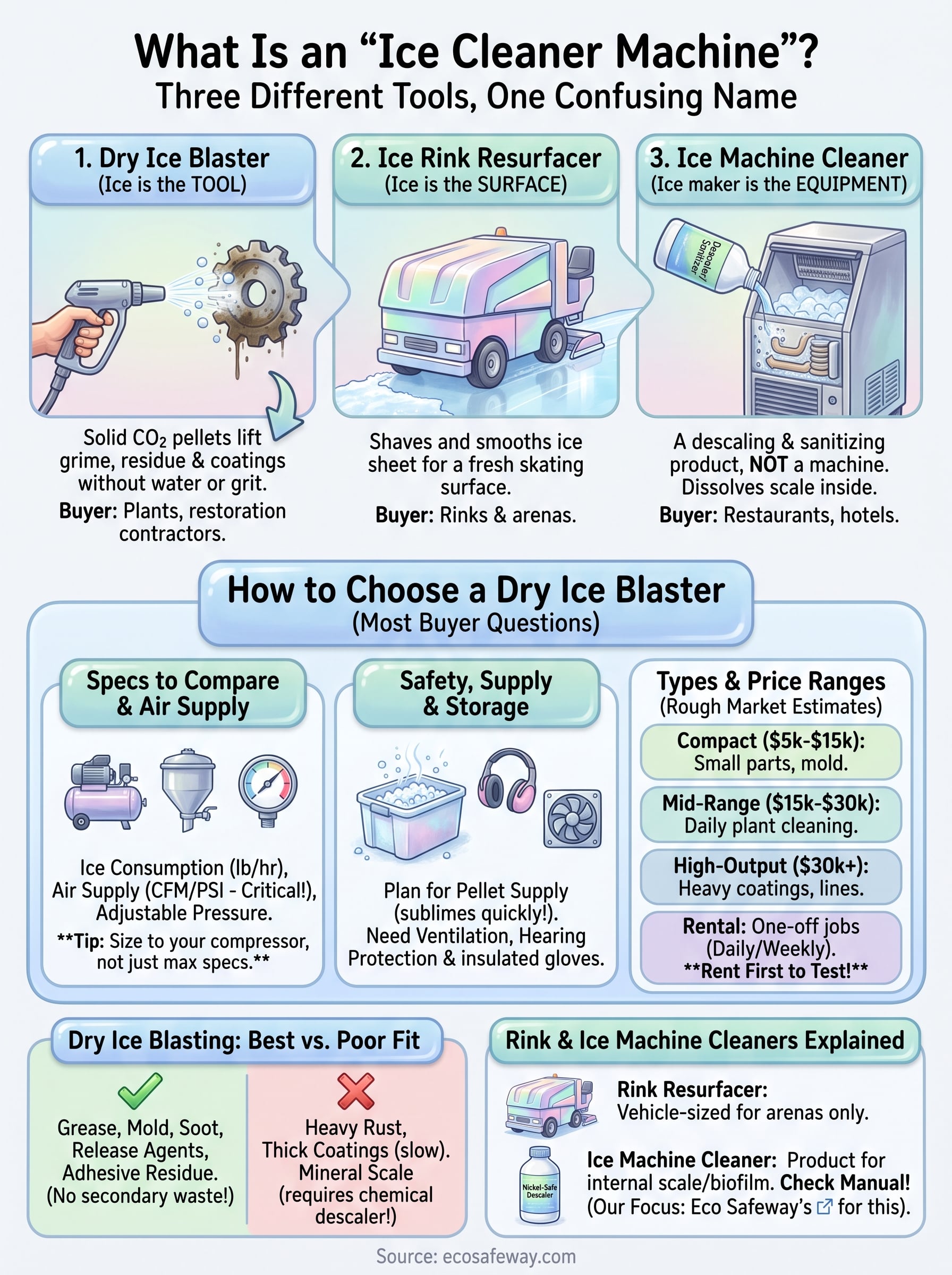
Here is the short answer. A dry ice blaster is the machine most buyers want. It fires solid CO2 pellets at a surface to lift grime, residue and coatings without water or abrasive media. A rink resurfacer shaves and smooths ice for skating. An ice machine cleaner is a descaling and sanitizing product, not a machine at all.
This article defines each type, explains what it does and who uses it, and covers what drives the price of a dry ice blaster and which manufacturers to look at. You will also see how ice machine cleaning works. At Eco Safeway, we focus on ice machine cleaning and descaling, so we will point out where that fits.
Why "ice cleaner machine" means different things
The phrase covers three unrelated product groups because "ice" and "clean" can connect in three ways. Ice can be the cleaning tool, the surface being cleaned, or the equipment that needs cleaning. Each reading points to a different buyer, a different budget and a different purchase.
Three meanings side by side
| Type | Role of ice | Typical buyer |
|---|---|---|
| Dry ice blaster | Solid CO2 pellets do the cleaning | Plants, restoration contractors, food processors |
| Ice rink resurfacer | The ice sheet is the surface being smoothed | Rinks and arenas |
| Ice machine cleaner | The ice maker is the equipment being cleaned | Restaurants, hotels, hospitals |
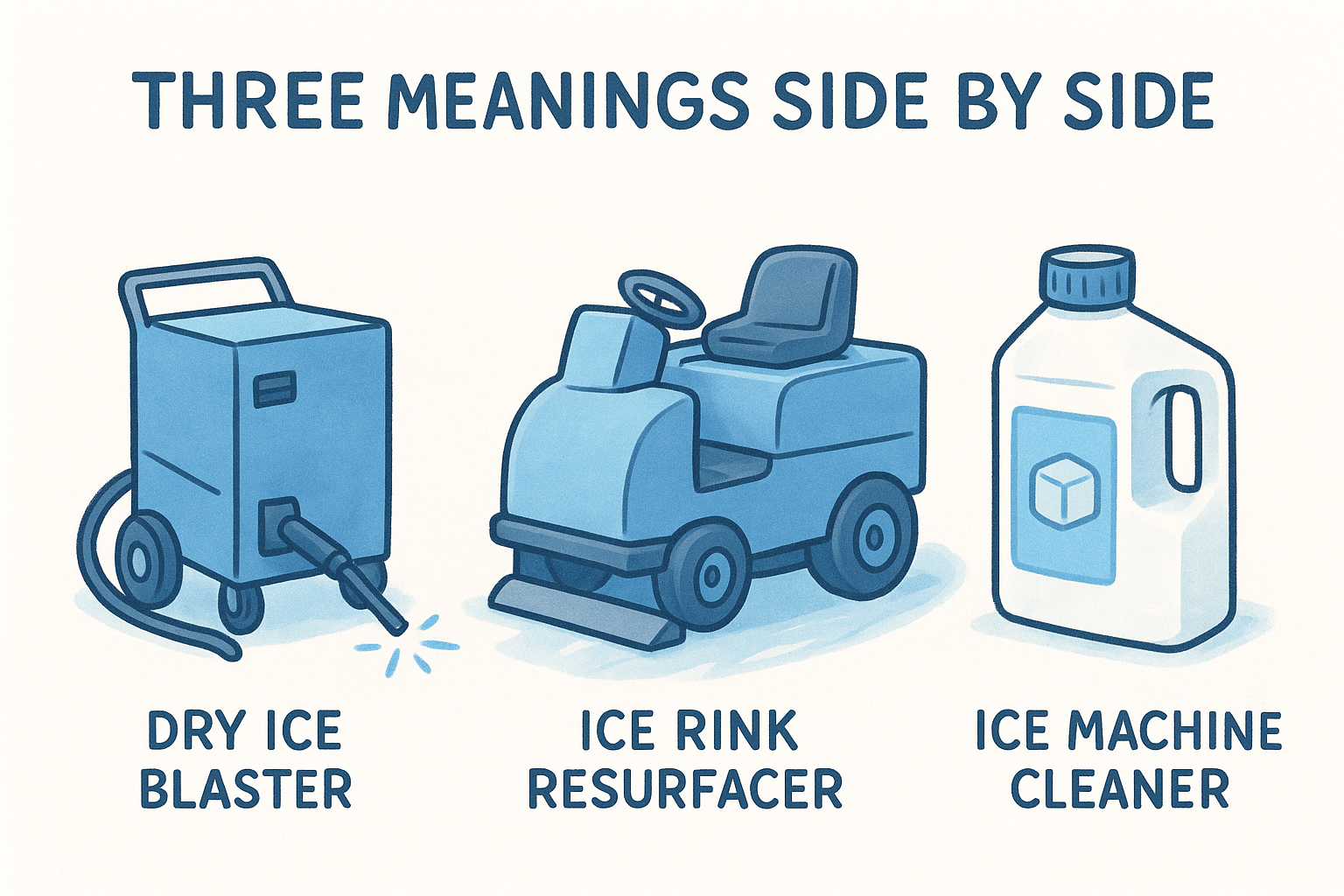
Only the first two are machines you operate. The third is a descaling and sanitizing product that you run through a commercial ice maker. People who search for an "ice cleaning machine" with that equipment in mind usually want the product, not a blaster.
How to tell which one a listing means
Search engines match words, not intent, so one query returns all three. You can sort the results quickly by reading the product description. Pellets, a hopper and a compressed air requirement mean dry ice blaster. A blade, a water tank and a driver's seat mean rink resurfacer. A bottle, tablets or a descaling solution means ice machine cleaner.
Before you compare prices, ask one question: is ice the tool, the surface, or the thing being cleaned?
Answering that first saves you from comparing a five-figure blaster with a few-dollar descaler. The next sections take the dry ice blaster first, since it carries the most buying questions.
How to choose a dry ice blasting machine
Start with the job, not the brand. Blasters differ mainly in ice consumption per hour, air supply requirements and portability. A compact unit handles mold or grease on small parts, while heavy coatings and long production lines call for more throughput.
Specs to compare
- Ice consumption (lb/hr): sets cleaning speed and how long a hopper load lasts.
- Air supply (CFM and PSI): some units need a large compressor.
- Adjustable pressure: protects softer surfaces.
- Nozzle and hose options: reach tight spots.
Many buyers overlook air supply. Your compressor capacity can rule out a model, and adding one raises the total cost of an ice cleaner machine well beyond the sticker price.
Size the blaster to your compressor and your job, not to the biggest number on the spec sheet.
Safety and supply
Pellets sublimate, so plan for ice supply and storage before you buy. Unused dry ice disappears, and a unit sitting idle wastes it.
Blasting is loud, and CO2 gas collects in enclosed spaces. You need hearing protection and ventilation, plus a CO2 monitor in tight areas. Pellets sit near -109°F, so operators also need insulated gloves.
Dry ice blaster types, manufacturers and price ranges
Dry ice blasters split into a few clear tiers, and price follows output and build quality. The figures below are rough market estimates, so get a current quote before you budget.
Types and typical prices
| Tier | Best for | Estimated price (USD) |
|---|---|---|
| Compact pellet blaster | Small parts, mold, light residue | $5,000 to $15,000 |
| Mid-range industrial | Daily plant cleaning | $15,000 to $30,000 |
| High-output system | Heavy coatings, production lines | $30,000+ |
| Rental | One-off or seasonal jobs | Daily or weekly rate |
Most buyers land in the first two tiers. Output per hour is what moves a machine up a tier, along with hose length and controls.
Manufacturers and renting first
Established names include Cold Jet, ASCO and Artimpex. Compare their spec sheets on ice consumption, air demand and service coverage in your area. Parts and support matter as much as the sticker price.
Rent first if you are unsure, because a rental shows your real ice and air needs before you commit five figures.
Also, ask each seller about pellet suppliers near you, since a blaster without reliable ice is an expensive ornament.
Where dry ice blasting works best and where it doesn't
Best-fit jobs
Dry ice blasting shines where water and abrasive media cause problems. Pellets sublimate on impact, so there is no secondary waste to collect, and surfaces stay dry. Common uses include:
- Grease and carbon buildup on food processing equipment
- Mold and soot during restoration work
- Release agents on industrial molds and tooling
- Paint and adhesive residue on machinery
Poor-fit jobs
Some jobs defeat an ice cleaner machine. Heavy rust and thick coatings clean slowly, because pellets lack the bite of grit blasting. Soft or thin materials can also be damaged at high pressure, so test a small hidden area first.
Mineral scale is the clearest mismatch. A blaster cannot reach inside a closed water system, and it does not dissolve deposits. A commercial ice maker coated in scale needs a chemical descaler, not a blasting machine.
Dry ice blasting lifts surface contamination; it does not dissolve mineral scale.
Ice resurfacers and ice machine cleaners explained
Ice rink resurfacers
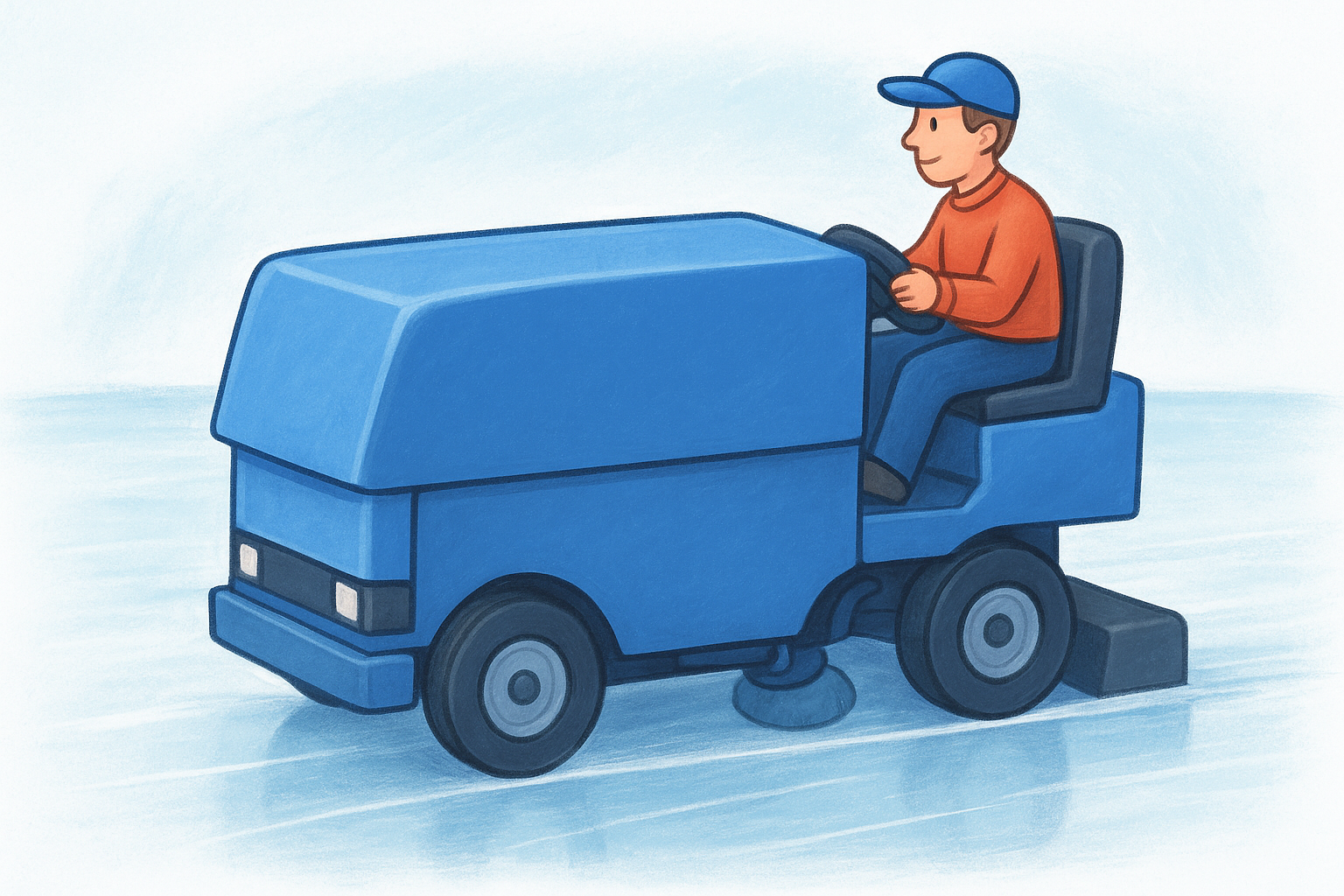
A rink resurfacer is a vehicle-sized machine that shaves the top layer of ice, collects the snow, and lays down a thin film of clean water. That water freezes into a smooth, fresh sheet. Zamboni and Olympia are the best-known makes. Rinks run them between sessions, and they are built for arenas, not workshops.
Ice machine cleaners
Commercial ice makers collect mineral scale and slime inside the water path. A descaler dissolves the scale, and a sanitizer handles biofilm that forms in damp parts. Left alone, scale can hurt ice production and quality, so cleaning belongs on a regular schedule.
Always follow the ice maker manufacturer's cleaning instructions for product type and frequency. Some manufacturers call for nickel-safe cleaners to protect plated evaporator parts, so check the manual before you buy. At Eco Safeway, this is the category we work in.
Scale calls for chemistry, not a machine, so no blaster or resurfacer will clean an ice maker.
Picking the right machine for your job
Choosing an ice cleaner machine comes down to one question: what is the ice doing in your job? If you need to lift grease, soot, mold or residue from equipment without water or grit, a dry ice blaster is the right tool. Size it to your compressor, plan your pellet supply, and rent before you commit five figures.
Rinks that want a smooth sheet of ice need a resurfacer from a maker like Zamboni or Olympia. Nothing else does that job.
Scale inside a commercial ice maker is a different problem. No machine reaches it, and a blaster will not dissolve it. That takes a nickel-safe descaler used on a regular schedule, following your ice maker manufacturer's instructions. If that is your situation, try our food-safe ice machine cleaner and descaler and keep your ice maker running clean.


