





A clogged evaporator coil can quietly rob your HVAC system of 20% or more of its efficiency, and a dirty condenser coil forces the compressor to work harder every single cycle. If you've searched for a hvac coil cleaner sprayer, you already know that a weak pump or a nozzle that clogs mid-job turns a 15-minute maintenance task into an hour of frustration. The right sprayer matters as much as the chemical you load into it.
This guide answers the practical question you're actually asking: which sprayer delivers consistent pressure, holds up against corrosive coil cleaners, and reaches tight fin spacing without leaving streaks or missed spots. We compared tank capacity, wand length, seal materials, and build quality across the models pros actually carry on service trucks.
Below you'll find eight sprayers tested against real coil cleaning demands, from compact units for residential tune-ups to heavy-duty tanks built for commercial rooftop units and cooling towers. Each entry covers pump durability, chemical compatibility, and where it fits your workload, so you can match the equipment to the job instead of guessing at the shelf.
1. HVAC Guys Coil Cannon automatic foaming mixing sprayer
The Coil Cannon sits at the top of this list because it solves the one problem every technician complains about: mixing chemical concentrate to the wrong ratio. Instead of eyeballing dilution in a bucket, this unit draws cleaner straight from its concentrate bottle and blends it with water on the fly, so every pull of the trigger delivers the same foaming solution from the first coil to the last.
How it works
A built-in metering valve pulls concentrated coil cleaner through a dip tube and mixes it with pressurized water inside the wand assembly, right before the fluid hits the nozzle. You dial the mix ratio on a knob, connect a garden hose for water pressure, and the unit does the blending automatically. Because the chemical never sits pre-mixed in a tank, you avoid the corrosion and clogging that ruins cheaper sprayers over time.
A sprayer that mixes chemical on demand instead of pre-diluting it in the tank simply lasts longer and cleans more consistently.
Key features
- Automatic inline mixing eliminates guesswork on dilution ratios
- Foaming nozzle clings to vertical coil faces instead of running off
- Compatible with acid-based and alkaline coil cleaners without seal degradation
- Adjustable output lets you switch between light rinse and heavy foam pass
- Hose-fed design means no hand-pumping between coils
| Spec | Detail |
|---|---|
| Power source | Garden hose water pressure |
| Mixing method | Automatic inline, adjustable ratio |
| Chemical compatibility | Acid and alkaline coil cleaners |
| Nozzle type | Foaming spray tip |
Best for
This sprayer suits commercial HVAC crews running multiple rooftop units in a single day, where consistent dilution across dozens of coils matters more than upfront cost. It's overkill for a homeowner cleaning one window unit once a year, but for a service company billing hourly, the time saved on mixing pays for the unit within a few jobs. Facility managers overseeing large air handler banks also gain from the repeatable results, since technicians can't under-mix or over-mix by mistake.
Price range
Expect to pay between $250 and $400 depending on the retailer and whether it ships with a starter bottle of concentrate. That's a step up from basic pump sprayers, but crews that clean coils daily typically recover the cost in reduced chemical waste and fewer callbacks from streaked or under-cleaned coils.
2. SpeedClean CoilJet CJ-125 portable coil cleaning system
SpeedClean built the CJ-125 for technicians who want a self-contained hvac coil cleaner sprayer without dragging a hose or generator to the job site. It's a hand-pumped, pressurized tank system, and it's become a staple on service trucks precisely because it doesn't depend on anything except the chemical you load into it.
How it works
You fill the polyethylene tank with your coil cleaning solution, seal the lid, and pump a hand lever to build internal air pressure. That pressure pushes fluid up through an internal tube and out a wand tip, giving you a steady stream you can aim directly into fin gaps. There's no motor or battery involved, so setup takes under a minute.
Fewer moving parts means fewer things that break on a rooftop in July.
Key features
- 1.5-gallon tank capacity, light enough to carry one-handed
- Chemical-resistant seals rated for both acid and alkaline cleaners
- Adjustable brass wand tip for stream or wide fan spray
- Shoulder strap for hands-free carrying between units
| Spec | Detail |
|---|---|
| Power source | Manual hand pump |
| Tank capacity | 1.5 gallons |
| Weight (empty) | Roughly 4 pounds |
Best for
Residential and light commercial technicians who service a handful of coils per stop benefit most here. It fits attic air handlers, tight mechanical rooms, and anywhere hauling a hose isn't practical.
Price range
Most retailers price the CJ-125 between $90 and $130, making it one of the more affordable entries on this list.
3. SpeedClean CoilJet CJ-200E electric coil cleaner
Once you outgrow hand-pumping, the CJ-200E picks up where the CJ-125 leaves off. SpeedClean built this unit around an electric pump instead of a manual lever, so you get continuous pressure without stopping to re-pump every minute or two. It's the model most techs reach for when a job means dozens of coils in a single shift, not just two or three.
How it works
Plug the CJ-200E into a standard 120V outlet or a generator, and an internal electric pump draws chemical from the tank and pushes it out through the wand at a steady, adjustable pressure. Because the pump does the work, your spray output stays constant from the first coil to the last, instead of tapering off as hand pressure fades over a long day. A pressure-relief valve keeps the tank from over-pressurizing if you leave the pump running while you reposition.
Continuous electric pressure means the coil at the end of your route gets cleaned as thoroughly as the first one.
Key features
- Electric pump delivers steady pressure with zero manual pumping
- 3-gallon tank capacity, roughly double the CJ-125
- Chemical-resistant components rated for acid and alkaline coil cleaners
- Adjustable pressure regulator for light rinse or aggressive spray
| Spec | Detail |
|---|---|
| Power source | 120V electric |
| Tank capacity | 3 gallons |
| Pressure | Adjustable, continuous |
Best for
Commercial technicians and facility maintenance teams cleaning multiple air handlers or rooftop units per visit get the most value here, since the electric pump removes the fatigue of manual pumping over a long day.
Price range
Expect $300 to $450, a jump over manual tanks but justified by the labor time saved on high-volume jobs.
4. SpeedClean CoilJet Backpack battery-powered sprayer
When a rooftop unit sits three stories up with no outlet nearby, dragging a corded electric sprayer stops making sense. SpeedClean solved that with the CoilJet Backpack, a battery-powered coil cleaning system built to strap on and walk anywhere the job takes you. It trades the CJ-200E's wall-plug dependency for a rechargeable battery, so you're never hunting for a generator on a job that should take twenty minutes.
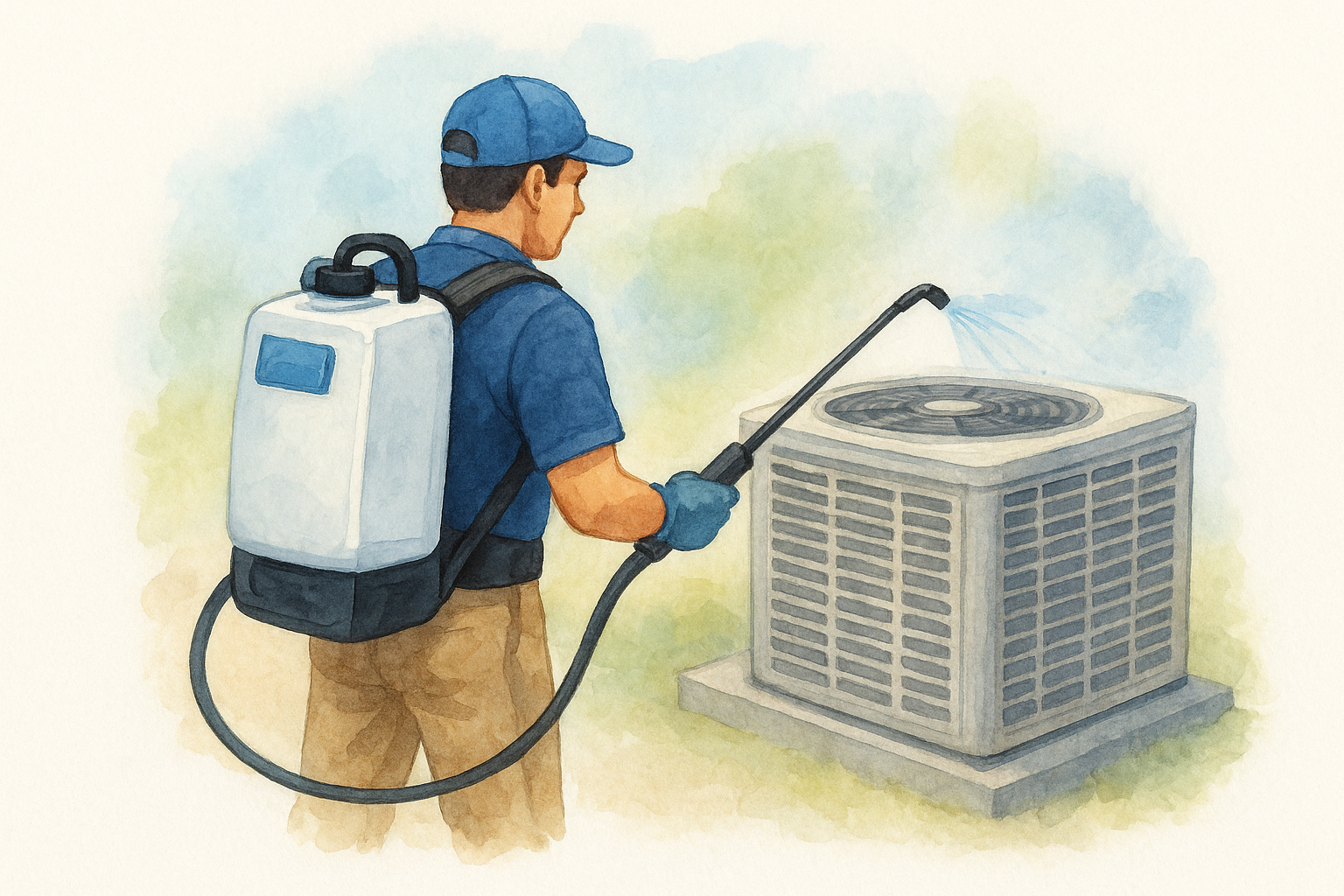
How it works
Strap the tank and battery pack onto your back like a leaf blower, and a rechargeable DC pump draws chemical from the reservoir and pushes it through a hand-held wand at consistent pressure. One charge typically covers a full day of coil cleaning across multiple units, and a low-battery indicator warns you before the pump loses pressure mid-spray. Since the pump and tank move with you, you can climb ladders, cross catwalks, or work rooftop mechanical rooms without a cord tethering you to a plug.
Cordless doesn't mean weaker pressure, it means you can finally reach the coil that's forty feet from the nearest outlet.
Key features
- Rechargeable battery pump eliminates cord and generator dependency
- Ergonomic backpack harness distributes tank weight across shoulders and hips
- Compatible with acid and alkaline coil cleaning chemicals
- Adjustable spray wand for stream or fan pattern
Best for
Rooftop and remote-site technicians who service commercial condensers, cooling towers and industrial HVAC systems, or air handlers far from any power source get the clearest benefit. It also suits crews cleaning multiple buildings in one day, since there's no cord to pack up between stops.
Price range
Expect to pay $400 to $600, reflecting the added cost of the battery and harness system over corded electric models.
5. DiversiTech Dial-a-Mix chemical mixing sprayer
DiversiTech takes a different approach to dilution than the Coil Cannon, but it solves the same headache: getting the concentrate-to-water ratio right without measuring cups or guesswork. The Dial-a-Mix attaches to a garden hose and lets you select a mixing ratio right on the dial, making it a straightforward hvac coil cleaner sprayer for techs who want inline mixing without the higher price tag of a fully automated foaming system.
How it works
Water from your hose passes through a venturi mixing chamber inside the unit, which draws concentrate from an attached bottle at whatever ratio you've selected on the dial, typically ranging from 1:1 up to 20:1. The blended solution exits through a fan-spray nozzle at hose pressure, no batteries or electricity required. Because you're not pre-mixing chemical in a tank, there's less risk of leftover solution degrading seals between jobs.
A dial that sets your mix ratio in seconds beats measuring concentrate by eye every time you refill.
Key features
- Venturi-based mixing with a dial for ratio selection
- Works with standard garden hose pressure, no power source needed
- Chemical bottle attaches directly to the unit for quick swaps
- Fan-spray nozzle suited to flat coil faces
Best for
Residential and light commercial technicians who want accurate dilution but don't need the Coil Cannon's foaming output or price point will find this a solid middle ground.
Price range
Most suppliers price the Dial-a-Mix between $60 and $100, making it one of the most budget-friendly mixing sprayers on this list.
6. DiversiTech compression and wand pump sprayers
Sometimes the simplest tool on the truck is the one that never lets you down. DiversiTech's compression and wand pump sprayers are the no-frills workhorses that most techs cut their teeth on, and they're still the first hvac coil cleaner sprayer many companies stock because they're cheap to replace and simple enough that nothing goes wrong on the job.
How it works
Compression sprayers work exactly like a garden pesticide tank: you fill the poly tank with your coil cleaning chemical, pump the handle to pressurize the air space above the liquid, and squeeze the wand trigger to release a steady stream. Wand pump versions skip the pressurized reservoir entirely, using a piston pump built into the wand itself to draw and push fluid on each stroke.
When budget and simplicity matter more than convenience features, a basic pump sprayer still gets the coil clean.
Key features
- Poly tanks resistant to acid and alkaline coil cleaners
- Manual pressurization, no power source or hose needed
- Adjustable nozzle for stream or cone spray pattern
- Lightweight enough for one-handed carrying between coils
Best for
Owner-operators, apprentices, and companies stocking backup sprayers for every truck lean on these units. They suit occasional residential coil cleaning where a technician handles one or two units per stop rather than a full commercial route.
Price range
Expect to pay $25 to $60, making this the most accessible entry point on this list for anyone building a coil cleaning kit from scratch.
7. SpeedClean dry steam vapor coil cleaner
Not every coil job calls for chemical at all. SpeedClean's dry steam vapor cleaner skips liquid coil cleaner entirely and relies on superheated steam to lift dirt, biofilm, and grease from fins without soaking insulation or electrical components. For techs working on coils near sensitive controls, or facilities that restrict chemical runoff, this hvac coil cleaner sprayer alternative solves a problem no pump-and-tank system can.
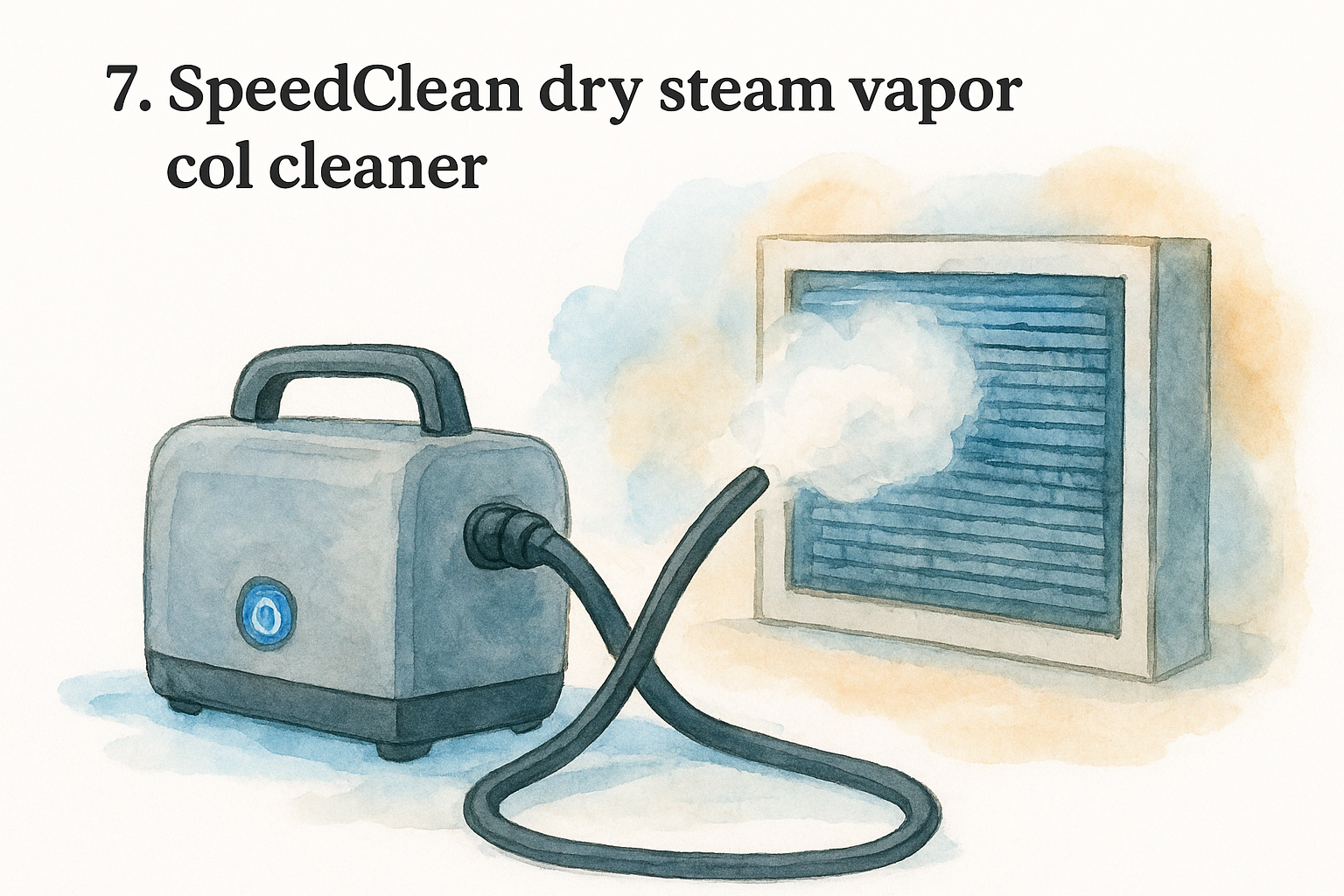
How it works
Water heats inside a sealed boiler to produce low-moisture steam vapor, which exits through a narrow wand tip at high temperature and low volume. The heat breaks down grime on contact while the minimal moisture content means fins dry almost immediately, so you avoid the runoff and drip trays a liquid sprayer requires. Some models let you add a light detergent to the steam line for stubborn buildup.
Steam cleans without wetting the coil, which matters when the unit sits inches from a control board.
Key features
- Sealed steam boiler reaches cleaning temperature in minutes
- No chemical runoff, reducing drain and containment requirements
- Narrow wand tip reaches deep between fins
- Optional detergent injection for heavy grease buildup
Best for
Commercial and hospital-grade facilities with strict runoff or chemical-exposure policies benefit most, along with technicians servicing coils mounted near sensitive electronics where liquid overspray poses a risk.
Price range
Expect to pay $1,200 to $2,000, reflecting the boiler and heating components. It's the priciest option on this list, justified mainly by compliance needs rather than routine residential work.
8. Manual pump sprayers and condenser needle tools
Rounding out this list is the pairing that solves the one problem no sprayer alone can fix: a fin channel packed solid with debris that no amount of pressure will push out. Basic manual pump sprayers, paired with a condenser needle tool (sometimes called a fin comb or coil pick), give DIYers and budget-minded techs a complete cleaning kit without buying anything electric or battery-powered.
How it works
The pump sprayer works the same way as any garden-style unit: fill the tank, pump the handle to build air pressure, and trigger the wand to release solution across the coil face. The needle tool handles what spray pressure can't reach. You slide thin steel picks between individual fins to physically dislodge compacted dirt, insect debris, or pet hair before you spray, so the chemical actually contacts the blockage instead of running over the top of it.
A sprayer cleans what water can reach, but a needle tool clears the channel water can't touch.
Key features
- Multi-pin needle set sized to match standard fin spacing
- Basic poly pump sprayer, no power source required
- Compact enough to fit in a small tool bag or glovebox
- Combined kit costs less than most single-purpose sprayers on this list
Best for
Homeowners doing annual DIY maintenance and techs handling older, heavily fouled residential coils get the most value here, especially units that haven't been serviced in years.
Price range
Expect $15 to $40 for a decent pump sprayer and needle set together, the lowest total cost on this list.
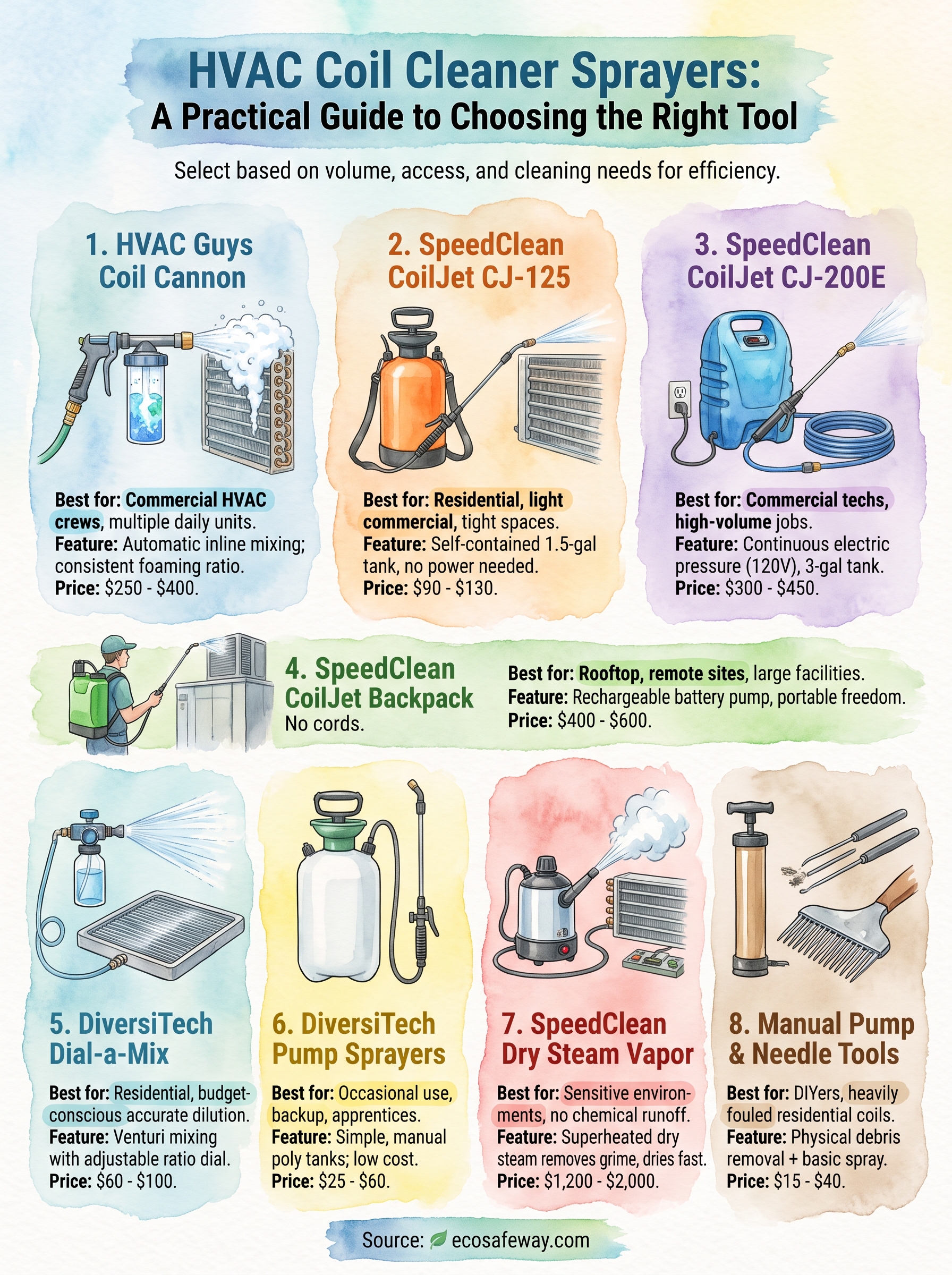
Finding the right sprayer for your coil cleaning routine
Your choice comes down to volume and access, not brand loyalty. A homeowner picking between a pump sprayer and a needle tool needs almost none of the mixing precision a commercial crew demands from the Coil Cannon or CJ-200E. Match the tool to how often you're actually cleaning coils, not to whichever unit looks most impressive on a shelf.
Equipment only does half the job, though. Even the best hvac coil cleaner sprayer can't compensate for a weak or corrosive chemical that damages fins or leaves residue behind. Pair your sprayer with a formula built specifically for coil work, one that cuts grease and biofilm without eating through aluminum fins or copper tubing. If you're stocking a truck or a maintenance closet, look at this heavy-duty condenser coil cleaner for commercial HVAC systems, a fast-acting, eco-friendly formula built to pair with any sprayer on this list.


