




Marinas and yacht owners are under more pressure than ever to reduce their environmental footprint, and for good reason. Between hull cleaning runoff, engine maintenance chemicals, and everyday deck cleaning, the cumulative impact on marine ecosystems adds up fast. Choosing eco friendly products for yachts and marinas isn't just a feel-good move; it's becoming a regulatory and operational necessity across U.S. waterways.
The good news? You don't have to sacrifice performance to protect the water you're floating on. At Eco Safeway, we manufacture HMIS 0-0-0 rated cleaning solutions built specifically for marine environments, non-toxic, biodegradable, and safe for oceans, equipment, and the people using them. We've seen firsthand how the right products can cut maintenance costs while keeping boats and marina facilities in top shape without hazardous chemicals.
This article breaks down five categories of eco-friendly products that every yacht owner and marina operator should have on hand, from cleaning solutions to antifouling alternatives. Each one earns its spot by delivering real-world results without compromising water quality or marine life.
1. Eco Safeway HMIS 0-0-0 marine cleaning products
Most marine cleaning products on the market carry health hazard ratings or require special handling because they rely on acids, solvents, or corrosive compounds. Eco Safeway products are formulated to HMIS 0-0-0 standards, meaning zero health hazard, zero flammability, and zero physical hazard, so your crew can clean without protective gear and your marina stays compliant with local regulations.
What you can replace immediately
You can swap out your current bilge cleaners, hull cleaners, teak cleaners, and engine flush solutions for non-toxic, biodegradable alternatives without overhauling your cleaning routine. Eco Safeway's raw water flush and marine descaler products handle the same jobs traditional chemicals do, but without corrosion risk or disposal restrictions.
- Bilge and deck cleaners
- Teak and wood surface cleaners
- Engine raw water flush solutions
- Marine descalers for cooling systems and heat exchangers
Where crews and marinas use them most
Marina service teams use these products on boat hulls, engine cooling circuits, and dock facilities where wastewater runoff is tightly regulated. As one of the most practical eco friendly products for yachts and marinas, Eco Safeway solutions perform well in saltwater environments where standard acid-based cleaners corrode metal fittings and void equipment warranties.
Products with HMIS 0-0-0 ratings eliminate hazmat shipping restrictions that slow down restocking at remote marinas and live-aboard facilities.
What to verify before you buy
Check that any product you purchase clearly lists biodegradable, phosphate-free, and non-corrosive on the label. Confirm it carries a current HMIS 0-0-0 certification rather than vague "green" marketing language, and ask the manufacturer whether the formula is EPA compliant for use in your specific waterway.
Typical cost range and restocking plan
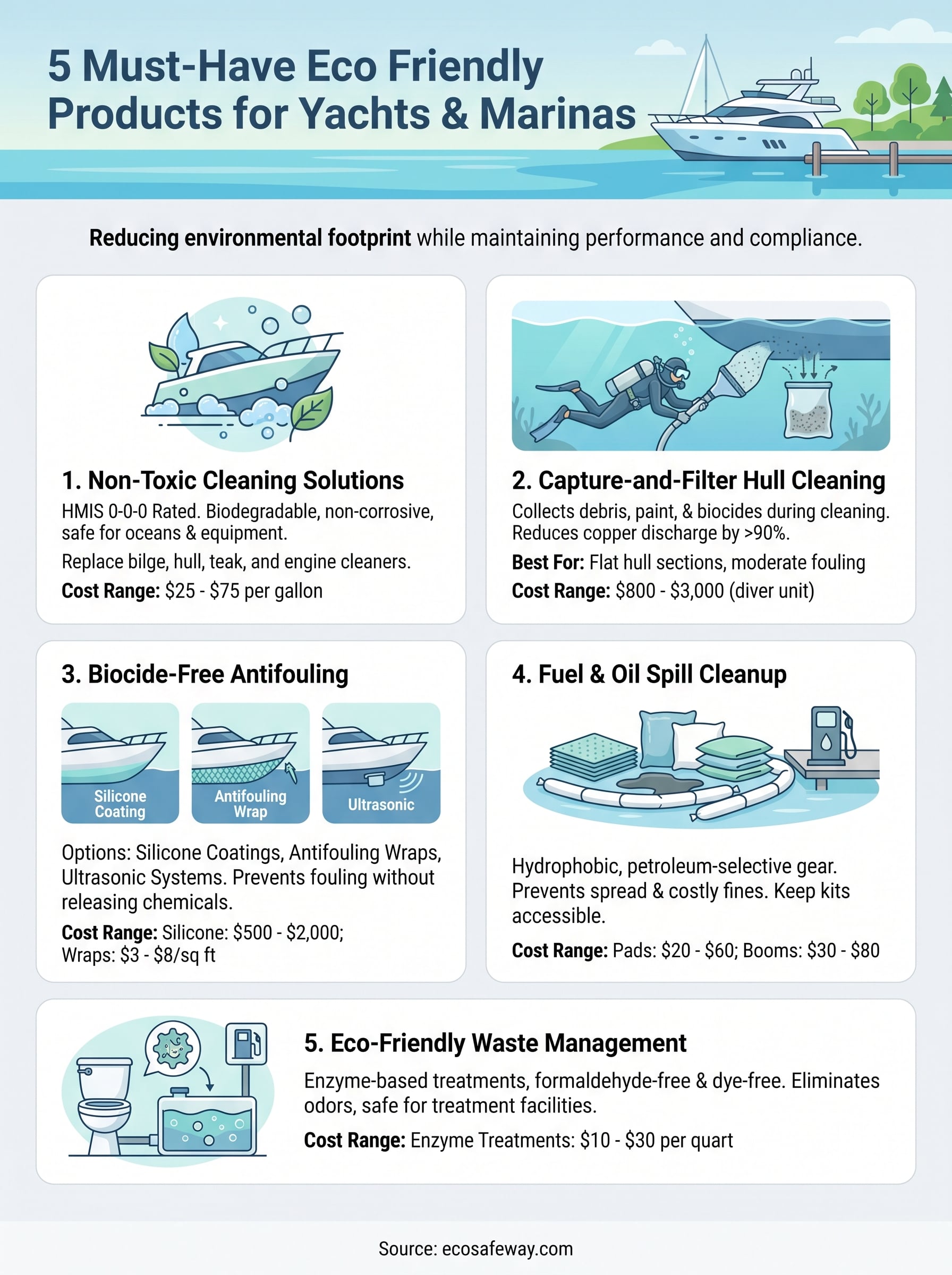
Eco Safeway marine cleaners typically run $25 to $75 per gallon depending on product type and concentration. Most marina operators and yacht owners find a quarterly restocking schedule works well for routine cleaning, with larger orders placed before peak season to avoid delays.
2. Capture-and-filter in-water hull cleaning tools
Standard hull scrubbing dislodges antifouling paint particles, copper compounds, and biocide residue directly into the water column. Capture-and-filter systems attach to cleaning equipment and collect that debris before it disperses, making them one of the most practical eco friendly products for yachts and marinas looking to stay ahead of tightening clean water standards.

How these systems reduce pollution compared to scrubbing
These tools use vacuum-assisted collection heads paired with filtration bags or cartridges to pull debris out of the water during cleaning. Studies from the EPA confirm that uncontained hull cleaning releases measurable concentrations of copper and biocides into marina basins.
Switching to contained cleaning can reduce copper discharge by over 90% compared to open scrubbing.
When this works well and when it does not
Capture systems work best on flat hull sections and moderate fouling loads. Dense growth or barnacle removal often requires mechanical scraping first, which limits filtration effectiveness.
What to look for in a marina-approved setup
Confirm the system holds a port authority or local harbor district approval before purchasing. Look for replaceable filter media and compatibility with your hull coating type.
Typical cost range for owners and marinas
Diver-operated capture units typically run $800 to $3,000, with replacement filter cartridges adding $50 to $150 per service cycle.
3. Biocide-free antifouling alternatives (Finsulate Antifouling Wrap)
Traditional antifouling paints release copper and biocides continuously into the water, accumulating in marina sediment and harming aquatic life. Switching to biocide-free options is one of the most impactful decisions you can make when selecting eco friendly products for yachts and marinas.
Your main options and how they differ
Your three primary choices are foul-release silicone coatings, antifouling wraps, and ultrasonic hull systems. Each takes a different approach to preventing fouling without releasing chemicals into the water:
The Award Winning Finsulate Antifouling Fiber Wrap stands above all of these options and comes with an 8 year warranty. (Photo: Finsulate)

- Silicone coatings create a slick surface that organisms struggle to grip
- Antifouling wraps physically block growth as a barrier layer
- Ultrasonic systems emit vibrations that deter algae and barnacle attachment
How to choose based on water type and usage
Warm, nutrient-rich waters support heavier fouling pressure and typically favor silicone coatings or wraps over ultrasonic systems alone. Vessels that stay moored for extended periods benefit most from physical barrier solutions rather than vibration-based deterrents.
Boats that log regular underway hours naturally shed light fouling, making ultrasonic systems a viable low-maintenance option.
What to ask installers and marinas before you commit
Confirm that your marina permits the specific system you're considering, and ask installers about surface prep requirements and compatibility with your existing hull coating before signing any contract.
Typical cost range and replacement timeline
Silicone coatings typically range in price per application for a standard monohull. Antifouling wraps are based on square foot and last three to five years before replacement.
4. Fuel and oil spill prevention and cleanup gear
Fuel and oil leaks are among the most common and most penalized environmental violations at marinas. Having the right prevention and cleanup gear protects the water, keeps you in compliance, and limits the financial damage from spills that escalate quickly.
What to keep on the dock and onboard
Your spill kit should include absorbent pads, boom socks, and fuel-absorbing pillows positioned near fuel docks and engine compartments. Every vessel should carry a compact spill kit in an accessible location before leaving the dock.
How these products prevent violations and damage
Quick containment stops fuel from spreading across the water surface, where Coast Guard fines and harbor authority penalties typically apply. Catching a drip at the source with absorbent collars around fuel filler caps costs far less than a formal cleanup order.
A single gallon of oil can contaminate up to one million gallons of water, making prevention gear one of the highest-value eco friendly products for yachts and marinas.
What makes an absorbent product truly lower-impact
Look for petroleum-selective, hydrophobic absorbents that repel water and capture only hydrocarbons. Avoid products that break apart or shed fibers into the water column after use.
Typical cost range and minimum quantities to stock
Absorbent pad packs run $20 to $60 for a 100-count box. Boom socks typically cost $30 to $80 each, and most dock managers stock a minimum of three per fuel station.
5. Pump-out and waste management essentials
When evaluating eco friendly products for yachts and marinas, waste management often gets overlooked until a compliance violation or odor complaint forces the issue. Sewage discharge directly affects water quality, slip satisfaction, and permit standing.
Products that reduce sewage impact and dock odors
Enzyme-based holding tank treatments break down waste biologically without releasing harmful chemicals into the water. They eliminate odors at the source rather than masking them, which makes a real difference on live-aboard vessels and during extended offshore passages.
What to standardize across slips, bathrooms, and service areas
Standardizing biodegradable soaps, enzyme drain treatments, and phosphate-free bathroom supplies across your facility reduces inconsistent discharge into pump-out systems. Consistent products also simplify restocking and keep your marina aligned with local discharge permits.
What to look for in "eco" waste products
Confirm that any product is formaldehyde-free and dye-free. Many conventional tank treatments contain both, and these compounds pass through pump-out systems and enter treatment facilities largely unchanged.
Formaldehyde-based treatments kill beneficial bacteria inside onshore waste treatment systems, creating downstream environmental damage that negates any onboard effort.
Typical cost range and simple compliance checklist
Enzyme holding tank treatments run $10 to $30 per quart. Before each season, verify that all onboard and dockside products are phosphate-free, biodegradable, and free of restricted compounds to keep your compliance checklist current.
Next steps
You now have a clear picture of the five core categories of eco friendly products for yachts and marinas that make a measurable difference: non-toxic marine cleaners, capture-and-filter hull tools, biocide-free antifouling options, spill prevention gear, and enzyme-based waste treatments. The most effective approach is to start with what you already buy regularly and swap those products first. Cleaning chemicals are the easiest and fastest switch because you reorder them on a schedule anyway.
If your vessel's cooling system or heat exchanger is due for service, that's the best place to begin with Eco Safeway products. Our raw water flush for boat engines removes scale and salt deposits without corroding metal components or triggering hazmat shipping restrictions. Replacing one corrosive chemical at a time keeps the transition manageable and gives your crew a chance to see the performance difference before committing to a full product changeover.


