





Every engine, boiler, cooling tower, and heat exchanger operates under the same fundamental constraint: not all the energy put in gets converted to useful work. The ratio of what you get out versus what you put in is called thermal efficiency, and it governs the performance of virtually every heat-driven system in industrial and marine operations.
Understanding this concept matters beyond the textbook. For facility managers, marine operators, and maintenance teams, thermal efficiency is the number that tells you whether your equipment is running well, or quietly wasting fuel and money. Scale buildup on condenser coils, fouling inside cooling towers, and mineral deposits in marine engines all drag thermal efficiency down, forcing systems to work harder and consume more energy. It's exactly why we developed Eco Safeway's line of non-toxic descalers and cleaners, to restore and protect the heat transfer surfaces that keep equipment running at peak performance.
This article breaks down what thermal efficiency actually means, walks through the key formulas used to calculate it, and shows how it applies to real engines and systems. Whether you're evaluating equipment performance or trying to understand why maintenance decisions affect energy costs, you'll find the foundation here.
Why thermal efficiency matters
Thermal efficiency tells you how much of the fuel or heat energy your system consumes actually converts into useful output. If your cooling tower, marine engine, or HVAC unit runs below its designed efficiency rating, you burn more fuel than necessary to produce the same result. That gap between energy input and useful output translates directly to higher operating costs, faster equipment wear, and more frequent maintenance cycles every single day your system runs.
The real cost of low thermal efficiency
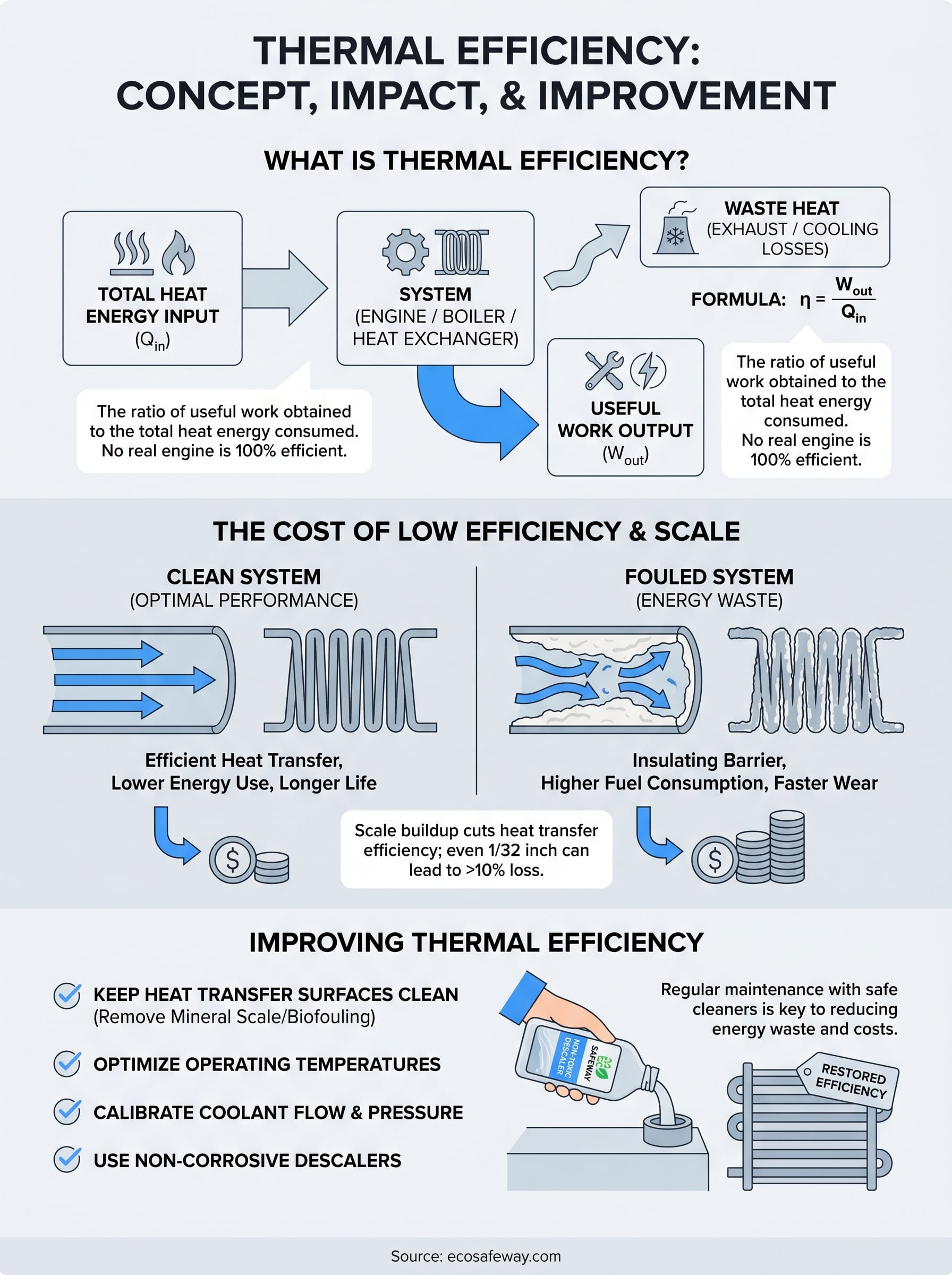
Scale deposits and fouling are two of the biggest hidden drivers of energy waste in industrial and marine systems. Even a thin layer of mineral scale on a heat exchanger surface acts as an insulating barrier, forcing your system to pull significantly more energy to achieve the same heat transfer rate. Equipment manufacturers consistently report that just 1/32 inch of calcium scale can cut heat transfer efficiency by more than 10 percent, and that loss compounds as deposits thicken over time.
A system that looks fully operational can still waste a significant share of its energy input because of fouling you cannot see from the outside.
How maintenance connects to efficiency losses
Your maintenance schedule directly controls how fast equipment drifts away from its rated thermal efficiency. When you skip descaling cycles or use the wrong cleaning chemistry, residue accumulates on critical heat transfer surfaces and insulates them. Choosing a non-corrosive, equipment-safe cleaner removes that residue without attacking metal components, so you restore the performance built into the system at installation rather than replacing expensive equipment ahead of schedule.
Thermal efficiency vs other efficiency terms
Thermal efficiency specifically measures the conversion of heat energy into useful work, but you will encounter several related terms in engineering contexts. Conflating them leads to misread performance data and poor maintenance decisions, so the distinctions are worth knowing clearly.
Mechanical and combustion efficiency
Mechanical efficiency measures how much of the work produced at the piston or turbine shaft actually reaches the output after accounting for friction losses inside the machine. Combustion efficiency, on the other hand, measures how completely fuel burns during the combustion process. Both affect your system's overall performance, but neither directly captures heat transfer losses the way thermal efficiency does.
Thermal efficiency sits upstream of both: even a machine with perfect combustion and minimal friction will underperform if poor heat transfer bleeds energy before useful work is ever produced.
Knowing which efficiency metric applies to the problem you are diagnosing helps you target the right fix, whether that means addressing fuel quality, mechanical wear, or fouled heat exchange surfaces.
Thermal efficiency formula and symbols
The standard thermal efficiency formula expresses the relationship between useful work output and total heat energy input. Engineers write it as:
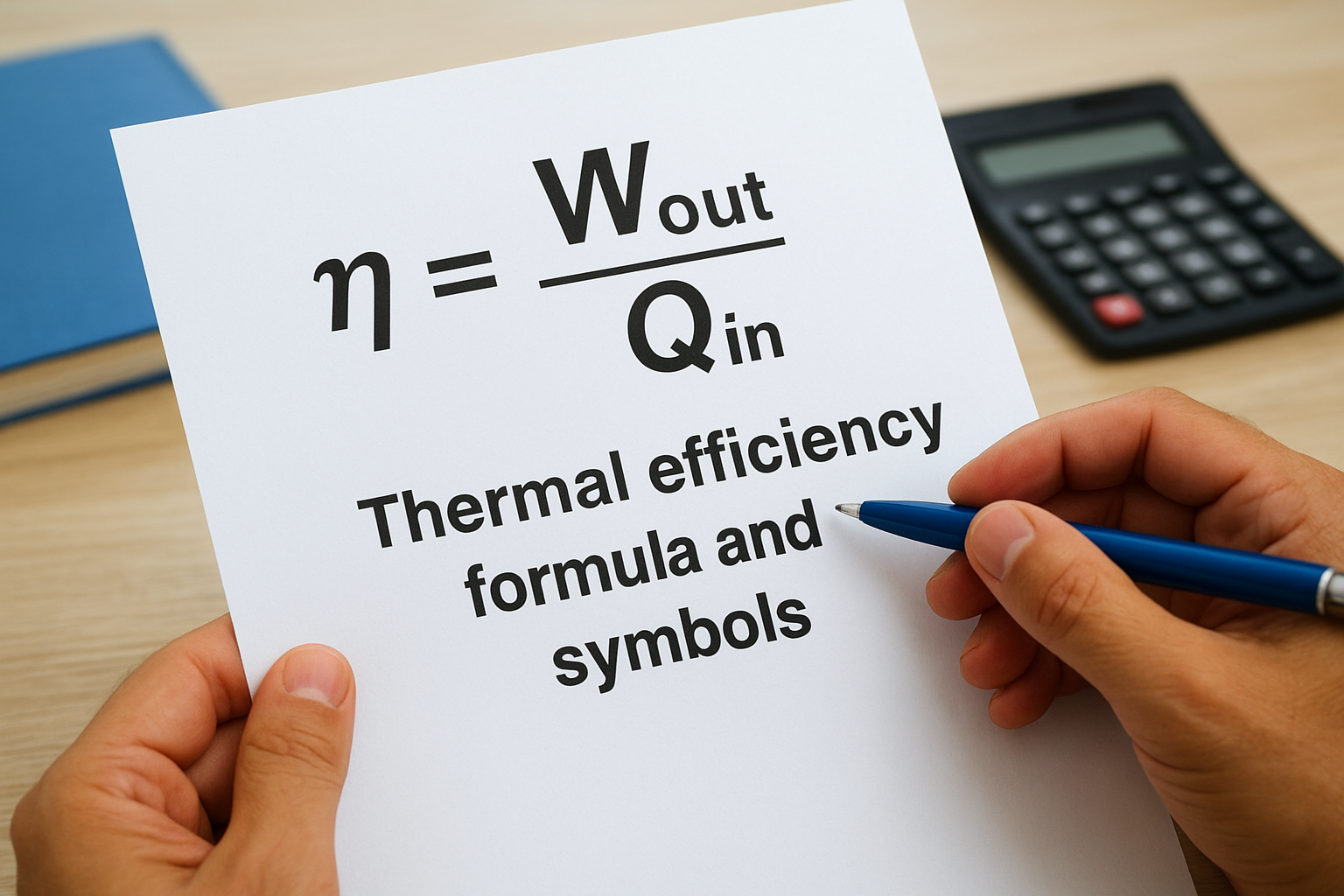
η = W_out / Q_in
In this equation, η (eta) represents thermal efficiency as a decimal or percentage, W_out is the net work output, and Q_in is the total heat energy supplied to the system.
A thermal efficiency of 1.0, or 100%, is physically impossible for any real heat engine due to the second law of thermodynamics.
Carnot efficiency formula
For heat engines, the Carnot efficiency formula defines the theoretical upper limit of performance. You express it as:
η_Carnot = 1 - (T_cold / T_hot)
Here, T_cold is the absolute temperature of the cold reservoir and T_hot is the absolute temperature of the hot reservoir, both measured in Kelvin. No real engine reaches this ceiling, but knowing your system's Carnot limit gives you a concrete benchmark to measure actual performance against and identify how much room for improvement exists.
How to calculate thermal efficiency step by step
Calculating thermal efficiency requires two numbers: the total heat energy input your system consumes and the net useful work it delivers. Once you have both values in the same units, the division is straightforward.
Gather your values and apply the formula
Start by recording your system's heat input (Q_in) and work output (W_out) in consistent units, typically joules or BTUs. Divide W_out by Q_in, then multiply by 100 to express the result as a percentage.
If your units don't match, your efficiency number will be meaningless, so convert everything before you calculate.
A simple worked example
Suppose a marine engine receives 10,000 joules of heat and delivers 3,500 joules of mechanical work. Here is how the calculation breaks down:
- Q_in: 10,000 joules
- W_out: 3,500 joules
- η: 3,500 / 10,000 = 0.35, or 35%
That remaining 65% exits as waste heat through exhaust and cooling losses.
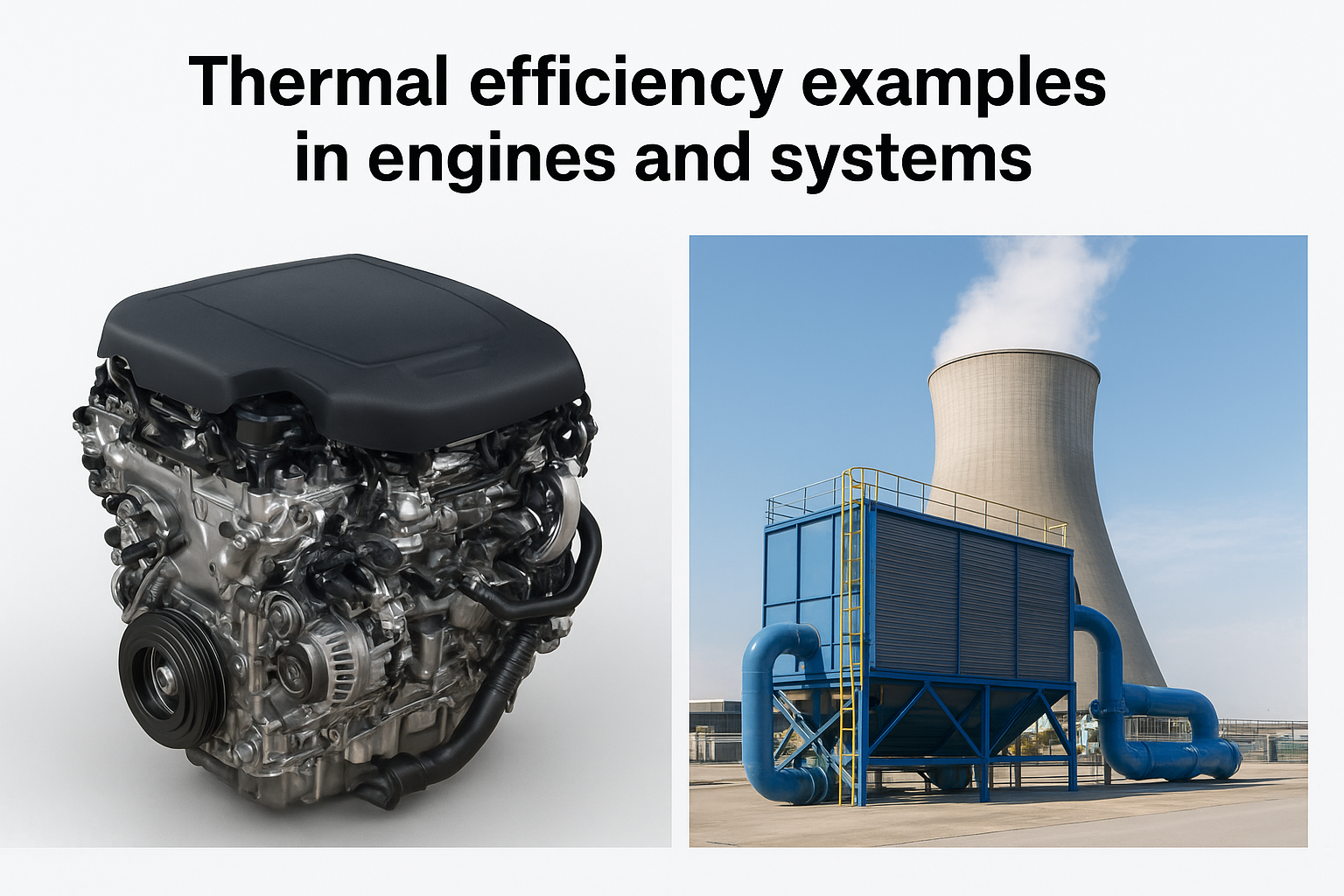
Thermal efficiency examples in engines and systems
Real-world systems convert heat energy at widely varying rates, and knowing typical thermal efficiency benchmarks for your equipment helps you spot underperformance quickly before it becomes a significant cost problem.
Internal combustion engines
Gasoline engines typically achieve thermal efficiencies between 20% and 35%, while diesel engines reach 40% to 45% under optimal conditions. The rest exits as exhaust heat and friction losses through the drivetrain and cooling system.
Even a well-maintained diesel engine discards more than half its fuel energy as waste heat.
Cooling towers and heat exchangers
Cooling towers and condenser coil systems rarely get measured against a thermal efficiency figure the same way engines do, but fouling directly reduces their effective heat transfer rate. A clean heat exchange surface in a cooling tower can maintain transfer rates close to manufacturer specifications, while mineral-scaled surfaces may lose 15% to 25% of that capacity within a single operating season.
How to improve thermal efficiency
Improving thermal efficiency in your system starts with addressing the two most controllable factors: heat transfer surface cleanliness and proper system calibration. Fouled surfaces, worn seals, and incorrect operating temperatures all cut into performance well before fuel energy converts to useful work. Both issues are fixable with the right maintenance approach.
Keep heat transfer surfaces clean
Mineral scale and biological fouling are the fastest routes to efficiency loss in cooling towers, heat exchangers, and marine engines. Removing deposits with a non-corrosive descaler restores the surface conductivity your system was designed to operate at, often recovering measurable efficiency gains without replacing any components.
Regular descaling is one of the highest-return maintenance actions you can perform on any heat-driven system.
Optimize operating temperatures
Running your system at the correct temperature range matters as much as keeping it clean. Higher temperature differentials between the hot and cold sides improve theoretical efficiency limits. Verifying that coolant flow rates and pressure settings match manufacturer specifications prevents heat from stagnating inside critical components and wasting energy.
Final takeaways
Thermal efficiency measures how well a system converts heat energy into useful work, and every percentage point lost to fouling, scale, or poor maintenance costs you real money in fuel and operating time. You can calculate it with a simple formula, compare your results against Carnot limits, and use those numbers to diagnose problems before they escalate. The gap between a system's designed efficiency and its actual performance is almost always traceable to correctable maintenance issues, not irreparable equipment failure.
Keeping heat transfer surfaces clean is one of the fastest ways to close that gap. Scale and fouling add up quietly, but their impact on energy consumption shows up clearly in your operating costs. If your cooling tower, condenser coils, or marine engine is running harder than it should, the right cleaning chemistry can restore performance without damaging components. Start with a non-toxic industrial HVAC and cooling tower descaler designed to remove mineral deposits safely and efficiently.


