





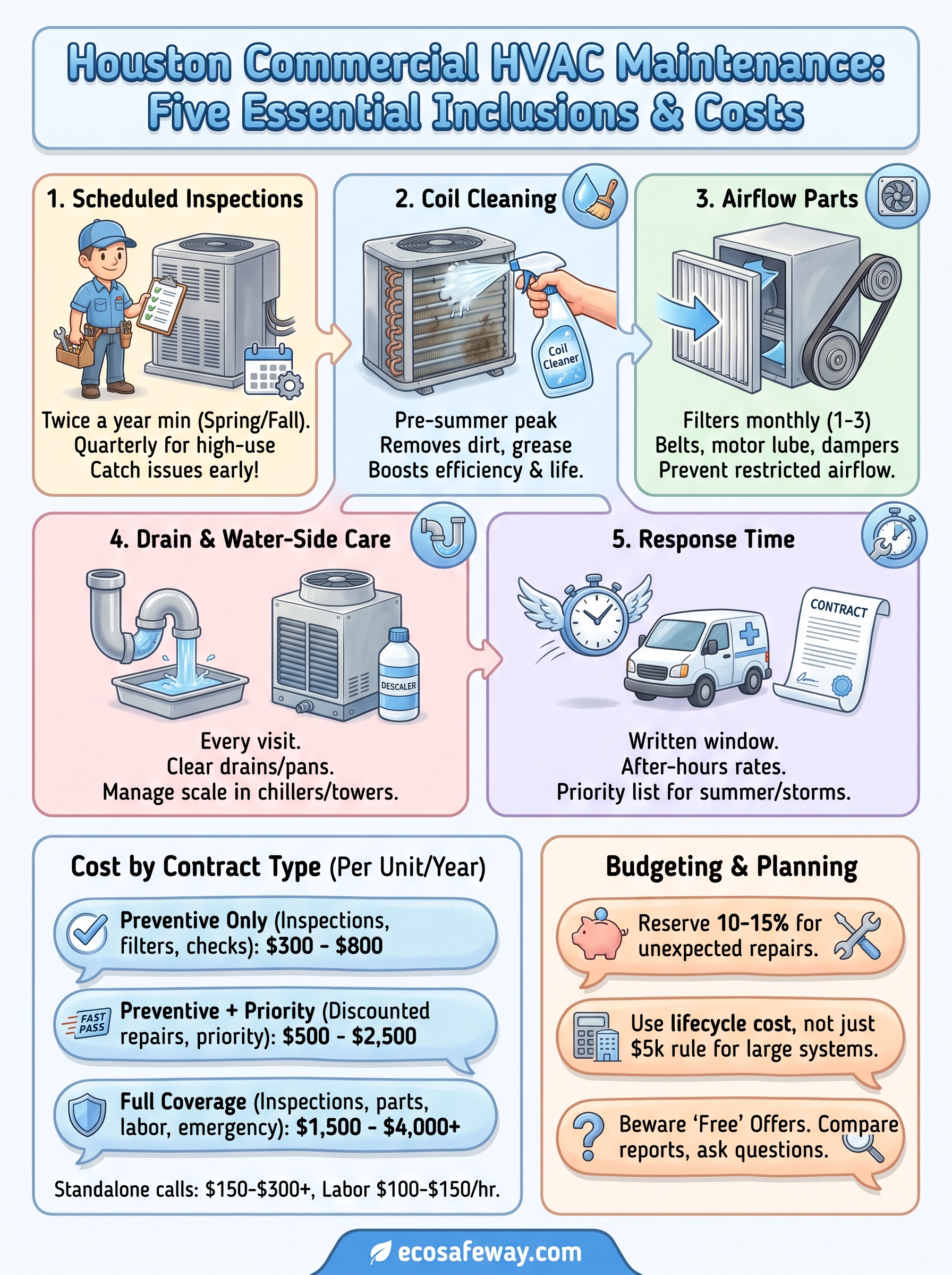
The best commercial HVAC maintenance contract in Houston puts five things in writing: scheduled inspections, coil cleaning, airflow parts, drain and water-side care, and a response time for breakdowns. A small office with a few packaged units can do well with a preventive-only plan. Restaurants, warehouses, and clinics, where one failed rooftop unit stops revenue, should pay for priority service or full coverage.
The trouble is that most proposals look alike. They list a visit count and a price per unit, then bury the exclusions that decide what you pay when a compressor fails in July. This article breaks a good contract into five inclusions you can check line by line. It then gives Houston-area price ranges so you can judge a quote.
Eco Safeway is a Fort Lauderdale company that supplies eco-friendly cleaning and descaling products for commercial HVAC equipment, including coil cleaners and cooling tower descalers. We do not provide contractor service in Houston. We do know what neglected coils and scaled-up water systems do to a building. Use this guide as a checklist when you compare bids.
1. Scheduled preventive inspections
What it covers
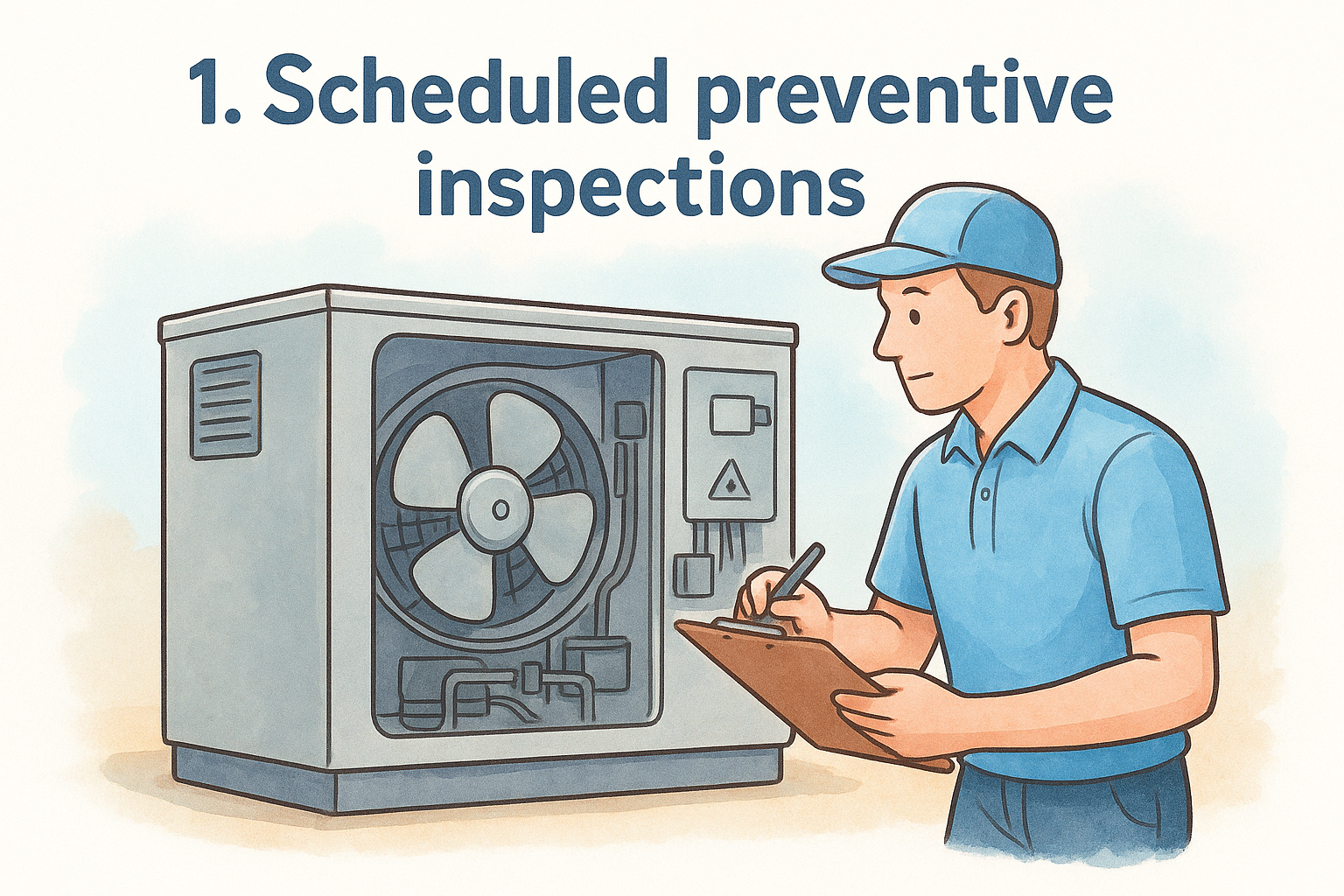
A preventive inspection is the core of any commercial HVAC maintenance plan. The technician works through each unit against a written checklist and records what they find. The usual scope looks like this:
- Electrical connections, contactors, capacitors, and motor amp draw
- Refrigerant pressures and visible leak checks
- Belts, bearings, and fan motor lubrication
- Thermostat and control calibration, including building automation
- Condensate pans and drain lines
- A written report with findings and recommended repairs
What Houston changes
Houston equipment runs hard for most of the year, so one visit a year is too little. The answer to how often a commercial HVAC system should be serviced is at least twice a year: a spring visit before the summer load and a fall visit after it. Restaurants, healthcare spaces, and any building with long operating hours should plan on quarterly visits.
Timing matters as much as frequency. A spring inspection catches a weak capacitor or low refrigerant charge while contractors have open calendars. The same problem found in July becomes an emergency call.
A preventive visit is only worth paying for if it produces a written report on every unit.
Questions to ask
Ask to see a sample report before you sign. Then confirm the basics:
- Is the checklist the same for every unit, and is it attached to the contract?
- Does the company hold a Texas air conditioning and refrigeration contractor license?
- Do technicians who handle refrigerant carry EPA Section 608 certification?
- Will you get the same technician or team on each visit?
2. Coil cleaning
What it covers
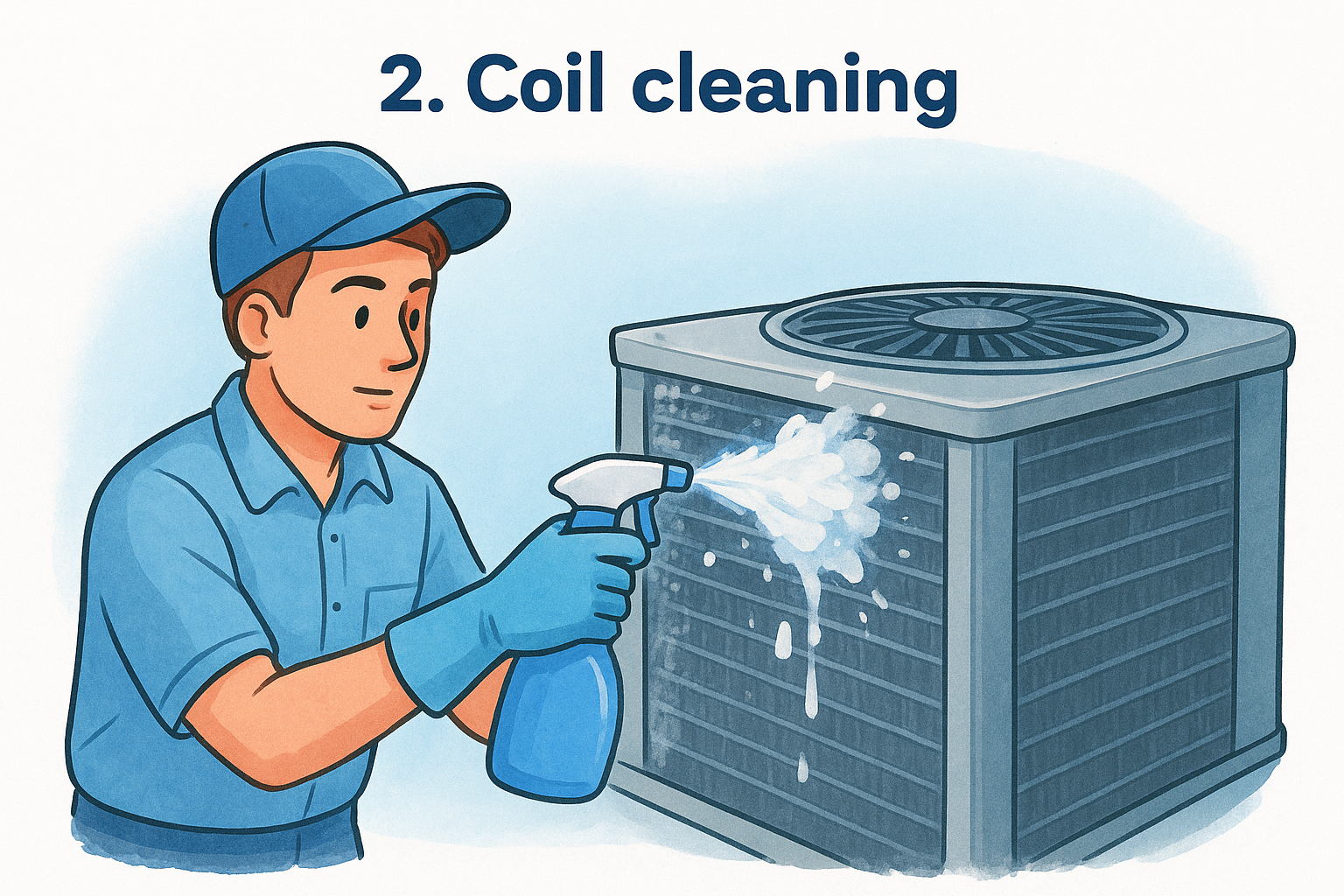
Coil cleaning removes the dirt, grease, pollen, and scale that block heat transfer on condenser and evaporator coils. Dirty coils make compressors run longer, raise energy use, and shorten equipment life. A proper job includes:
- Cleaning outdoor and rooftop condenser coils with a suitable coil cleaner, then rinsing
- Straightening bent fins carefully without crushing them
- Inspecting evaporator coils wherever they are accessible
- Noting corrosion, which matters near the coast and in industrial areas
What Houston changes
Long cooling seasons, storm debris, dust, and airborne kitchen grease load coils faster here than in cooler markets. Plan on one cleaning a year before the summer peak, and more often for warehouses, restaurants, and units near heavy traffic. Check that the contract says cleaning is included, not an add-on.
If you want control over what touches your coils, Eco Safeway supplies a condenser coil cleaner for commercial HVAC systems with an eco-friendly formula. Whatever product is used, confirm it suits your coil metals and the equipment manufacturer's guidance.
Clean coils are the cheapest efficiency upgrade in a commercial building, and they belong inside the contract.
Questions to ask
- Is coil cleaning part of every visit, once a year, or billed separately?
- Which product do you use, and does it suit my coil material?
- How do you protect fins, insulation, and nearby electrical components?
- Do you photograph coils before and after?
3. Filters, belts, and airflow parts
What it covers
Airflow parts are cheap, wear out constantly, and cause many service calls. The contract should cover filter changes, belt and pulley inspection, fan motor lubrication, and a look at dampers, economizers, and visible ductwork leaks. Restricted airflow freezes coils and overworks blowers, so these small items protect the expensive ones.
What Houston changes
Filters should be checked monthly and replaced every one to three months, depending on foot traffic and how much outside air your building draws. Belts get inspected at every visit and replaced when cracked or glazed, not on a calendar.
Watch the filter rating. A higher MERV filter traps more particles, but it can also restrict airflow if the system was not designed for it. Use the rating your equipment and building need, not simply the highest one.
Many contracts quote filters as "included" without saying who buys them, so get it in writing.
Questions to ask
Pin down the supply details, since these are the items that show up as surprise line charges:
- Who supplies filters and belts, and are they in the flat fee?
- Who changes filters between technician visits?
- What MERV rating will you install, and why?
- Do you check economizers and dampers, or only the mechanical parts?
4. Drain and water-side care
What it covers
Humid Houston air produces a lot of condensate, and clogged drain lines cause the water damage that turns a maintenance issue into an insurance claim. Drain and water-side care covers condensate lines and pans, float switches, and, where you have them, chillers and cooling towers. It also covers the scale that builds up in heat exchangers and pipes.
What Houston changes
Warm, wet conditions feed algae and slime in drain lines, so drains need attention at every visit. Chiller and cooling tower scale follows your water treatment program and the manufacturer's guidance, not a fixed calendar. If your building has water-cooled equipment, ask who owns water treatment and descaling, because it often falls between the contractor and a separate treatment vendor.
For chillers, cooling towers, and pipelines, Eco Safeway supplies an industrial HVAC and cooling tower descaler that is non-toxic and biodegradable. Confirm compatibility with your system materials before any descaling.
Water-side neglect rarely shows up on a thermostat until the damage is already done.
Questions to ask
- Do you flush and test condensate drains and float switches every visit?
- Who is responsible for scale control on chillers and towers?
- How do you document water-side readings?
- Is descaling included, or quoted as a separate project?
5. Priority response and repair terms
What it covers
This is the part of the contract that decides what a breakdown costs. Plans differ in four ways: how fast the contractor shows up, whether after-hours calls are covered, who pays for parts and refrigerant, and who pays for labor. Read it for the following:
- A response window in hours, written into the agreement
- After-hours and weekend rates
- Coverage for parts, refrigerant, and labor
- Common exclusions, such as compressors, coils, heat exchangers, and controls
- Term length, renewal, and cancellation terms
What Houston changes
Summer failures hit every building at once, and hurricane season runs June 1 through November 30. A contractor with a priority list gets you back online sooner than one who treats you as a walk-in. Ask for a post-storm inspection of rooftop units and electrical components after a major event.
A response time that is not in the contract is only a promise, and promises do not cool a building.
Questions to ask
Will you commit to the response window in writing, and what happens if you miss it? Which parts are excluded from coverage? What does a multi-year term lock in on labor rates, and can you leave if service slips? A good contractor answers each of these without hesitation.
What commercial HVAC maintenance costs in Houston
Expect roughly $300 to $4,000 or more per unit per year, depending on how much repair risk the contract covers. These figures come from published Houston-area contractor estimates. Treat them as ballpark numbers and confirm with written quotes.
Price ranges by contract type
The more repair risk the contractor absorbs, the higher the annual fee.
| Contract type | What it includes | Typical annual range per unit |
|---|---|---|
| Preventive only | Scheduled inspections, filter changes, system checks | About $300 to $800 for small to mid systems |
| Preventive plus priority service | Adds discounted repairs and priority scheduling | About $500 to $2,500 |
| Full coverage | Inspections, parts, labor, and emergency repairs | About $1,500 to $4,000 or more |
Standalone service calls typically run $150 to $300 or more per unit, and hourly labor often falls between $100 and $150.
Ranges by building type
Annual totals scale with load and use:
- Offices of 5,000 to 20,000 sq ft: about $1,500 to $3,000 or more
- Retail and restaurants: about $2,000 to $4,500 or more
- Warehouses and distribution: about $3,000 to $7,000 or more
- Healthcare and labs: about $5,000 to $15,000 or more
Budgeting rules and free offers
A common planning habit is to reserve 10 to 15 percent of the maintenance budget for repairs outside the contract. The "$5,000 rule" says to multiply the equipment's age by the repair estimate, and consider replacement if the result exceeds $5,000. It is a rule of thumb that works better for smaller equipment, so ask for a lifecycle cost on large systems.
Offers of free commercial HVAC maintenance are usually free inspections meant to start a sales conversation. Take the report, but compare it against a paid contractor's findings before you approve a large replacement.
Price per unit tells you less than what the contract actually covers.
Choosing your contractor
A good commercial HVAC maintenance contract in Houston covers inspections, coil cleaning, airflow parts, drain and water-side care, and a written response time. Get three quotes, line them up against those five items, and ignore any proposal that cannot show you its checklist and its exclusions.
Cheap contracts usually leave out coil cleaning, filters, or repair coverage, and you pay for them later. The right plan depends on how much downtime your business can absorb.
If you want to specify the products used on your equipment, start with Eco Safeway's condenser coil cleaner for commercial HVAC systems and bring it to your contractor's scope discussion.


